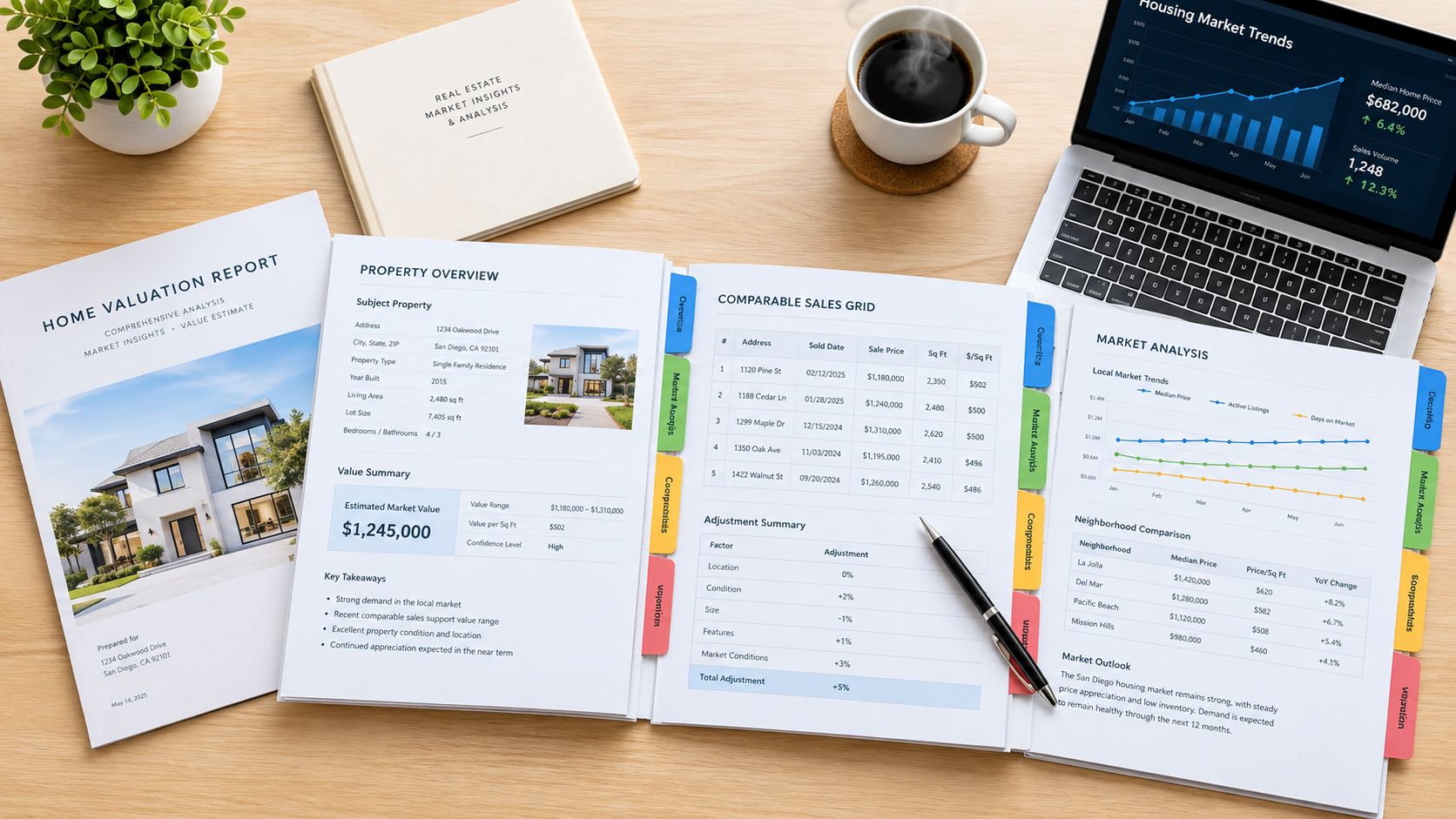
A home valuation report usually lands in your inbox as a dense PDF with charts, grids, and a number that instantly grabs all your attention. If you're sitting at a kitchen counter in Naperville, Wheaton, Downers Grove, or Elmhurst trying to decide whether your place is worth listing now, that's a normal reaction. You scroll until you find the estimated value, then skip the pages that explain where it came from.
That's the wrong page to start with.
A useful home valuation report isn't mystery math. It's a working document. It should help you decide whether to list this month, push back on an offer, ask for a price reduction, or walk away from a deal that doesn't make sense. In the western suburbs, where one block can trade differently from the next and condition matters more than sellers want to admit, reading the report well can save you from pricing by hope.
Table of Contents
- Opening the Report Without Panic
- What a Home Valuation Report Actually Is
- Reading the Comparable Sales Section
- How Adjustments Change the Numbers
- Market Summary and Trend Context
- Valuation Report vs Online Estimate vs Tax Assessment
- Using the Report When You Are Selling
- Using the Report When You Are Buying
- When the Report Goes Stale
- Quick Reference Checklist for Any Home Valuation Report
- Common Questions About Home Valuation Reports
Opening the Report Without Panic
I've watched homeowners open a home valuation report like they're bracing for bad medical news. The file is long. The tables look technical. The value range feels personal.
But once you strip away the formatting, the same parts repeat in almost every credible report.
What most people do first
They jump to the final number and ask one question: “So is that what my house is worth?”
Sometimes. Sometimes not. That number only means something if the comparable sales are strong, the condition notes are honest, and the report date is current enough to matter.
A home valuation report works better as a map than as a verdict.
If your home has an updated kitchen, a deep lot, a finished basement, or a location next to a busy road, those details usually show up in the comp choices and the adjustment lines. That's where story is.
What actually matters on the counter in front of you
When I read one of these with a seller, I'm looking for a few practical answers:
- What sales is this report leaning on
- How similar are those homes to yours
- What did the agent adjust for
- What price range is supportable
- How fresh is the data
If you can answer those five questions, the report stops feeling abstract. It becomes usable. That's when it starts helping with pricing, offers, and negotiations instead of just feeding anxiety.
What a Home Valuation Report Actually Is
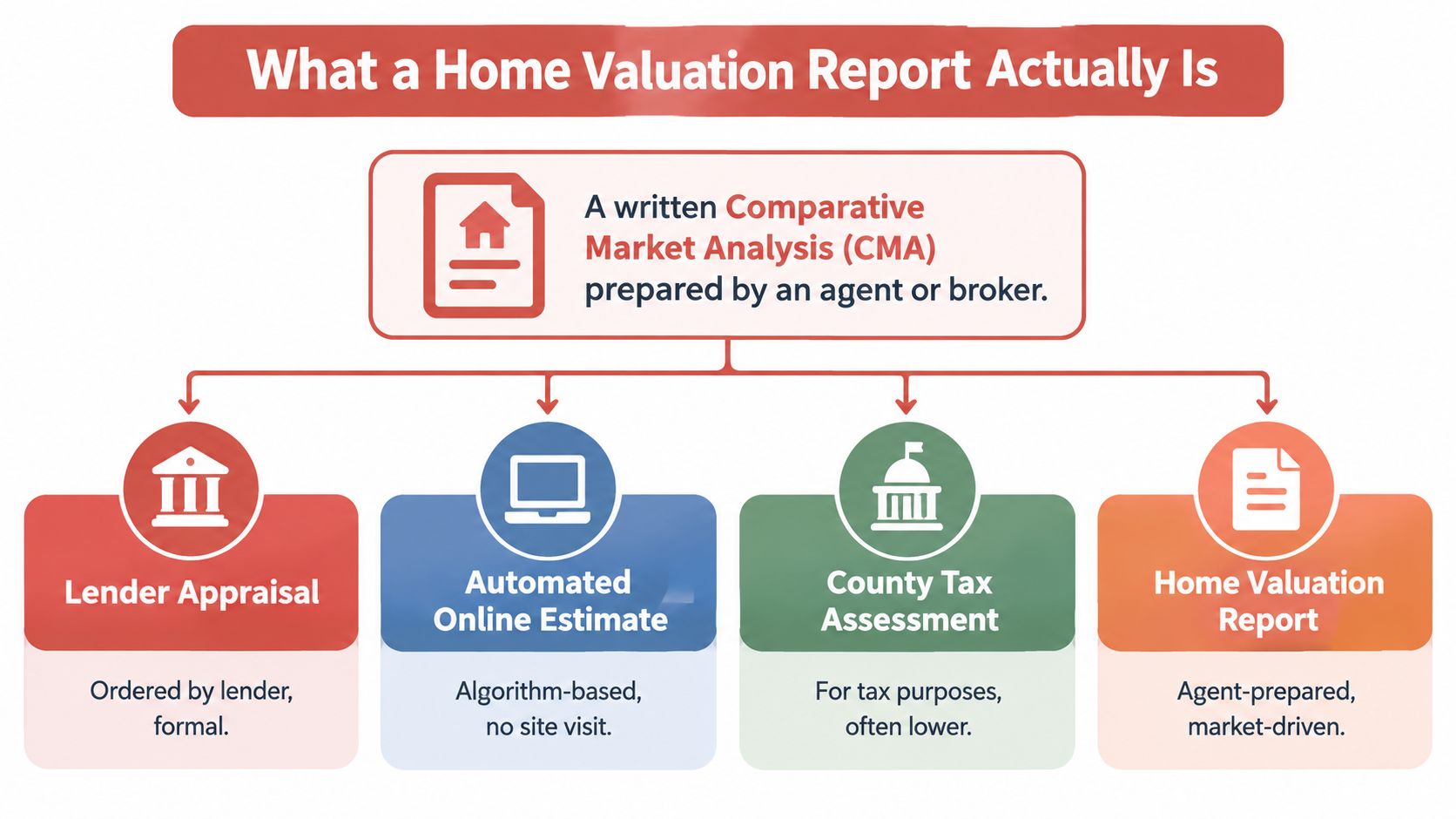
A home valuation report is usually an agent-prepared comparative market analysis. It's a written estimate of market value based on recent sales, active competition, pending listings, and public property records. It's built to help a seller choose a list price or help a buyer judge whether an asking price is reasonable.
What should be inside it
A credible report usually includes these core pieces:
- Subject property summary with the home's basic facts, including size, room count, style, lot, and condition notes
- Comparable sales section showing nearby homes that sold and compete with the subject
- Adjustment grid where differences between the subject and each comp are accounted for
- Market summary with current listing competition and broader neighborhood movement
- Final value reconciliation that narrows the evidence into a supportable range
Some agents also add pages for days on market, price reductions, pending sales, or neighborhood-specific notes. Those extras can be useful if they explain buyer behavior instead of just padding the PDF.
What it is not
A home valuation report is not a lender appraisal. It's also not a tax assessment and not the same thing as a model-generated online estimate.
Professional valuation standards require the valuer or appraiser to research, verify, collect, and analyze the information needed for credible results, and to disclose the nature and extent of inspection and research performed, as outlined in the Appraisal Institute guide notes on standards of professional practice. That's why a serious valuation document should show its reasoning, not just a final price.
In practice, the best agent-prepared reports do exactly that. They explain why the number makes sense, where it came from, and what could change it.
Reading the Comparable Sales Section
This is the section I trust most, or reject first.
A comp page tells you whether the report was built with discipline or with convenience. In suburban markets west of Chicago, a strong comp usually comes from the same neighborhood or a directly competing one, matches the same property type, sold recently, and doesn't need huge excuses to make it fit.
What makes a comp worth using
Four filters matter more than anything else:
- Location fit. A sale from a different subdivision, school boundary, or street pattern can distort the story fast.
- Recency. Newer sales usually deserve more weight than older ones, especially if inventory has shifted.
- Physical similarity. Square footage, bedroom count, layout, garage setup, and lot utility all matter.
- Property type match. A detached single-family home should compete against detached homes, not attached product with a different buyer pool.
A report can include weaker comps if the market is thin. The problem starts when weak comps are treated like equal evidence.
How to read the grid
The comp table looks simple, but each line tells you something.
| Comp Address | Sale Date | Sale Price | Sq Ft | Beds / Baths | Garage | Distance |
|---|---|---|---|---|---|---|
| 123 Example Lane | Recent | $XXX,XXX | 2,100 | 4 / 2.5 | 2-car | Nearby |
| 456 Sample Drive | Recent | $XXX,XXX | 2,250 | 4 / 3 | 2-car | Nearby |
| 789 Model Court | Recent | $XXX,XXX | 1,950 | 3 / 2.5 | 2-car | Nearby |
Start with address and distance. Then check sale date. Then compare size, baths, garage, and any remarks about updates or condition. If one home sold fully renovated and your home hasn't been touched in years, that comp may still be useful, but only if the report adjusts for that difference.
Signs the comp selection is weak
Watch for these problems:
- Subdivision mismatch because the homes “look close enough” on a map
- Condition mismatch where renovated comps are used against original-condition homes
- Odd sale circumstances hinted at in remarks or transaction notes
- Overreliance on one flashy comp that sold high but isn't representative
If a comp needs a long verbal defense, it usually shouldn't carry much weight.
The strongest reports don't just list comps. They rank them mentally. One or two comps usually do most of the heavy lifting. The rest are there to bracket the range and test whether the conclusion holds up.
How Adjustments Change the Numbers
Set the report on the kitchen counter and look at the adjusted prices before you argue with them.
That number is the appraiser or agent saying, "If this comp had the same features and condition as your house, here is roughly where it would land." It is a pricing judgment, not a receipt. In the western suburbs, that judgment gets tested fast because buyers usually know the difference between a dated split-level in Lombard, a fully updated colonial in Glen Ellyn, and a similar square-footage home in Wheaton with a better lot or school draw.
A clean way to read adjustments is to watch what happens to each sale after the report corrects for the big differences:
- A comp sold for more because it had a newer kitchen. The report brings it down.
- A comp sold for less because it backed to a busy road. The report brings it up.
- A comp had an extra bath, a three-car garage, or a finished basement with real living utility. The report accounts for that, but only to the extent local buyers pay for it.
The hard part is not spotting differences. The hard part is deciding which differences matter enough to move the value conclusion.
A quick reality check on common adjustments
A finished basement in one neighborhood can help a lot. In another, it barely separates one listing from the next because buyers already expect it. The same goes for lot size, first-floor office space, or a third garage stall. Features do not carry fixed dollar amounts across every town.
That is why large adjustments deserve skepticism.
If one comp needs major changes for condition, location, size, basement finish, and garage count, it may still serve as a boundary marker. It should not be the comp doing the heavy lifting. I see this most often when someone wants to justify a high list price and starts stretching to make a stronger sale fit.
Here is the practical test I use. After adjustment, would a real buyer looking at both homes say the numbers now feel reasonable? If the answer is no, the math may be neat but the value logic is weak.
| Feature difference | What usually matters most | Why readers should care |
|---|---|---|
| Square footage | Whether the added space is usable and well integrated | Extra area does not carry the same value if the layout feels chopped up |
| Bathroom count | Full bath vs half bath, plus placement | A hall bath and a primary bath do not solve the same buyer need |
| Basement finish | Ceiling height, finish quality, true livability | Painted walls and old carpet do not equal finished living space |
| Garage | Neighborhood standard and storage usefulness | In many western suburbs, a one-car garage can limit buyer interest |
| Kitchen updates | Condition, function, and finish level | Older but workable kitchens get judged differently than fully obsolete ones |
| Deferred maintenance | Roof, windows, mechanicals, flooring | Buyers discount visible work because they expect cost and hassle |
For a closer look at how these line items are built in real pricing work, this comparative market analysis overview helps connect the grid to the pricing decision.
One more thing matters in negotiations. A buyer will rarely pay your report's adjusted value just because the spreadsheet says so. They pay based on the alternatives they saw that weekend, how your home shows, and whether anything about the property creates hesitation. Adjustments can support your position. They cannot rescue a weak comp set or force the market to agree.
Market Summary and Trend Context
A valuation report can be accurate on paper and still miss the market you are walking into this week.
The sales grid looks backward. The market summary tells you whether those closed sales still match current buyer behavior in places like Elmhurst, Glen Ellyn, Wheaton, Lombard, or Downers Grove. That distinction matters when a house would have drawn five offers in April but sits longer in late summer, or when a well-updated home still moves fast even though the broader pace has cooled.
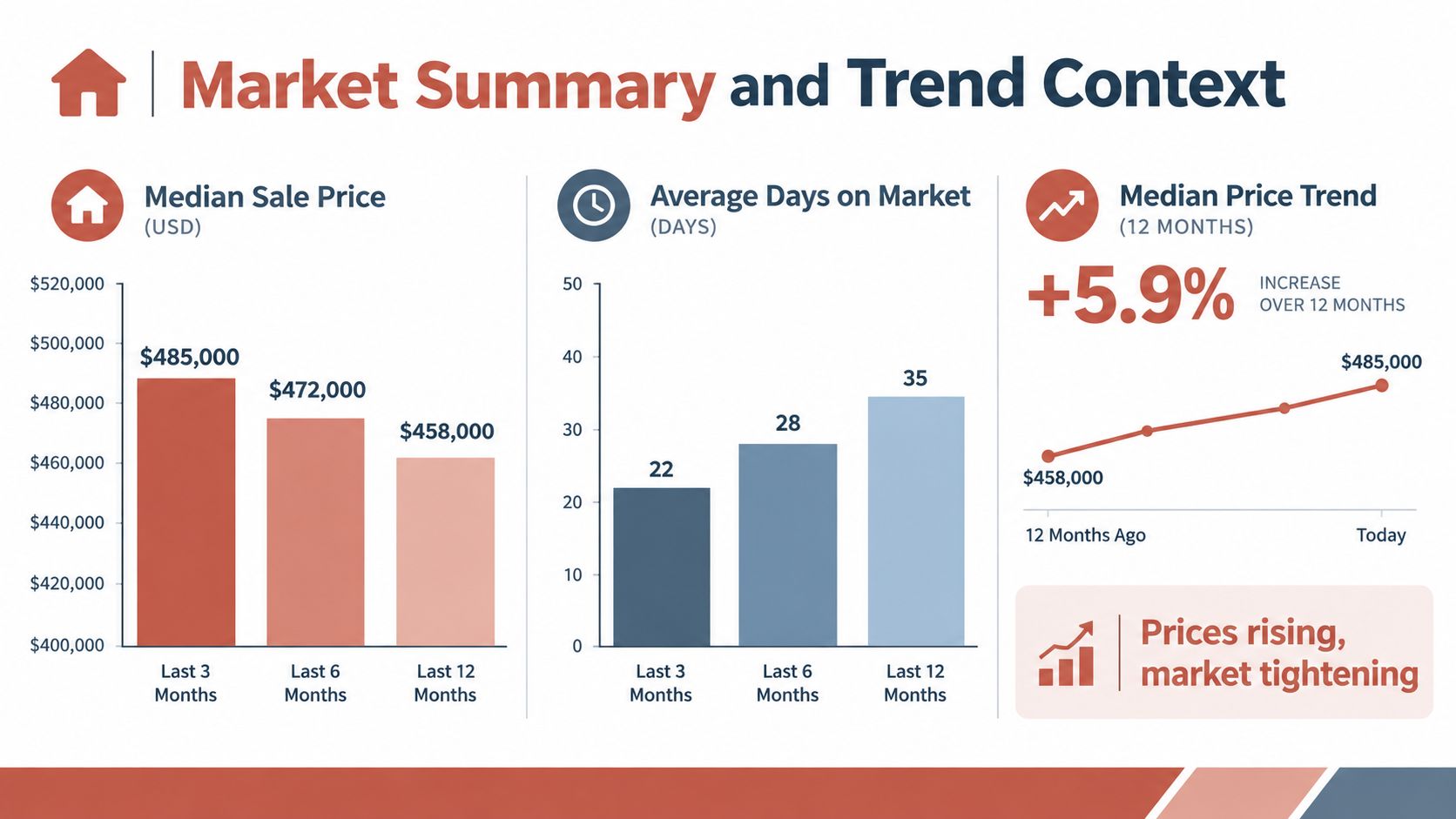
I read this part of the report like a timing check. If the comparable sales support a price of $650,000 but active listings at that level are piling up, I treat the number differently than I would in a week where clean homes are going pending in a few days. Sellers use that difference to set list price and concessions. Buyers use it to decide whether to come in strong, ask for credits, or wait out an overpriced listing.
A useful market summary usually answers four practical questions:
- How old is the report snapshot
- How many similar homes are competing right now
- Are pending deals forming quickly or dragging
- Is the current shift seasonal, or does it look more like a real pricing reset
That last point gets missed all the time. In the western suburbs, normal seasonality can look dramatic if you only stare at a few recent closings. Fewer showings in August or around the winter holidays do not automatically mean values dropped. On the other hand, repeated price cuts, longer market time, and weaker pending activity across similar homes usually call for a pricing adjustment, not wishful thinking.
Broader trend data can help as background, but it should stay in the background. National price indexes and appraisal datasets are useful for long-run perspective. They do not price a split-level in Villa Park with an older kitchen and a great school-boundary location. For that local read, I would rather see neighborhood-level inventory, pending activity, and price reduction patterns, or use a Chicago housing market trends page focused on local conditions.
If this section is thin, the report becomes harder to use in real-world situations. A seller may overprice because the closed sales looked strong. A buyer may overbid because last month's pendings looked aggressive. Good valuation work puts the sales evidence in context so the number can turn into a decision.
Valuation Report vs Online Estimate vs Tax Assessment
People mix these up constantly, then wonder why the numbers don't match.
They don't match because they're built for different jobs, on different dates, with different rules.
Comparing the tools side by side
| Tool | Purpose | Data Source | Freshness | Best Use |
|---|---|---|---|---|
| Home valuation report | Pricing or offer strategy | Agent review of comparable sales, listings, and public records | Depends on report date and comp recency | Listing prep, offer planning, negotiation |
| Online estimate | Quick directional estimate | Model-based public and listing data | Often refreshed frequently | Early screening or casual monitoring |
| Tax assessment | Property tax administration | Mass appraisal methods under tax rules | Set by assessment cycle | Reviewing tax basis and appeal context |
| Lender appraisal | Mortgage underwriting | Formal appraisal process for a specific transaction | Tied to transaction timing | Financing approval |
Why the numbers diverge
Official appraisal guidance defines market value as the most probable price in a competitive and open market. A tax authority may use a formula-driven mass appraisal tied to a set valuation date and tax rules instead. Public mass-appraisal guidance also makes clear that for single-family residential property, the sales comparison approach is the best approach, while the cost approach can supplement it and become primary when sales data are inadequate, and the income approach is usually inappropriate for owner-occupied homes, as outlined in this mass appraisal guidance reference.
That's why one number can feel grounded in current buyer behavior while another feels disconnected from your actual sale prospects.
The practical mistake is using a tax number to set a list price, or using an automated estimate to argue with a lender's appraisal. Each tool has its own lane. If you want a quick starting point before a deeper review, a home valuation calculator can help frame the conversation, but it doesn't replace a comp-based report.
Using the Report When You Are Selling
For a seller, the report isn't just about “value.” It's about positioning.
The adjusted range should guide where your list price belongs. If your home shows well, has updates buyers can feel immediately, and enters the market with limited direct competition, pricing near the stronger end of the supported range can make sense. If the home has dated finishes, a one-car garage in a two-car area, or backs to a busier street, the safer move is usually more disciplined.
Turn report sections into listing decisions
| Report Section | What to Extract | Seller Action |
|---|---|---|
| Subject summary | How the home is described | Correct errors and clarify upgrades |
| Comparable sales | Which sales buyers will mention | Prepare for likely objections and low anchors |
| Adjustment grid | Features pulling value down | Decide whether to fix, credit, or price around them |
| Market summary | Current competition and momentum | Time launch and set expectation on showing traffic |
| Final reconciliation | Supportable price range | Choose list price and counter strategy |
Where sellers lose leverage
Two things usually hurt sellers early.
First, they treat the highest comp as the only comp that matters. Second, they ignore the adjustment lines that buyers will use against them later anyway. If the report shows clear drag from condition or layout, you're better off deciding upfront whether to improve the property, disclose the weakness, or price around it.
A pricing strategy that ignores the report's weak spots usually meets them again in the first round of feedback.
I also like to use the comp pages to rehearse the likely low offer before the listing goes live. If one sale will become every buyer's favorite talking point, that's the one to answer before showings start.
Using the Report When You Are Buying
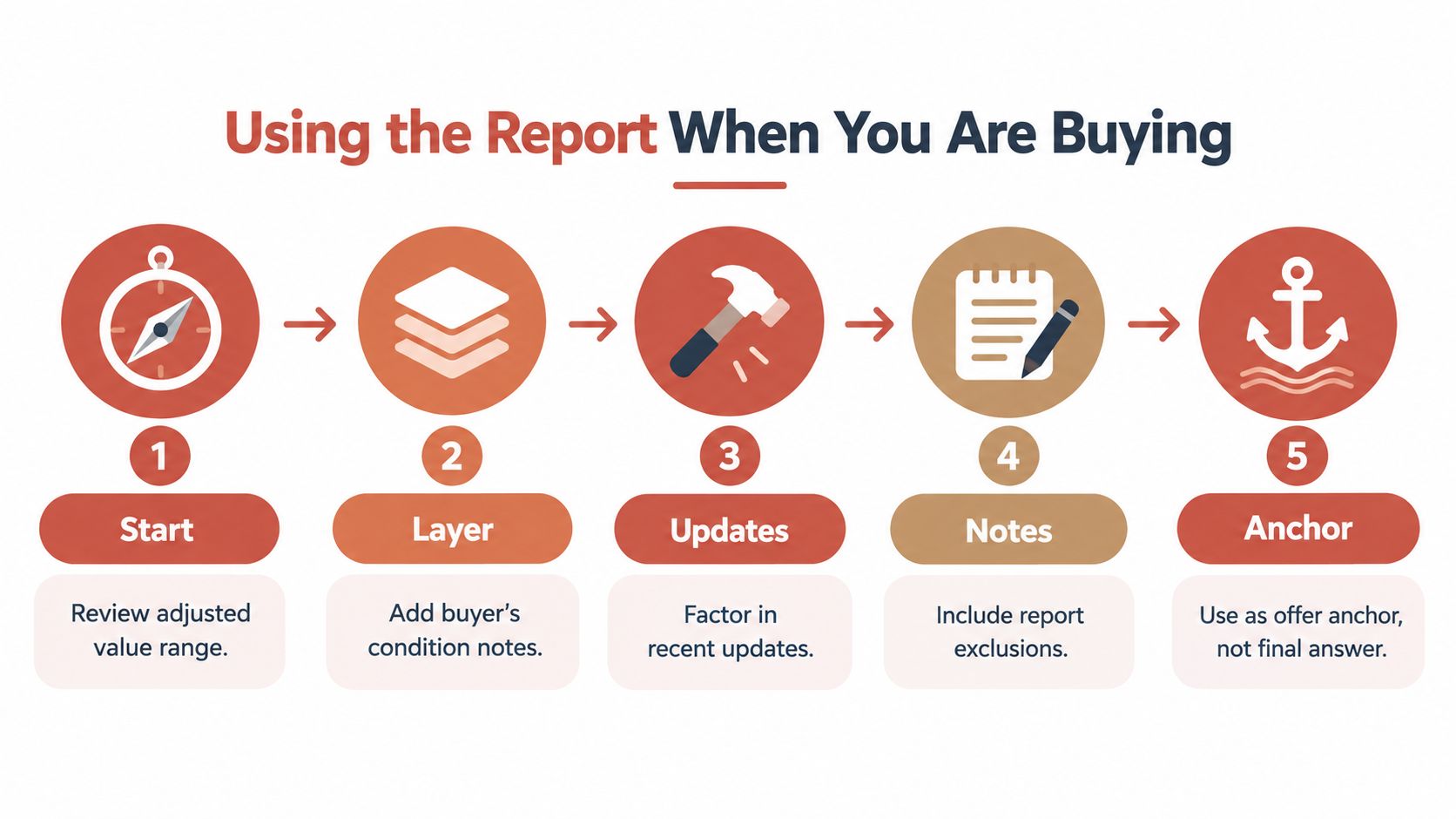
Buyers should use a home valuation report as an anchor, not as a command.
The report gives you a disciplined starting point. Your actual offer still needs to account for what you saw in person, what the seller knows about the house, and what your own tolerance is for stretching beyond supportable value.
How buyers use it well
A smart buyer usually works in this order:
- Start with the adjusted range and identify the band that feels supportable.
- Layer in condition notes from the showing. Reports can miss cosmetic wear, odors, odd layouts, or small signs of neglect.
- Check for updates or omissions that matter, including improvements that may not be obvious in the grid.
- Choose two or three strongest supporting comps for your offer logic.
- Set your walk-away line before the counteroffer starts pulling you upward.
How to respond when the seller pushes back
Don't argue every adjustment. That turns a negotiation into a spreadsheet fight nobody wins.
Go back to the clearest sales. Point to the comps that are closest in location, condition, and utility. If the seller counters above the top of a supportable range, decide whether you're paying for the home or paying for momentum and emotion.
If a lender appraisal later comes in low, the same report can still help. The cleaner comps, especially the ones with fewer major adjustments and the closest fit to the subject, are often the best foundation for a reconsideration request.
When the Report Goes Stale
A seller in Naperville prints a valuation report on Thursday, plans to list in two weeks, and then three nearby homes hit the market over the weekend. The PDF did not become wrong overnight. It just stopped being current enough to use without a fresh look.
That is how these reports work in the western suburbs. They are time-stamped opinions tied to a specific date, a specific comp set, and a specific market moment.
The date problem I see buyers overlook when relying on an older PDF is that they treat every date in the report as the same date. It helps to separate the inspection date, the effective date of value, and the date the report was delivered. Independent guidance makes the same point and notes that a valuation can have a short shelf life, which is why checking those dates separately matters, as explained in this property valuation report guide.
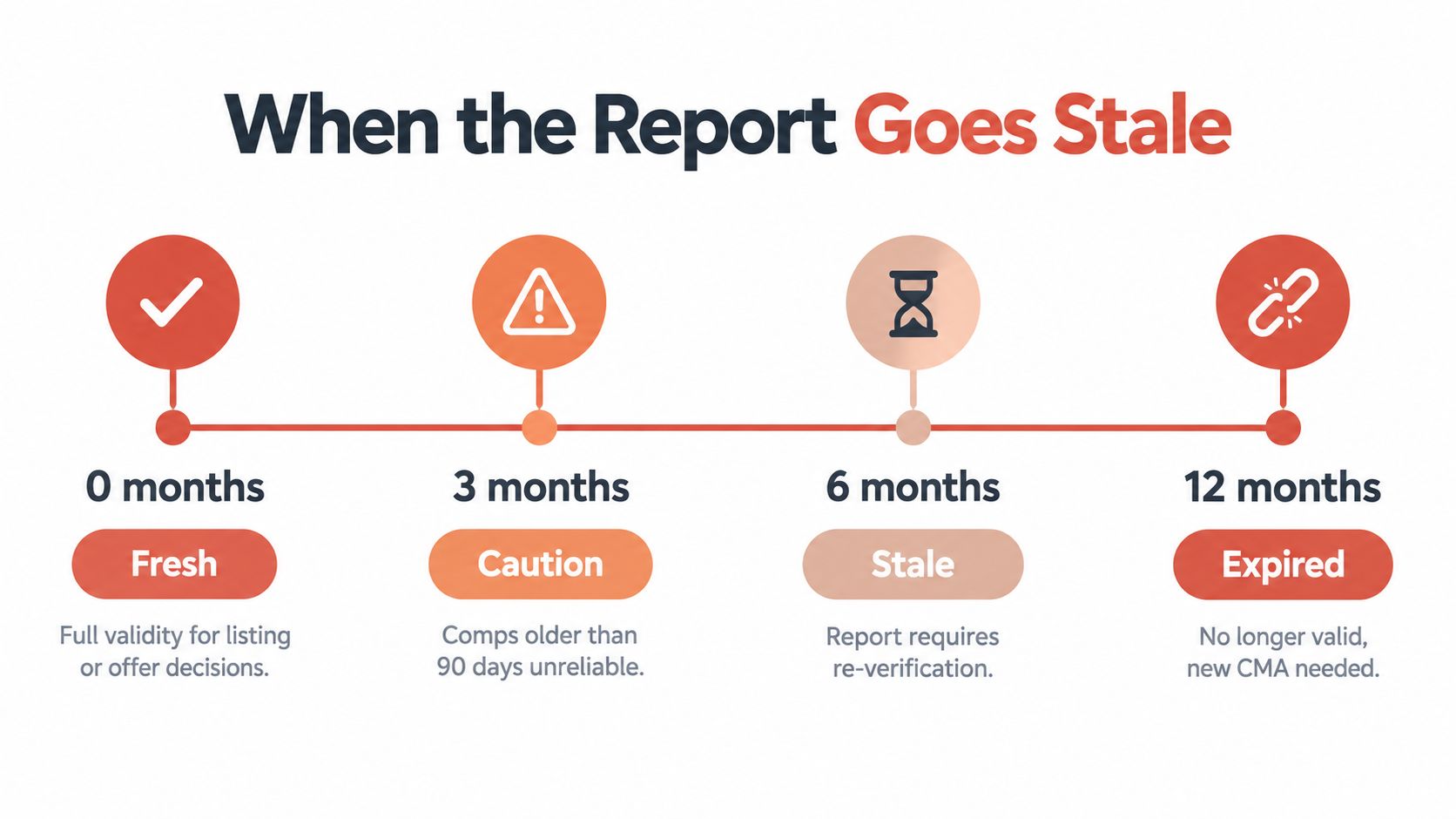
I usually ask one simple question. What changed since this report was finished?
If the answer is "nothing important," the report may still be useful as a pricing guardrail. If the answer is "new listings, a price cut, a contract fell apart, rates moved, or we found condition issues during showings," I want it refreshed before anyone leans too hard on the final number.
In practical terms, I would update the report when a seller is about to list into new competition, when a buyer is bidding with stale comps from an earlier rate environment, when an estate decision will rely on the figure for more than a short window, or when a lender needs a more current formal valuation. In fast-moving pockets of Elmhurst, Glen Ellyn, or Downers Grove, even a decent report can age faster than owners expect.
Use the older report as a starting file, not as a permanent answer. The useful part is often the logic and the strongest comparable sales. The final number needs another look once the market around the house has changed.
Quick Reference Checklist for Any Home Valuation Report
If you only have two minutes with the PDF, scan it like this.
What to verify first
- Effective date. Find the date the value opinion applies to.
- Comp pull window. Check how recent the closed sales are.
- Subject facts. Make sure square footage, bed and bath count, garage, and style are right.
- Condition notes. Look for honest mention of updates, dated finishes, and maintenance issues.
- Neighborhood fit. Confirm the comps really compete with the subject.
Red flags that should slow you down
- Vague adjustments with no clear explanation
- Comp selection drift into different subdivisions or clearly different buyer pools
- No market summary or no indication of data freshness
- A final number with little reconciliation explaining why some comps matter more than others
- Missing support for major differences such as renovations, lot influence, or layout problems
Before you trust the final value, trust the chain of evidence that created it.
A working home valuation report should let you reconstruct the logic. If you can't tell how the report got from raw sales to a final range, don't put real money decisions on top of it.
Common Questions About Home Valuation Reports
Who prepares a home valuation report
Usually a real estate agent or broker prepares it for pricing or offer strategy. That's different from a licensed appraisal prepared for lending or another formal purpose.
Can I challenge the comps or adjustments
Yes, if you have better evidence. The strongest challenges usually point to a more similar recent sale, a correction to property facts, or a meaningful condition difference the report missed.
Will a refinance lender accept one
Usually, an agent-prepared report helps you prepare, but the lender decides what formal valuation they require for the loan process. For financing, their standards control.
Why does my tax value or model estimate disagree with the report
Because each number serves a different purpose and may use a different valuation date, evidence base, and standard. A mass appraisal used for tax administration is not the same thing as a comp-driven pricing analysis for a current sale.
A good home valuation report doesn't promise certainty. It gives you a defendable range and a better decision.
If you need help reading a report, pressure-testing the comps, or turning the numbers into a list price or offer strategy in Chicago's western suburbs, Homes By Carmen offers practical valuation guidance tied to current local inventory and recent sales. If you already have a PDF in hand, bring it to the conversation. That usually makes the next decision much clearer.