
You're sitting at the kitchen table, and the agent has just slid a comparison market analysis across to you. You expected one number. Instead you got a price range, a grid of houses that don't look exactly like yours, and a lot of small adjustments that seem suspiciously subjective.
That moment is where most sellers get stuck.
In the Chicago suburbs, especially in places where one block can trade differently from the next, a CMA is useful only if you know how to read it. Not admire it. Not treat it like a glossy listing presentation. Read it well enough to ask better questions about price, timing, concessions, and what your home is competing against.
Table of Contents
- What This Guide Will Help You Do With a Comparison Market Analysis
- What a Comparison Market Analysis Actually Is
- How an Agent Builds a CMA From Comparable Sales
- A Sample CMA Walkthrough for a Melrose Park Bungalow
- How Sellers Should Use a CMA to Set List Price
- How Buyers Should Use a CMA to Shape an Offer
- The CMA Question Most Articles Skip in 2026
- Your Next Step After Reading This CMA Guide
What This Guide Will Help You Do With a Comparison Market Analysis
A good comparison market analysis should calm you down a little. A bad one usually does the opposite. It gives you a number without showing its work, or it gives you a range so wide that it doesn't help you decide anything.
The kitchen-table version of this happens all the time. A seller in a Berwyn bungalow hears one value in their head, sees a different range on paper, and immediately wants to know which house in the packet caused the gap. That's the right instinct. The grid matters more than the cover page.
Four things sellers need to learn fast
By the time you finish reading, you should be able to do four practical things:
- Read a comp grid without guessing: You'll know why one nearby sale belongs in the CMA and another should be ignored.
- Understand the adjustment math: You'll see how agents account for square footage, baths, garages, basements, and condition.
- Treat the range like a probability band: The most useful CMA isn't a magic list price. It's a forecast of what pricing choices are likely to produce.
- Use the same tool on both sides of a deal: Sellers need it to price. Buyers need it to challenge price.
What this looks like in the suburbs
The examples here stay close to how agents work in western Chicagoland. One section uses an Elmhurst-style three-bedroom example to show the adjustment math. Another walks through a Melrose Park bungalow CMA the way I'd want a first-time seller to see it, line by line.
Practical rule: If an agent can't explain why each comp was chosen and how each adjustment was made, the list-price recommendation isn't finished.
A comparison market analysis is a working document. It's supposed to help you make decisions under uncertainty. If you can leave this guide able to spot weak comps, question unsupported adjustments, and connect price to likely negotiation outcomes, you'll be in much better shape than most first-time sellers.
What a Comparison Market Analysis Actually Is
A comparison market analysis is an agent-prepared opinion of value based on comparable properties. It usually draws from recent sold listings, plus current active and pending listings, to estimate where a property fits in the market. Independent guidance describes a CMA as a structured opinion of value built from comparable sales and adjusted for subject-property differences rather than a formal appraisal, and notes that it's most accurate when it uses recent sold, active, and pending listings with feature-by-feature adjustments.
That definition matters because people often expect the wrong thing from it.
What it is
A CMA is fast, practical, and designed for decision-making. It helps a seller choose a listing strategy and helps a buyer decide whether the asking price looks supported. In plain language, it answers this question: what are buyers likely to pay for this home, compared with similar choices nearby?
What it is not
A CMA is not a lender appraisal. It isn't legally binding, and it doesn't guarantee a sale price. It also doesn't mean the market will agree with every adjustment on the page.
A lender's appraiser is a third party using a formal process. Your agent's CMA is closer to a market forecast. It's useful, directional, and often quite good when done carefully, but it's still an opinion.
Think of it this way. A CMA helps you decide how to go outside. An appraisal is the instrument a lender relies on when money is on the line.
A definition you can repeat at home
If you need a short version for your spouse or partner, use this:
- A CMA compares our home to similar nearby homes that sold or are competing right now
- The agent adjusts those homes for differences like size, baths, condition, and features
- The result is a likely value range, not a guaranteed price
That last part matters most. If you remember only one thing, remember that a comparison market analysis should guide a pricing decision, not pretend uncertainty doesn't exist.
How an Agent Builds a CMA From Comparable Sales
Most agents don't start with price. They start with exclusion.
The first job is cutting out homes that look close on a map but aren't comparable. In the suburbs around Chicago, that usually means tightening the search to recent closed sales, keeping the radius small, and staying inside the same school district when possible. HOA status matters too. A house with association restrictions or shared amenities doesn't always compete cleanly with one that doesn't have them.
What gets screened in first
A practical comp search usually filters for homes that are similar in the ways buyers shop:
- Recency: Recent closings matter most because the market moves faster than many sellers think.
- Location: Same subdivision, same school pattern, same side of the tracks if that split affects demand.
- Basic footprint: Similar living area, bedroom count, bath count, lot utility, and home style.
- Ownership feel: Attached and detached homes don't always belong in the same pricing conversation.
If you want to understand how agents pull and narrow listing data in the first place, this walkthrough on how to search MLS listings effectively gives useful context.
Where the adjustment math comes in
After selecting likely comps, the agent normalizes differences. That usually means adjusting for living area, baths, basement finish, garage count, and condition. The exact amounts are judgment calls tied to the local segment, not universal truths.
Here's a simplified Elmhurst-style example for a three-bedroom subject property around 1,950 square feet. In this kind of analysis, many agents test a size adjustment in the rough range of $30 to $50 per square foot, then layer in feature adjustments such as $4,000 for an extra half bath and $6,000 for a finished basement when those items materially separate one comp from the subject. The point isn't that every agent uses identical figures. The point is that good CMAs show the math.
Elmhurst Three-Bedroom CMA Adjustment Grid
| Comparable Address | Sale Price | Sq Ft | $/Sq Ft Base | Size Adjustment | Bath Adjustment | Condition Adjustment | Adjusted Value |
|---|---|---|---|---|---|---|---|
| Comp A | $540,000 | 2,100 | $257.14 | -$6,000 | $0 | -$8,000 | $526,000 |
| Comp B | $515,000 | 1,880 | $273.94 | +$2,100 | +$4,000 | $0 | $521,100 |
| Comp C | $532,000 | 2,040 | $260.78 | -$3,600 | $0 | +$6,000 | $534,400 |
The most argued adjustments
Condition is usually the biggest fight. Sellers tend to price their updates emotionally, while buyers compare them competitively. Basement finish can also get messy because not all finished lower levels contribute the same value. A clean rec room, a legal bedroom setup, and a basic older finish are not the same thing.
The more a comp needs to be “fixed” with adjustments, the less weight it should usually carry.
That's one of the hidden rules behind good comp selection. Stronger comps need fewer corrections.
A Sample CMA Walkthrough for a Melrose Park Bungalow
Let's use a bungalow example because a lot of first-time sellers get tripped up. The home looks straightforward, but bungalows often vary a lot in basement utility, kitchen updates, and garage setup. Those differences move price more than the seller expects.
Assume the subject is a 1,100-square-foot Melrose Park bungalow being considered near $259,900. The agent pulls three nearby closed comps and one active competitor within roughly a tight neighborhood radius, then starts adjusting each against the subject.
The raw grid first
Before adjustment, the grid should show what sold and what's competing now. Not just homes the agent likes.
Melrose Park Bungalow CMA Grid with Adjustments
| Comp Address | Sale/List Date | Sq Ft | Bed/Bath | Key Differences vs Subject | Raw Price | Net Adjustment | Adjusted Value |
|---|---|---|---|---|---|---|---|
| Comp 1 | Recent sale | 1,080 | 3/1 | Similar size, finished basement, updated kitchen | $262,000 | -$14,000 | $248,000 |
| Comp 2 | Recent sale | 1,140 | 3/2 | Extra bath, two-car garage | $265,000 | -$9,000 | $256,000 |
| Comp 3 | Recent sale | 1,120 | 3/1 | Similar layout, no basement finish, dated kitchen | $254,000 | +$6,000 | $260,000 |
| Comp 4 | Active listing | 1,100 | 3/1 | Competing now, two-car garage, updated kitchen | $269,000 | -$11,000 | $258,000 |
How the adjustments work in plain English
In this example, the subject lacks some features that one or two comps have, but also beats other comps in areas that buyers care about.
Typical line-item adjustments might look like this:
- Finished basement: A comp with a finished basement may need a downward adjustment of $8,000 if the subject doesn't offer the same utility.
- Updated kitchen: A recently updated kitchen can justify a $6,000 adjustment where the subject is more dated, or the reverse if the subject is stronger.
- Garage difference: A comp with a two-car garage when the subject lacks that advantage may need a negative $5,000 adjustment.
- Bath count: A bath-count gap may justify about $4,000 in either direction depending on which property has the extra utility.
Those aren't universal rates. They're local judgment tools. What matters is consistency across the grid.
Why one comp carries more weight
Even when four homes are in the packet, they shouldn't all count equally. The most similar closed comp usually deserves the most weight, especially if it needed the fewest corrections. In the example above, the adjusted values cluster from $254,000 to $268,000, which supports a suggested range around $255,000 to $265,000.
That doesn't mean every list price inside the band performs the same way. A lower list may attract faster activity. A higher one may sit long enough to invite a reduction.
A tight cluster is helpful. A forced cluster is not. If the comps don't naturally point to the same range, the agent should say that plainly.
What the grid leaves out on purpose
Even a careful CMA leaves some things outside the spreadsheet:
- Disclosure details: Water issues, aging mechanicals, and repair history can shift buyer behavior.
- Street feel: Traffic, backing to an alley, train noise, or a stronger block can matter.
- School-zone nuance: Buyers often sort neighborhoods more tightly than a map suggests.
That's why the best agents don't just pull comps. They interpret them in person, with local context.
How Sellers Should Use a CMA to Set List Price
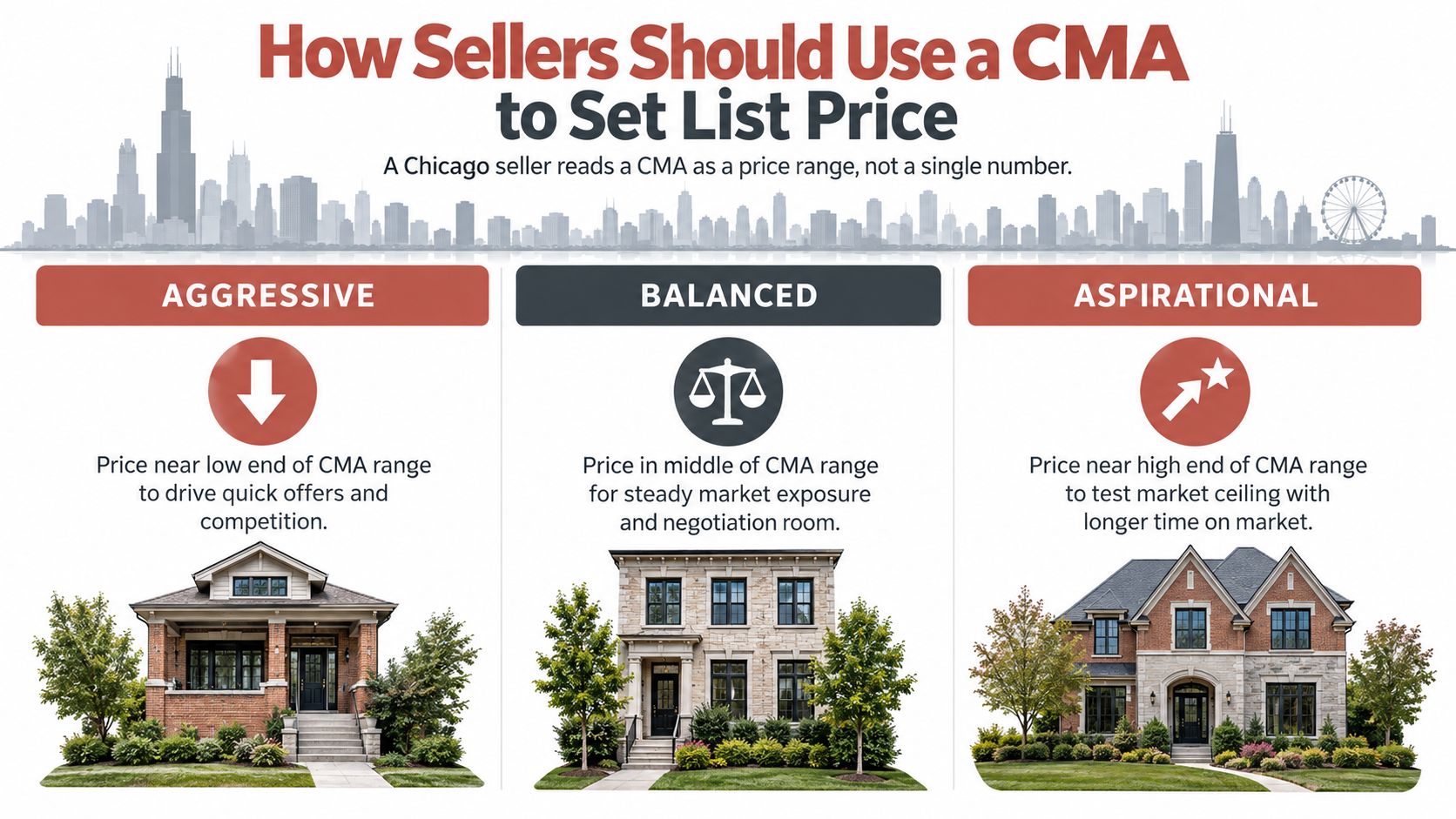
A seller should read the CMA as a range first and a strategy second. If you treat it like a single correct number, you'll miss the decision, which is how much risk you want to take on speed, concessions, and future price changes.
Current market data makes that especially important. In July 2026, the U.S. median sale price reached $400,000, up 2.6% year over year from $390,000, while single-family homes reached $410,000, townhomes $362,000, and condos $350,000. The same report notes the average U.S. home value at $368,697 as of August 2026, homes going pending in about 24 days, and 30.2% of sales closing above list price. In Chicago, the Case-Shiller series showed the IL-Chicago market up 6.9% year over year in June 2026, versus 2.1% for the 20-city composite (national housing market data summarized here). That spread is exactly why a local pricing decision can't rely on a national headline.
If you want a rough starting point before the full comp review, a local home valuation calculator can help frame the conversation, but the CMA is where the pricing work happens.
Three ways to use the range
- Aggressive pricing: List near the low end of the adjusted range when your priority is speed and strong early attention. This can work well when buyers are active and inventory in your segment feels tight.
- Balanced pricing: List near the middle when you want the most defensible path to contract without inviting immediate discounting.
- Aspirational pricing: Test the top end, or slightly above it, when the home has unusual appeal or when you're willing to trade time for the chance at a stretch result.
What the list price is really buying you
Price doesn't just affect offer amount. It shapes the whole negotiation:
- Lower entry price can reduce staleness
- Middle-of-range pricing often preserves bargaining power during inspection
- High-side pricing raises the chance you'll revisit the number later
Recent seller behavior points in that direction. In July 2026, fewer than 40% of active listings had a price cut, down from 54% a year earlier, and sellers were making their first reduction sooner and in smaller increments. At the same time, pending sales rose 3.7% year over year in June 2026 even as the national median asking price fell 2.5% (summer 2026 seller pricing trends are summarized here).
Two warning signs in a CMA
A CMA should make you cautious when:
- The range is unusually wide: That often means the comps are weak or too dissimilar.
- The recommended list price sits well above current competition: That can mean the agent is chasing the listing instead of reflecting buyer behavior.
The right question isn't “What number do you think I can get?” It's “What outcome does this pricing choice make more likely?”
How Buyers Should Use a CMA to Shape an Offer
Buyers should ask for a comparison market analysis before writing an offer, not after emotions have already taken over. The seller already has a pricing story. Your job is to test whether it holds up.
That starts with identifying which comp likely anchored the asking price. Every overpriced listing usually has one favorite comp doing too much work. Sometimes it's a nearby sale with a better garage, a better basement, or cleaner updates than the subject offers.
How a buyer pushes back without sounding arbitrary
A buyer's agent can use the grid to challenge price in a way that stays factual:
- Call out the missing adjustment: If the seller leaned on a comp with a two-car garage and the subject has less utility, that difference belongs in the math.
- Separate features from finish: A recent roof, a stronger kitchen, or a more usable basement can't be hand-waved away.
- Compare against current alternatives: If active competition offers more at the same price, the asking price loses support.
Pending and active listings help. Sold data shows what buyers paid. Current competition shows what your seller is up against right now.
Offer position depends on listing posture
When a home has been sitting, the bottom of the adjusted range becomes a more reasonable anchor. When it's fresh to market in a suburb where good listings move quickly, the middle of the range may be the realistic place to compete.
That's not because buyers should chase. It's because timing changes the dynamics.
Ask the listing agent which comparable they relied on most. The answer often tells you where the pricing logic is solid and where it starts to wobble.
The same CMA can support negotiation after inspection
The comp grid doesn't stop mattering once you're under contract. It can support a request for credits or repairs if the home's condition turns out weaker than the pricing implied. A listing priced like a turnkey house but behaving like a deferred-maintenance house often needs terms adjusted somewhere, either in price, credits, or repairs.
For buyers, that's the quiet power of a good CMA. It gives you a way to argue value without turning the negotiation personal. You're not saying, “We just feel it's too much.” You're saying, “Here's where the comparable evidence breaks.”
The CMA Question Most Articles Skip in 2026
The least useful way to read a CMA in 2026 is as a single list-price opinion. Sellers don't just need a number. They need a forecast of what that number is likely to cause.
That matters because broad market averages can hide the exact segment your home belongs to. A Northwest Multiple Listing Service history of CMA notes that the method became a formalized brokerage practice as multiple listing systems expanded, and describes a CMA as estimating price using recently sold, similar properties in the immediate area. On the valuation side, the FHFA says its House Price Index covers data back to the mid-1970s and incorporates tens of millions of home sales across all 50 states and more than 400 American cities. FHFA also found that during 2013 to 2021 the average and median number of comparable properties per appraisal was five, the modal number was six, and more than two-thirds of Enterprise-backed mortgage appraisals included five or more comps even though only three are required. The same study showed appraisals with five or more comparables fell from 76% in 2013 to 59% in 2021, a 17-point decline.
What a segmented CMA should answer
A serious seller should want the CMA broken into likely outcomes by pricing tier:
- If we list near the lower end, how quickly are similar homes contracting?
- If we list at the top end, how often do similar listings cut later?
- When homes miss early, what concessions usually show up next?
A segmented approach also matters because market movement can split by subtype. Recent reporting showed U.S. listing prices fell 2.4% year over year in July 2026, while a separate national tracker showed single-family homes still posted 2.5% annual growth in July 2026, underscoring how misleading one broad benchmark can be when property types diverge (property-type segmentation in recent housing research is discussed here).
Segmented CMA Price Tier vs. Likely Outcomes
| List Price vs. Segment Median | Chance of Price Cut Before Contract | Typical Inspection Concession | Expected Days to Contract |
|---|---|---|---|
| Below segment median | Lower | Lighter | Shorter |
| At segment median | Moderate | Market-normal | Typical |
| Above segment median | Higher | Heavier | Longer |
The table is qualitative on purpose. The exact numbers should come from your local comp set, not from a canned script.
Why this matters more than the headline number
Two homes can list close together and produce very different seller experiences. One gets a contract quickly with modest inspection friction. Another hangs around, then gives away value through a price cut and credits.
That's why the right CMA question in 2026 isn't just “What should we list at?” It's “What are the odds this price leads to a cut, a credit, or a longer wait?”
Your Next Step After Reading This CMA Guide
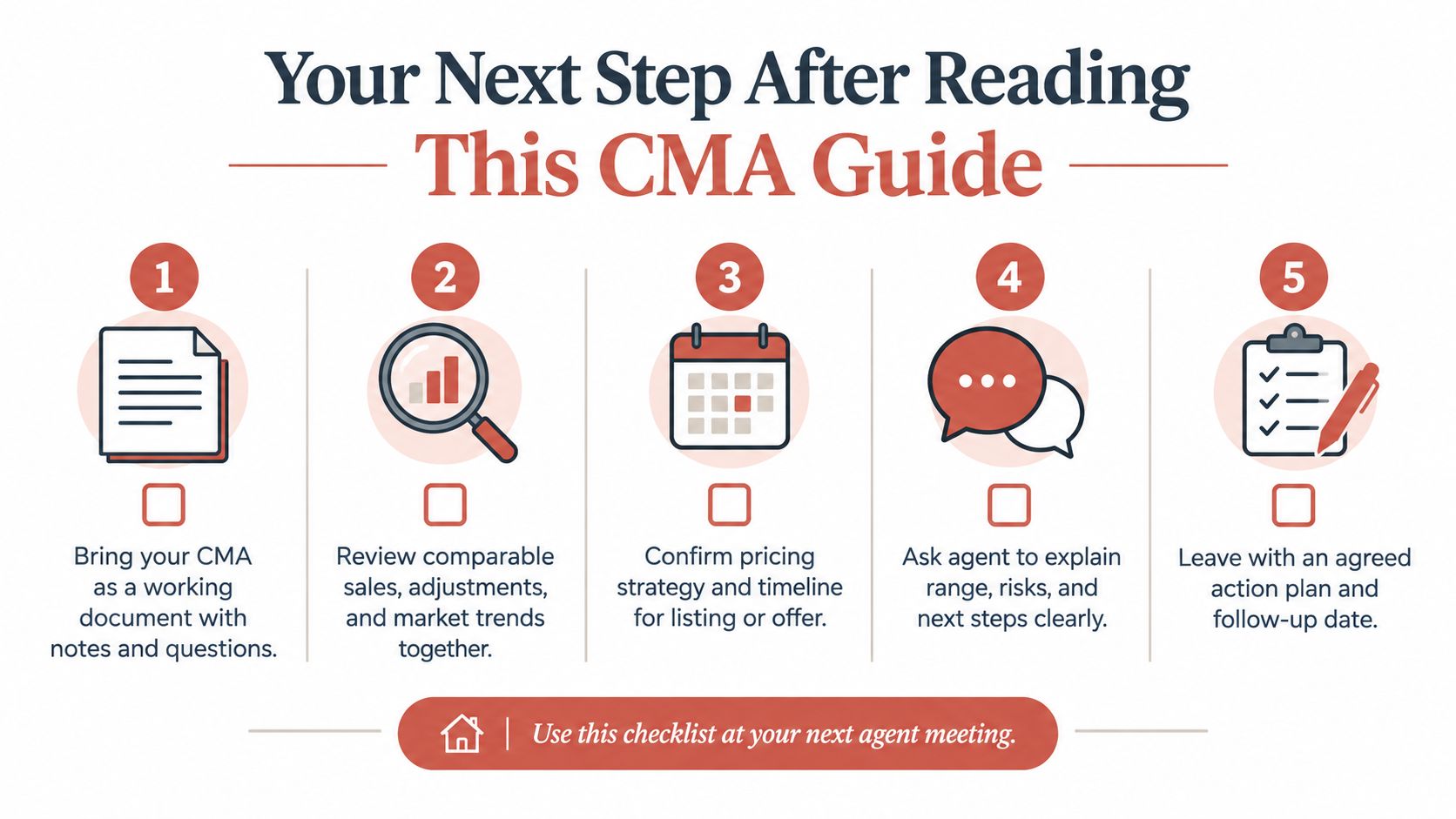
The strongest use of a comparison market analysis is simple. Bring it into the conversation as a draft, not a verdict.
If you're meeting an agent soon, ask for the full grid and make them defend it. If you're buying, ask for the same discipline before you write. A CMA is most helpful when both sides treat it as evidence that can be challenged and refined.
Bring this checklist to the meeting
- Ask for nearby closed comps: Request at least three strong sold comparables that match your school zone and basic property type as closely as possible.
- Insist on visible adjustments: Don't settle for a list of homes and a final number. You want the dollar adjustments shown line by line.
- Review current competition too: Closed sales matter, but active and pending listings tell you what buyers are choosing from right now.
- Push for the probability view: Ask what pricing choices are likely to mean for price cuts, inspection credits, and time to contract.
- Refresh the CMA if timing slips: Once listed, the analysis should be updated regularly if nearby inventory changes or if your home misses the first wave of attention.
A local professional who works these neighborhoods every week can usually explain the why behind a comp much better than someone reading a spreadsheet from a distance. If you're deciding who to talk to next, it helps to start with someone who works as a real estate agent in Illinois with day-to-day experience in these western suburbs.
The best CMAs come from agents who've seen the comps, know the block differences, and aren't afraid to tell you when the range is narrower or wider than you hoped.
Use this guide for the questions it gives you. Those questions are what protect you from overpricing, underpricing, and negotiating off a weak valuation story.
Homes By Carmen helps buyers and sellers in Melrose Park and the greater Chicago area work through pricing, comps, negotiation strategy, and the real-world details that a generic CMA often leaves out. If you want help reviewing your home's likely value range or pressure-testing an asking price before you make a move, visit Homes By Carmen.