You're probably doing what a lot of first-time buyers do. It's late, you've got six condo tabs open, you've filtered by price, bedrooms, and maybe monthly HOA, and then one simple question starts changing everything: “Wait, where am I parking in January?”
That's usually the moment the search stops being about square footage and starts being about daily life. In western Chicagoland, a garage can mean no scraping ice before work, no carrying groceries through slush, no guessing whether street parking will still be there when you get home, and sometimes no paying later for a problem you could've screened out early.
A lot of buyers treat parking like a bonus feature. In condo shopping, that's a mistake. Garage parking is often a scarce, priced asset, and it doesn't show up the same way in every listing. Some units include a deeded garage spot. Some have an assigned space. Some say “garage” when they really mean one stall in a shared structure. Some older buildings near walkable downtown areas have fewer garage options at all.
That's why searching for condos for sale with garage needs a different approach than a basic condo search. You need to read the listing language carefully, use the right MRED filters, and know which western suburbs tend to offer easier garage inventory versus where garage parking is harder to find and more important to value.
Table of Contents
- Introduction Why Garage Parking Changes Your Condo Search
- Understanding What Garage Means in a Condo Listing
- How to Find Condos for Sale With Garage Using MRED Filters
- What a Garage Adds to Price and Monthly Cost in Chicagoland
- Where Garage Condos Make the Most Sense in Western Suburbs
- Smart Search Strategies Beyond the Garage Filter
- Your Next Steps to Secure a Garage Condo With Confidence
Introduction Why Garage Parking Changes Your Condo Search
A buyer looking in places like Elmhurst, Oak Park, or Downers Grove might start out thinking, “I just need a 2 bedroom condo under budget.” Then winter reality kicks in. Maybe you've dealt with overnight street parking rules before. Maybe your current building has open parking and half the spaces are buried after a snow. Maybe you work early and don't want a daily parking scavenger hunt.
That's when garage parking stops being a want and becomes part of the floor plan.

In multifamily housing, parking has been getting tighter over time. A useful baseline comes from a 2018 parking-ratio analysis summarized here, which found average parking ratios for apartment properties with 50 or more units peaked at 1.62 spaces per unit in the 2000s and then fell to 1.46 in the 2010s, the lowest level since the 1960s. That same research noted strong regional variation, with lower parking ratios in places where land is tighter and development patterns are denser.
That matters because condo garage supply usually isn't random. It's shaped by land cost, zoning, building age, and neighborhood design. In practical terms, a condo with garage parking in a close-in, walkable area often isn't just nicer. It's harder to replace.
Practical rule: If garage parking changes how you live day to day, treat it like a core buying criterion, not a nice surprise.
Why first-time buyers get tripped up
The confusion usually starts with assumptions:
- “Garage” sounds like ownership. In some listings, it isn't.
- A lower list price looks better. But a cheaper unit without parking may not be the better fit.
- Two similar condos can feel equal online. One may come with easier resale appeal because parking is already solved.
When you search the right way, you can shortlist faster and waste fewer tours on units that were never really contenders. That's especially true in western suburbs where condo stock varies a lot by building style and age.
Understanding What Garage Means in a Condo Listing
The word garage sounds simple. In condo listings, it often isn't. The same word can describe a private enclosed garage, one stall in a shared garage, or a parking arrangement you don't own.
That's why you want to read parking language the way you'd read appliance language. “Includes washer and dryer” means something different from “hookup available.” Garage wording works the same way.
Ownership matters more than the label
Think of parking rights like seats at a game.
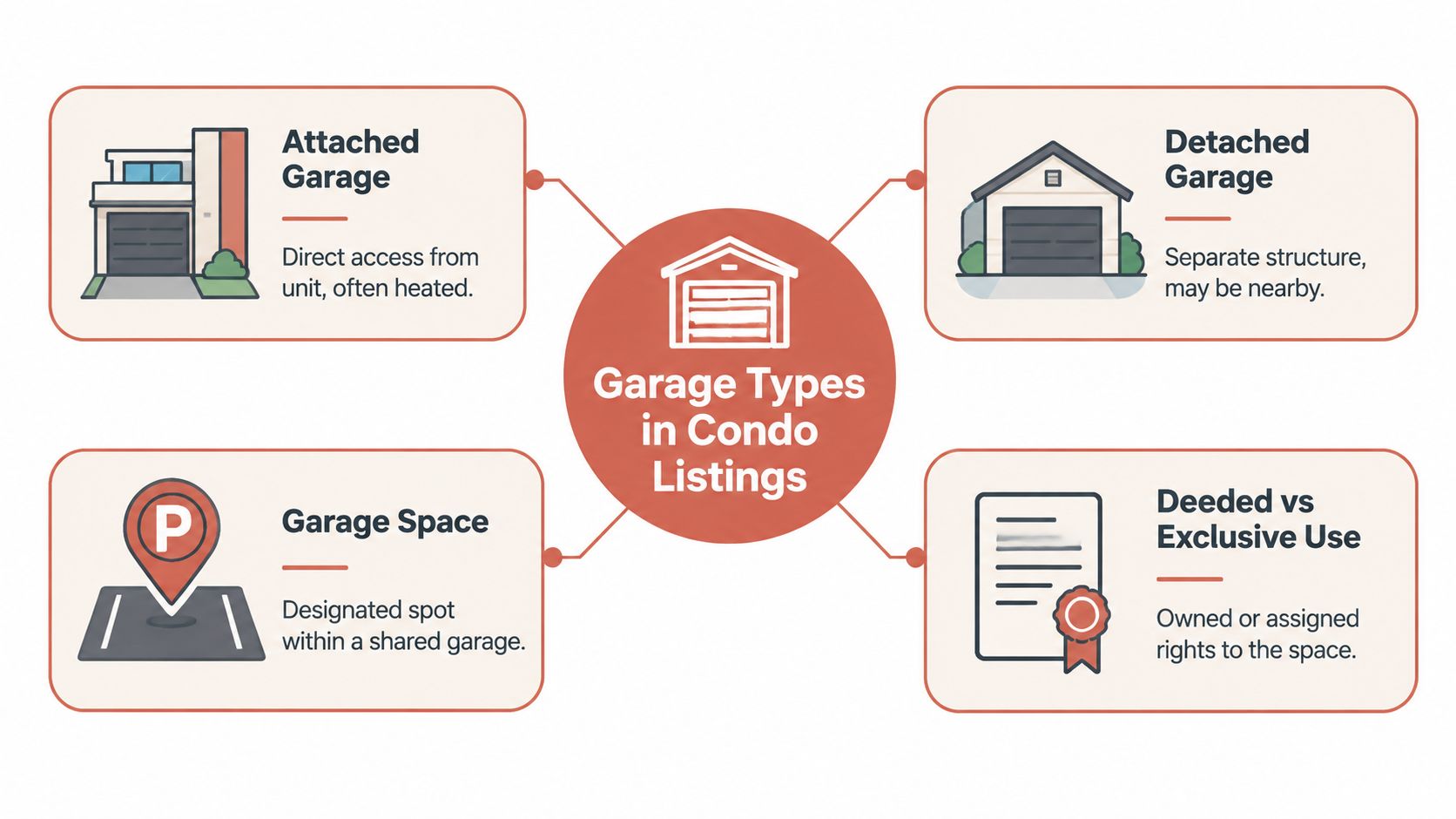
A deeded space is like owning your exact seat. It's part of your property rights, and sometimes it may even appear as a separate legal interest or tax line item depending on the setup.
An assigned space is more like having a reserved seat that the association controls. You can use it, but the way it's documented and transferred may depend on condo rules.
A leased space is the least secure version for long-term planning. You may use it now, but you need to know whether it transfers, renews, or can disappear.
If a listing says “garage included,” ask, “Included how?” That one follow-up can save a lot of confusion later.
Common garage terms buyers should decode
Here's the language that tends to matter most:
- Attached garage. Usually means direct access as part of the building or unit layout. In some suburban condo formats, this can feel more like townhome living.
- Detached garage. A separate garage structure on the property. Still valuable, but the day-to-day experience is different.
- Garage space. Often a designated stall inside a shared garage, not a private enclosed room.
- Tandem parking. Two cars stacked front to back. Fine for some households, annoying for others.
- Heated garage. Helpful in winter, but you'll still want to confirm whether the stall itself is deeded or assigned.
- Exclusive use. You have the right to use it, but that's not automatically the same as fee ownership.
Where to verify the real answer
Don't rely on the headline alone. Check these places:
- MLS parking fields for type and number of spaces.
- Agent remarks for details like tandem, detached, or leased.
- Association documents for ownership structure and rules.
- Survey, plat, or legal description if parking rights are more complex.
A buyer in Glen Ellyn might see “1 garage space” and assume it's enclosed. It may be one marked stall under the building. A buyer in Naperville might see “2 car garage” and think it's attached to the unit. It may be detached across a private drive.
Red flags worth slowing down for
| Listing phrase | What to ask next |
|---|---|
| Garage included | Is it deeded, assigned, or leased? |
| Parking available | Available to whom, and on what terms? |
| Heated garage | Private garage or shared indoor space? |
| Additional parking | Can it be purchased, rented, or waitlisted? |
The goal isn't to get suspicious about every listing. It's to read parking the way experienced buyers do. Specific rights matter more than broad labels.
How to Find Condos for Sale With Garage Using MRED Filters
Most buyers start too broad. They search for condos, sort by price, and then manually scan photos for garages. That's slow, and it misses listings where the parking detail is buried in fields or remarks.
A better approach is to build the search around the garage from the start.

Start with the non-negotiables
Before touching filters, decide what “garage” means for your household. One indoor space? Two spaces? Private garage? Shared garage is okay? Detached is okay? If you skip this part, your results will look bigger than they really are.
Then build your search in this order:
- Property type first. Select condo or attached single-family categories that match what you're willing to buy.
- Location second. Draw your map area or narrow by suburb, such as Elmhurst, Oak Park, Glen Ellyn, Downers Grove, Naperville, or Melrose Park.
- Price and payment comfort. Keep this realistic before you add stricter parking requirements.
- Garage and parking fields. Add garage spaces, parking type, and any available notes tied to indoor parking.
If you want a refresher on reading MLS search options more efficiently, this walkthrough on how to search MLS listings is a good companion.
Use the filters, then read the remarks anyway
Here's where first-time buyers get surprised. MRED-style data can be detailed, but condo parking is still only as clear as the listing input. So use the structured fields first, then verify through remarks and photos.
Look for combinations like:
- Garage spaces set to at least 1
- Parking type indicating garage or attached garage
- Remarks mentioning deeded, assigned, indoor, heated, detached, or tandem
A smart move is to keep one search a little wider than your ideal. For example, if you only search “2 garage spaces,” you may miss a unit with one deeded space plus an extra rentable stall. That might still work for your household.
Some of the best search results come from using one strict search and one flexible search at the same time.
A simple western suburb filtering method
Try this practical pattern:
Search A for certainty
Use your must-haves only. Example: condo, one specific suburb, minimum one garage space, price cap, bedroom count.
Search B for hidden options
Use the same area and price, but loosen the parking filter slightly. Then scan remarks for words like “garage available,” “assigned indoor,” or “additional stall.”
Search C by map
Draw around the district where parking pressure matters most to you, such as near a downtown train stop or a dense corridor with older condo stock.
This works well because parking supply often changes block by block. Near a walkable downtown in Oak Park or Elmhurst, garage availability can look very different from condo communities farther out.
Save the search before you forget
Garage inventory can feel limited because it often is limited. Save your searches and turn on alerts so you don't have to rebuild them every few days.
Use saved searches for different scenarios:
- Your ideal fit for units with the exact garage setup you want
- A compromise search for one step down, such as detached instead of attached
- A future resale search to watch how often garage condos come up in your target pocket
What to confirm before scheduling a tour
Don't spend a Saturday touring a maybe. Ask these upfront:
- Is the garage space deeded, assigned, or leased?
- How many spaces come with the unit?
- Is the space enclosed or open within a shared garage?
- Can an additional stall be rented or purchased?
- Does the HOA place rules on vehicle type, storage, or guest parking?
Those questions turn a vague listing into a real candidate fast.
What a Garage Adds to Price and Monthly Cost in Chicagoland
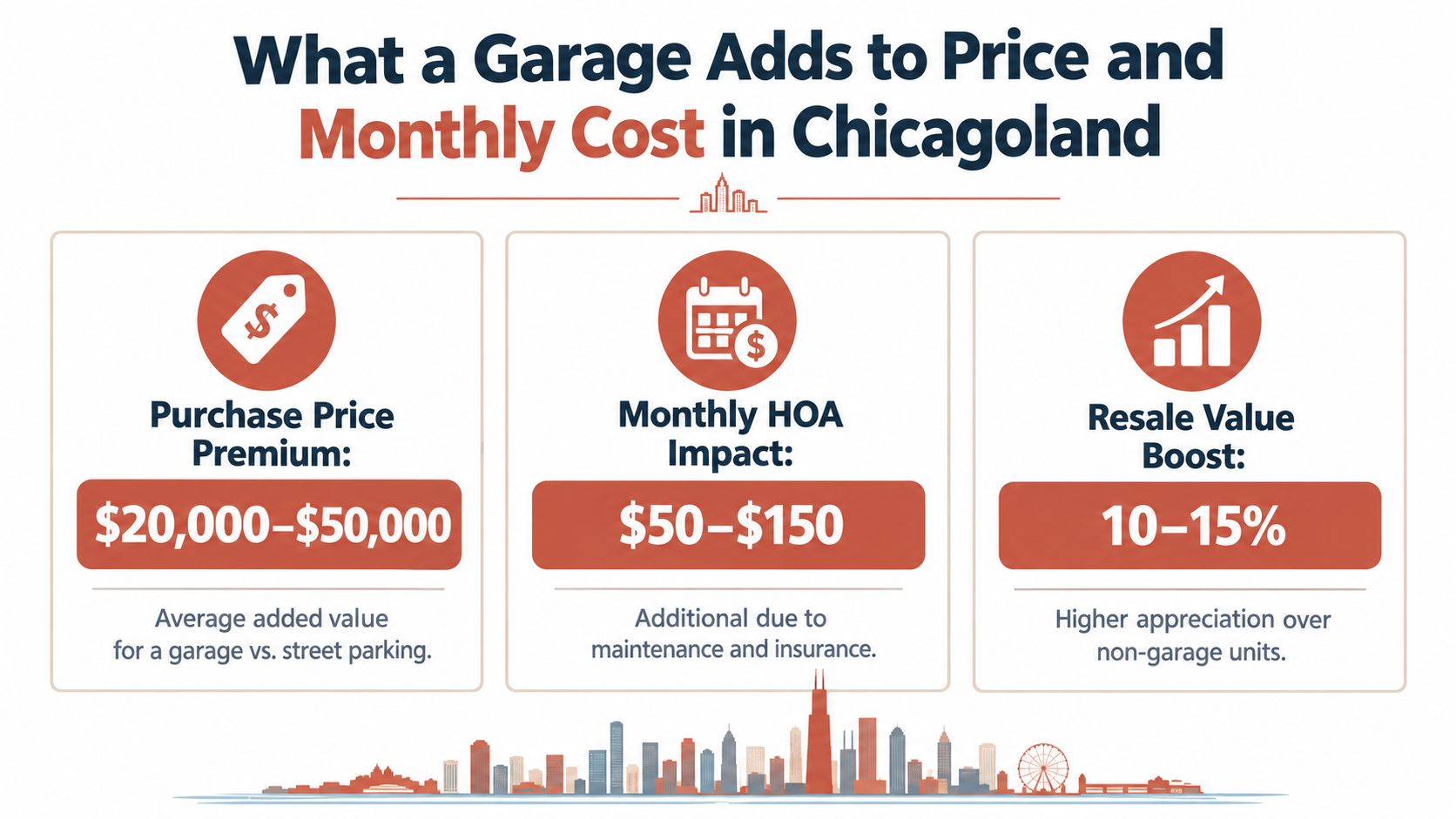
A garage usually isn't priced like a throw-in. Buyers pay for it because it solves a daily problem and because supply is limited.
That's true in many condo markets, and the research helps explain why. In a major parking-affordability study, dedicated parking or garage space raised condo sale values by about 5% to 7% in bundled-product studies, with some hedonic models finding an average condo price increase of roughly 13% when parking is included, according to this CMHC report on parking requirements and housing affordability.
Why the premium exists
In plain language, buyers aren't just paying for concrete and a door. They're paying for:
- Predictability when parking is tight
- Protection from weather
- Convenience for groceries, strollers, tools, and daily loading
- Scarcity because not every building can easily add more garage space later
That's why comparing two condos by bedroom count alone can mislead you. A unit with garage parking may be the more expensive listing for a good reason.
Garage cost isn't just in the sale price
There can also be monthly or ongoing costs tied to parking. In some markets, a parking space itself carries meaningful ownership cost. A housing report discussing condo parking in Toronto found standalone parking spots listed on the multiple listing service averaged 34% higher in Toronto than in the suburbs, with an average listing price of $50,057 and a median of $46,000 in January 2022. That same report noted listings ranged from $15,000 to $125,000, while monthly maintenance fees averaged $58 and ranged up to $211, as summarized in this parking and condo affordability reference.
Those are not Chicagoland numbers, but they're useful for one reason. They show parking can carry real price weight and real monthly cost. It's not a token amenity.
If you're budgeting payments, run scenarios with and without the garage premium using a home loan repayment calculator. That helps you see whether the better fit still works comfortably each month.
How to think about value without overpaying
Use a simple lens:
| Situation | Likely interpretation |
|---|---|
| Condo with garage is priced a bit higher than a similar unit without | Often reasonable if the parking rights are strong |
| HOA is higher on a garage building | May reflect maintenance, access systems, or shared structure costs |
| Garage is separate from unit pricing | Review whether it transfers with the sale and what fees apply |
A garage should change your budget math before you write an offer, not after you move in.
In western Chicagoland, the right question usually isn't “Why is this garage condo more?” It's “Is this premium justified in this building, in this location, with these parking rights?”
Where Garage Condos Make the Most Sense in Western Suburbs
Garage value changes by suburb because daily life changes by suburb. The same buyer may feel very differently about parking in Oak Park than in Naperville, even if the condo itself is similar on paper.
A good way to think about it is this: the more your area mixes winter weather, tighter streets, older buildings, or high walkability, the more a garage tends to matter emotionally and practically.
For a broader look at community differences, the neighborhood pages covering Chicago-area suburbs can help you compare where your lifestyle fits best.
Older, walkable, and tighter parking patterns
Oak Park often attracts buyers who want transit access, older housing stock, and a more urban street grid. In that kind of setting, garage condos can feel more limited and more valuable because many buildings were built before today's parking expectations.
Elmhurst has a strong draw near its downtown and train area. Closer-in condo locations can make garage access more meaningful because convenience competes with denser development patterns and busy streets.
Melrose Park can vary more by pocket and building style. Some condo communities are straightforward on parking. Others require closer reading of whether garage space is part of the unit package.
Newer layouts and easier everyday driving
Naperville often gives buyers more options in developments where driving is already central to daily life. If your routine includes regular commuting by car, errands across town, or multiple household vehicles, garage condos can make immediate sense there because the car use pattern is already built in.
Downers Grove sits in an interesting middle ground. Some areas lean walkable and commuter-friendly, while others feel more spread out. Garage importance often depends on whether you're aiming near downtown and the train or in a more auto-oriented section.
Glen Ellyn can also split this way. Older, charming areas may have tighter supply, while some condo communities offer more parking clarity and easier vehicle storage.
A quick suburb-by-suburb lens
Oak Park
- Best for: Buyers who want walkability and transit
- Garage takeaway: Often worth prioritizing early because older stock may have fewer easy parking solutions
Elmhurst
- Best for: Buyers who want suburban living with a strong downtown core
- Garage takeaway: Especially valuable if you're searching near active, central areas
Downers Grove
- Best for: Buyers balancing commuter access and suburban convenience
- Garage takeaway: Importance rises near denser downtown-style pockets
Naperville
- Best for: Households with car-heavy routines
- Garage takeaway: Often a practical must-have, especially for multi-car households
Glen Ellyn
- Best for: Buyers who want character and suburban ease
- Garage takeaway: Check each development closely because supply can vary a lot
Melrose Park
- Best for: Buyers comparing value and access across western close-in suburbs
- Garage takeaway: Don't assume consistency from one complex to the next
The right suburb for a garage condo isn't the one with the most parking. It's the one where the parking setup matches how you actually live.
Smart Search Strategies Beyond the Garage Filter
A garage filter gets you closer. It doesn't guarantee the condo works.
One indoor space may sound perfect until you remember your household has two cars, one visitor who stays often, a bike collection, and an electric vehicle you plan to buy soon. That's why the best condo buyers evaluate parking as part of a system, not as a single checkbox.
A practical buyer checklist should include more than “has garage.” Recent market guidance on condo parking questions emphasizes asking about vehicle count, extra stalls, guest parking, and EV charging rights. That same coverage also noted tracked garage-condo developments rose from 610 to 619 in one month, with newer projects highlighting more lifestyle amenities and mixed-use design, summarized in this garage condo buyer question guide.
The questions that save buyers from regret
Use this short checklist on every serious condo:
- Household reality: How many vehicles do you have today, not in theory?
- Guest use: Is there guest parking, and is it realistic or always full?
- Extra space options: Can you lease or buy another stall if life changes?
- EV planning: Does the association permit charging, and what approval process applies?
- Storage tradeoff: Is the garage strictly for a car, or do people also use it for bikes, tires, and seasonal items?
What to verify during the tour
Don't just glance at the stall and move on.
Look at turning radius, pillar placement, ceiling height, garage lighting, entry security, snow access, and how far the space is from the elevator or unit entrance. A tight or awkward space can feel very different once you're using it every day.
A garage that technically fits your car may still be a poor fit for your routine.
Also ask to see the exact location of the space, not just a general garage entrance. “Included parking” sounds good until you realize your assigned stall is the farthest one from the door and impossible for a larger vehicle to enter cleanly.
Your Next Steps to Secure a Garage Condo With Confidence
The buyers who feel best about their condo purchase usually do four things well. They define what garage means for them, search with that definition instead of a guess, verify the parking rights early, and price the unit with parking treated as part of the asset.
For a first-time buyer, that can make the whole process feel calmer. You stop chasing every condo that looks decent online and start focusing on the ones that match your real routine.
Use a simple action sequence:
- Write your garage must-haves. Number of spaces, indoor or detached, deeded or assigned, and whether EV readiness matters.
- Set up focused searches. Keep one strict search and one flexible search so you don't miss workable options.
- Pre-screen before touring. Confirm the exact parking arrangement in writing or through listing details.
- Compare value correctly. Don't judge a garage condo against a non-garage condo as if they're the same product.
- Review condo rules carefully. Parking rights, extra stalls, storage rules, and charging permissions matter as much as the kitchen finishes.
That approach works well in western Chicagoland because condo buildings vary so much by age, layout, and parking design. A garage can be a simple add-on in one development and a real scarcity advantage in another.
If you're shopping for condos for sale with garage, patience helps, but clarity helps more. The clearer you are about what counts, the easier it becomes to spot the right fit when it shows up.
If you want help narrowing the search, Homes By Carmen offers local MLS access, suburb-by-suburb guidance, and practical support for buyers sorting through condo parking details in western Chicagoland. If garage parking is a must-have for your next place, that kind of local filtering and tour planning can save you time and a lot of second-guessing.