
A home sale contingency makes your purchase depend on selling your current home by a written deadline, and it doesn't guarantee either closing.
You've found a house in Elmhurst or Naperville that fits your next chapter, but the money for it is still tied up in the home you own. You want to make an offer without committing to a purchase you can't fund. The seller wants to know whether accepting your offer means passing up someone who can close without waiting.
The practical question isn't just whether you can include the clause. It's what must happen, by when, and which dollars you could still lose if the transactions don't line up.
Table of Contents
- What a Home Sale Contingency Means
- Terms That Decide Whether the Offer Is Real
- How a Kick-Out Clause Keeps the Seller Marketing
- Money the Contingency Does Not Give Back
- A Naperville Chain From Offer to Notice
- Choosing a Higher Offer or a Cleaner Close
- Decide Before You Write the Offer
What a Home Sale Contingency Means
Say you own a home in Melrose Park and want more space in Naperville. You have equity, but equity isn't cash available for a down payment until you sell or arrange another approved way to access it. Your offer needs to account for that gap.
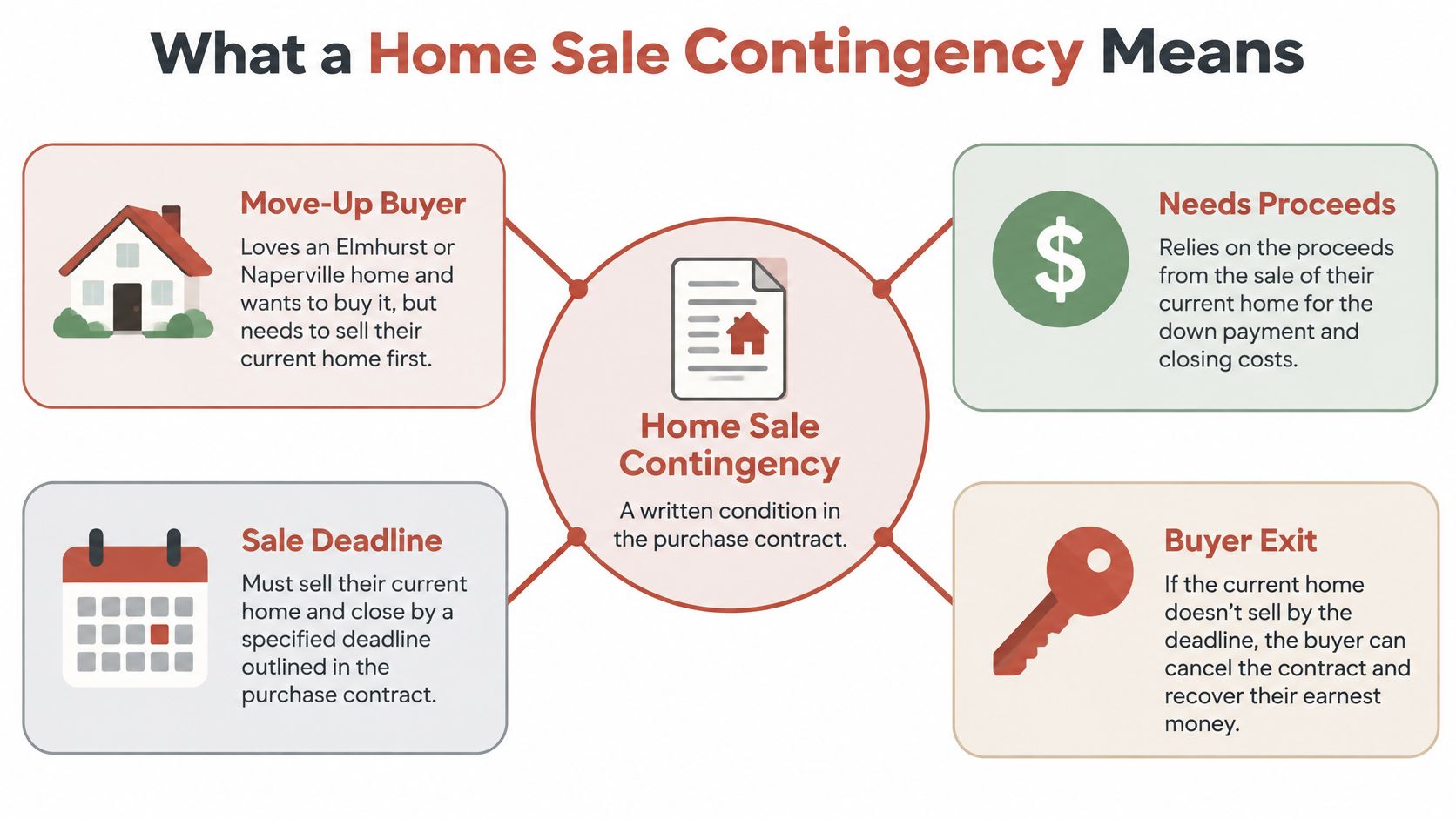
A home sale contingency is a written condition connecting the new purchase to the sale of your existing property. As Chase's explanation of contingent offers describes, it can protect a buyer who needs sale proceeds for the down payment, closing costs, or other purchase obligations, with cancellation and earnest-money protection governed by the agreement.
That's the kitchen-table answer to “what is a home sale contingency?” You're telling the seller that your ability to purchase depends on completing another transaction.
The protection requires the seller's agreement
Owning another home doesn't automatically give you permission to cancel a purchase because that home hasn't sold. Both parties must negotiate the condition into the contract. Telling the listing agent that you need to sell isn't a substitute for written language.
The clause balances competing concerns:
- For the buyer: Avoid committing to overlapping mortgages or scrambling for short-term financing.
- For the seller: Decide how much uncertainty to accept while another homeowner finds a buyer and completes a sale.
- For both parties: Establish a workable exit instead of arguing later about what everyone intended.
A seller may reasonably ask whether your home is ready to list, whether the proposed price is supportable, and whether the expected proceeds will fund your purchase. A buyer should reasonably ask what happens if that sale stalls despite a genuine effort.
Treat it like a relay handoff
The proceeds from your existing home are the baton needed for the next purchase. The agreement should identify when that handoff must occur and what happens if it doesn't.
For an Illinois transaction, have the local contract language reviewed rather than relying on a verbal understanding. Deadlines, notice requirements, and deposit treatment belong in the signed deal. A missed handoff may permit an exit without forfeiting earnest money, but only when the contract gives that right and the buyer follows its requirements.
Terms That Decide Whether the Offer Is Real
Home sale contingency terms and typical windows
| Term | What it controls | Common range | Main risk if vague |
|---|---|---|---|
| Listing or marketing proof | Current home must be on the market | Agreed at offer | Buyer delays listing |
| Sale deadline | Time to sell the current home | Negotiated sale period | Seller loses marketing time |
| What counts as a sale | Accepted contract, contingency removal, or closing | Written in the contract | Dispute over whether the condition is met |
| Buyer notice date | Deadline to cancel or confirm the sale | Set in the contract | Lost cancellation right |
| Kick-out response | Time to waive after a backup offer | Contract's stated response window | Buyer loses the house or waives needed protection |
| Earnest money | Deposit if the buyer cancels properly | Generally returnable when contractual conditions and notice rules are met | Deposit dispute |
| Minimum sale price | Floor applicable to the current-home sale | Negotiated dollar amount | Pressure to accept an inadequate sale or a stalled transaction |
The most dangerous wording isn't necessarily complicated. It's wording that sounds clear until the parties try to use it. A requirement that your home must sell, for example, leaves an important question unanswered if the agreement doesn't define sell.
Listing activity isn't a completed sale
A listing requirement establishes when you must begin marketing. It can also specify evidence of activity, such as listing documentation or marketing updates. If the seller expects price adjustments or particular marketing commitments, negotiate those obligations rather than assuming everyone shares the same expectations.
A sale deadline serves a different purpose. It limits how long the seller must wait for your transaction to reach the required stage. Don't choose the deadline solely because it makes the offer look competitive. Choose one that your listing preparation, local competition, and likely closing process can support.
Then define the milestone:
- Accepted contract: You've secured a buyer, but that buyer may still have conditions to satisfy.
- Contingencies resolved: Specified inspection, financing, or other conditions have been addressed.
- Completed closing: The sale has settled, subject to the contract's exact definition and funding requirements.
These aren't interchangeable. If your purchase requires sale proceeds, an accepted offer on your existing home may not solve the funding problem.
Notice and money need their own instructions
The notice deadline tells you when and how to confirm compliance, request an extension, or exercise a cancellation right. Ask who must receive notice, what form it must take, and whether delivery or receipt controls.
The earnest-money language should explain what happens after a valid termination. The minimum-price provision, if included, should address whether you must accept an offer that meets specified terms. A price floor can prevent an unacceptable sale from being required, but it doesn't create unlimited time.
For another market's contract-review perspective, Royal LePage Brookside Realty's guidance on what to review before signing your Albion home offer offers a useful reminder to examine the written obligations. It isn't a substitute for reviewing an Illinois form with local professionals.
Before signing: Put the listing-or-contract date, sale closing date, and notice date on your calendar. If you can't identify them from the agreement, resolve the wording first.
An accepted purchase offer remains conditional until its requirements are satisfied. A signature starts the work; it doesn't eliminate the conditions.
How a Kick-Out Clause Keeps the Seller Marketing
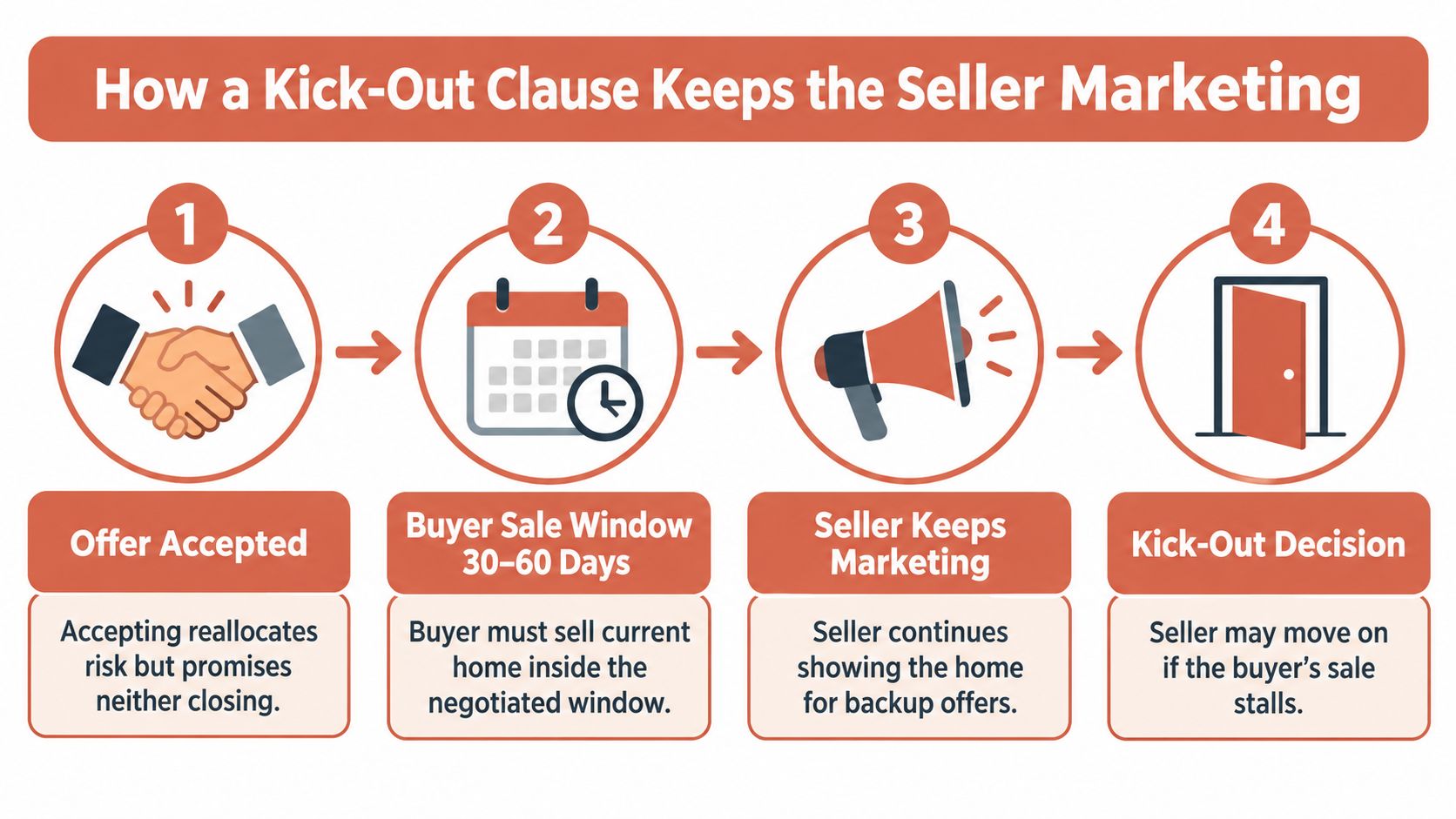
A seller doesn't have to choose between rejecting every contingent buyer and waiting without alternatives. A negotiated kick-out clause can allow continued marketing while giving the original buyer a defined opportunity to proceed if another acceptable offer appears.
According to Sunward's explanation of contingent status, a typical contingent period is 30 to 60 days, a home-sale contingency may extend to 30 to 90 days, and a kick-out response window is often 24 to 72 hours. Those are practical ranges, not universal legal requirements.
Follow the sequence, not the nickname
The exact wording matters more than whether someone calls the provision continued marketing, a kick-out, or a first right of refusal.
- The seller continues showing. Accepting your offer doesn't necessarily remove the property from consideration by other buyers.
- A qualifying offer triggers notice. The seller must follow the agreed process, not announce that someone else is interested.
- The original buyer evaluates removal. You determine whether you can proceed without the home-sale condition and provide any required documentation.
- The contract controls the outcome. If you don't remove the condition as required, the seller may have the right to terminate and proceed with the other buyer.
A backup buyer shouldn't assume the property is immediately available. For a separate market's perspective on that waiting position, Jacky Levi on Vancouver backup offers provides context for the backup-offer strategy. Your Illinois agreement still determines your rights.
Removing the clause requires a funding plan
Waiving the contingency isn't a promise that you'll try harder to sell. It means giving up a particular contractual protection. Before doing that, establish how you'll close if your existing home remains unsold.
Available savings, an approved bridge arrangement, or financing that doesn't depend on sale proceeds may provide a path. A hoped-for loan or an encouraging conversation isn't enough. Have your lender confirm the actual requirements before the response clock starts.
A home sale contingency isn't mortgage approval. The lender may still need to verify income, assets, debts, mortgage payoff information, projected proceeds, and the timing of your sale.
For a seller, continued marketing is useful protection, but it doesn't excuse skipping the initial review. Examine whether the buyer's property is priced credibly and whether its estimated net proceeds support the purchase. A kick-out clause gives you another option; it doesn't make an unrealistic sale plan realistic.
Money the Contingency Does Not Give Back
No, a home sale contingency doesn't protect every dollar you spend if your current home fails to sell. It may allow a proper cancellation and return of earnest money without reimbursing the services and arrangements you've already purchased.
Investopedia's guide to home sale contingencies distinguishes deposit protection from expenses that may remain unrecoverable, including inspection, appraisal, lender, moving, storage, and rate-lock costs. That distinction should be part of your budget before you submit the offer.
The deposit may be refundable. Work already ordered may still be money spent.
Separate the deposit from the spending
Earnest money is a contract deposit, not a general insurance policy for the transaction. Our guide to earnest money when buying a house explains its role in the purchase process.
An inspector who completes the inspection has performed a service even if you never buy the house. An appraisal may already have been completed for the lender. A moving reservation, storage arrangement, or rate-lock fee has its own payment and cancellation terms.
Don't assume those providers must refund you because the property contract ended. Ask about cancellation terms before authorizing work, and distinguish refundable reservations from nonrefundable charges.
Calculate your exposure before authorizing expenses
Build a simple cash-at-risk worksheet using actual quotes:
- Inspection and appraisal: Record the charges and when each becomes payable or nonrefundable.
- Lender and rate-lock fees: Ask which charges survive a canceled purchase.
- Moving and storage commitments: Include deposits, reservation charges, and cancellation penalties.
- Your loss limit: Decide whether you can comfortably absorb those expenses if the purchase ends.
This isn't an argument for skipping due diligence. It's a reason to order work deliberately and understand the financial consequences. An inspection can still protect you from a much larger mistake even if its fee isn't recoverable.
Deposit protection also depends on more than the fact that your home didn't sell. Your conduct must satisfy the agreement, including good-faith performance, the applicable sale definition, and any obligation concerning reasonable offers.
Use the listing-or-contract, closing, and notice dates to plan spending. Don't assume that letting a deadline pass automatically produces a refund or that requesting an extension means one has been granted.
The useful affordability question is broader than whether you have enough cash to close. Can you afford the money that stays spent if you never reach closing? A higher purchase budget doesn't answer that question.
A Naperville Chain From Offer to Notice
Consider an illustration, not a completed client transaction: a homeowner wants to buy in Naperville while selling a Melrose Park home. Before making the offer, the buyer obtains a valuation, mortgage payoff, estimated selling expenses, and a net-proceeds worksheet.
That preparation follows the practical framework in the National Association of REALTORS® consumer guide to contract contingencies: identify the sale requirements, deadlines, notice obligations, and available contractual options. The buyer also asks the lender to confirm how the projected proceeds affect qualification and cash needed to close.

If the Melrose Park home is only listed
The Naperville seller accepts an offer with a sale deadline and continued-marketing provision. The Melrose Park home is available for showings, but nobody has committed to buying it.
A cleaner backup offer arrives before the buyer secures a sale. The seller delivers the required notice. The buyer checks with the lender and confirms that proceeding without the sale proceeds isn't feasible.
The buyer doesn't waive the contingency just to keep the house. The parties follow the agreement's termination and deposit procedures, with earnest-money recovery governed by compliance and the contract. The buyer may still have paid for services that aren't refundable.
If the Melrose Park home is already under contract
Now change the starting point. The buyer has accepted an offer on the Melrose Park home, and its inspection contingency has been resolved. The Naperville seller can evaluate an identified purchaser, documented contract status, and a scheduled closing rather than an anticipated future offer.
That doesn't make the transaction certain. Financing, appraisal, title, or closing problems may remain. But the seller can negotiate around a concrete schedule and request evidence of progress.
If an inspection report becomes part of that closing checklist, FullScope Pest Control's closing report guide is a topic-specific resource. Whether such a report is needed should be confirmed for the actual transaction, not assumed from another market's practices.
If the offer misses the agreed minimum
A different outcome arises when the Melrose Park buyer offers less than the minimum specified in the purchase contingency. If the clause protects that threshold, the homeowner may not have to accept the inadequate offer merely to preserve the Naperville purchase.
The deadline still matters. A protected minimum isn't an extension.
- The seller's question: Is there a credible route from the current sale status to closing?
- The buyer's question: Will the actual net proceeds cover the required funds?
- The shared lesson: A signed sale contract and sufficient proceeds matter more than an optimistic listing price.
Choosing a Higher Offer or a Cleaner Close
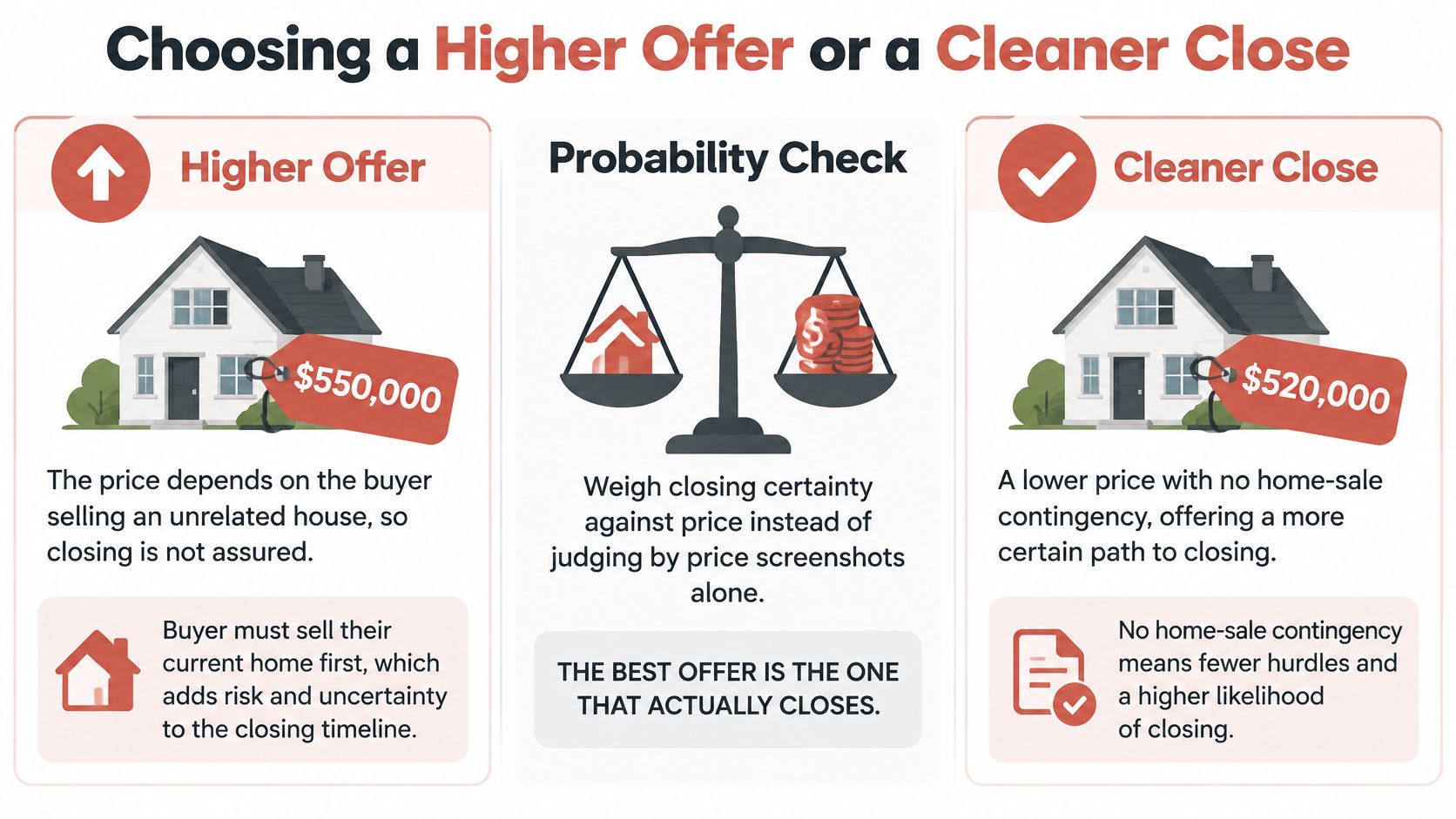
A higher offer can still be the weaker offer. If the buyer can't perform without selling another property, the seller must evaluate more than the amount on the purchase agreement.
Freddie Mac's explanation of contingencies describes how a home-sale condition can add seller-side uncertainty and complicate or prolong closing. The practical comparison is expected proceeds with a credible path to closing, not headline price alone.
Higher contingent offer versus a cleaner close
| Factor | Higher home-sale contingent offer | Lower offer with no home-sale contingency |
|---|---|---|
| Headline price | Higher | Lower |
| Chance of closing | Subject to an unrelated sale | Not tied to another house |
| Buyer only listed | Seller bets on a future contract | No current-home sale required |
| Buyer already under contract | More defined path that can still fail | Not applicable |
| Carry while tied up | Mortgage, tax, insurance, and utilities during added delay | Less exposure to sale-related delay |
| Market shift | More time for rates or buyer demand to change | Less exposure to that particular delay |
| Kick-out | Continued showings and a negotiated response deadline | Not needed for a home-sale condition |
| Western-suburb decision with other showings | Consider when documented progress and price justify waiting | Often the stronger choice when avoiding delay matters |
Evaluate the sale status before the premium
Only listed means the seller is being asked to rely on a future negotiation. Attractive photos and strong showing activity don't establish what someone will pay or when they'll close.
Already under contract gives the seller more to evaluate. Review the remaining conditions and expected settlement rather than treating every accepted contract as equally secure. A transaction past inspection may still depend on financing or other unresolved requirements.
Compare the premium with the cost of waiting
Start with the extra proceeds the higher offer would produce. Then account for the carrying expenses during the expected delay and the consequences if the purchase fails and you must resume negotiations with other buyers.
Don't invent a closing probability to make the calculation look precise. Use evidence: contract status, unresolved contingencies, financing requirements, pricing support, and the buyer's ability to fund a gap.
Negotiate the notice procedure, response deadline, proof-of-sale requirements, and consequences of declining to waive. Continued showings and a first opportunity for the original buyer to proceed exist only to the extent the agreement provides them.
Our real estate negotiation tips for buyers can help buyers think beyond price when shaping an offer.
A premium is useful only if it compensates the seller for a risk the seller can afford to take.
For a western-suburb seller with other credible interest, I would favor the cleaner offer unless the contingent buyer's documented progress and price advantage justify the wait. Even then, no home-sale contingency doesn't mean no remaining purchase risks.
Decide Before You Write the Offer
Choose the contingency based on your funding, not how strongly you want the property. A clause that makes your offer less attractive may still be essential protection. Removing it without a workable alternative doesn't improve your finances.
Match the offer to your actual position
- Include it when proceeds are necessary. You should be able to support the current home's proposed price, explain the expected net proceeds, and accept the inspection and appraisal exposure if the purchase ends.
- Consider skipping or waiving it when funding is independent. Confirm that available assets and lender approval cover the purchase without assuming an immediate sale. Don't treat possible financing as available financing.
- As a seller, accept it selectively. Look for documented sale progress, manageable remaining conditions, a workable response procedure, and enough additional value to justify the potential delay.
If you're weighing alternatives, our guide to buying a house before selling yours can help frame the planning conversation.
Resolve uncertainty before signing
Have a licensed Illinois REALTOR® check the local form and a real estate attorney review the deadlines, notice provisions, and earnest-money language. Ask your lender to verify the funding assumptions behind any proposed waiver.
Carmen Salerno is a REALTOR® and works with clients from the first showing through to the closing table. The immediate goal is a purchase agreement you understand and can perform, not just an accepted offer.
If your proceeds estimate is still a guess, start with a free expert home valuation and strategy call from Homes By Carmen. Use that starting point to build a net sheet and marketing plan before committing to a sale deadline.
Homes By Carmen helps homeowners coordinate buying and selling, beginning with a free expert home valuation and strategy call. Visit Homes By Carmen to discuss your current home, the proceeds your next purchase requires, and whether a home sale contingency fits your move.