
You've found a home you can picture yourself living in, and you're ready to make an offer. Then your agent asks how much earnest money you want to put down. You've been saving for the down payment, closing costs and moving expenses, so another deposit can sound like another bill.
When you're buying a house, earnest money is also a question of timing and access to cash. You need to know when to send it, what protects it and how it will be used. Just as important, you can have a valid reason to cancel a purchase and still find your money stuck in escrow while the seller disputes its release.
Table of Contents
- Earnest Money Amounts at a Glance
- Where the Deposit Goes and When to Fund It
- Contingencies That Decide Whether You Get It Back
- What Happens When Buyer and Seller Disagree
- How Earnest Money Applies at Closing
- Buyer and Seller Checklist Before Closing
Earnest Money Amounts at a Glance
Earnest money is a negotiated deposit that shows the seller you're serious about completing the purchase. It usually becomes a credit toward your down payment or closing costs, rather than an extra purchase expense.
In its 2024 homebuying guidance, Zillow describes earnest money deposits as usually 1% to 3% of the purchase price. To calculate a proposed deposit, multiply the purchase price by the percentage expressed as a decimal.
Calculate the deposit before choosing an amount
The National Association of Realtors' earnest money guide describes a wider U.S. residential range of 1% to 10%, with a $400,000 home requiring $4,000 at 1% or $40,000 at 10%. The table applies that calculation to the purchase prices shown, using the typical range and broader range described by those guides.
Earnest money deposits by purchase price
| Purchase price | Typical deposit (1% to 3%) | Full U.S. range (1% to 10%) |
|---|---|---|
| $300,000 | $3,000 to $9,000 | $3,000 to $30,000 |
| $400,000 | $4,000 to $12,000 | $4,000 to $40,000 |
These are planning ranges, not a requirement to offer the highest amount. Your contract establishes the actual deposit you agree to fund.
Several parts of the offer influence that negotiation:
- Competition for the property. A seller comparing otherwise similar offers may prefer a buyer who commits a larger deposit.
- Your down payment. Consider the deposit alongside your overall financing plan, not as a separate display of purchasing power.
- Your contingencies. The protections you retain affect the circumstances in which you can cancel without putting the deposit at risk.
- The seller's preferences. A seller may care more about the price, closing schedule or certainty of financing than a larger deposit.
Keep the offer and your cash reserves in balance
A larger deposit doesn't make an offer stronger by itself. Price, contingencies, deadlines and escrow instructions work together, and a generous deposit won't fix terms the seller can't accept.
Practical rule: Choose a deposit you can fund promptly, leave unavailable during the transaction and potentially lose if you breach the agreement.
Before settling on an amount, ask your agent what deposits recent offers in the target neighborhood included. Then review the possible loss with your attorney, including whether the contract treats the deposit as liquidated damages and what other remedies might apply. Don't assume the amount in escrow is automatically the limit of your liability.
Where the Deposit Goes and When to Fund It
Think of escrow as a holding arrangement, not a payment directly to the seller. The named holder keeps the deposit separate while the transaction moves toward closing or a contractually authorized release.
For Illinois transactions using the standard residential contract, the funding deadline is generally close of business on the next business day after acceptance, with funds held in a broker's non-interest-bearing escrow account or by a licensed third-party escrow holder, consistent with the Illinois Real Estate License Act's escrow requirements. Read your signed agreement for the actual obligation, including any negotiated changes.
For example, if the seller accepts on Monday afternoon and Tuesday is a business day, that next-business-day rule generally points to close of business Tuesday. Don't assume that writing a check or starting a transfer means you've satisfied the deposit requirement.
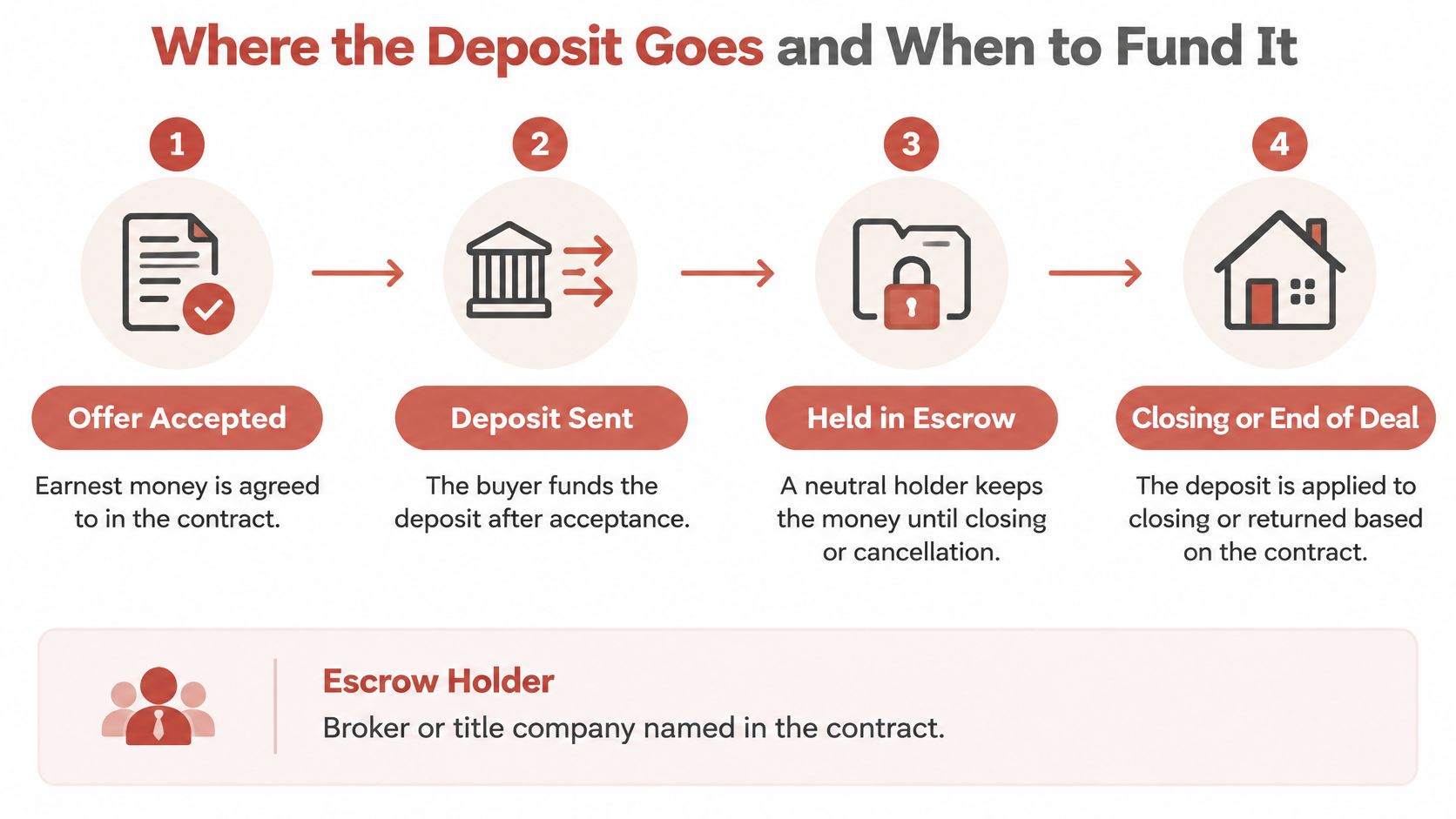
Follow the money from acceptance to receipt
Use this sequence immediately after acceptance:
- Confirm the named holder. Match the brokerage, attorney, title company or other authorized holder to the contract.
- Check accepted payment methods. Ask whether the holder accepts a check, wire or another approved method, and what constitutes timely delivery.
- Deliver funds before the deadline. Allow for bank processing and the holder's business hours.
- Get a dated written receipt. Save evidence of the amount, property, recipient and delivery date.
- Record the details. Put the deadline and holder's contact information in your calendar and transaction folder.
For a wire, verify payment instructions through an independently confirmed phone number before sending money. Don't rely solely on an email that announces new banking details.
Distinguish delivery from completed funding
A check sitting with someone who isn't the designated holder can create a compliance problem. So can an incomplete transfer, even if you intended to pay on time. If anything delays payment, tell your agent and attorney immediately rather than assuming the seller won't object.
Use the homebuying timeline to coordinate funding with your other transaction tasks. In the broker's non-interest-bearing account described above, you shouldn't expect interest income. Focus instead on verifying custody, documenting payment and confirming that the holder has received the funds.
Contingencies That Decide Whether You Get It Back
On the Friday your lender denies the loan, an active financing contingency may give you a way to cancel and request the earnest money back. Your purchase agreement controls which circumstances qualify, what evidence you need, and how quickly you must give notice.
The National Association of Realtors' consumer guide to escrow and earnest money explains that financing, appraisal, and inspection contingencies can protect a deposit when buyers follow the contract's requirements. A problem with the home or loan alone does not end the agreement; you must take the steps the contract specifies.
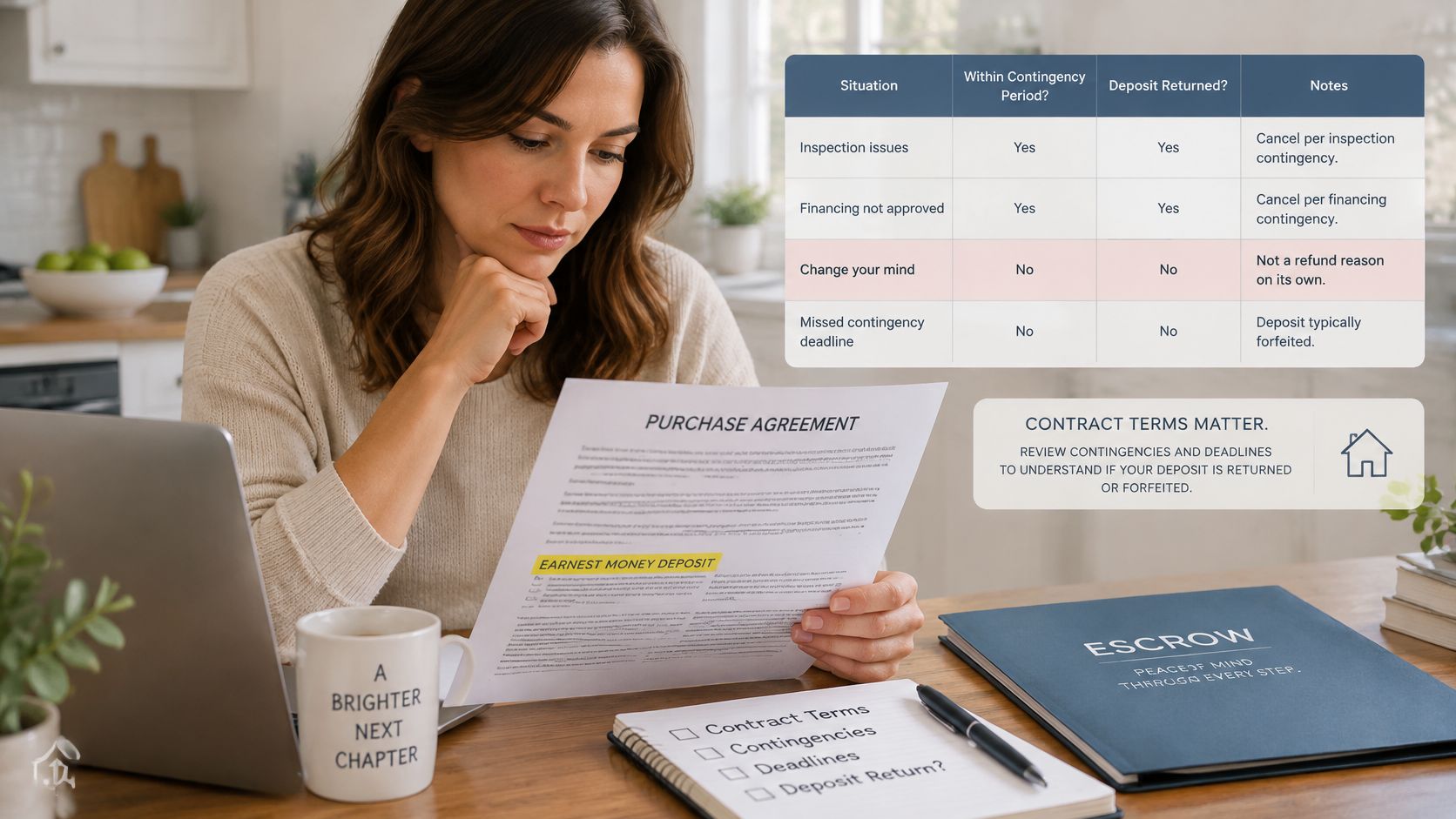
Match each protection to its required action
Contingencies that protect the deposit
| Contingency | What it protects you from | What to do before the deadline |
|---|---|---|
| Financing | Loan not approved by the deadline | Apply promptly, keep the lender's written denial, and deliver the required notice |
| Appraisal | Home appraises below the price | Coordinate the appraisal with your lender and give written notice if the value is short |
| Inspection | Major defects found after acceptance | Schedule the inspection early and send the required repair or termination notice in writing |
| Attorney review (Illinois) | Contract terms the attorney rejects under the review provision | Complete the review and have written disapproval delivered before the deadline |
The contract's wording determines what each contingency allows. An inspection provision may require a negotiation process before termination, while a financing provision may require proof that you pursued the loan diligently.
For a closer look at loan-related contract language, read Tanner Law's resource on reviewing financing contingencies in a home sale and prepare questions for your attorney. If inspection findings are the concern, review the steps for negotiating repairs after a home inspection before deciding what notice to send.
Avoid actions that remove your protection
These choices can expose the deposit to forfeiture:
- Waiving a contingency. You may take on the financial risk that the contingency would otherwise address.
- Missing a deadline. Finding a problem in time may not protect you if the required notice arrives late.
- Leaving without a contractual basis. Preferring another home does not create a cancellation right.
Keep the lender's written denial, give it to your attorney, and have the required notice delivered by the contract's specified method before the deadline. The lender's communication with you does not necessarily notify the seller.
Track each contingency date, keep the supporting paperwork, and ask your attorney to review your options before requesting or signing a release. Add reminders early enough to meet each deadline.
What Happens When Buyer and Seller Disagree
Monday, the buyer requests the earnest money back. Tuesday, the seller disputes the cancellation and declines to sign a release. The buyer may have a contractual basis to end the purchase, yet the deposit can remain in escrow while the disagreement is resolved.
Under the Illinois Real Estate License Act's escrow provisions, an escrow holder generally can't decide which party is right. Releasing disputed funds typically requires joint written instructions, a court order or another legally authorized procedure. Depending on the circumstances, the holder may continue holding the money or use a notice-and-hold or court process.
Treat disputed money as unavailable
For a buyer with limited reserves, an escrow delay can affect the next purchase. Money still held by the escrow holder can't also fund another offer, pay movers or cover expenses for a different closing.
Plan around the possibility that the deposit will be unavailable until the parties agree or the dispute is resolved. Before making another financial commitment, tell your lender and agent that the funds remain tied up. A requested refund is not spendable cash.
Build a documented release request
Keep the release process focused on the contract and the escrow holder's requirements:
- Request the release in writing. Ask the holder what documents are needed, including signed instructions from both parties where applicable.
- Keep a clear record. Save correspondence, supporting documents and responses related to the release request.
- Follow the dispute clause. If the seller refuses, check whether the agreement calls for mediation, arbitration or another process.
- Get legal advice before escalation. Consult your attorney before filing in court or asking the holder to release funds over an objection.
If the seller backs out or refuses to perform without a contractual reason, the buyer may have grounds under the agreement to seek return of the deposit. The escrow holder still must follow its release obligations, so ask your attorney to confirm the available path for resolving the disagreement.
How Earnest Money Applies at Closing
At closing, earnest money normally becomes a credit for money you've already paid. You don't pay that portion of your contribution again, and you generally don't receive it as a separate refund after completing the purchase.
The useful distinction is between the total amount you must contribute and the amount still due. Your deposit reduces the remaining balance, provided it appears correctly in the settlement accounting.
Work out the remaining contribution
Consider this hypothetical calculation, not a required down payment or a quote for a particular loan:
| Calculation | Hypothetical amount |
|---|---|
| Purchase price | $400,000 |
| Down payment at 20% | $80,000 |
| Earnest money already deposited | $8,000 |
| Down payment still needed | $72,000 |
In this example, you would need the remaining down payment plus closing costs and any other applicable adjustments, rather than the full down payment again. The simplified planning formula is:
Cash to close = down payment − earnest money credit + closing costs, adjusted for other deposits, credits, prepayments and settlement items.
Your final cash-to-close amount comes from the transaction documents, not this simplified formula. Loan terms, taxes, prepaid expenses, credits and other settlement entries can change what you must bring.
For an explanation of the expenses beyond your down payment, use the guide to closing costs when buying a home. Lein Law Offices' overview of navigating a property purchase closing also provides context for the documents and legal steps involved.
Reconcile the credit before sending final funds
Compare your deposit receipt with the closing disclosure and settlement statement. Check that the credit belongs to your transaction, reflects the amount received and hasn't been omitted from the final calculation.
- Ask about discrepancies promptly. Send the receipt to the closing team and request a corrected explanation before authorizing final payment.
- Use current instructions. Don't calculate your transfer from an earlier estimate if the closing team has issued updated figures.
- Keep the final statement. It documents how the deposit and remaining funds were applied.
For the seller, the deposit is accounted for within the transaction's sale proceeds, not as a bonus on top of the purchase price. It generally isn't available to spend before closing unless the agreement ends and the appropriate release procedure is completed.
If the purchase doesn't close, there's no completed purchase against which to apply the credit. The deposit instead follows the contract's refund, forfeiture or dispute process.
Buyer and Seller Checklist Before Closing
A useful earnest money checklist assigns an action to a person and leaves a record that it was completed. Keep the signed agreement, payment receipt, notices and settlement documents together so you're not searching through text messages when a question arises.
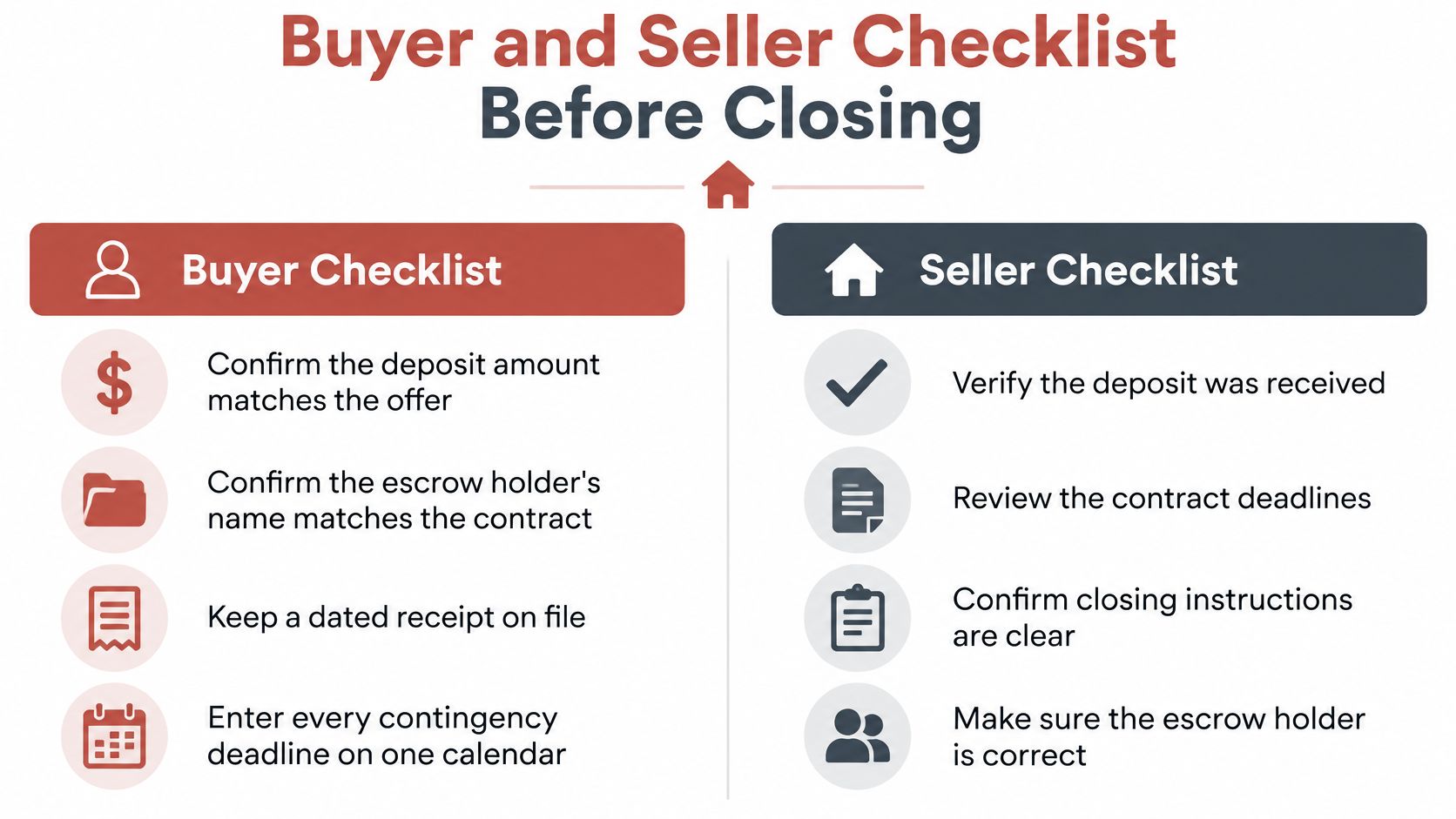
Buyer checklist
- Match the amount. Confirm the deposit obligation agrees with the accepted offer and any signed amendments.
- Verify the holder. Check the holder's legal name against the contract before making payment.
- File the receipt. Keep dated proof of delivery and confirmation of receipt.
- Centralize deadlines. Enter every contingency date into a shared calendar when the contract is accepted.
- Coordinate appointments. Confirm the lender, appraiser and inspector can complete their work in time for any required decisions.
- Preserve the paper trail. Save lender correspondence, inspection documents and formal notices in the transaction folder.
Seller checklist
- Verify receipt. Obtain confirmation that the required deposit reached the correct holder.
- Track funding. Note the buyer's payment deadline and refer a missed obligation to your agent and attorney.
- Separate proceeds from expectations. Don't budget the deposit as final sale proceeds before closing.
- Check release requirements. Confirm whether joint written instructions or another authorized procedure is needed before disbursement.
- Review contingency status. Have your attorney assess deadlines, extensions and notices before treating a protection as expired.
These habits are useful whether you're buying in Melrose Park, Elmhurst, Downers Grove, Naperville, Oak Park or Glen Ellyn. Don't assume a town name establishes the funding rule or cancellation outcome. Your signed agreement, the holder's obligations and applicable Illinois law govern the transaction.
Legal guidance should also match the property's jurisdiction. If your relocation search includes Hawaii, Olson & Sons' resource on choosing a Maui real estate attorney offers context for that separate purchase; it doesn't establish Illinois requirements.
Before submitting your next offer, prepare a deposit worksheet with the proposed amount, source of funds, holder and payment method. Add the actual funding and contingency dates as soon as they're established, and bring your closing calculation to the contract review. Carmen works with clients from the first showing through to the closing table, while your attorney can review the legal terms before you commit or a deadline passes.
Homes By Carmen offers a step-by-step first-time buyer's guide created by Carmen Salerno to help you prepare for the purchase process. Visit Homes By Carmen to discuss your offer, earnest money plan and transaction milestones, and bring your deposit worksheet so you can identify the next actions before signing.