
In 2024, U.S. home buyers spent a median of 10 weeks searching, according to the National Association of Realtors' buyer and seller profile. That search window is only the front half of a western-suburb purchase, whether you are renting in Melrose Park, relocating to Elmhurst, or selling before buying in Downers Grove.
The contract period runs on parallel deadlines, not one countdown. If inspection scheduling eats a week, contractor bids may need to move; if appraisal, HOA paperwork, or loan conditions slip, protect your move-out and possession plans first.
A useful buying a house timeline starts with your housing deadline and works backward. The lender's estimate helps you plan, but the signed contract, contingency dates, and possession terms decide what has to happen and when.
Table of Contents
- A Chicago Suburb Buying Timeline at a Glance
- Get Pre-Approved Before You Tour
- From Accepted Offer to a Clean Close
- Close, Fund and Get the Keys
- Set Your Move Date With a Buffer
A Chicago Suburb Buying Timeline at a Glance
Covered mortgages must have the Closing Disclosure in hand at least 3 business days before closing, and a qualifying material change restarts that count, according to the Consumer Financial Protection Bureau's Closing Disclosure guidance. One federal rule like that can move a move-out date, which is why the calendar below is built from deadlines rather than wishes.
The stage lengths in the table follow the planning frame in Freddie Mac's homebuying timeline. Use the national timing figures to reserve calendar room. Hold off on giving your landlord a move-out date until the contract fixes one for you.
Buying a house timeline from prep through keys
| Phase | Typical timing | What controls the date | Chicago-suburb note |
|---|---|---|---|
| Lender prep and pre-approval | Before touring, once the lender reviews your file | Income, assets, credit | Finish before the first weekend tour |
| Organized home search | About 10 weeks, about 10 homes * | Inventory and must-haves | Plan tours in clusters across the western suburbs |
| Offer to accepted contract | 1 to 2 days * | Price and contingency terms | Attorney-review dates come from the signed contract |
| Inspection and report | 2 to 3 hours on site, report in about 2 days * | Inspection contingency deadline | Separate safety items from cosmetic asks |
| Appraisal | Up to 2 weeks * | Lender and appraiser schedule | A shortfall can change cash needed |
| Loan closing window | 30 to 60 days after agreement | Underwriting and title | The contract date controls the calendar |
| Closing Disclosure review | At least 3 business days before closing | Federal disclosure rule | A qualifying material change can restart the wait |
| Overall search to keys | About 17 to 21 weeks | Overlapping stages | Add buffer before any lease end |
*Planning assumption. Hold that space now, then replace it with the dates your contract, lender, and attorney give you.
Treat the rows as overlapping work. The lender collects documents while you compare houses, and the appraisal moves while you negotiate inspection items. Running those tracks side by side is what keeps a western-suburb purchase inside the contract window, because every deadline runs on its own clock.
Put the phases onto an actual calendar
For a hypothetical week-by-week calendar, reserve the opening weeks for lender preparation, then a longer block for searching. Hold these blocks as space you control; the signed contract replaces them with dated obligations:
- Opening weeks: Assemble your lender file, establish a payment ceiling, and narrow the search area before touring.
- Search weeks: Cluster showings geographically and update your comparison notes after each outing.
- Acceptance week: Send the contract to your lender and attorney, calendar review deadlines, and book the inspection.
- Early contract weeks: Evaluate the inspection while the lender coordinates the appraisal and processes your file.
- Remaining contract weeks: Resolve underwriting conditions, title questions, insurance, and settlement figures.
- Closing week: Complete disclosure review, the walkthrough, signing, and funding on confirmed dates.
Build the calendar so a late piece has somewhere to land. If the inspection report runs long, shift the negotiation deadline and get any attorney-review extension in writing. If the appraisal stalls, expect underwriting to compress and answer lender conditions the same day. If the Closing Disclosure changes materially, the waiting period restarts, so keep days open between signing and possession.
For purchases in Oak Park, Elmhurst, Naperville, Downers Grove, or Glen Ellyn, ask which additional documents the particular property requires. An association packet, a municipal transfer item, or an attorney-review provision each earns its own dated calendar entry.
Calendar rule: Put the lease-end date after your latest workable closing and possession dates, with cushion between the scheduled signing and any hard move-out.
Get Pre-Approved Before You Tour
Pre-approval preparation protects the weeks that follow. A rushed lender file can leave you comparing homes at the wrong payment or submitting an offer with a closing date the lender hasn't evaluated.
Start with the payment you can live with, then organize the paperwork that supports it. Don't reverse that order because a listing looks perfect.

Build the budget and lender file
Calculate the whole housing payment. Include property taxes, homeowners insurance, mortgage insurance when applicable, and association dues. Use a mortgage calculator to test different purchase prices, but don't mistake its output for a lender's approval. Our explanation of how to calculate mortgage affordability helps separate a comfortable payment from a maximum borrowing amount.
Create a secure document folder. Gather tax returns, recent pay stubs, wage or self-employment records, and bank statements according to your lender's checklist. Keep complete statements rather than screenshots of account balances. Ask how to upload sensitive documents securely and how the lender wants unusual deposits documented.
Get the written pre-approval and read its conditions. Confirm the loan program, purchase-price assumptions, down payment, and what remains unverified. Ask whether your income structure or source of funds creates additional review work. A letter is useful only if you understand what supports it.
Make the search manageable
Keep financial decisions predictable. Before opening credit, financing furniture, transferring substantial funds, or changing employment, speak with the lender. If a job change is unavoidable, disclose it promptly rather than hoping it won't matter.
Narrow the geography using your daily life. Compare commute routes, school information, building types, parking, and maintenance responsibilities. A condo near transit and a detached house farther west aren't interchangeable purchases just because their asking prices match.
Tour in clusters and record trade-offs. Keep separate lists for must-haves and preferences. After each showing, record condition concerns, likely ownership expenses, and the reason you would or wouldn't make an offer. Otherwise, attractive finishes can crowd out the practical comparison.
Renters need another conversation before the search gets serious. If your lease is nearly over, ask about an extension, flexible renewal, or temporary housing before you depend on finding and closing on a home immediately.
Paying some overlapping rent may be less disruptive than rushing into the wrong house. The green light to tour is a written pre-approval, an organized document file, and a target closing date that fits your housing situation.
From Accepted Offer to a Clean Close
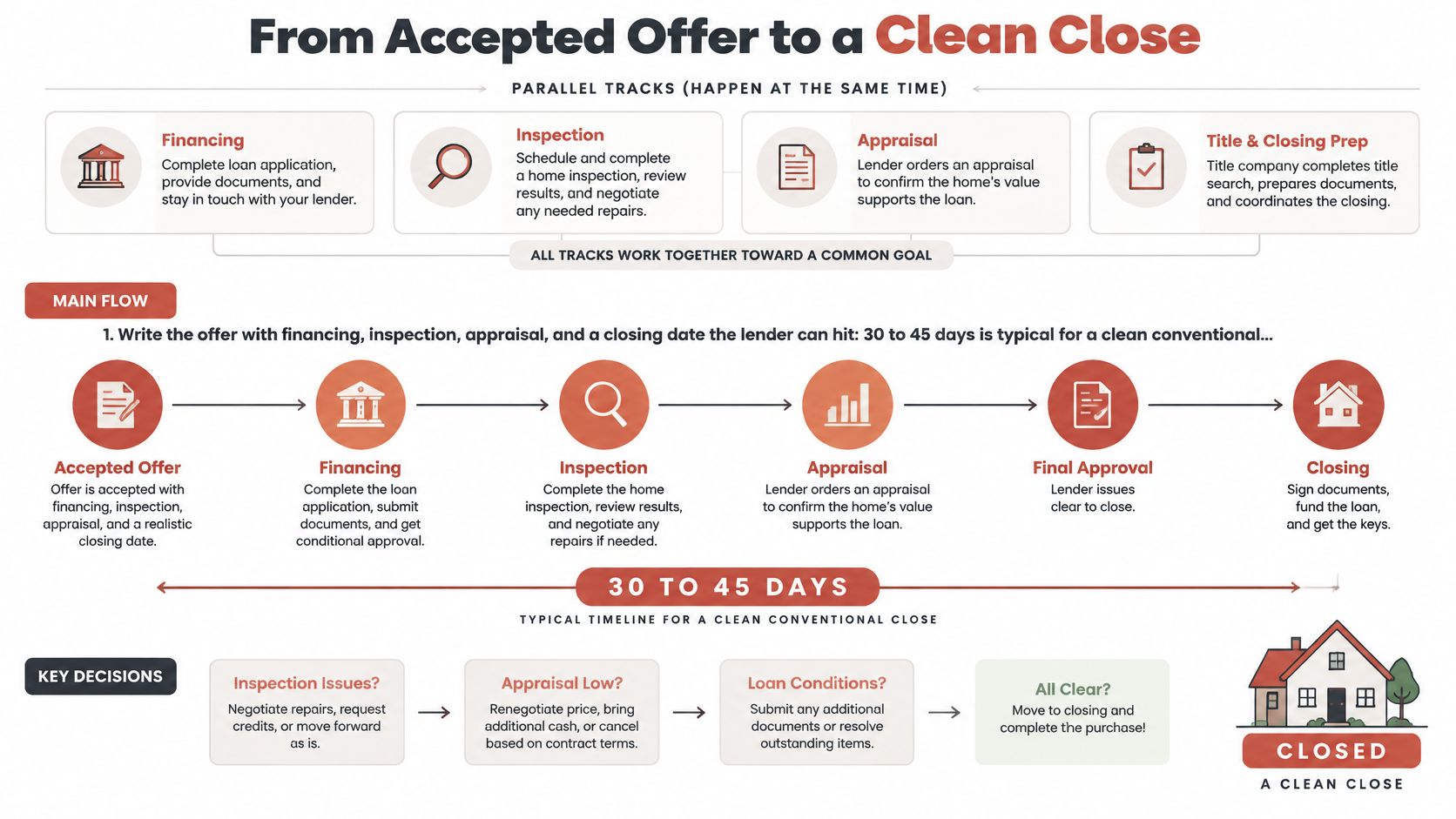
An accepted offer starts parallel workstreams. Your lender reviews the borrower and property, your inspector evaluates condition, your attorney reviews the agreement and title-related issues, and the seller handles agreed obligations.
Fannie Mae's homebuying guidance treats documentation, inspection, appraisal, loan finalization, and ownership transfer as distinct stages. Each stage clears on its own calendar. A finished inspection leaves underwriting running, and a borrower approval leaves appraisal and title work open, so plan from your contract dates rather than one big countdown.
Make the contract dates achievable
Write a closing date the lender has evaluated. Before offering, confirm that the proposed financing, property type, down payment source, and any home-sale contingency fit the requested date. A short closing sounds competitive, but it weakens fast if you need an extension in the first week.
Distribute the signed agreement promptly. Send it to your lender and attorney, confirm receipt, and identify who is handling each next step. Calendar earnest-money delivery and every contractual notice deadline. A forwarded email delivers the document; a separate reply confirms the person who matters has reviewed it.
Read the attorney-review provision with your attorney. For a Chicago-area contract containing attorney review, ask counsel to name the exact deadline, permitted objections, and notice method in writing. That deadline comes from your executed contract, and any weekend or holiday counting follows its terms. Another buyer's timeline belongs to their deal.
A local multi-board form is a starting template; the executed agreement controls. Amendments and negotiated terms can change the obligations that matter to your purchase.
Use the inspection period to make a decision
- Book the inspection immediately and prioritize the findings. Separate safety or structural defects from lender or insurance concerns and routine maintenance. A deteriorated structural component deserves a different response from worn paint or an aging appliance that still works.
Ask for targeted repairs when the work must be completed before closing and can be verified. A credit can give you control over the contractor and scope after possession, but the lender must approve how the credit is applied, and it may not satisfy a property-condition requirement.
Use our guide to negotiating repairs after a home inspection to organize requests around the report rather than turning every observation into a demand.
An inspection contingency creates contractual choices. Sellers can accept, counter, or refuse repair requests, and your protection comes from acting inside the deadline.
If specialist evaluation is needed, ask for access and address the deadline before it expires. An unanswered contractor call can easily become a waived decision; get the specialist's answer or a written extension while the window is open.
Insurance questions belong here too. Before you bind a policy, ask what the inspection report changes about coverage, exclusions, and required repairs. As a general example of questions worth putting to any insurance agent, Duncan & Associates Insurance Brokers outlines coverage considerations for Tumwater homebuyers, covering the coverage and property-condition topics worth raising with your own agent.
Respond to appraisal and document problems early
- Treat a low appraisal as a financing decision. Ask the lender for the revised loan and cash requirements before deciding whether to cover a gap. You can seek a price reduction, contribute additional eligible funds, or consider cancellation if your contract still provides that protection.
A price cut and extra cash do different things to your reserves. Ask what a bridged gap leaves available for repairs, moving, and emergencies before you agree to it.
- Keep one page of contract dates. List the closing date, attorney-review end, inspection deadline, appraisal status, financing deadline, title questions, association documents, and open lender conditions. When one date moves, check which other deadlines it touches, because a slipped appraisal can eat your financing window.
Ask the association or management company for its packet-delivery estimate in writing. No universal delivery period applies to every condo or HOA purchase, so the written estimate is what you plan around.
If the timeline slips, who can fix it
Appraisal issues accounted for 6% of contract delays in 2026 reporting, according to Paperless Pipeline's discussion of closing timelines. That figure describes appraisal-related problems broadly, not merely reports delivered late.
Work the table like an if-then list: find what went wrong, name who controls it, and take the listed move while your deadline is still open.
| What went wrong | Who controls it | Your move |
|---|---|---|
| Inspection finds a safety or structural issue | Buyer and seller within the contingency | Seek a credit, targeted repair, or cancellation when permitted before the deadline |
| Cosmetic or old-maintenance items | Mostly negotiable | Prioritize consequential defects instead of spending the inspection window on minor asks |
| Appraisal below price | Lender valuation review, buyer cash, and seller price | Evaluate the gap, renegotiate, or exercise an available appraisal contingency |
| Appraisal not back | Lender and appraiser | Get a status update and request a written extension before affected deadlines expire |
| HOA or condo packet late | Association or management company | Obtain a written delivery estimate and align review and closing dates |
| Underwriting still asking for documents | Buyer and lender | Answer promptly and confirm which conditions remain unresolved |
| Closing Disclosure late or loan terms changed | Lender | Confirm required delivery and review timing before proceeding |
| Title, survey, or village requirement unresolved | Attorney, title company, seller, or municipality | Identify the actual owner and document any necessary extension |
A verbal promise that everyone will work it out leaves the contract unchanged. Have your attorney paper extensions and notice requirements while you still have time to act.
Close, Fund and Get the Keys
The federal disclosure deadline comes before the signing appointment. For covered mortgage purchases, the lender must provide the five-page Closing Disclosure at least 3 business days before closing, according to the Consumer Financial Protection Bureau's pre-closing document guidance.
That document states the final loan terms, projected payment, closing costs, and settlement payments. Its arrival isn't a signal to stop checking details. It's your opportunity to compare the final transaction with what you expected.
Review the money before arranging delivery
Compare the disclosure with your Loan Estimate as soon as it arrives. Don't limit the review to whether you have enough money in the bank.
- Loan terms: Check the borrower names, loan amount, interest rate, loan product, and projected monthly payment.
- Settlement charges: Review lender fees, title and settlement charges, credits, and any item you don't recognize.
- Prepaid expenses: Check taxes, insurance, and escrow funding so you understand why the cash requirement changed.
- Cash to close: Confirm that your deposit and agreed credits appear correctly and ask how final adjustments will be handled.
Our explanation of closing costs when buying a home can help you sort transaction charges from prepaid ownership expenses. Send discrepancies to the lender or settlement professional in writing, with the specific line identified.
If the disclosure hasn't arrived when expected, request it immediately. Don't proceed without receiving and reviewing it, and have the lender confirm whether any changed terms require rescheduling.
Confirm the property, funds, and possession
Ask for the remaining closing package early enough to raise questions with your attorney. Confirm that homeowners insurance is bound with the correct effective date, and follow the settlement agent's instructions for acceptable funds.
Verify wire instructions independently. Call a trusted number you already have for the settlement office, not a number supplied in a last-minute email changing the instructions. Resolve any mismatch before sending money.
Schedule the final walkthrough after agreed repairs and before signing. Bring the repair agreement and available invoices, check included appliances and fixtures, and report unresolved conditions to your agent and attorney rather than relying on a promise at the door.
Possession check: A scheduled closing appointment isn't permission to unload a moving truck. Confirm the contract's possession terms and obtain explicit confirmation that the transaction has closed.
Signing, funding, and access aren't interchangeable milestones. A seller's negotiated post-closing possession can separate ownership from your move-in date.
Keep movers, utility activation, landlord notice, and other date-sensitive commitments flexible until the disclosure is in hand, the lender confirms closing readiness, and possession is settled. If a landlord requires earlier notice, solve that conflict through a housing backup, not an assumption that closing cannot move.
Set Your Move Date With a Buffer
Your household calendar needs a backup even when the transaction appears healthy. A delayed closing can affect rent, storage, temporary lodging, childcare, work schedules, and the cost of keeping a rate lock in place.
Financing, document collection, and closing coordination each carry their own timing risk. For a western-suburb buyer, the practical response is to budget for slippage as deliberately as you budget for repairs.
Match the buffer to the purchase
A cash purchase removes mortgage underwriting and mortgage-disclosure requirements. Contractual review, title work, association documents, and condition investigation still apply, and a cash buyer may choose an appraisal rather than skipping valuation.
A conventional financed purchase needs a date supported by the lender's actual file review. Ask what must happen before the lender can confirm readiness and what could require a rate-lock extension.
For an FHA, VA, sale-contingent, estate, or as-is purchase, the label alone tells you little about timing. Ask which unresolved conditions affect this property and transaction, then negotiate enough time to address those specific issues.
- Renters: Price a lease extension or overlapping housing before giving irreversible notice.
- Move-up buyers: Coordinate sale proceeds, possession, and funding availability rather than assuming simultaneous closings will align.
- Relocating households: Keep a temporary lodging and storage option available if travel dates can't move.
Write down the latest workable date
I'd keep a separate target closing date and latest workable household date. Set the space between them from your real constraints: backup housing options, association-document status, municipal requirements, and what a delay would cost you in rent, storage, and rate-lock fees.
Put your lease-notice deadline and the date you would activate backup housing on the same calendar as closing. If the appraisal or loan conditions push signing past your rate-lock window, get the extension cost from the lender before agreeing to a new date. If association documents or a municipal requirement are still open as your latest workable date approaches, use the backup housing rather than compressing the remaining steps.
A written fallback date turns a slip into a decision you already made.
Homes By Carmen offers a step-by-step first-time buyer's guide created by Carmen Salerno and support from the first showing through the closing table. Visit Homes By Carmen and use the Schedule A Call button to discuss your lease, financing, and target move date so we can help you build a purchase calendar around local requirements.