
You've opened the inspection report, and the house you loved suddenly looks like a collection of expensive problems. Say you're staring at a thirty-page report on the third day of a seven-day inspection window. There's a basement stain, an electrical concern, an aging roof, and a long list of smaller repairs. Which ones should you ask the seller to handle?
Start with the deadline, not the defects. Learning how to negotiate repairs after home inspection means separating documented risks from routine ownership costs, then asking for a remedy you can use. You're buying a home, not commissioning a renovation at the seller's expense.
Table of Contents
- Your Inspection Deadline Sets the Pace
- Sorting Inspection Findings Into What to Ask For
- Choosing Between Repairs, Credits and Price Cuts
- Send the Request With Scripts Before the Deadline
- Chicago Suburb Issues That Change Your Ask
Your Inspection Deadline Sets the Pace
Find the inspection expiration date in your signed purchase agreement before calling contractors. LegalClarity's explanation of inspection repair obligations describes inspection periods as commonly 7–10 days, but your signed contract controls the actual deadline and the parties' obligations.
The report isn't a repair invoice. Sellers generally aren't automatically required to correct every condition, and your opportunity to request remedies comes from the contract. Confirm how notice must be delivered, who receives it, and whether negotiations have a separate response window.
Count backward from the deadline
Use this suggested working schedule only when it fits your agreement. The day ranges are planning targets, not additional contractual rights, and they start when your inspection period begins, not when the report arrives.
Inspection negotiation timeline
| Stage | Typical timing | Action | Output |
|---|---|---|---|
| Read the report | Immediately upon receipt | Read the summary and mark urgent items | Shortlist of findings |
| Triage findings | Suggested days 1 to 3 | Sort by safety, structure, systems and cosmetics | Negotiable list |
| Get estimates | Suggested days 3 to 5 | Call licensed specialists for items with unclear cost | Written quotes |
| Send request | Before the contract deadline | Submit one written request with evidence | Dated request |
| Seller response | Set in contract or request | Accept, counter or decline | Written counteroffer |
| Sign addendum | Before the applicable negotiation deadline | Record scope, payer, contractor and completion date | Signed addendum |
| Final walkthrough | Before closing | Confirm the work or credit is in place | Closing file |
Read the full report after identifying urgent findings. Call specialists promptly rather than waiting until you've drafted the request. If appointments won't fit, have your agent and attorney address a written extension before time expires; don't assume a pending estimate stops the clock.
Specialty inspections also need scheduling. For buyers considering nearby northwest Indiana, The Green Advantage's resource on termite inspections for Crown Point homebuyers is useful when deciding whether pest concerns deserve a separate evaluation.
Keep an inspection calendar with appointments, notice dates, and responsibility for each task. Understanding what a real estate agent does for a buyer helps you know what to delegate and what still needs your approval. Carmen works with clients from the first showing through to the closing table, so these milestones stay part of the transaction rather than becoming your private to-do list.
Sorting Inspection Findings Into What to Ask For
Forwarding the whole report with a demand to fix everything is a weak negotiating move. It mixes serious defects with loose hardware and gives the seller an easy reason to dismiss the request as a wish list.
Instead, test each finding against severity and evidence. The ASHI Standard of Practice distinguishes significantly deficient, unsafe, or improperly functioning components from those merely approaching the end of their useful lives; it also explains that inspectors aren't required to determine repair methods, materials, or costs.
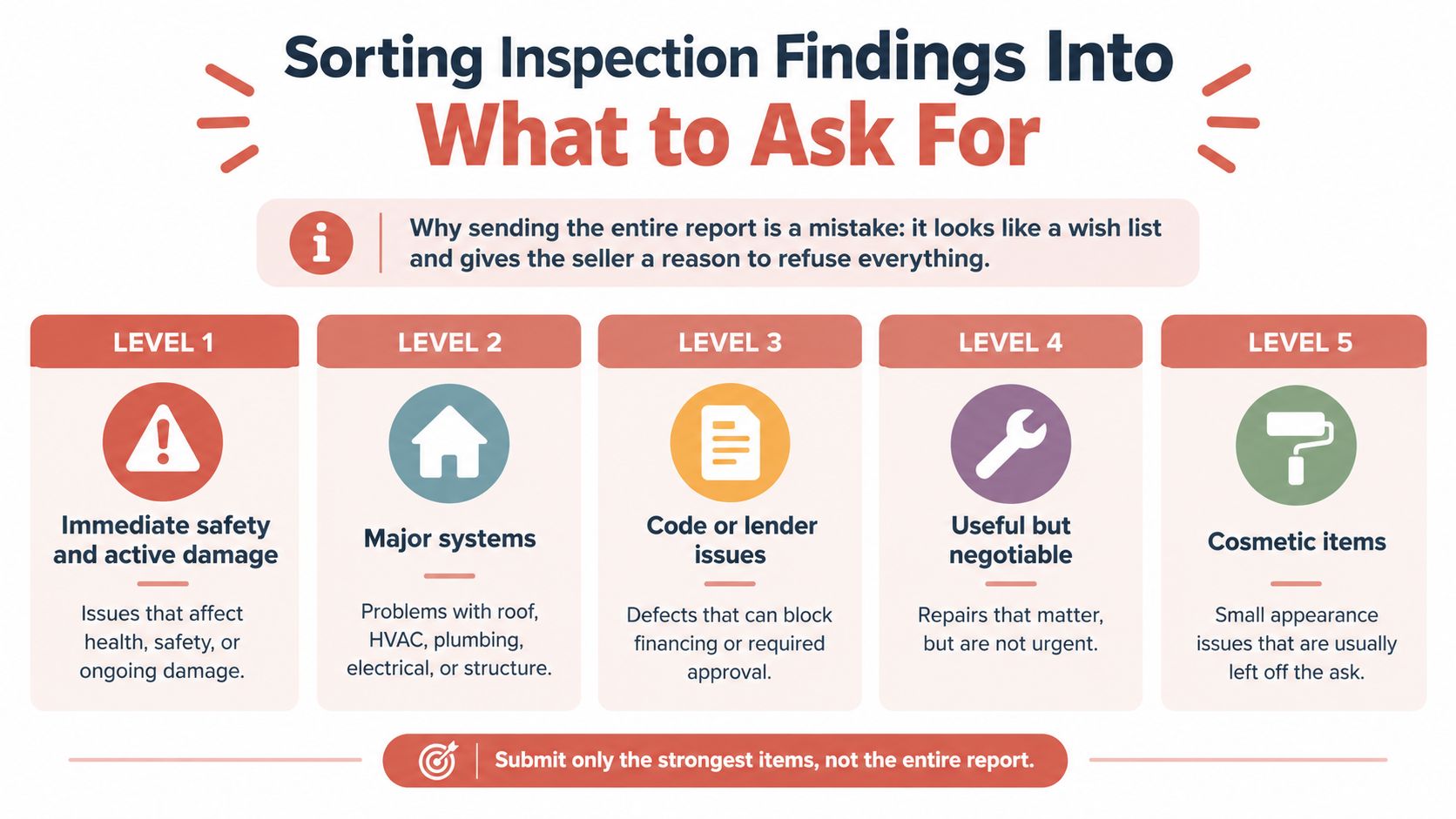
Separate risk from routine ownership
Use this detailed checklist to decide what earns space in your request:
- Immediate safety or habitability risks. Exposed energized wiring, evidence of a possible gas leak, or a handrail that gives way deserve immediate attention. A suspected gas leak calls for immediate safety action, not just negotiation.
- Active water intrusion or structural defects. A leaking basement, displaced foundation crack, or sagging joist needs an explanation of cause and repair scope. Paint over staining isn't a remedy.
- Nonfunctioning major systems. A furnace that won't fire, leaking water heater, or sewer backup belongs on the negotiating list. Ask whether a repair restores reliable operation before demanding replacement.
- Code or permitting concerns. Verify finished-basement work, additions, or questionable alterations with the local building department. An inspector's concern isn't itself a municipal determination.
- Maintenance and cosmetic wear. Worn caulk, a dripping faucet washer, paint damage, and an older roof that still performs usually belong in your ownership budget.
Request remedies for the material safety, water, structural, and system defects. Investigate permit concerns before assigning a remedy, and mostly leave ordinary maintenance alone.
Build an evidence file for each request
For each item you keep, gather the relevant report page, a clear photograph, and a specialist's written scope or estimate. Ask the specialist to distinguish the necessary correction from optional improvements.
Moisture deserves particular care. The Restore Heroes mold inspection guide provides additional context for buyers sorting water damage and mold concerns; your property still needs its own evaluation rather than a diagnosis from photographs.
If you're wondering whether the house failed, the explanation of how to pass a home inspection helps put the report in context. Focus on the condition and its consequences, not a pass-or-fail label.
Base your concession request on verified reasonable cost, with a modest, explained allowance for concealed conditions when justified. Don't turn every aging component into an automatic discount.
Choosing Between Repairs, Credits and Price Cuts
An active roof leak needs a clear remedy before your inspection clock runs out. Ask for a licensed roofer to complete the repair before closing, or request a credit based on a written quote if your lender allows it. If neither option works, weigh a price adjustment against the cost and risk of taking on the repair yourself.

Match the remedy to your cash and financing
Remedy options compared
| Remedy | Best when | Main limit | Verify before agreeing |
|---|---|---|---|
| Completed repair | The lender requires the fix or a safety issue needs prompt attention | Quality and completion disputes | Contractor qualifications, applicable permits and paid invoice |
| Seller credit | You want to choose the contractor | Lender limits and eligible closing costs | Loan-program limit and usable credit amount |
| Price reduction | Repair cost is large and uncertain | Limited cash for repairs after closing | Appraisal, revised loan amount and separate repair budget |
| Repair escrow | Work cannot be completed before closing | Lender approval and negotiated escrow terms | Escrow holder, funding, release conditions and completion deadline |
| Walk away | A specialist identifies significant structural or insurability risk | Earnest money may be at risk if contingency rights have expired | Contract deadline and proper written notice |
A seller credit is a closing-cost concession, not cash for repairs. Your lender may limit concessions to eligible closing costs or prepaid expenses, and may reject any amount above those costs. Confirm the usable amount with your lender before accepting it.
A price reduction lowers the purchase price, but may leave little money available for the repair itself. If you cannot cover urgent work from your remaining funds, a lower price alone may not solve the problem.
Completed work means less to arrange after taking possession, but it does not guarantee quality. Put contractor qualifications and the completion standard in writing instead of relying on a promise to take care of it.
Don't accept an unpriced problem
A repair escrow requires lender approval and precise release terms. It is not a reliable workaround if the lender requires repairs before funding.
The inspection period is also when you need to decide whether the unresolved risk is acceptable. Check your contract deadlines and speak with your attorney before ending the transaction or giving up contingency rights.
For roof work, distinguish repairs that restore performance from upgrades to materials. If replacement is justified, compare residential roofing materials, then keep your request focused on the verified problem rather than premium finishes. These buyer negotiation strategies can help you weigh the repair request against your purchase priorities.
Send the Request With Scripts Before the Deadline
A strong request should be easy to understand and answer. The seller should be able to identify the defect, review your evidence, and see exactly what agreement would resolve it.
Keep emotion out of the wording. You can be firm without accusing the seller of hiding something or describing the house as a disaster.
Prepare the request before you send it
Confirm the dates and delivery method. Ask your agent to put the inspection expiration, response window, and required notice procedure in writing. Have your attorney resolve unclear contract language before you rely on it.
Assemble the supporting documents. Keep the strongest verified defects, attach the relevant inspection pages, and include specialist evaluations or estimates. For a permit concern, attach the municipal record or written response rather than an unsupported allegation.
Check the scope against the quote. Make sure the proposed work addresses the cause, not just the visible symptom. For complex work, get a licensed specialist's written assessment and distinguish repair, replacement, and optional upgrades.
The Rapid Eye Inspections industry guide cautions against demanding replacement where repair is adequate and emphasizes documenting contractor work and completion. Use the property-specific quote, not a broad repair average, to support your request.
Use short messages with a clear decision
The following scripts are message templates, not legal notices or substitutes for the contract forms your attorney recommends. Replace the bracketed fields with the actual details before sending.
Opening request
The inspection identifies an active roof leak at [location] on [report page]. The attached roofer's evaluation describes the cause and repair scope. We request completion of that scope by a licensed roofing contractor before closing, with the paid invoice and applicable permit documentation provided.
This identifies the problem and a measurable remedy without reopening unrelated parts of the deal.
Fallback offer
If completing the documented roof repair before closing isn't workable, we'll consider a seller credit equal to the attached repair quote, subject to lender approval. This is an alternative to the repair request, not an additional concession.
That wording prevents the seller from reading the fallback as a demand for both work and money.
Counteroffer
Thank you for the proposed credit. The attached estimate supports the documented scope, but the offered amount leaves part of that work unfunded. Please identify any excluded work or provide a qualified contractor's written quote supporting the lower amount so we can evaluate the difference.
You're asking for a reasoned counteroffer rather than accepting a smaller number because negotiations feel uncomfortable.
Refusal reply
Thank you for confirming the seller's position. Our decision is [withdraw this specific repair request and proceed / exercise the applicable inspection right through the required written notice]. Please confirm receipt before [contract deadline].
Select only the applicable option, and have your agent and attorney handle any formal termination notice required by the agreement.
- Send a consolidated request and track receipt. Keep each item brief, supported, and separate from optional improvements. Don't use unsupported round-dollar demands or ask the inspector to design the repair. Preserve the sent message, attachments, and acknowledgment.
A pending conversation isn't an agreement. If the seller needs more time, address the deadline in writing rather than relying on a reassuring phone call.
Turn acceptance into enforceable details
- Complete the written addendum. Identify the scope, payer, contractor qualifications, required permits, completion date, invoices, and any warranty transfer. For a credit, state the exact agreed amount and have the lender and closing team confirm its treatment.
The addendum should also address what happens if the work isn't finished. Don't leave an incomplete repair to a closing-day argument about whether you must proceed, postpone, or accept another arrangement.
- Schedule verification before closing. Use the final walkthrough to check visible completion, and arrange specialist reinspection when the repair can't be meaningfully assessed by sight. A patched ceiling doesn't establish that a roof leak was corrected, and an invoice alone doesn't prove the system works.
Confirm the agreed credit on the closing documents rather than expecting it to appear automatically. If something doesn't match, raise it before signing and ask your attorney how to proceed.
Clients can reach out to us to schedule a consultation or get answers to their real estate questions. Bring the report, agreement, and any quotes so the discussion stays tied to your actual decision.
Chicago Suburb Issues That Change Your Ask
An older bungalow in Oak Park or a mid-century house in Elmhurst may need a different investigation than a newer property. Age alone isn't the negotiating issue. The question is whether the condition creates a documented safety, financing, insurance, or repair risk.

Investigate the cause before accepting the allowance
Sewer and water concerns deserve more than a guess. Have a plumber evaluate suspected problems with clay or cast-iron sewer laterals, including a sewer scope where appropriate. Galvanized supply piping and older water service lines also need an assessment of condition and scope before you accept compensation.
Basement staining or efflorescence doesn't tell you the repair cost. Redirecting downspouts or correcting surface drainage may help, but don't assume those measures resolve foundation leakage. Ask for disclosure information and available documentation of previous water events or waterproofing work.
Masonry and electrical findings need the right specialist. A mason should distinguish ordinary tuckpointing from displaced or deteriorated brickwork. An electrician should evaluate older panels and wiring, while your insurance agent confirms whether the insurer requires corrections.
Pull records from the actual municipality
Chicago records to pull by issue
| Issue | Record to pull | Who confirms |
|---|---|---|
| Sewer laterals | Sewer scope report and sewer permit history | Licensed plumber and village public works |
| Basement water and grading | Available prior water claims and grading or drainage notes | Inspector and waterproofing contractor |
| Brick masonry and tuckpointing | Mason's written estimate | Licensed mason |
| Older electrical panels and wiring | Panel permit records and insurer requirements | Licensed electrician and insurance agent |
| Galvanized or old water service | Plumbing permit history | Licensed plumber |
| Finished basements and additions | Building permit history from village or city | Municipal building department |
For finished basements and additions, ask the seller for permit history and check village or city records yourself. Confirm whether permits were finalized, not merely issued.
Municipal requirements aren't interchangeable across Chicagoland. Verify what applies to that address, and contact your insurance agent early enough to investigate any underwriting concern before your inspection decision is due.
Homes By Carmen helps buyers coordinate inspections, evaluate repair requests, negotiate terms, and stay organized through closing. Visit Homes By Carmen to discuss your purchase and build a focused response to the findings that matter most.