
A seller's agent manages the sale from pricing and MRED marketing through showings, negotiation, and closing. In the 2025 national seller profile, the National Association of REALTORS® found that 91 percent of sellers used an agent or broker. A good agent gets your home noticed and helps you reach a closing you can finish.
For a homeowner in Melrose Park or the western suburbs, the job is to balance price, exposure, and contract certainty. A promising asking price means little if buyers won't tour, and an impressive offer means little if the buyer can't complete the purchase. Like adjusting three connected dials, a change in one can affect the others.
Table of Contents
- What a Seller Agent Handles from Pricing to Closing
- How Price Exposure and Time Work Together
- Marketing the Home and Reading Showing Feedback
- What Sellers Pay and What They Keep
- Comparing Offers Beyond the Highest Price
- A Western Suburb Sale from Consult to Closing
- Choose Seller Help Before You List
What a Seller Agent Handles from Pricing to Closing
A seller's agent is the sale's project manager, not just an advertising vendor. The agent organizes the work, explains the choices, and keeps the people handling your transaction moving toward the same finish date.
The National Association of REALTORS®’ 2025 Profile of Home Buyers and Sellers found that 91% of sellers used an agent or broker, the highest level recorded in the report, while 5% sold for sale by owner, an all-time low. Sellers' leading priorities were marketing the home, pricing it competitively, and selling within their desired timeframe.
Seller agent work by phase
| Phase | What the agent does | Seller decision |
|---|---|---|
| Before launch | Comparative market analysis, pricing strategy, net estimate, preparation guidance, and disclosures | Approve the list price and which repairs to make |
| Launch | MRED listing with broker reciprocity exposure, photos, remarks, and a buyer-segment plan | Confirm the go-live date and access rules |
| Showings | Schedule tours, collect feedback, and track traffic and days on market | Adjust price, presentation, or terms |
| Offers | Compare price, financing, contingencies, deposit, and timing, then negotiate | Accept, counter, or decline |
| Under contract | Coordinate inspection issues, repair credits, attorney review, and deadlines | Choose a credit or repair and meet agreed dates |
| Closing | Coordinate payoff, title, final walkthrough, keys, and proceeds with the closing team | Review the closing statement |
The agent organizes, but you decide
A comparative market analysis, usually shortened to CMA, gives you a reasoned pricing recommendation. It isn't an appraisal or a promise about what a buyer will pay. You approve the asking price after discussing the evidence and your priorities.
The same division of responsibility continues throughout the sale. Your agent can recommend a repair credit, negotiate its terms, and coordinate the paperwork, but you decide whether to agree. The agent shouldn't make a financial commitment on your behalf without your authorization.
This timeline shows how the responsibilities fit together.
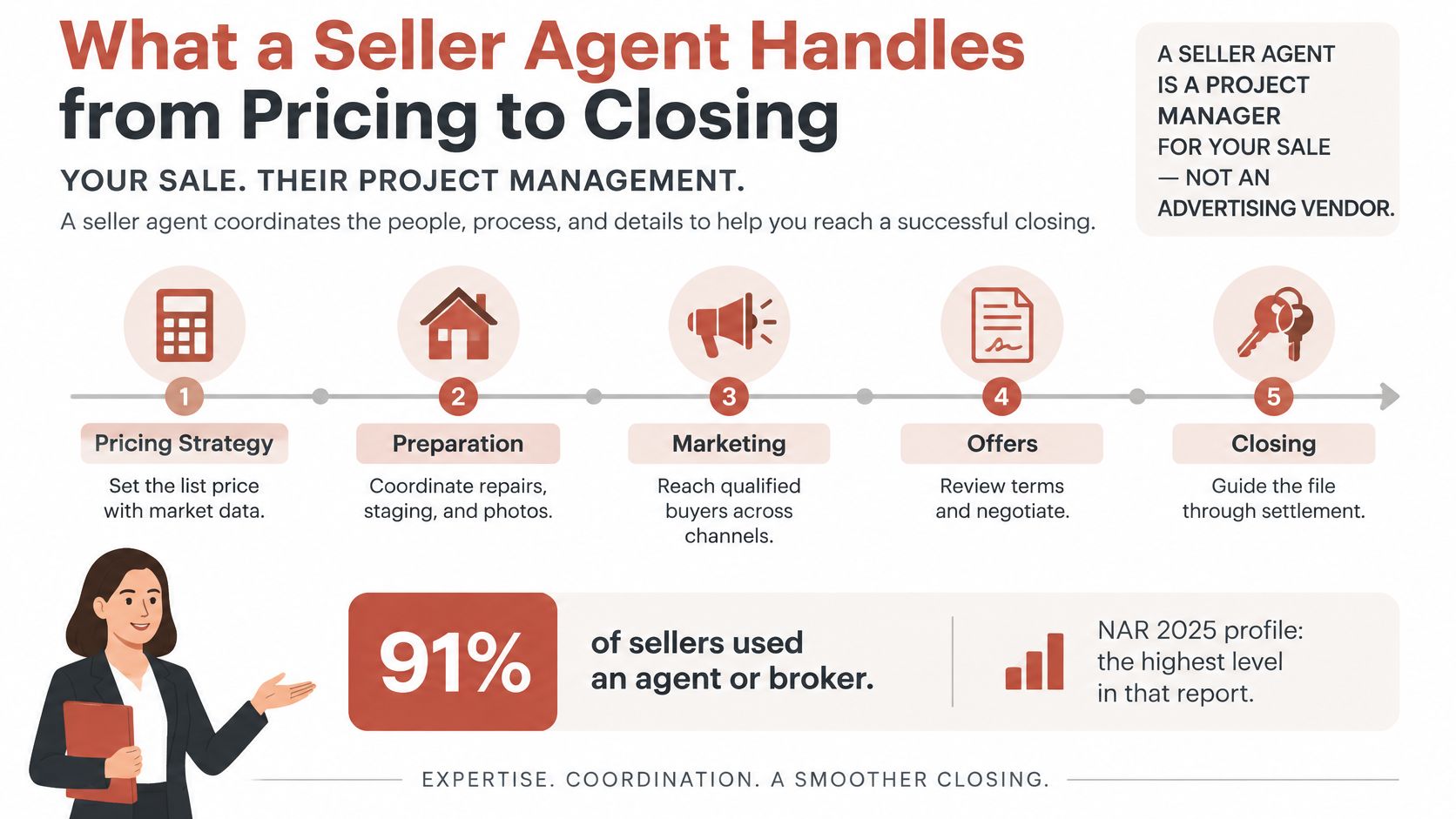
Know who handles each question
Your agent coordinates the transaction without replacing the other professionals involved. An attorney handles legal advice and contract interpretation. The lender supplies payoff information, while the title and closing professionals address their parts of settlement.
A Melrose Park listing follows this same sequence as a listing in Elmhurst or another western suburb, even when buyer demand differs by town. What changes is the strategy within each phase, not the need to manage it.
Bring this checklist to every listing appointment. Ask who owns each task, how you'll receive updates, and which decisions require your approval. Missing steps become much easier to spot when you discuss the whole sale instead of just the marketing presentation.
How Price Exposure and Time Work Together
Price, exposure, and time work together. An agent who recommends a list price without discussing the launch plan or your moving deadline hasn't finished the recommendation.
Overpricing can discourage the buyers who would otherwise consider your home. As the property remains available, later buyers may wonder what's wrong or assume you'll accept less. A reduction can restore interest, but it doesn't guarantee you'll regain the negotiating position you had at launch.
Pricing below competing properties requires just as much judgment. A deliberate strategy may encourage competing offers, but an accidental underprice can leave proceeds behind. Neither approach should rest on the hope that buyers will automatically correct the seller's mistake.
Build the comparison before choosing the number
The priorities identified in NAR's takeaways from its 2025 buyer and seller profile reinforce why pricing must support both buyer exposure and the seller's timeframe. In practice, a Chicagoland agent builds the recommendation from MRED properties with different evidentiary value:
- Closed homes show completed transactions, interpreted in light of when those contracts were negotiated.
- Pending homes help identify what buyers are choosing, although the final sale terms may not yet be available.
- Active homes show the alternatives buyers can tour today, not proof of what those owners will receive.
The agent then accounts for location, living area, condition, amenities, and timing. Say a renovated Elmhurst colonial and a dated Melrose Park ranch have similar square footage. Treating them as interchangeable because their size matches would overlook differences buyers evaluate.
Price per square foot is a screening tool, not a complete valuation. Ask your agent to explain why each comparable belongs in the analysis and how its differences affect the recommendation.
The diagram captures the relationship between launch pricing and buyer response.
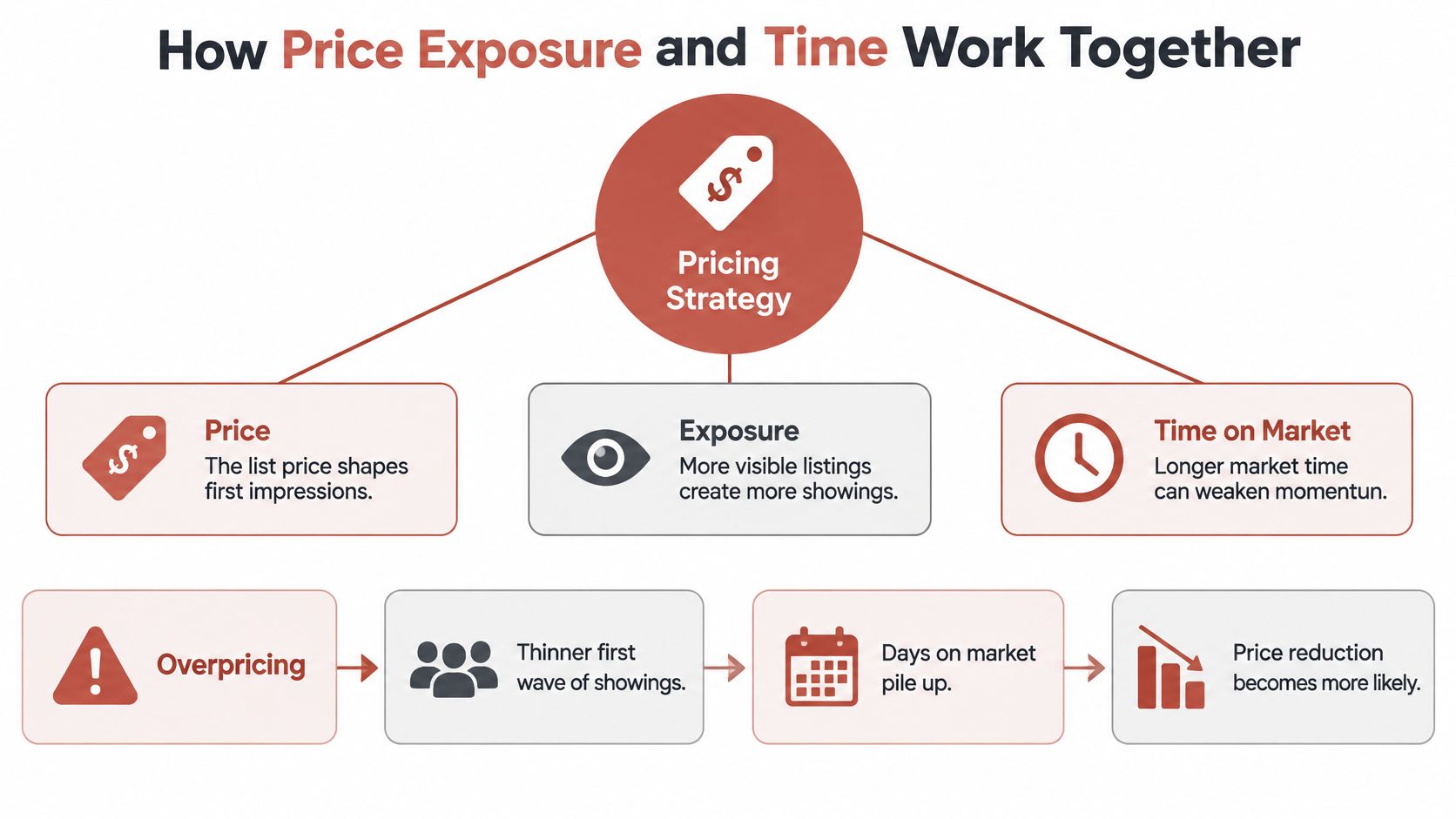
Give your moving deadline financial weight
A seller relocating for a job may care more about a dependable closing date than holding out for an uncertain premium. That preference should shape the launch strategy from the beginning, rather than emerge after the seller has already committed to a move.
Your agent should also distinguish list price from expected net proceeds. A preliminary estimate should account for compensation, transfer taxes, attorney and title charges, credits, repairs, mortgage payoff, and other projected closing costs.
Practical rule: Leave the pricing conversation with a defensible list price and a written net range, not a single hopeful number.
Marketing the Home and Reading Showing Feedback
In the 2025 Profile of Home Buyers and Sellers highlights, 88% of prospective sellers expected to accept an offer after ten or fewer showings, including 61% who expected one within five showings. Treat these figures as expectations to test against your own showing data. Your agent's job is to create appropriate exposure, then read the response alongside the price and the kind of offer the home can realistically support.
Make the listing useful to the likely buyer
Marketing connects a priced property with people who might purchase it. Start with accurate MRED information, photographs that explain the rooms and layout, and remarks describing meaningful features instead of relying on empty adjectives.
MRED Broker Reciprocity helps participating brokers display eligible listing information. For background before discussing the listing setup, review how to list your home on the MLS.
Buyers comparing Elmhurst, Downers Grove, Naperville, Oak Park, Glen Ellyn, and Melrose Park may weigh school boundaries, commute options, condition, and price differently. The agent should present verifiable details about the property and location, rather than assume every buyer is looking for the same things.
Presentation choices need a budget conversation, too. Before paying for physical or digital staging, decide which rooms need help and what the images should communicate. A staging decision guide for agents can help frame that choice. Clearly identify altered images, and make sure they do not disguise the home's condition.
Turn response into a decision
A launch is closer to a store's first day open than a guarantee of a sale. The price and presentation aim to attract particular buyers; their visits, questions, and offers show whether that approach is working.
A useful update tracks:
- Showing volume and online engagement to separate visibility from actual tour interest.
- Feedback patterns rather than treating one opinion as a verdict.
- Competing listings and market time to see how buyers' alternatives are changing.
- Offer quality to judge whether attention is turning into a workable deal.
Repeated comments about a dated kitchen may point to better presentation, a price adjustment, or terms that account for the condition. A commute objection cannot be changed, but the agent can check whether the listing clearly explains transportation options and whether the price reflects the location. Each response matters because the goal is not just attention. It is an offer whose terms and timing can lead to closing.
A planned adjustment is a response to evidence, not proof that the sale has failed. At the first review, ask: Who came? What did they object to? What change do you recommend?
What Sellers Pay and What They Keep
Your closing check is what remains after the sale's obligations are paid. A worksheet makes that amount easier to understand by showing each deduction, what you have agreed to pay, and what a buyer has requested. The contract price is the starting point, like the top line of a budget, not the amount you take home.
How seller costs change net proceeds
| Cost item | How it is set | Effect on the seller's net |
|---|---|---|
| Listing compensation | Negotiable and written in the listing agreement | Subtracted from the contract price |
| Buyer-broker compensation | Separately negotiated, not an automatic seller obligation | Its own line, not a condition of a concession |
| Seller concessions or credits | Negotiated in the offer | Lowers net; cannot be tied to paying a buyer broker |
| Repair credits or work | Negotiated after inspection | Cash credit or money and time spent before closing |
| Transfer taxes | State and local rules | Paid at closing from proceeds |
| Attorney and title charges | Quotes from the closing team | Quoted charges deducted at settlement |
| Mortgage payoff | Seller's lender statement | Paid before the seller receives the balance |
Separate compensation from concessions
Commissions are negotiable, and compensation arrangements belong in a written agreement. NAR's guidance on compensation, commission, and concessions explains the distinction between seller concessions and compensation, including that concessions cannot be conditioned on paying a buyer broker.
Start with the listing-side compensation in your agreement. Then review any separately negotiated seller contribution toward buyer-broker services. Keeping these as distinct worksheet lines makes it easier to see what each amount covers and prevents a bundled deduction from obscuring the terms.
A buyer may also ask for help with transaction costs, loan costs, or repairs. Those requests have different purposes, so each needs its own line and a clear explanation of its effect on your proceeds. Your agent negotiates within your instructions, while the lender and closing team confirm how agreed credits can be applied.
Compare the check, not just the contract price
For example, suppose a buyer requests an $8,000 credit. If the contract price and every other expense stay unchanged, your net falls by that amount. A before-and-after worksheet shows the effect clearly, instead of burying the request in a general closing-cost allowance.
Another buyer might request repairs. Before treating that offer as less costly than a credit, get written estimates and consider whether the work can be completed on time. Contractor access, scheduling, and responsibility for acceptable work all affect the plan, especially while you are preparing to move.
Some deductions come from obligations that remain part of the sale, rather than requests in an offer. Your mortgage payoff needs confirmation, and applicable taxes and settlement charges belong in the calculation. This guide to real estate closing costs for sellers can help you prepare questions for your closing team.
For owners considering a sale without representation because they want to avoid paying listing compensation, compare the potential savings with the services and responsibilities they would take on themselves. The practical question is how each option affects both the work involved and the amount left after closing.
Before signing, ask what's required, what's optional, who negotiates concessions, and how this offer changes the amount you receive.
Comparing Offers Beyond the Highest Price
Consider a hypothetical western-suburb sale. Offer A is $15,000 higher, but the buyer must sell another home and wants to close in 60 days. Offer B is lower, with a larger earnest deposit, strong financing, fewer contingencies, and a closing date that matches the seller's move.
The extra price is attractive. The question is whether the seller can tolerate the additional uncertainty required to collect it.
Offer A vs Offer B in one view
| Term | Offer A | Offer B |
|---|---|---|
| Purchase price | Higher by $15,000 in this illustration | Lower, base offer |
| Financing | Relies on proceeds from another home sale | Strong financing |
| Contingencies | Home-sale contingency and appraisal risk | Fewer contingencies |
| Earnest deposit | Smaller than Offer B in this illustration | Larger deposit |
| Closing timing | 60 days in this illustration | Matches seller's move date |
| Estimated net | Higher before unresolved costs and credits | Lower before unresolved costs and credits |
| Likelihood of closing | Less certain on the stated terms | More certain on the stated terms |
Explain what could stop payment
The agent should examine financing documentation, contingency language, appraisal exposure, inspection provisions, and possession requirements. A large deposit can support an offer's seriousness, but it doesn't automatically mean the seller keeps that money if the contract ends. The contract and circumstances matter, and legal questions belong with the attorney.
Risk-adjusted value means considering what you might receive alongside what must happen for you to receive it. It isn't a precise probability an agent can manufacture. It's a structured explanation of which unresolved events could delay closing, reopen negotiations, or terminate the agreement.
This comparison highlights why terms deserve the same attention as price.
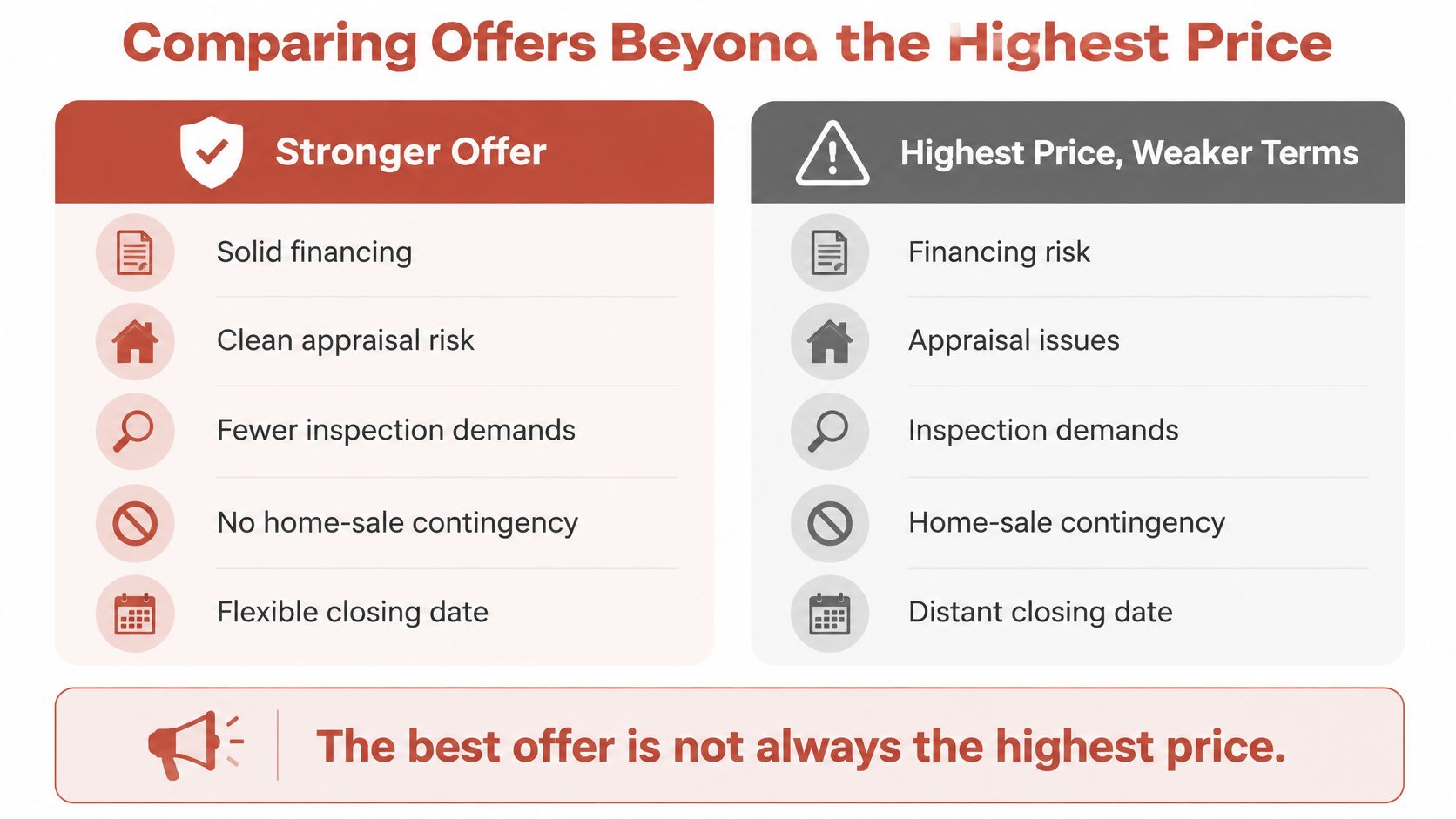
Keep the accepted contract moving
According to NAR's reporting on seller representation, 86% of sellers said their agent provided a broad range of services and managed most aspects of the sale. The stretch after acceptance makes that work especially visible.
The agent drafts or coordinates counteroffers, communicates required disclosures, and tracks the transaction calendar. The buyer's representative, lender, inspector, attorneys, and title professionals each have different responsibilities, but their work needs to fit the agreed deadlines.
A missed response or incomplete document can create an avoidable dispute. Your agent should flag problems early, identify who needs to act, and document agreed changes rather than rely on an informal conversation.
Read every offer summary as estimated net, what can still fall apart, and the closing and possession dates. For a seller, the key question is when you must hand over the keys, which may not be identical to the day funds are disbursed.
A Western Suburb Sale from Consult to Closing
The following is a composite illustration, not a real client transaction. Its calendar shows a possible sequence, not a promised selling period.
Consultation and preparation
Before launch, the homeowner and agent walk through an Oak Park bungalow with a tired kitchen. Instead of automatically proposing a renovation, they discuss cleaning, presentation, visible maintenance, and what the seller can reasonably complete before moving.
A Naperville property needing paint and further condition investigation could require a different preparation list. The point isn't to give every house the same treatment. It's to make each proposed task serve a clear purpose.
The seller tells the agent which work is manageable and which projects are off the table. Together, they establish a launch plan that fits those limits.
The visual below illustrates how preparation, marketing, and transaction work can fit into a selling calendar.

Launch and buyer visits
During the launch period, photography and listing details are finalized, the seller completes disclosures with appropriate guidance, and the property enters MRED. Showing instructions protect access while accounting for the seller's work schedule.
The agent's updates turn individual comments into patterns. Instead of forwarding a pile of reactions, the agent explains which concerns recur and which are isolated preferences.
Local judgment remains important. Buyers evaluating Melrose Park, Elmhurst, Downers Grove, Glen Ellyn, and nearby towns have different competing properties available, so the agent checks the relevant neighborhood rather than treating western Chicagoland as a single price category.
- When offers arrive, the seller reviews net proceeds and completion concerns side by side, then authorizes a targeted counteroffer.
- During inspection, the seller chooses between a manageable repair list and an agreed credit, with the attorney involved in documenting the resolution.
- Before settlement, the agent follows up on outstanding milestones and confirms that the appropriate professionals are handling payoff, title, and closing arrangements.
On closing day, the seller reviews the final statement, the closing team confirms the payoff arrangements, and keys transfer according to the agreement. The seller can identify which decisions protected the proceeds, rather than remembering only the asking price.
Choose Seller Help Before You List
If you can't access and interpret current MRED comparables, manage showing access, evaluate contract risks, and track inspection and attorney deadlines, a seller's agent is a practical way to assign that work. The decision isn't whether you're capable of selling a house. It's whether you have the time, information, and support to manage this sale.
If you already have a buyer, the discussion can be narrower. You still need clarity on disclosures, financial terms, documentation, and who will coordinate the closing.
Make the consultation useful
Use the phase checklist as your meeting agenda. This guide to finding a good real estate agent can also help you evaluate the answers rather than choose on personality alone.
Bring the information that changes the plan:
- Mortgage information including a recent statement and any available payoff details.
- Your moving deadline with any flexibility clearly identified.
- Repair boundaries listing work you'll consider and work you won't take on.
- Your questions about communication, compensation, marketing, and transaction oversight.
A downloadable seller's guide can help you arrive prepared, but the consultation should address your property specifically. Ask Carmen Salerno for a strategy discussion focused on your Melrose Park or western-suburb home.
So, what does a real estate agent do for a seller? The useful answer is a price range you can defend, a net estimate you understand, and a launch plan you can carry out, without pressure to sign that day.
Homes By Carmen offers seller representation, comparative market analysis, MRED listing exposure, showing management, negotiation, and transaction oversight in Melrose Park and western Chicagoland. Visit Homes By Carmen to request a strategy consultation, and bring your mortgage information, moving deadline, and repair priorities so the conversation starts with a sale you can finish.