
You're a week from listing. The photographer is booked, the contractor has finished the touch-ups, and you're trying to decide whether an offer will leave enough cash for the next home. The sale price looks solid on paper, but it isn't the number that lands in your account.
Your real number is the net proceeds: the sale price minus selling expenses, closing charges, buyer credits, and your mortgage payoff. In Chicagoland, the municipality matters. A Chicago seller can face a tax line that a seller in Melrose Park or Naperville may not, so a single Illinois-wide estimate can leave you planning around the wrong figure.
Table of Contents
- What a Seller Actually Walks Away With at Closing
- Closing Costs Versus the Full Cost of Selling
- Typical Line Items on a Chicagoland Seller Settlement Statement
- How Chicago and Suburban Transfer Taxes Stack Up
- Prorations, Title Work, and the Repair Credit Conversation
- Where Sellers Can Realistically Cut the Number
- Sample Settlement Statement for a $400,000 West Suburb Sale
- Pre-Listing Checklist and Smart Questions to Ask
What a Seller Actually Walks Away With at Closing
At closing, you sign the transfer documents and the title company distributes the money according to the settlement statement. The statement starts with the sale price, then subtracts charges assigned to you, any agreed credits, and the mortgage payoff. What remains is your estimated take-home amount.

Think of the sale as a cash-flow calculation, not a headline price. A $400,000 offer doesn't mean you'll receive $400,000, and two offers at the same price can leave you with different proceeds if one includes a larger buyer credit or different tax allocation.
The real estate closing costs for a seller are only part of that calculation. Your statement may show transfer taxes, title and settlement charges, recording fees, property-tax prorations, and negotiated credits. Your agent's compensation and mortgage payoff also reduce the cash you receive, even though they aren't all classified as closing costs in the narrow sense.
Start with the net, not the list price. Before you choose a price or accept an offer, ask for an itemized estimate that names the property's exact municipality and spells out who pays each charge.
This guide focuses on the Chicagoland details that change the result: local transfer taxes, negotiable allocations, prorations, and the difference between closing expenses and the full cost of selling. Once you know which lines are fixed, customary, or negotiable, you can judge an offer by what you'll keep.
Closing Costs Versus the Full Cost of Selling
“Closing costs” has a narrower meaning than many sellers assume. It usually refers to charges tied to completing the transfer, such as title and settlement services, recording, transfer taxes, and prorations. Those are different from the broader expenses and deductions that affect your final proceeds.
The full cost of selling can include agent compensation, repair credits, buyer concessions, mortgage payoff, and moving expenses. Renovations and possible capital-gains tax belong in your wider financial plan, too. Mortgage payoff is often the largest deduction on the settlement statement, but it isn't a selling expense: it determines how much cash remains after the loan is paid, not how the taxable gain is calculated.
This distinction matters because a seller can misunderstand both the cash needed to close and the tax treatment of expenses. The IRS says commissions, advertising, legal fees, and other direct selling expenses reduce the amount realized from a sale. Certain costs, including qualifying title-related legal fees, recording fees, surveys, transfer taxes, and owner's title insurance, may instead be included in the property's adjusted basis. Escrowed amounts for future taxes or insurance generally aren't basis additions. Keep the settlement statement, invoices, and improvement records, then ask a tax professional how the rules apply to your return. (IRS Publication 523 explains the distinction between selling expenses and basis)
For another regional perspective on which expenses sellers should plan for, see this guide to selling costs for BC homeowners from Royal LePage Brookside Realty. Different markets have different rules, but the useful habit is the same: separate settlement charges from every other cost that reduces your cash.
Typical Line Items on a Chicagoland Seller Settlement Statement
A settlement statement isn't a mystery document. Each line should have a purpose, a calculation, and a party assigned to pay it. Ask the closing team to explain anything that doesn't fit those three tests.
Common lines include:
- Owner's title insurance: A policy that protects the buyer's ownership rights. Sellers often pay it by custom, but the contract can allocate it differently.
- Escrow or settlement fee: Payment for coordinating documents, funds, and closing tasks. The amount and allocation depend on the transaction.
- Recording charges: Government fees for recording the deed and related documents.
- Survey: A property survey may be required or requested to clarify boundaries and identify potential issues. Check the contract and title requirements.
- Attorney review: Legal fees for reviewing the contract or advising you on the sale. The work and fee depend on the lawyer and transaction.
- Transfer taxes: State, county, and possibly municipal charges. The exact location and contract allocation matter.
- Property-tax proration: Your share of property taxes through the closing date, calculated under the contract's proration terms.
- HOA dues and buyer credits: If applicable, unpaid or prorated association charges and any negotiated seller concessions can reduce proceeds.
Don't treat small administrative charges as meaningless. A courier, wire, document, or processing fee may look minor on its own, but several small lines still deserve a clear explanation. Ask whether a charge is required, customary, or optional, and who selected the service provider.
The buyer's agent compensation arrangement can also affect negotiations and the offer's net value. For context on how that compensation is handled in a transaction, review this explanation of buyer agent compensation. Don't assume it's automatically part of your closing costs or automatically your responsibility. The written agreements and purchase contract determine what's being paid and by whom.
How Chicago and Suburban Transfer Taxes Stack Up
Use a $400,000 contract as the test case: a Melrose Park seller and a Chicago seller can face materially different transfer-tax totals before title work, settlement charges, credits, or commissions enter the statement. The parcel's municipality controls the answer, even when two addresses feel like the same market.
Using that $400,000 example, Illinois charges $0.50 per $500 of consideration ($400), and a county charge of $0.25 per $500 adds $200 where applicable, putting the state-and-county subtotal at $600 before municipal tax (Lake County's transfer-tax guidance lays out the state and county rates).
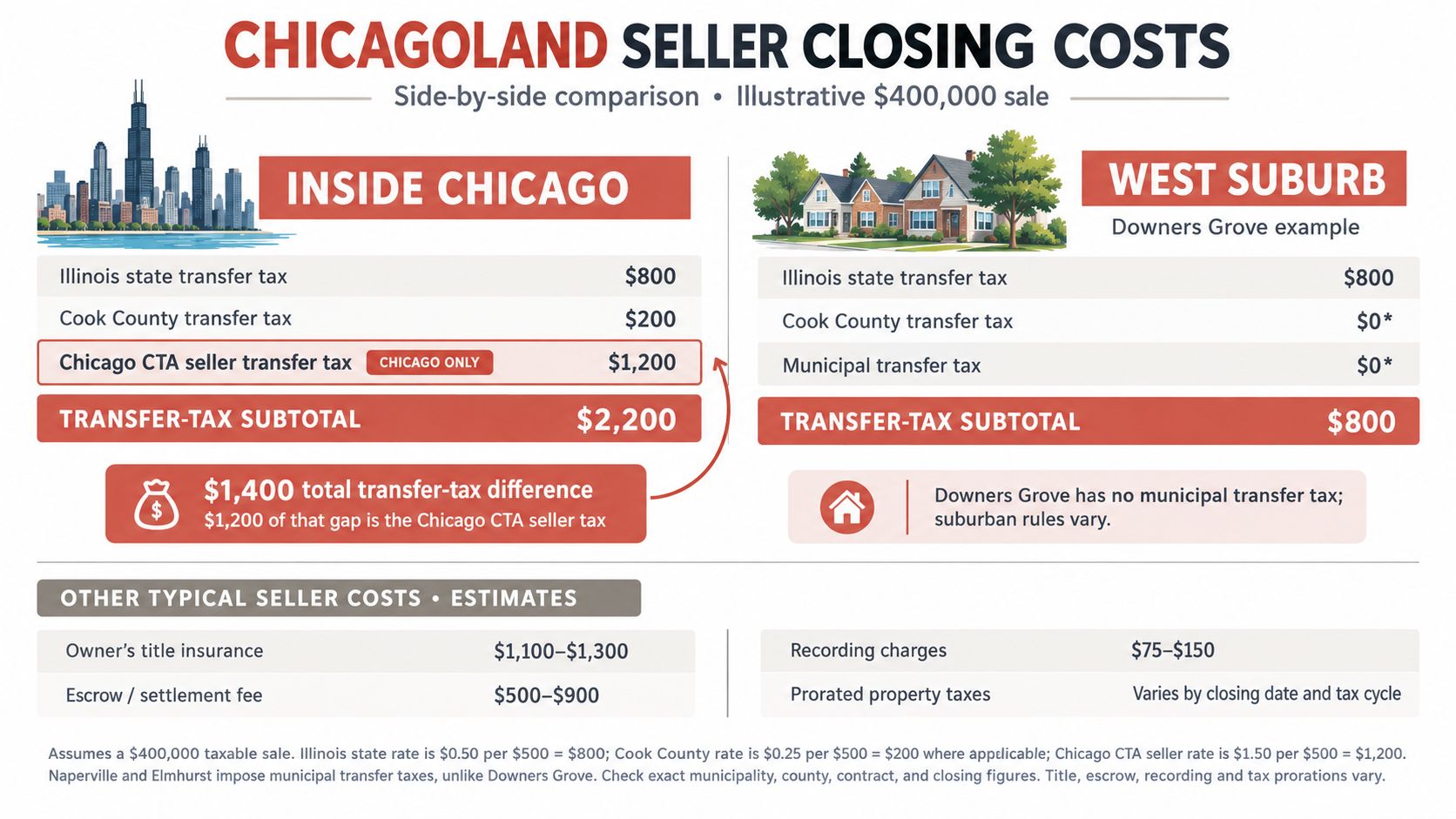
Chicago adds a separate municipal layer. The city says the seller generally pays the CTA portion of $1.50 per $500 ($1,200 on a $400,000 sale or $1,035 on a $345,000 sale), the buyer generally pays $3.75 per $500, and the combined city rate is $5.25 per $500 (Chicago's real property transfer-tax page details the city tax structure).
A seller in Melrose Park, Elmhurst, Downers Grove, or Naperville should not assume Chicago's CTA charge applies. Some municipalities impose their own local charges, so have the title company verify the parcel's municipality, county, and every applicable tax before estimating proceeds.
My advice is simple: negotiate from net. Local custom often assigns the seller a portion of transfer taxes, while the written contract controls the final allocation. If a buyer asks you to absorb a municipal charge, calculate it and offset that amount through price or another term before agreeing. A nominally higher offer can leave less cash after an unfavorable allocation; a lower offer with cleaner terms can produce the better closing check.
Prorations, Title Work, and the Repair Credit Conversation
Prorations divide costs according to who owned the property during the relevant period. Property taxes are a common example: the closing statement credits or charges the parties according to the contract's method and the closing date. If the final tax bill isn't available, the settlement team uses an estimate, which can make the adjustment look different from what you expected.
A recent tax appeal can complicate that estimate. If the assessed amount changes, the parties should confirm what figure the title company used and whether the contract allows a later adjustment. Don't assume a tax proration is a penalty or a refund. Ask for the calculation, the tax period it covers, and the source amount.
Owner's title insurance is another line sellers often pay by local custom, but custom isn't the same as a legal requirement. Review the contract's allocation and ask whether the buyer's chosen title provider affects the premium or related charges. The settlement agent should explain what the policy covers and whether any reissue pricing is available.
Inspection negotiations can have a more direct impact on your net. A $5,000 repair credit reduces your proceeds by the same amount as a $5,000 price reduction, though the buyer may view a credit as more useful because it helps with their cash needs at closing. Decide whether to repair the issue, offer a credit, or decline the request based on the condition, competing offers, and your bottom line. These real estate negotiation tips for buyers offer useful context for understanding how the other side may evaluate a concession.
Finally, ask whether any money will remain in escrow after closing for taxes, insurance, or an unresolved item. If funds are held back, your initial disbursement will be lower until the conditions for release are met. Get the purpose and release terms in writing.
Where Sellers Can Realistically Cut the Number
Not every line is fixed, and not every attempt to save money is worth the effort. Focus on costs that are negotiable or on choices that prevent a larger concession later.
Start with the contract and service arrangements. Ask whether you can choose the title provider, whether a reissue rate is available for owner's title insurance, and how settlement charges are allocated. Then review the expected property-tax proration against your likely closing date. A later closing may change the proration, but it doesn't automatically mean a lower total cost; ask the title company to model the actual dates and figures.
A pre-listing inspection can help you identify material issues before a buyer uses them to reopen negotiations. It won't guarantee that a buyer won't ask for repairs, but it gives you a chance to decide what to fix, disclose, or price around before an offer arrives. A clean, well-documented response can be more valuable than improvising under contract pressure.
Commission is a separate discussion, and the agreement should be explicit. Since August 17, 2024, settlement rules have allowed sellers to communicate concessions, including contributions toward buyer closing costs, through an MLS, subject to local MLS rules and provided the concession isn't conditioned on using or paying a particular buyer broker. (The National Association of REALTORS® settlement FAQ explains the concession rules) Compare service scope, marketing, negotiation support, and contract oversight, not just a percentage.
Don't spend your energy chasing tiny savings while overlooking a substantial buyer credit or an unclear tax allocation. Photography and staging can support presentation and buyer interest, but skipping them to save money may hurt your sale strategy. The right question is whether a proposed expense helps protect your price or reduce the risk of a larger deduction.
Sample Settlement Statement for a $400,000 West Suburb Sale
The table below is an illustrative worksheet, not a quote. It assumes a $400,000 sale in a western suburb with no municipal transfer tax, a contract assigning the applicable state and county taxes to the seller, and the county tax rate described earlier. Title, settlement, recording, proration, compensation, and credit amounts are placeholders that must be replaced with actual quotes and contract terms.

| Line Item | Description | Estimated Amount |
|---|---|---|
| Sale price | Contract price | $400,000 |
| Illinois state transfer tax | $0.50 per $500, if allocated to seller | −$400 |
| County transfer tax | $0.25 per $500, if applicable and allocated to seller | −$200 |
| Owner's title insurance | Placeholder, confirm with title provider | −$1,200 |
| Escrow or settlement fee | Placeholder, confirm with settlement provider | −$700 |
| Recording charges | Placeholder, confirm actual charges | −$100 |
| Property-tax proration | Depends on tax bill, closing date, and contract terms | −$6,000 |
| Agent compensation | Assumed example only, based on written agreement | −$20,000 |
| Repair credit | Assumed negotiated credit | −$2,000 |
| Estimated proceeds before mortgage payoff | Sale price minus listed deductions | $369,400 |
| Mortgage payoff | Placeholder, replace with lender payoff statement | −$250,000 |
| Illustrative cash to seller | After assumed payoff | $119,400 |
This estimate is only as useful as its assumptions. The $6,000 proration, $20,000 compensation, $2,000 credit, and $250,000 payoff are examples, not claims about typical charges or anyone's actual transaction. Get written figures from the title company and lender, and confirm every negotiated amount in the contract.
For the same sale price inside Chicago, the seller-side CTA tax would generally add $1,200 before any contract-specific allocation. That would lower the illustrative cash figure by the same amount if all other assumptions stayed unchanged. The settlement statement, not a round-number rule of thumb, should drive your decision.
Pre-Listing Checklist and Smart Questions to Ask
Two weeks before your listing goes live, sit down with four documents: your latest property-tax bill, your current mortgage statement, the closing papers from when you bought, and a blank page for questions. Sellers who gather these early get a net sheet built on real numbers. Sellers who skip the prep get a net sheet built on guesses, and guesses tend to favor everyone except the person signing.
- Pull your latest property-tax bill. The title company uses it to estimate your proration, and a real bill beats an estimate of an estimate.
- Request a payoff figure from your lender. The balance on your monthly statement is not your payoff. Interest accrues daily, and some loans carry fees the statement never shows.
- Ask for a net sheet at three price points. Have your agent include transfer taxes, estimated closing charges, compensation, likely credits, and the mortgage payoff. If the numbers only work at the highest price, that tells you something about the pricing strategy.
- Schedule a pre-listing inspection. The findings let you choose which repairs to make, which to disclose, and how to answer buyer requests before anyone is under contract.
- Confirm the transfer-tax allocation in writing. Read the contract language rather than relying on local custom. Custom changes at the negotiating table.
Then press your agent on three questions: Which costs in this estimate are negotiable? What changes my net most if the offer includes credits? Does the estimate use my exact municipality or just my postal address? Put a parallel question to the title company: name each transfer-tax layer and show how the contract assigns it.
That last question matters more than sellers expect. As noted in the transfer-tax section, Illinois and Cook County taxes together can equal 0.15% of the sale price, while Chicago adds a separate seller-side CTA tax of 0.30%. A net sheet built on one statewide percentage can misprice a Melrose Park or Naperville sale. If you are still organizing the sequence of decisions, this step-by-step home selling process walks through what to handle before the sign goes up.
Preparation matters most. A seller with the tax bill, payoff, inspection plan, and contract questions in hand negotiates calmly weeks before closing. A seller without them argues line items at the closing table, where every answer arrives too late to use.
Homes By Carmen helps sellers across Melrose Park and the western Chicago suburbs with pricing strategy, a property-specific net estimate, offer negotiations, and closing coordination. If you're preparing to list, visit Homes By Carmen to discuss your home and the costs that will shape your proceeds.