
You're getting ready to sell your home in Elmhurst, but the online estimates don't agree. One makes your planned move look comfortable; another leaves you questioning the budget. Before you choose the number you prefer, you need to know which nearby sales resemble your home and what buyers can choose instead.
A comparative market analysis for real estate should answer those questions. It should also show how different pricing decisions could affect your timeline, negotiations, and eventual proceeds.
Table of Contents
- Why a Seller in the Western Suburbs Cannot Rely on a Single Estimate
- What a Comparative Market Analysis Actually Is
- The Data Sources Behind a Defensible CMA
- How Adjustments Work and Why Percentages Can Mislead
- Why Detached and Attached Homes Need Different Reads
- How Buyers and Sellers Should Read a CMA Report
- The Case Against Pricing 3 Percent Above the Range
- How Homes By Carmen Builds a CMA for Western Chicagoland
Why a Seller in the Western Suburbs Cannot Rely on a Single Estimate
Consider a hypothetical Naperville homeowner preparing to sell an older house with a renovated kitchen and an unfinished basement. The owner sees a nearby renovated home sell and expects a similar result. During the pricing conversation, however, the differences become harder to ignore: the other home had updated mechanical systems, finished lower-level space, and a different lot setting.
Neither property is a bad home. They are not interchangeable.
That's where a single estimate becomes inadequate. Before recommending a list price, an agent needs to separate the features that influence buyer decisions from the improvements the seller understandably values personally. A kitchen renovation deserves attention, but its cost doesn't establish what the next buyer will pay.
Start with the decision you need to make
A seller moving on a flexible schedule has a different pricing problem from an owner coordinating a purchase or handling an inherited property. The valuation conversation should establish those constraints before turning a suggested value into a listing strategy.
Useful preparation includes:
- Describe the actual condition. Identify dated finishes, known repairs, and improvements that listing photos might not explain.
- Clarify your timing. Distinguish a preferred closing date from a deadline you can't move.
- Identify your alternatives. Decide whether you'd rather prepare the home, sell as-is, or explore both paths.
A complimentary property valuation and strategy consultation gives those questions a practical starting point. Bring your improvement records and concerns, not just the estimate you hope is right.
Practical rule: Treat the recommended price as a conclusion that needs supporting evidence, not as the starting assumption.
The useful result isn't reassurance alone. It's an explanation you can test against competing homes, your property's condition, and your own priorities.
What a Comparative Market Analysis Actually Is
A CMA is a pricing argument built from evidence. It compares the subject home with recently sold properties, homes under contract, and active listings to estimate what a buyer is likely to pay now, not what a seller hopes to recover or what an automated estimate happens to show.
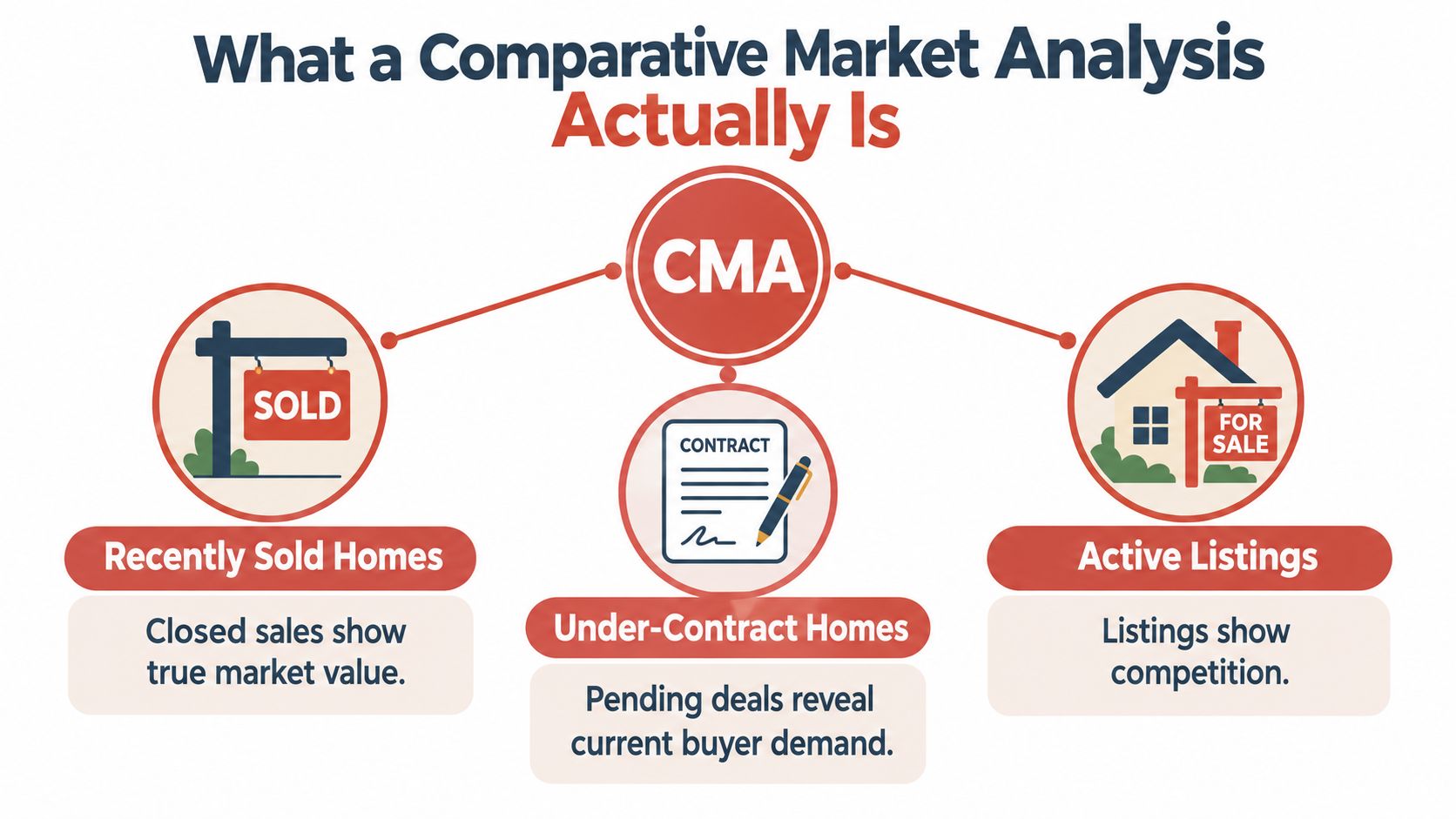
Say a western suburbs ranch competes with three nearby sales, one pending listing, and two active competitors. The closed sales show what buyers did. The pending home hints at what they are doing right now. The actives set the ceiling and the pressure: if those homes sit while new listings appear, the subject cannot borrow their optimism. If they go under contract quickly, the range can move faster than a cautious seller expects.
The comparison rests on the sales comparison approach. I weigh closed transactions most heavily because they are finished outcomes, treat pendings as a current-demand check, and read actives as competition rather than proof of value. The same set of homes can support different decisions depending on condition and timing: a dated attached townhome and a detached colonial may share a ZIP code and still need different pricing paths.
That discipline lines up with Fannie Mae's comparable-sales guidance, which points appraisal analysis toward location, physical characteristics, transaction conditions, financing concessions, and market conditions, plus the subject property's three-year sales history and each comparable's 12-month sales history. A CMA is not an appraisal, but those checks keep the evidence honest.
For the wider framework, this guide to property valuation explains where a CMA fits beside other valuation methods. The report earns trust when you can trace each choice: why this sale counts, why that one needs caution, and how the final range changes if the market speeds up or slows down.
The Data Sources Behind a Defensible CMA
A polished report can still contain weak evidence. The important question isn't how many properties appear in it, but whether the agent verified the information needed to interpret them.
The source-identification principle in the comparable-sales guidance above is straightforward: name the actual records or providers used. Public records is too broad when the reader needs to distinguish a deed entry from a tax assessment record.

Match the source to the question
| Information source | What to examine | What still needs checking |
|---|---|---|
| Local multiple-listing service | Listing history, reported property details, transaction status, photographs | Missing details, inconsistent measurements, or incomplete concession information |
| Deed records | Recorded transfers and ownership history | Whether the transfer represents a comparable market transaction |
| Tax records | Recorded characteristics and tax information | Whether the recorded description reflects the home's current configuration |
| Listing-agent verification | Clarification of condition, terms, and transaction context | Which details can be confirmed rather than assumed |
| Competing listings | Available alternatives and asking-price positioning | Whether buyers will accept those asking prices |
For an outdated or inherited home, the gap between the record and the property deserves particular attention. A listing description that says “updated” doesn't tell you whether the work was cosmetic, complete, or comparable to the subject home's needs.
A source can be reliable without answering every question you need to ask.
The report should also separate verified information, reasonable inference, and unknown information. If a pending contract's final terms aren't available, the agent shouldn't treat the asking price as the eventual closing price.
Ask what happens when sources disagree. An unexplained square-footage discrepancy or uncertain condition description can affect which properties deserve the most weight.
Transparency doesn't require burying the client in documents. It requires enough detail to understand where the evidence came from, what it establishes, and which unanswered questions could change the recommendation.
How Adjustments Work and Why Percentages Can Mislead
The right adjustment question is not, “What did this feature cost?” It's, “What does the available evidence suggest buyers paid for this difference?”
Suppose the subject home has a recently updated kitchen while a comparable has older finishes. Adding the renovation invoice to the comparable's sale price would confuse the seller's expenditure with the buyer's valuation. Ignoring the difference would be equally unhelpful.
Fannie Mae's adjustment guidance requires market-supported adjustments and illustrates why an overall 7% appreciation trend doesn't justify applying an identical adjustment to every comparable. Each transaction has its own relevant timing and market context.
Build an adjustment ledger
A useful ledger identifies the difference, explains the evidence, and records the uncertainty. It shouldn't conceal judgment behind a precise-looking formula.
Common CMA Adjustments and Their Evidence
| Adjustment | What It Captures | Evidence Source |
|---|---|---|
| Condition | Differences in maintenance, finishes, and renovation level | Paired sales, listing photographs, verified property descriptions |
| Living area and layout | Buyer response to usable space and functional differences | Similar local sales with documented size and layout differences |
| Location and lot setting | Differences involving street exposure, placement, or surroundings | Nearby transactions and competing properties |
| Market timing | Price movement between the comparable's contract date and the valuation date | Repeat-sales trends and relevant local transaction evidence |
| Seller concessions | The portion of price attributable to negotiated assistance | Verified closing terms and documented concession patterns |
Paired-sales analysis means comparing sufficiently similar transactions to investigate a particular difference. It's useful only to the extent that the properties and circumstances allow a meaningful comparison.
Concessions need similar care. Under the adjustment guidance, seller-paid assistance shouldn't automatically be subtracted dollar-for-dollar; the analyst should estimate the portion of the price attributable to that assistance.
Keep broad trends in their proper role
The Federal Housing Finance Agency's House Price Index methodology uses repeat transactions or refinancings involving the same single-family properties. That approach helps distinguish market movement from changes in the mix of homes sold, but it doesn't replace neighborhood-level analysis.
A regional trend can inform the investigation. It can't, by itself, establish the adjustment for a particular block, condition category, or property type.
When evidence is thin, a wider range with a clear explanation is more useful than an unsupported adjustment carried to an impressive-looking level of precision.
Why Detached and Attached Homes Need Different Reads
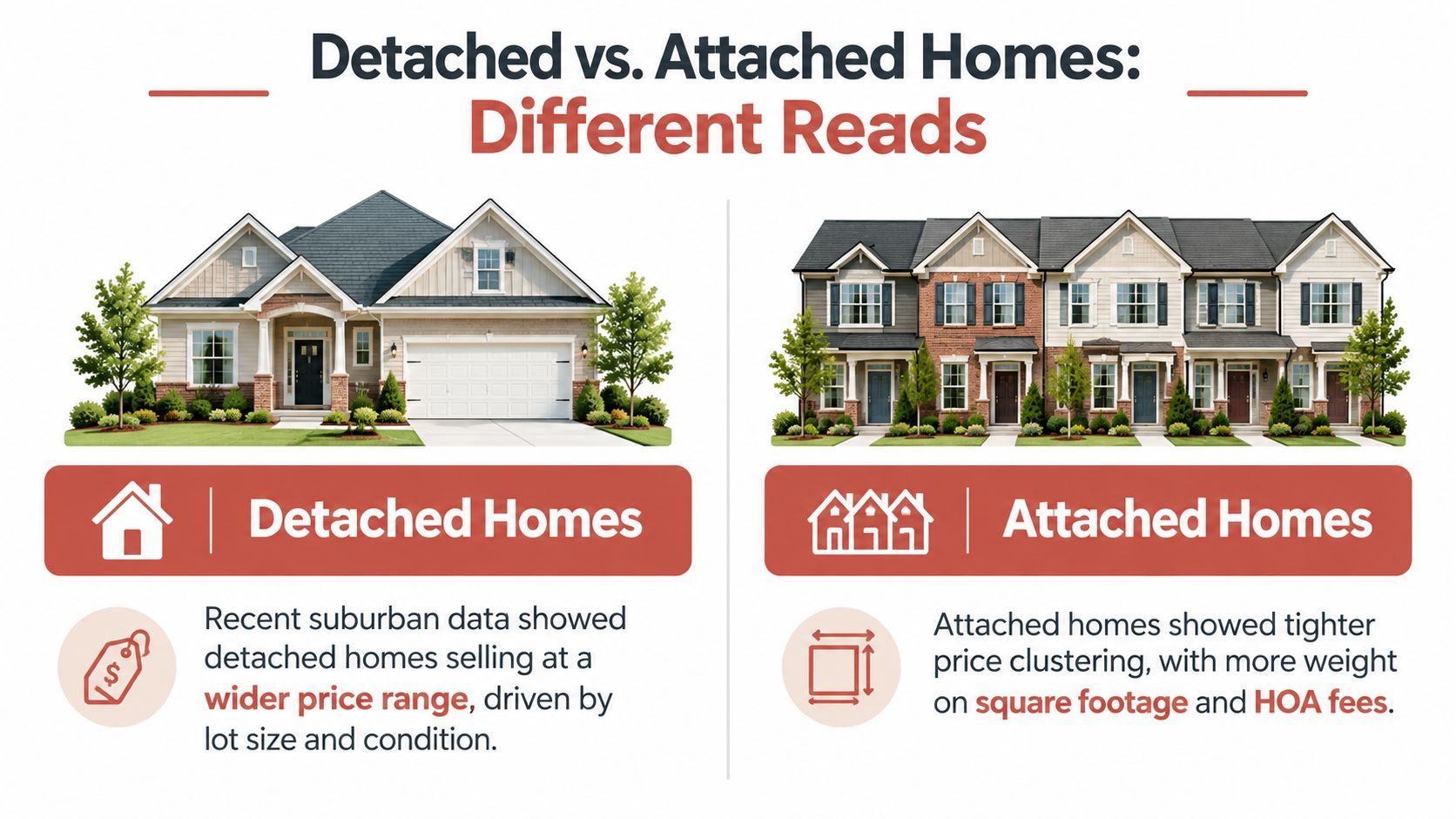
A townhome seller watches the detached colonial across the street go under contract in a week and assumes the same demand applies to her unit. It usually doesn't. The two properties share a ZIP code, but their buyers are comparing different things, and a CMA that treats proximity as equivalence will misprice one of them.
In recent MRED data for the western suburbs, detached prices rose about 7% year over year while attached homes rose closer to 4% and took longer to sell. That gap describes one market snapshot, not a permanent relationship or a forecast for an individual property.
What each buyer pool actually weighs
For a detached home, the investigation runs through the lot, the garage, exterior maintenance demands, and interior condition measured against other available houses. For an attached unit, it runs through monthly assessments, the building's financial and physical context, and the competing units a buyer could tour in the same afternoon.
None of these factors is an automatic premium or deduction. Each is a question the agent should answer before choosing the comparison set.
Consider a move-up buyer deciding between an updated townhome and an older detached house. The townhome may need less immediate interior work. The house may offer outdoor space the buyer values. A broad suburban median resolves none of that trade-off, and cross-category comparables only earn a place in the report when the agent can explain why the same buyer would consider both.
When the evidence runs thin
The practical test is whether the report separated detached and attached transactions before drawing conclusions, and whether the final comparables reflect the subject home's actual buyer alternatives.
Sometimes same-type evidence is scarce. A careful agent says so and widens the indicated range rather than blending unlike properties into a tidy average. The less alike the properties, the more careful the explanation has to be.
How Buyers and Sellers Should Read a CMA Report
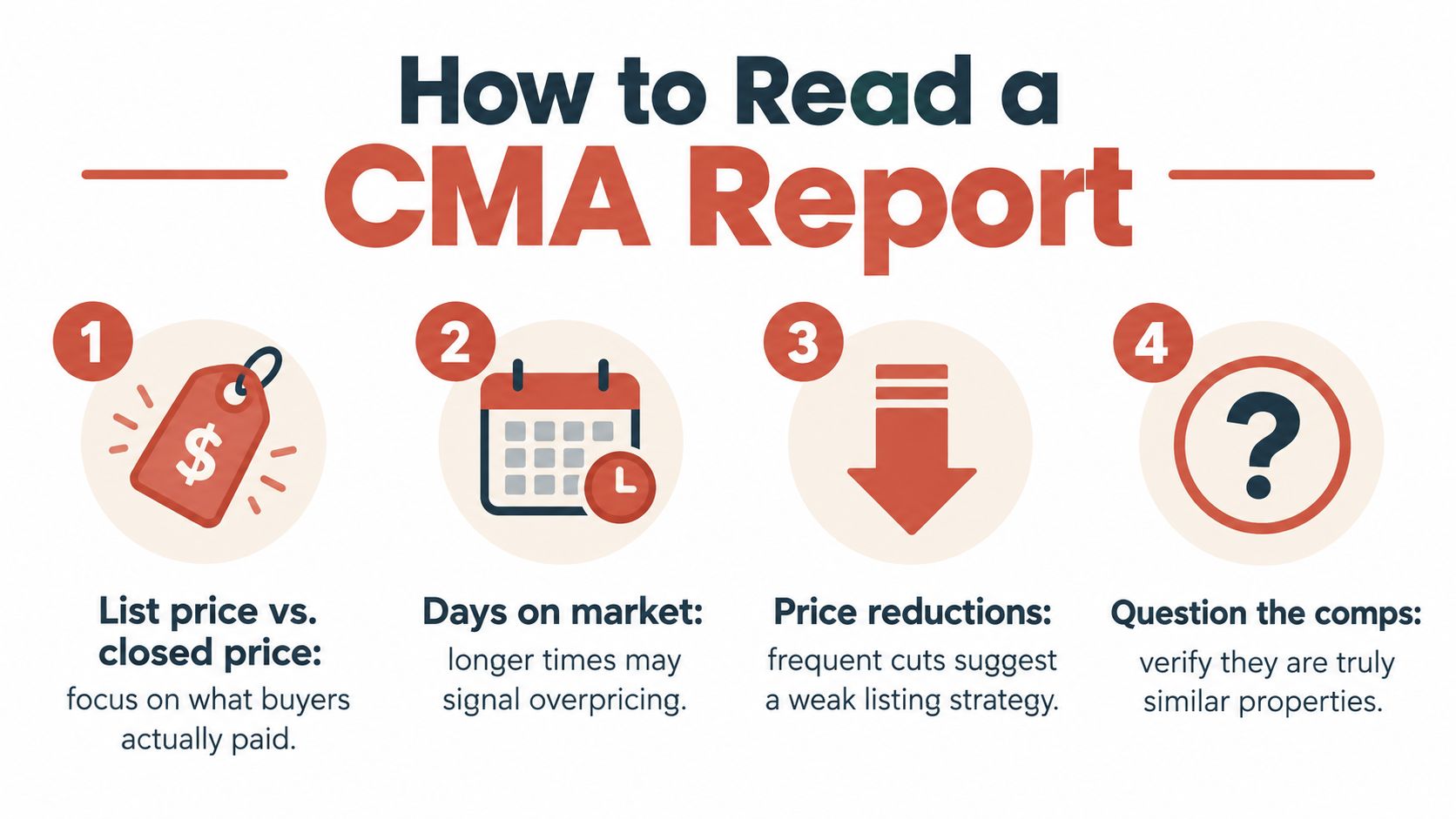
Start with the status of each property, not the most appealing price. An asking price is a proposal; a closed price documents a completed agreement. A pending listing belongs between them, with any unavailable terms clearly marked.
Next, read the pricing history alongside market time. A property that attracted interest after a reduction tells a different story from one that found a buyer at its initial asking price. Don't assume that a long listing period proves a particular discount without investigating condition, access, and transaction history.
Request scenarios rather than a promise
The Illinois REALTORS June market report reports a June 2026 Chicago-metro snapshot with inventory down 14.4% year over year to 12,832 homes, a median price up 4.6% to $407,000, and suburban inventory at 1.5 months. Treat that as dated context, not proof of conditions when you're ready to transact.
For your property, ask the agent to develop distinct paths:
- Market-priced. Position the home within the supported range and document the expected negotiation assumptions.
- Aggressive. Test a higher position with a defined review point and an explicit explanation of what buyer response would justify staying there.
- Conservative. Prioritize a more accessible asking position or simpler sale process, while acknowledging the potential price trade-off.
Each path should address expected market time, possible concessions, inspection credits, carrying costs, and probable net proceeds without pretending those outcomes are guaranteed.
Bring better questions to the conversation
Ask which comparable deserves the most weight, which assumption is least certain, and what new evidence would change the conclusion. Buyers can connect those answers to these real estate negotiation tips for buyers when deciding how price and terms should work together.
If you're also evaluating the presentation plan, LiveDocument real estate video metrics offers a related resource for discussing walkthrough content. Keep that discussion separate from valuation: marketing engagement shouldn't be treated as comparable-sale evidence.
Before you act: Ask the agent to explain not only the recommendation, but also the conditions under which they'd revise it.
The Case Against Pricing 3 Percent Above the Range
A seller in Glen Ellyn adds 3% to the top of the comparable-sales range to leave room for negotiation. Six weeks later the home has taken one price cut, and the contract that finally comes together lands near the bottom of the original range. I have watched that sequence repeat often enough across the western suburbs to treat the cushion as a decision with a cost, not a free option.
A useful sensitivity test before listing is whether pricing 3% above or below the comparable-sales range changes the seller's likely net outcome. Run both directions. A premium earns its place only when the home offers something the strongest comparables lack, such as a finished lower level, a larger lot, or recently replaced mechanicals. Scarcity across the neighborhood describes the market rather than the property, and the budget for the seller's next purchase says nothing about what this one is worth.
Put the two positions side by side and the trade-off sharpens:
| Priced inside the range | Priced 3% above | |
|---|---|---|
| Search exposure | Reaches buyers filtering at the right bracket | Can sit beside better-conditioned competition |
| Early signal | Showings and offers confirm or challenge quickly | Slow traffic stays ambiguous longer |
| Risk carried | Negotiation from a supported number | Reductions, added carrying costs, possible appraisal dispute |
An unsupported premium can extend market time, force later reductions, or invite a financing-related valuation fight. Those are risks to weigh, not outcomes any agent should promise or dismiss.
The highest conceivable contract price and the strongest probable net result are rarely the same number. Pick the position whose assumptions you can defend and whose downside you can carry.
How Homes By Carmen Builds a CMA for Western Chicagoland
For a western-suburban CMA, local MLS access through Midwest Real Estate Data (MRED) supports the property search, but the service needs to go beyond exporting a list. The work connects the selected evidence with the home's condition, the client's objectives, and the decisions ahead.
The publisher's seller services include comparable analysis, pricing strategy, listing coordination, offer negotiation, and transaction oversight. Its complimentary valuation and strategy consultation provides a starting point for prospective sellers in Melrose Park and surrounding communities, including Elmhurst, Downers Grove, Naperville, Oak Park, and Glen Ellyn.
Turn the report into a working plan
For sellers, bring repair concerns, improvement records, and timing requirements to the conversation. For buyers, bring the property you're considering, your financing constraints, and the terms you're prepared to offer.
Relocating households can also compare Chicago neighborhoods with ReloMaps while narrowing their search. Use that broader orientation to frame questions, then rely on property-specific analysis for the pricing decision.
A useful consultation should leave you able to:
- Understand the range. Know which properties support it and where uncertainty remains.
- Choose a path. Connect the recommendation to preparation, timing, or offer terms.
- Recognize a reason to reassess. Identify the new information that would justify changing course.
Homes By Carmen offers a complimentary property valuation and strategy consultation to help connect comparable sales with your home's condition and your next move. Visit Homes By Carmen to request a consultation or access the Buyers Guide or Sellers Guide, and bring your address, improvement history, and target timeline so the conversation starts with your actual situation.