
Since August 17, 2024, sellers no longer advertise a buyer-agent fee through the MLS, and buyers generally must agree in writing to compensation before touring a home. The fee might be paid by the buyer, requested from the seller as a concession, contributed by the listing broker, or handled through a combination of those options.
You're scrolling through homes in Melrose Park, Elmhurst, or Oak Park, finally find a property worth seeing, and then your agent sends over a buyer representation agreement. The document asks how the agent will be paid, how long the relationship lasts, and what happens if the seller doesn't cover the agreed amount.
That conversation can feel uncomfortable, especially if you're buying your first home. It shouldn't. Buyer-agent compensation is now part of your offer strategy and cash-to-close planning, not a detail to discover after you've toured several properties. The right agreement connects the fee to the actual work you need, the neighborhoods you're considering, and the amount of cash you can bring to closing.
Table of Contents
- What Changed for Chicago Buyers in 2024
- How Buyer Agent Compensation Used to Work
- The Four Ways Buyers Can Fund a Buyer Agent Today
- Percentage vs Flat Fee vs Hourly and Hybrid Models
- What to Ask Before You Sign a Buyer Agreement
- How Compensation Shapes Your Offer Strategy
- Why Fees Did Not Collapse and What Buyers Should Expect Next
What Changed for Chicago Buyers in 2024
A first-time buyer looking at a bungalow in Melrose Park may expect to tour the home first and discuss commissions later. Since August 17, 2024, the order has changed. Under the National Association of Realtors settlement framework, a buyer generally signs a written representation agreement before touring homes, and the agreement must state the compensation amount or an objective method for calculating it. The NAR explanation of the settlement describes the required written agreement and the removal of buyer-agent compensation offers from MLS platforms.

Before the change, buyers commonly saw a seller-paid buyer-agent offer communicated through the MLS. The buyer's agent was often compensated from the overall brokerage payment negotiated by the seller. The buyer still financed the transaction through the purchase price and other costs, but the payment conversation usually happened behind the scenes.
Today, the seller may still contribute, but that contribution isn't automatically advertised through the MLS or guaranteed for every property. You and your agent need to discuss the fee before the first tour, then decide how to address it in an offer if the seller's contribution doesn't cover the agreed amount.
Practical rule: Don't sign a buyer agreement until you understand the exact fee, who may pay it, what services it covers, and what you could owe if the seller contributes less.
That change matters in western Chicagoland because a buyer can't reliably compare listings by looking for a published buyer-agent fee. The agreement with your agent becomes the starting point, while the purchase offer becomes the place where seller contributions and other credits may be negotiated.
The settlement did not create a universal commission rate. Compensation remains negotiable, and the payment source can affect your offer, financing plan, and cash needed at closing. A clear pre-tour conversation prevents a common problem: finding the right house first, then discovering that the payment structure doesn't fit your budget.
How Buyer Agent Compensation Used to Work
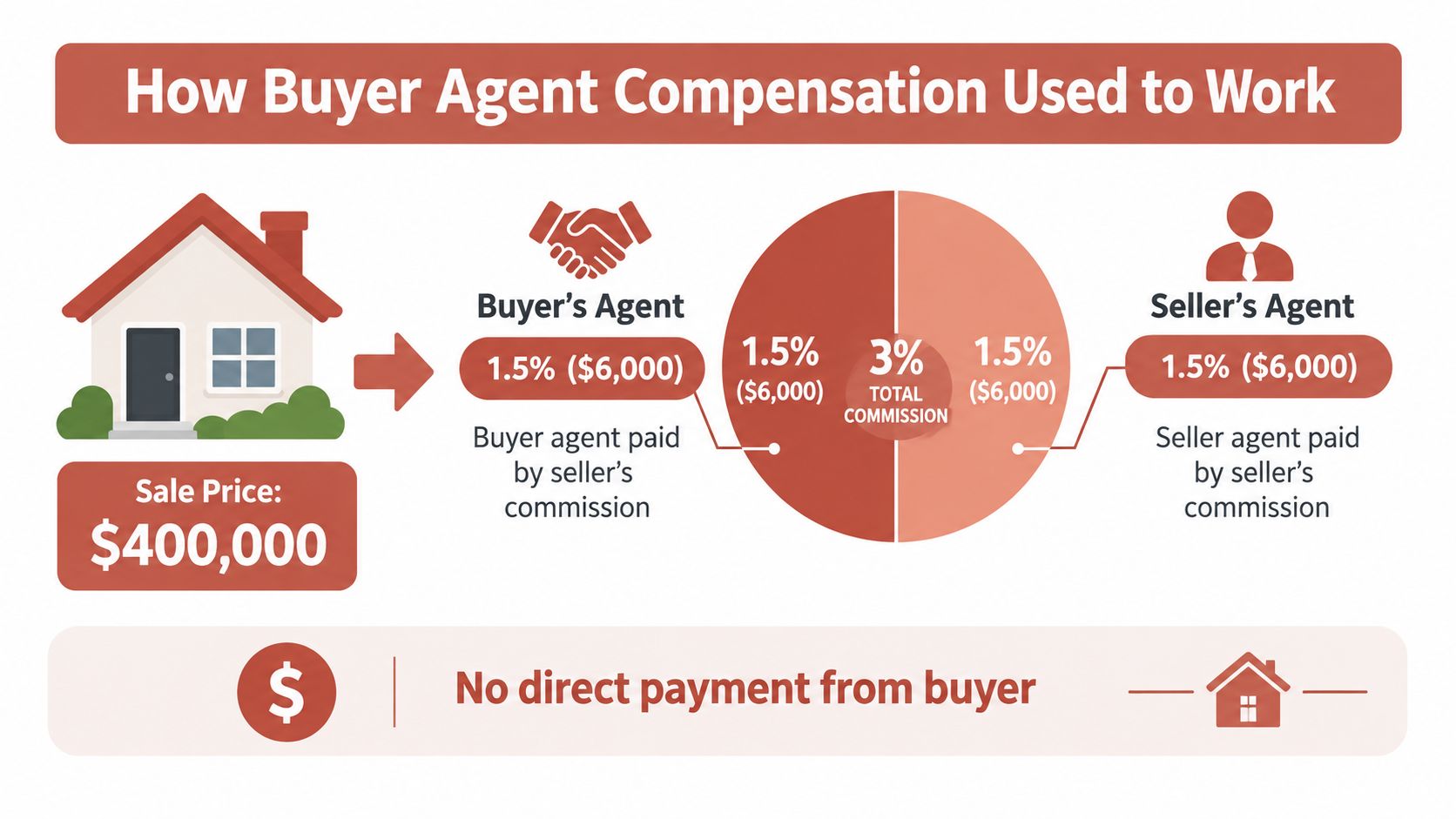
The traditional model was usually percentage-based. The buyer's agent received compensation from the overall brokerage payment negotiated by the seller, with the buyer agent's share commonly around 3% of the sale price, according to the Federal Reserve Bank of Richmond analysis of real estate commissions.
The math was straightforward:
- A $300,000 home at 3% produced $9,000 in buyer-agent compensation.
- A $450,000 home at 3% produced $13,500.
- A $600,000 home at 3% produced $18,000.
The phrase “seller-paid” described the payment route, not the ultimate economics. The seller's brokerage compensation came from the transaction, and the buyer paid the purchase price that supported the transaction. That doesn't mean the buyer wrote a separate check for the agent at closing, but it also doesn't mean representation had no economic cost.
The percentage wasn't identical everywhere. Historical data summarized by the Richmond Federal Reserve show that the national average advertised buyer-agent commission gradually declined from about 3.0% in the late 1990s to approximately 2.7% before the 2024 changes. The same research notes variation across metropolitan areas, properties, brokerage arrangements, and market conditions, so a national figure shouldn't be treated as a Chicago quote.
Why the old benchmark still matters
The old percentage model gives you a reference point, not a rule. For example, on a $400,000 home, 3% equals $12,000, while 2.7% equals $10,800, as the Richmond Federal Reserve illustrates. A difference that looks small on paper can materially change the cost of a transaction.
The model also tied payment to the home price rather than directly to the agent's workload. A buyer who needed a short search and a straightforward offer could generate the same percentage fee as a buyer who required months of tours, complex negotiations, inspection coordination, and relocation support.
The post-2024 framework replaced the MLS-displayed seller offer with a written, pre-tour compensation agreement. That gives buyers a better opportunity to compare services and payment structures, but it also means you need to understand the agreement before you start touring.
The Four Ways Buyers Can Fund a Buyer Agent Today
On a $475,000 purchase, the payment structure affects both your offer and the amount of money you may need to bring to closing. The agreement might establish a fee paid directly by you, a seller contribution requested in the offer, a contribution from the listing broker, or a combination.
| Structure | Buyer Pays | Seller Concession | Cash to Close Effect |
|---|---|---|---|
| Buyer pays directly | The agreed fee from personal funds or closing funds | None required | Increases the buyer's required funds unless another cost is reduced |
| Seller concession | Any shortfall after the seller's agreed contribution | Requested in the purchase offer | May reduce buyer-paid cash, subject to loan-program and seller-credit limits |
| Listing-broker portion | Potentially none or a reduced balance, depending on the agreed arrangement | Not required for that portion | Can lower the buyer's balance, but the amount must be confirmed and documented |
| Hybrid structure | A negotiated portion of the fee | Seller or listing broker covers another portion | Splits the funding burden and may preserve flexibility in the offer |
Buyer-paid compensation
If your agreement calls for a fee paid directly by you, treat it as part of the same cash planning exercise as your down payment, inspection costs, lender charges, title expenses, and other closing items. A buyer-funded fee can make an otherwise affordable home harder to purchase if your available cash is already committed.
This structure can be clean and predictable. You know what you owe regardless of the seller's preferences, but you also carry the full shortfall if the property's seller refuses to contribute.
Seller concession
You can request that the seller provide a concession toward the agreed compensation. The seller might accept, reject, or counter that request. A concession can reduce your immediate cash requirement, but it may compete with requests for closing costs, inspection repairs, or other credits.
Loan-program rules also matter. A lender must confirm whether the proposed seller-paid amount fits the applicable limits and whether the credit can be used for the specific expense. Don't assume that a seller concession automatically becomes cash back to you.
Listing-broker contribution
The listing broker may agree to contribute part of the compensation from the brokerage arrangement, depending on the transaction and the agreements involved. That contribution should be identified clearly, with the remaining amount shown in your buyer agreement.
Hybrid funding
A hybrid arrangement can combine a seller concession, a listing-broker contribution, and a buyer-paid balance. It can help when a seller won't cover the entire fee but remains open to making the offer work.
For percentage calculations and side-by-side dollar scenarios, a RealEstateCRM commission calculator can help you model the fee before discussing the offer. Use the result as a planning estimate, then rely on the written agreement and lender guidance for the final structure. Buyers can also review practical questions about representation in this guide to questions to ask a real estate agent.
Percentage vs Flat Fee vs Hourly and Hybrid Models
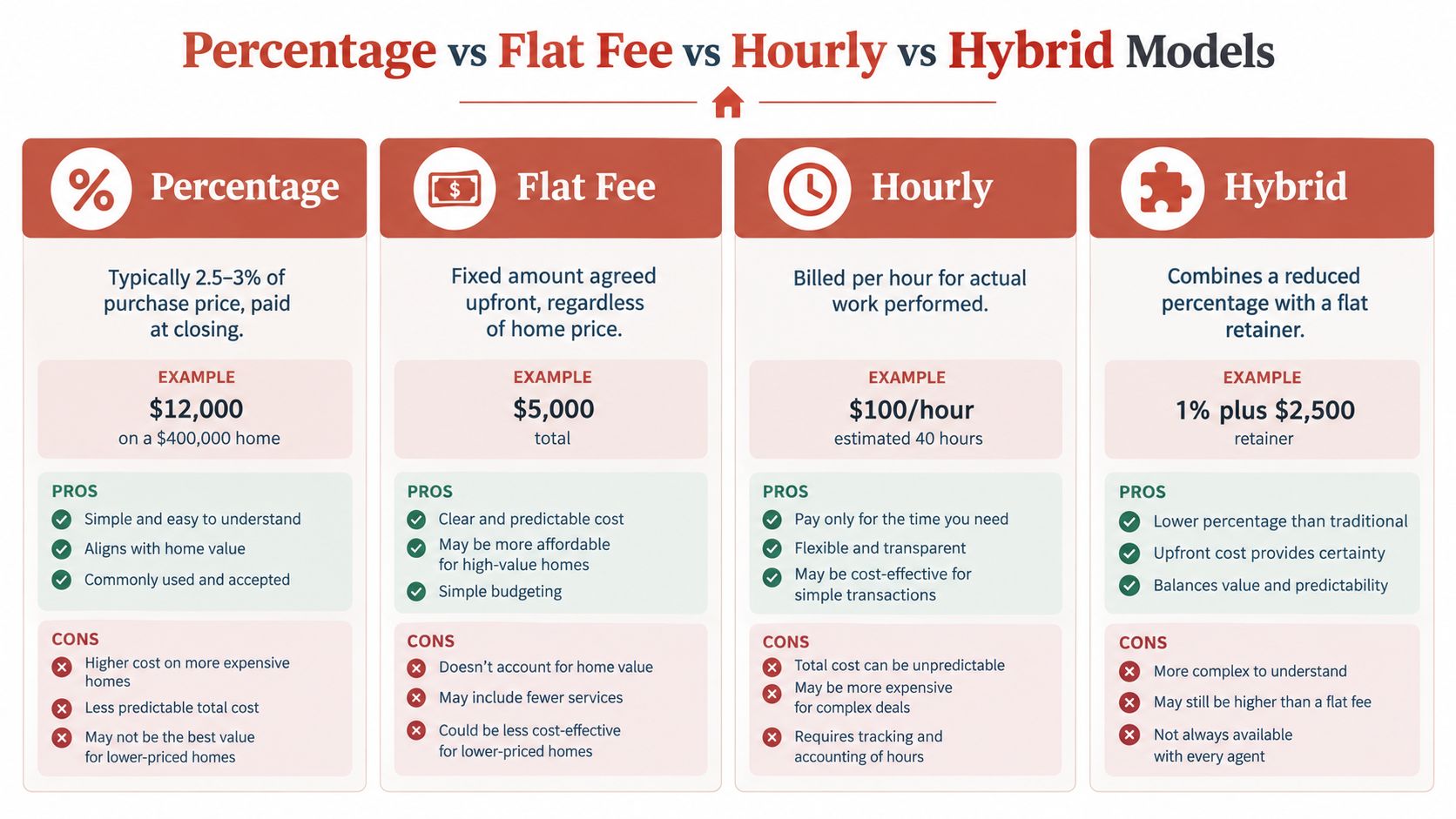
A percentage fee is easy to calculate, but ease isn't the same as fairness. The right structure depends on how much work your search requires, how long you expect the process to last, and what happens if the transaction doesn't close.
The Federal Reserve research on broker compensation and search incentives explains why price-linked compensation can influence service levels and search duration. Its analysis gives buyers a useful question: Does the proposed fee match the services and risk involved in this particular search?
Percentage model
A percentage works well when the agent provides broad support from search through closing and the buyer wants a fee tied to the transaction. It can cover listing research, tours, comparable analysis, offer preparation, negotiation, inspection coordination, appraisal issues, and closing support.
The drawback is that the fee rises with the home price even when the service workload doesn't rise at the same pace. Ask whether the agreement explains what happens if the seller pays less than the agreed amount or if the transaction fails.
Flat fee
A flat fee gives you a fixed amount before you begin. It can be easier to budget and may suit a buyer with a focused search, a clear target area, or limited assistance needs.
Read the service description carefully. A lower flat fee may exclude additional tours, complex negotiations, inspection attendance, relocation support, or work after a failed contract.
Hourly model
Hourly billing connects payment to time spent. It may suit a buyer who already understands the market and wants help with selected tasks, such as reviewing an offer or negotiating inspection items.
The agreement should explain how time is recorded, whether calls and emails count, and whether there is an estimated range. Without those details, hourly billing can make the final cost difficult to predict.
Hybrid model
A hybrid arrangement combines structures, such as a reduced percentage and a fixed retainer. It can balance predictable upfront payment with compensation for closing work.
Ask what happens if you terminate the relationship, switch agents, buy directly from a seller, or purchase a property introduced by another agent. The agreement should address those outcomes instead of leaving them to an argument later.
What to Ask Before You Sign a Buyer Agreement
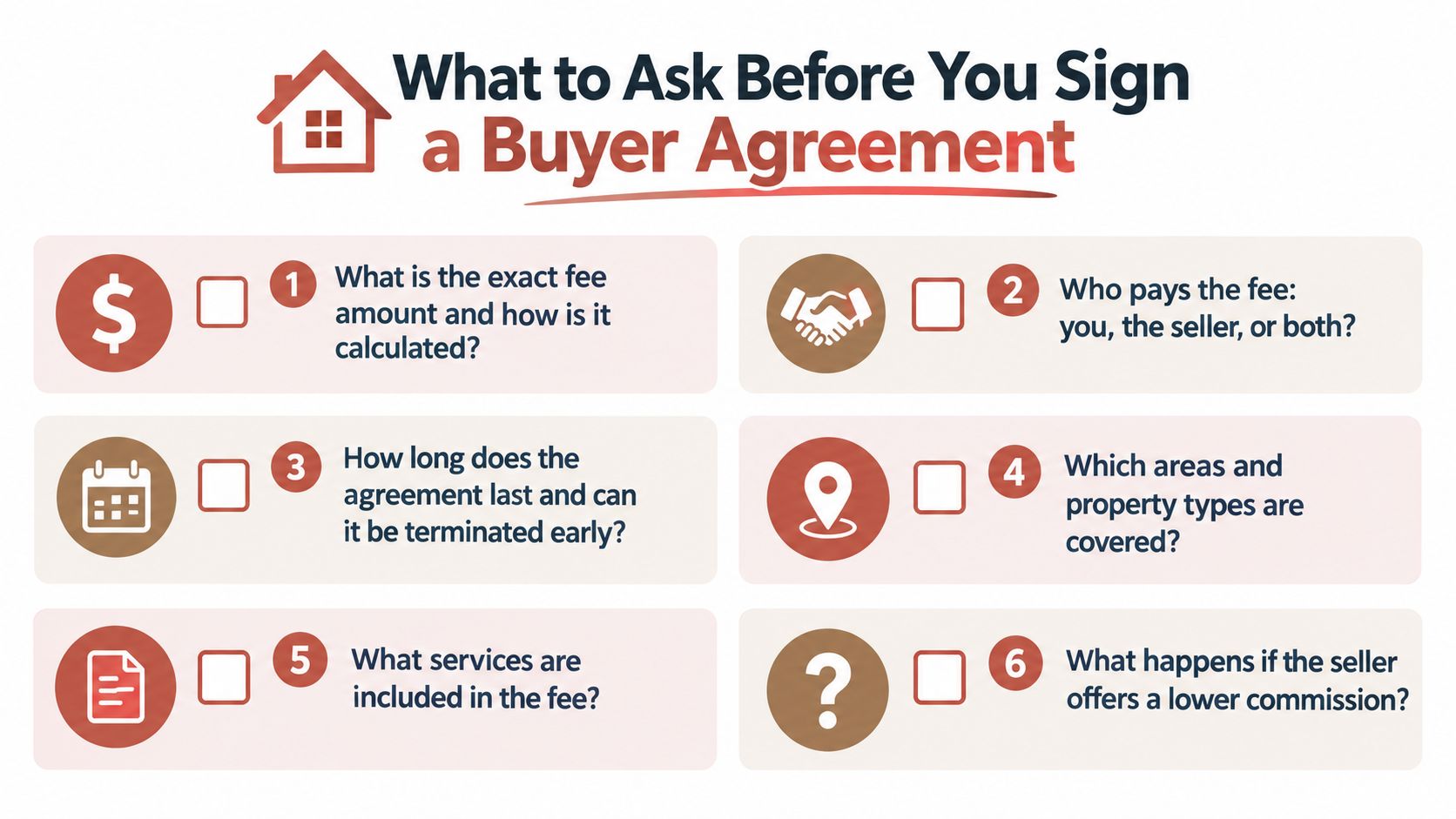
The agreement should answer practical questions in plain language. If you need a verbal explanation, ask the agent to connect that explanation to the exact paragraph in the document.
Confirm the money
Ask for the exact dollar amount, percentage, flat fee, hourly rate, or formula. Then ask how the agreement treats a seller contribution that is lower than the agreed compensation.
- Fee amount: Is the fee calculated from the purchase price, paid as a fixed amount, billed hourly, or combined?
- Payment source: Can the seller contribute, can the listing broker contribute, and what balance would you owe?
- Timing: When is compensation earned, and when is it payable?
Don't accept an open-ended phrase such as “market compensation” without an objective method. The agreement should let you calculate the maximum obligation.
Define the relationship
A buyer looking in Melrose Park, Elmhurst, or Naperville may not want an agreement covering every property type and suburb. Confirm the geographic area, property types, agreement term, and whether the arrangement is exclusive.
Ask whether the agreement can be terminated early and what notice is required. Also ask whether a protection period applies after termination if you later purchase a property introduced during the relationship.
For document terminology and examples, you can review general real estate agent agreement templates as a preparation aid, but your signed agreement is the document that controls. You can also compare the practical issues covered in this resource about a buyer-agent exclusive agreement.
Match services to the fee
Ask the agent to list what the fee includes. The answer should cover the work you expect, not only the phrase "full service."
- Search support: MLS search setup, property filtering, listing review, and scheduling.
- Touring: In-person tours, access coordination, and guidance during showings.
- Offer work: Comparable analysis, offer drafting, negotiation, and contingency strategy.
- Contract-to-close support: Inspection coordination, repair negotiation, appraisal communication, attorney or lender coordination, and closing preparation.
- Limits: Relocation support, new construction, auctions, for-sale-by-owner properties, rentals, and additional tours.
A professional answer doesn't require you to negotiate aggressively. It requires the agent to explain what you're buying.
How Compensation Shapes Your Offer Strategy
Buyer-agent compensation becomes a negotiation issue the moment you write an offer. A buyer-paid fee may reduce the cash available for the purchase, while a seller concession may compete with other credits the seller is considering.
Suppose two buyers are pursuing comparable homes with similar financing. Buyer A asks the seller for a concession toward the agreed buyer-agent compensation. Buyer B offers to fund the fee directly and requests a different credit for closing costs. Their headline prices could look similar, but their net economics and cash requirements are different.
The listing side may evaluate more than the offered price. A concession request can reduce the seller's proceeds or use credit capacity that might otherwise support repairs. A buyer-funded structure can look cleaner to the seller, but it may raise questions about the buyer's available reserves and ability to close.
Build the offer around verified numbers
Before writing, ask your lender and agent to model:
- The purchase price: What is the proposed price and estimated monthly payment?
- The compensation balance: What amount remains if the seller or listing broker contributes?
- The credit limits: Can the loan program accept the requested seller-paid amount?
- The competing credits: Will compensation be requested alongside closing-cost assistance or repair credits?
- Cash to close: How much money must be available after the down payment and other expenses?
A seller concession doesn't automatically solve the problem. The concession must be permitted, documented, and usable for the expense involved. If the seller won't contribute enough, your choices are to pay the balance, renegotiate the service scope or fee, revise the offer, or walk away if the economics no longer work.
A clear offer can still be competitive when it explains the requested credit and protects the buyer's ability to close. For broader offer tactics, review this guide on how to make a competitive offer on a house.
Why Fees Did Not Collapse and What Buyers Should Expect Next
The settlement changed the disclosure and negotiation mechanism, while buyer representation and agreed compensation remained part of the transaction. Removing compensation from the MLS did not automatically reduce the fee a buyer may owe or negotiate.
Industry tracking reported buyer-agent compensation rising from 2.36% in Q3 2024 to 2.42% in Q3 2025. The same report said about two-thirds of surveyed agents reported no significant change in fees, while 34% identified buyer-side compensation as their largest pressure point, according to reported compensation data and agent survey.
Representation remains common. NAR data for 2025 reported that 88% of buyers and 91% of sellers used a broker, as summarized in that source. Before touring homes, decide whether the proposed fee fits the services, your budget, and the likely payment source.
For a first-time buyer in Melrose Park or the western suburbs, calculate the fee at your target purchase price. Ask what the agreement includes, how much could be due from you, and whether the fee changes if the seller contributes. Have your lender review any concession's effect on the loan and cash to close.
Homes By Carmen helps western Chicagoland buyers evaluate homes, coordinate tours, prepare offers, and discuss compensation before they commit to a property. Visit Homes By Carmen for buyer guidance in Melrose Park, Elmhurst, Oak Park, Naperville, and nearby communities.