
A comparative market analysis is a broker's estimate of a property's likely sale price based on recent comparable sales in the same market area. In western Chicagoland, choosing the right neighborhood-level comps can matter more than applying a broad countywide average when you're deciding what to offer or how to price a home.
You may be a Melrose Park homeowner who just checked an online estimate, an Elmhurst seller preparing for a move, or a first-time buyer comparing homes in Oak Park and nearby suburbs. The number you found may not match the number an agent gives you. That doesn't automatically mean one is wrong. Each estimate may be answering a different question, using different data, and overlooking different details inside and around the property.
Table of Contents
- The Pricing Conversation Most Buyers and Sellers Get Wrong
- How a CMA Actually Works Behind the Scenes
- CMA vs Appraisal vs Online Estimate
- Running the Comps in MRED Step by Step
- The Factors That Move a CMA Value Up or Down
- Reading a CMA in Real Western Chicagoland Situations
- Putting a CMA to Work and Avoiding Costly Mistakes
The Pricing Conversation Most Buyers and Sellers Get Wrong
A Melrose Park homeowner pulls up an online estimate before calling an agent. The figure looks reassuring, so the homeowner starts planning around it. Then the agent reviews the bungalow, points out its condition, checks nearby closed sales, and produces a different range. The homeowner may hear that range as bad news, but the underlying issue is that the two figures were built for different purposes.
A comparative market analysis, or CMA, is an evidence-based estimate prepared by a broker or real estate licensee by comparing a subject property with recently sold homes that share relevant characteristics and the same market area. Massachusetts describes a CMA as an “unbiased estimate or opinion” prepared by a real estate licensee who isn't a licensed or certified appraiser, and its guidance generally points toward comparable properties with the same highest and proper use that sold within approximately the previous six months. Massachusetts CMA guidance provides the regulatory context.
That definition matters because a CMA is a pricing recommendation, not a guaranteed sale price. It also isn't a formal appraisal. A broker uses the analysis to estimate where a home may compete effectively, how buyers may react to its condition and features, and whether the seller's preferred price is supported by actual market evidence.
Why the number affects more than the listing
Price influences the entire transaction. It affects which buyers see the home as a reasonable option, how many competing properties they consider, how long the listing may remain exposed, and how much negotiating room exists after an offer arrives.
A seller who prices above the relevant competitive range may receive useful feedback, but that feedback can come through fewer showings and weaker offers. A seller who prices below the market may create attention, yet the resulting strategy only works if the seller understands the likely trade-off between speed, competition, and net proceeds.
For a buyer, the CMA provides a disciplined way to evaluate an asking price. A first-time buyer in Oak Park may be willing to compete for a well-maintained home, while a buyer considering an outdated property may need room for repairs. The same recent sales can support different decisions depending on financing, condition, timing, and tolerance for negotiation.
Practical rule: A CMA should help answer, “What would informed buyers likely pay for this home in this market?” It shouldn't answer only, “What is the highest price someone can imagine?”
Sellers who want a broader pricing framework can review this data-backed pricing guide for sellers. The useful takeaway is simple: a CMA is both a valuation tool and a pricing strategy. The quality of the decision depends on whether the analysis reflects the buyers competing for the property.
How a CMA Actually Works Behind the Scenes
A defensible CMA follows the sales comparison approach. The analyst starts with similar properties, identifies meaningful differences, and considers how buyers in that market would value those differences. Colorado's appraiser guidance describes this method as deriving a value indication by comparing similar properties, selecting appropriate units of comparison, and adjusting comparable sale prices for market-relevant differences. Colorado real-estate appraiser practice guidance explains the underlying valuation framework.
The analytical map
The process usually looks like this:
- Define the subject property. Record its location, property type, living area, room count, lot, age, condition, renovations, and other features that affect buyer demand.
- Define the market area. Identify the geographic area supplying most demand and containing most competition. That may be a neighborhood, a subdivision, or a buyer pool connected by schools, transit, housing style, and local expectations.
- Select closed comparables. Begin with recently sold homes that resemble the subject in physical and legal characteristics. Fannie Mae's sales-comparison guidance requires at least three closed comparable sales in the approach and emphasizes similarities such as site, room count, finished area, style, and condition. Fannie Mae comparable-sales guidance
- Study current competition. Active listings show what buyers can choose today. Pending sales can indicate where buyers have recently accepted a price, although their final terms may not yet be fully visible.
- Adjust and weigh the evidence. Compare the properties feature by feature, then give more weight to the sales requiring fewer and better-supported adjustments.
The result should be a supported range, not a mechanically averaged figure. One attractive sale can distort the conclusion if it has a superior renovation, a better street position, or unusual transaction terms.

Why market area beats a simple radius
A comp isn't automatically useful because it's close. A Melrose Park bungalow may compete with nearby bungalows that share buyer expectations, while an Elmhurst colonial may draw a different audience because of architectural style, lot pattern, school considerations, and neighborhood identity. A newer Naperville home may compete with other newer construction even when an older property is physically closer.
That's why a CMA is best understood as a structured argument. The broker is arguing that these sales represent the subject's likely alternatives, that the differences can be understood, and that the resulting range reflects current buyer behavior rather than a convenient average.
CMA vs Appraisal vs Online Estimate
These three tools may produce a number that looks similar, but they aren't interchangeable. A CMA supports a broker's pricing recommendation. A formal appraisal is an independent opinion of value prepared for a defined professional or lending purpose. An online estimate is a model-generated indication that may not account for what an in-person review reveals about condition, upgrades, layout, or street position.
| Dimension | Comparative Market Analysis | Formal Appraisal | Online Estimate |
|---|---|---|---|
| Who produces it | A broker or real estate licensee | A licensed or certified appraiser | A statistical valuation model |
| Primary purpose | Set a realistic list price or inform an offer | Support lending, fiduciary, or other formal valuation decisions | Provide a quick preliminary indication |
| Main evidence | Local closed sales, current competition, pending activity, and property-specific review | Comparable sales and recognized appraisal methodology | Available property and market data processed by an algorithm |
| Condition and upgrades | Can be evaluated directly by the broker | Can be evaluated by the appraiser under the assignment | May be incomplete or not reflected accurately |
| Legal status | Pricing recommendation, not a formal appraisal | Formal opinion of value for its intended use | Not a formal appraisal |
| Best use | Pricing and negotiation strategy | Financing or a situation requiring an appraisal | Early research and general orientation |
A CMA can be more useful than an online estimate when a home has a renovated kitchen, finished basement, deferred maintenance, unusual lot, or a location that changes its buyer pool. The broker can investigate why a comparable sold for its price instead of treating every recorded sale as an equivalent data point.
For readers who want more background on the valuation process, this guide to how appraisers select comps offers helpful context. The central distinction remains practical: an appraisal is not a more expensive CMA, and an online estimate isn't a substitute for either one.
A seller in Naperville may want a CMA before setting a list price, then need an appraisal later if a lender or another formal decision requires one. A buyer in Downers Grove may use an agent's analysis to decide whether an asking price is supported, while the lender's appraisal serves a different role in the loan process. For a broader explanation of property value, see this property valuation guide.
Running the Comps in MRED Step by Step
A broker running a CMA in Midwest Real Estate Data, or MRED, starts with the address, not with a favorite sale. The first task is to understand how that property competes. A map can reveal whether the subject sits near a neighborhood edge, a school boundary, a major road, a Metra station, or a transition between housing types.
Starting narrow, then widening carefully
The search typically begins with closed sales that match the subject's property type, architectural style, room configuration, finished area, condition, and immediate market area. If the initial set is too thin, the broker can widen the geographic or time boundaries, but the reason for widening should be documented.
The workflow often includes:
- Closed sales: These provide the strongest evidence of prices buyers and sellers completed.
- Pending sales: These offer clues about current price acceptance, although the final result may not yet be known.
- Active listings: These show the competition a buyer sees today and help explain whether the recommended price will stand out or blend into the market.
- Map review: The broker checks streets, boundaries, transit access, schools, lot patterns, and nearby influences that a simple distance filter may miss.
- Listing verification: Photos, remarks, disclosures, and transaction details help determine whether a comparable really resembles the subject.
A Melrose Park bungalow may need a tighter search around similar bungalow stock. An Elmhurst colonial may be weighed against homes sharing a comparable neighborhood and buyer profile, rather than against every nearby detached home. For a newer Naperville property, age, construction quality, and subdivision competition may carry more weight than raw proximity.
The time spent on a CMA is mostly spent choosing, checking, and interpreting comps. The software can retrieve records quickly. It can't decide whether a nearby sale had a superior renovation package, a difficult street position, or a buyer pool that doesn't overlap with the subject.
Public property data can supplement an MLS review when an analyst needs another way to organize records. For technical users, resources explaining how to fetch Zillow data by property ID show how property information may be accessed programmatically, but data retrieval still isn't the same as local comp judgment. Buyers who want to understand the search side can also review this guide to searching the MLS.
The Factors That Move a CMA Value Up or Down
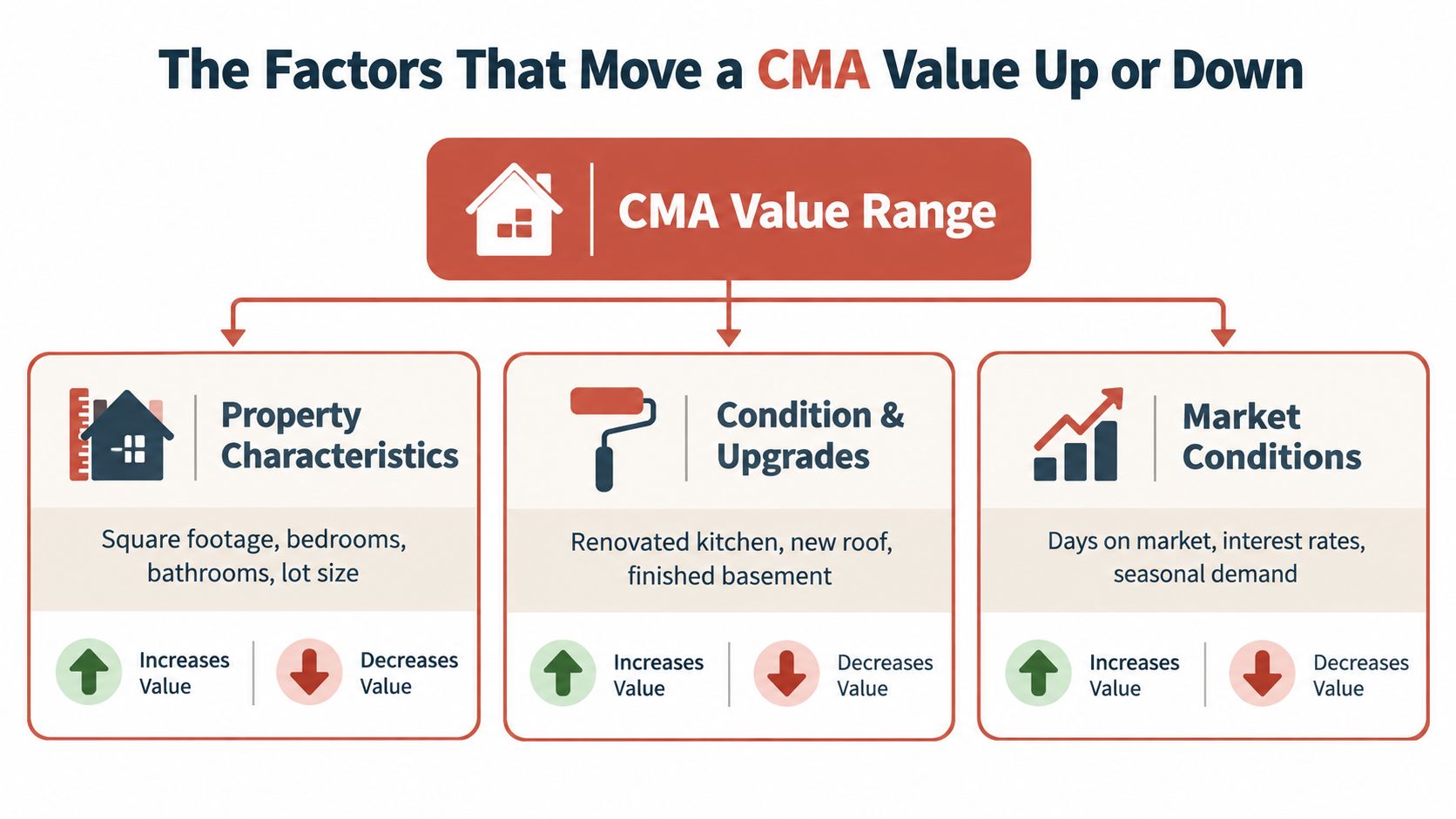
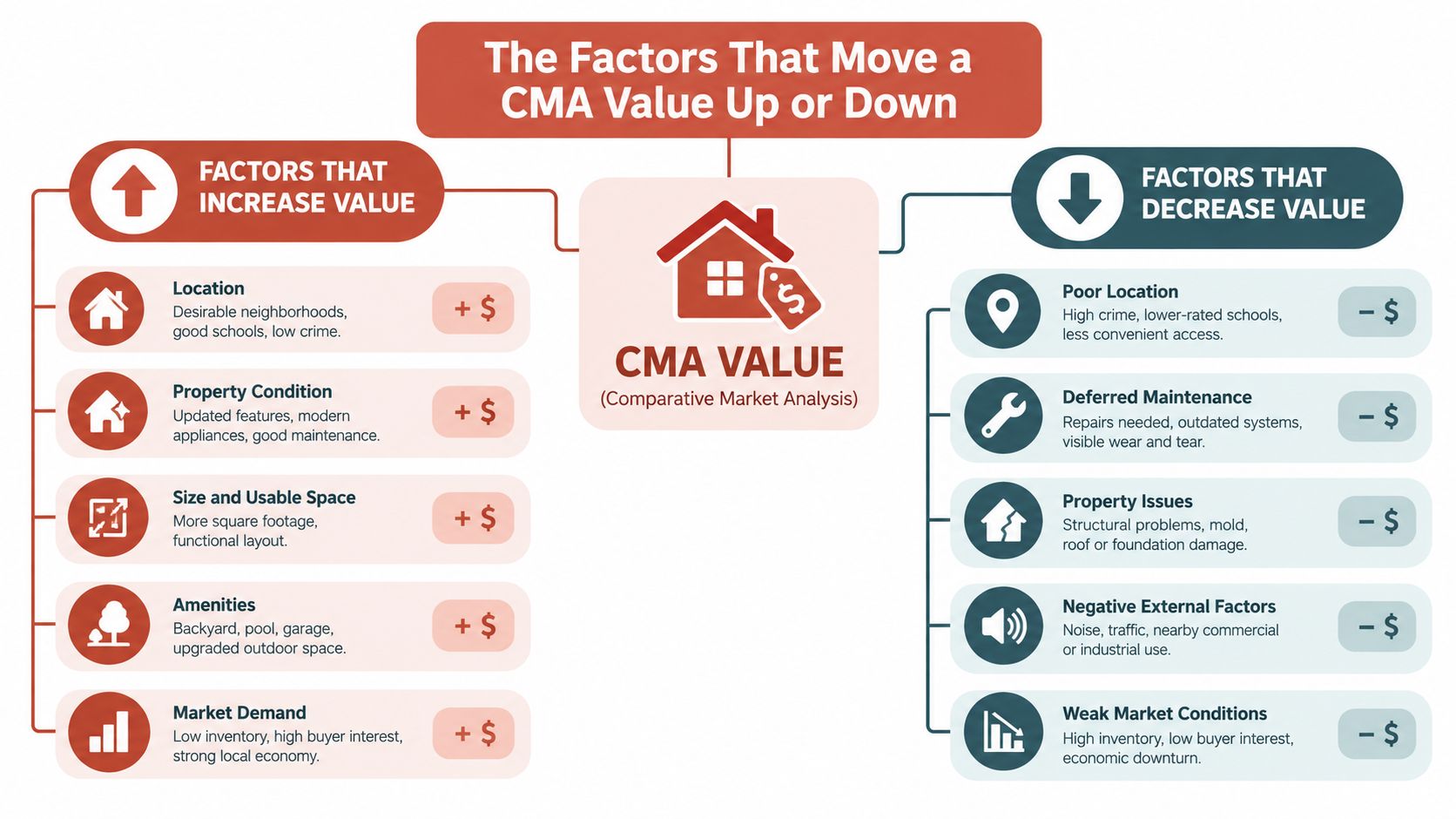
Two homes with similar living area can attract very different offers. The difference usually comes from the features buyers notice quickly and the risks they expect to absorb after closing.
Condition creates the first adjustment
A renovated kitchen doesn't automatically justify a fixed premium. Its contribution depends on quality, consistency with the rest of the home, workmanship, and what buyers in that market consider move-in ready. A comparable with a dated kitchen may still be useful, but its sale price can't be treated as equivalent to a property with a cohesive renovation.
The same applies to roofs, windows, mechanical systems, bathrooms, flooring, and visible maintenance. A broker should describe the difference and connect it to market evidence rather than apply an unsupported percentage. The adjustment is an estimate of buyer reaction, not an accounting entry.
Finished basements require particular care. Buyers may value usable finished space, but it may not carry the same weight as above-grade living area. Ceiling height, natural light, finish quality, permits, layout, and access all affect how the space competes.
Features matter in combination
A garage, lot, bathroom count, and overall layout can change the buyer pool. In western Chicagoland, a garage may be especially meaningful where buyers compare homes partly on storage, winter convenience, and off-street parking. Lot size and orientation can matter when the yard is usable, private, and well matched to the home, but a larger lot doesn't automatically create equal value if it is difficult to use or affected by a nearby road.
The most useful adjustment questions are specific:
- What differs physically? Note the extra bathroom, garage space, finished basement, lot characteristic, or renovation.
- What differs in condition? Separate maintained, dated, renovated, and fully updated homes instead of grouping them together.
- What did the transaction include? Review credits, concessions, and other terms that may have influenced the recorded price.
- What did buyers choose? Give greater weight to sales where buyer response supports the interpretation.
If a comparable included a seller-funded credit that increased its contract price, the analyst should adjust the comparable downward by the portion attributable to that concession. Treating the gross price as identical to an unassisted sale can overstate the subject's likely value.
Timing changes the meaning of an older sale
A sale from an earlier period may need a positive or negative time adjustment if prices changed between the comparable's contract date and the CMA date. That adjustment should be supported by market evidence and explained clearly. A fast-moving Naperville or Glen Ellyn segment can make timing more consequential, while a slower segment may require a different interpretation.
Fannie Mae states that there are no fixed acceptable limits for total net or gross adjustments, and the size of an adjustment alone doesn't determine whether a comparable is appropriate. Fannie Mae adjustment guidance supports a better standard: document each adjustment, verify the transaction terms, and rely most heavily on comparables that require the fewest market-supported changes.
Reading a CMA in Real Western Chicagoland Situations
Consider a first-time buyer evaluating a Melrose Park bungalow. The analysis shows a value range supported by nearby sales, but the subject has an older kitchen and less finished space than the strongest comparable. The buyer shouldn't automatically offer at the top of the range. A more disciplined offer reflects the home's actual condition, the strength of current competition, and the buyer's willingness to handle future work.
A seller faces the same evidence from the opposite direction. An Elmhurst homeowner with a larger colonial may see one high sale and assume it establishes the asking price. But if that sale had better updates, a more desirable lot, or fewer competing alternatives, it may be a weak anchor. The seller's recommended list price should reflect the subject's position against the homes buyers can choose now, not just the most flattering closed transaction.

Read the range as a decision tool
The low end may fit a property needing work, facing weaker competition, or requiring a faster sale. The middle may reflect the most defensible balance between condition, exposure, and buyer response. The high end requires the subject to compare favorably with the best alternatives, not merely to share a bedroom count or approximate size.
Buyers and sellers can request a home valuation report that presents the evidence in a more usable format. The important question isn't whether the CMA contains a single impressive number. It's whether the report explains why the range exists and which assumptions move the recommendation toward one end or the other.
Putting a CMA to Work and Avoiding Costly Mistakes
A CMA becomes useful when it changes a decision. Before relying on one, ask the agent to explain the market area, the strongest closed sales, the active competition, and the adjustments that matter most.
A practical review checklist
- Check the subject details: Confirm that the living area, room count, lot, garage, basement, condition, and renovations are accurate.
- Question the comp selection: Ask why each comparable competes for the same buyer demand and why closer alternatives were included or excluded.
- Separate evidence types: Closed sales show completed transactions, pending sales show emerging acceptance, and active listings show present competition.
- Request a range: A supported range is more useful than a single number because it connects value to condition, exposure, and timing.
- Discuss the objective: A seller seeking a faster response may choose a different strategy from one willing to test a higher position. A buyer may value negotiation room differently from a seller.
Countywide averages are a common trap. They combine neighborhoods with different housing stock, buyer pools, transit access, school contexts, and price behavior. A Melrose Park bungalow, Elmhurst colonial, and Naperville newer build shouldn't be treated as interchangeable just because they share a broad geographic label.
A strong CMA makes its assumptions visible. If you can't tell why the agent selected the comps or how the price range was formed, you don't yet have enough information to make a pricing decision.
Questions that come up often
Is a CMA the same as a BPO?
No. A broker price opinion can be prepared for certain lender or asset-management contexts, while a CMA is generally used by a real estate licensee to advise a buyer or seller about likely market value and pricing. The exact purpose and requirements depend on the assignment.
Should a seller order a pre-listing appraisal?
Sometimes. A pre-listing appraisal may make sense for a unique property, an estate situation, a dispute, or a home with limited comparable evidence. For many ordinary listings, a well-supported local CMA addresses the practical question of how the home should compete in the current market.
What if the agent gives me one number?
Ask for the range, the supporting closed sales, the active and pending context, and the reasoning behind each adjustment. A single figure may be a shorthand recommendation, but it should still be explainable.
A CMA should also be refreshed when the property changes materially, when meaningful new sales close, or when the competitive set shifts. The right interval depends on the market and the seller's timing. What matters is keeping the recommendation tied to current alternatives rather than allowing an older analysis to guide a new pricing decision.
Homes By Carmen provides local buyer and seller representation in Melrose Park and western Chicagoland, including personalized valuation guidance supported by MRED data and neighborhood-level comp review. Visit Homes By Carmen to discuss a CMA for your home, evaluate an offer, or plan your next move with a pricing strategy grounded in the market area that matters.