
A first-time buyer in Melrose Park may start with a simple plan: browse listings, attend an open house, and call an agent when a home feels right. The surprise often comes at the next step. The listing agent may be able to show the property, but that agent represents the seller's interests, not yours. Before a private tour with a buyer agent, you may also be asked to sign a written agreement that defines exactly who represents you, for how long, and at what cost.
That document is commonly called a buyer agent exclusive agreement. In western Chicagoland, it has become part of the practical touring conversation for buyers comparing homes in places such as Elmhurst, Downers Grove, Oak Park, Glen Ellyn, and Naperville. The agreement isn't automatically a bad deal, but it shouldn't be treated as routine paperwork either. Read it as the operating contract for your home search.
Table of Contents
- What a Buyer Agent Exclusive Agreement Actually Is
- Four Critical Contract Terms to Scrutinize
- Exclusive Versus Non-Exclusive Agreements Compared
- How the 2024 Rule Change Affects Chicago Buyers
- Benefits and Drawbacks of Signing Early
- Negotiation Tips for First-Time Buyers
- Your Pre-Signing Checklist for Western Suburban Buyers
What a Buyer Agent Exclusive Agreement Actually Is
Suppose you walk into an open house in Melrose Park and ask the listing agent whether the seller would accept a lower offer because the basement needs work. The agent may answer factual questions, but that person still owes duties to the seller. You don't have a private advocate evaluating the asking price, preparing your offer, negotiating inspection concerns, or advising you on terms from your side of the transaction.
A buyer agent exclusive agreement changes that relationship. Instead of casually contacting an agent for occasional help, you agree to work with one brokerage within a defined scope and term. The brokerage and its agent then represent you during the search, offer process, negotiations, inspections, and closing support, depending on the services stated in the agreement.

The relationship behind the paperwork
The agreement creates a single-broker mandate for covered purchases during the contract period. It may authorize the broker to arrange showings, receive inquiries, communicate with listing representatives, prepare and submit offers, and negotiate according to your instructions. Some forms also state that the agreement applies to affiliated agents working under the same brokerage, so buyers should identify the brokerage named in the contract, not only the individual they first meet.
The practical benefit is accountability. You know who is responsible for helping you interpret disclosures, compare neighborhoods, structure an offer, and manage deadlines. A clear agreement can turn a scattered search across Downers Grove and Naperville into a coordinated process rather than a series of disconnected property tours.
Why the term “exclusive” matters
Exclusive doesn't mean you're prohibited from seeing any property on your own. It generally means that if you purchase a covered property during the agreement term, you may owe the agreed compensation even if you first found the home independently. Some forms also extend that obligation to a defined period after termination for properties connected to the agent's prior work, as described in this buyer-broker agreement form.
Before signing, ask what the agent will do beyond opening doors. A useful discussion should cover search strategy, property analysis, offer preparation, negotiation, inspection coordination, and communication expectations. For a broader explanation of the service side, review what a real estate agent does for a buyer.
Four Critical Contract Terms to Scrutinize
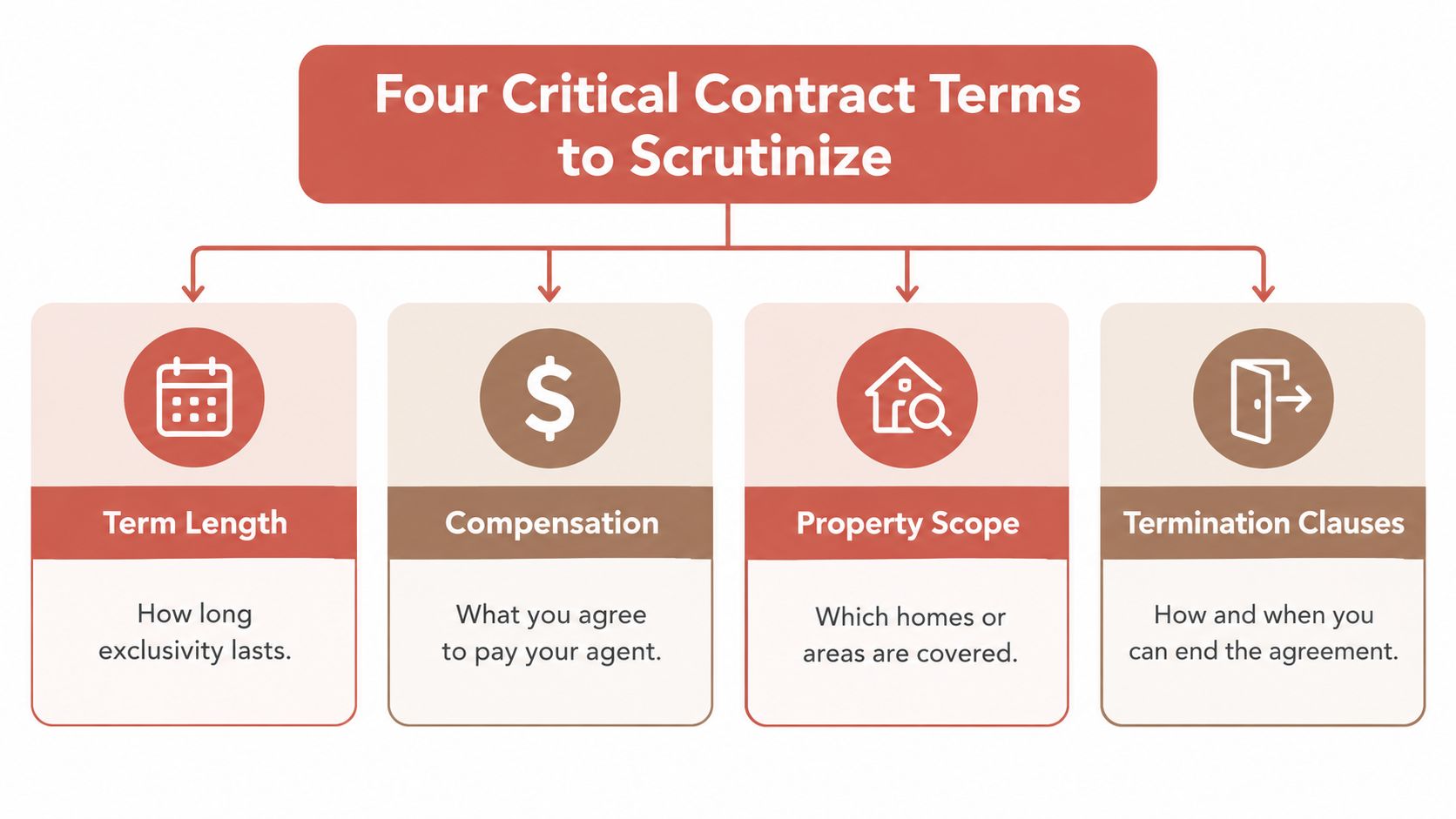
The strongest buyer agreements make four things easy to locate: how long the relationship lasts, what compensation is owed, which properties are covered, and how the relationship can end. Don't focus only on the percentage or flat amount. A favorable fee paired with a long term and difficult exit clause may still create an uncomfortable arrangement.
Term length
A buyer looking casually in Elmhurst may want a limited initial commitment, while a relocating family comparing Glen Ellyn with Naperville may need a longer search window. The document should state a clear start date and end date. Avoid signing a term that extends far beyond your realistic buying horizon just because the form presents it as the default.
Ask whether the agreement can be renewed by mutual consent. A shorter initial term gives both sides an opportunity to evaluate communication, local knowledge, availability, and working style before extending the relationship.
Compensation
Compensation must be objectively ascertainable. It might be written as a percentage of the purchase price, a flat amount, or another negotiated structure, but the agreement should state the amount or calculation method clearly. Industry guidance describes the fee as negotiable and emphasizes that the agent can't receive more than the amount agreed with the buyer, as explained in this buyer representation compensation guidance.
Ask three direct questions:
- What is the agreed fee? Identify the exact percentage, flat amount, or formula.
- When is it earned? Confirm whether payment is tied to closing and what happens if a transaction fails.
- What if the seller contributes less? Find out whether you could owe a difference and how a seller concession would be requested.
Property scope and protection period
A contract may apply to a geographic area, a property type, or all purchases within a broad region. If you're comparing Oak Park, Elmhurst, and Glen Ellyn, make sure the scope reflects your actual search without covering places you're not considering.
The protection period matters after termination. It may cover homes the agent introduced, showed, or negotiated during the agreement. Ask how those properties are identified, how long the protection applies, and whether you can exclude a home you already found through another relationship.
Termination language
Read the exit clause before you sign, not after the relationship becomes strained. Look for notice requirements, mutual-release language, early-termination fees, and continuing compensation obligations. If the agent won't explain those provisions in plain English, pause before committing.
For planning around the broader purchase timeline, buyers can also review guidance on how long it takes to close on a house. The agreement term should fit the search and transaction timeline you expect.
Exclusive Versus Non-Exclusive Agreements Compared
An exclusive agreement and a non-exclusive showing agreement aren't interchangeable. The first creates an ongoing relationship with one brokerage for covered properties. The second may be limited to a particular home, tour, or search interaction, allowing you to retain more flexibility.
That distinction is especially relevant when a buyer is still comparing western suburban markets. Someone touring one condo in Oak Park may not need the same commitment as a buyer who has already chosen a price range, secured financing, and is ready to compete for a home in Elmhurst.
| Feature | Exclusive Agreement | Non-Exclusive Showing Agreement |
|---|---|---|
| Relationship | One brokerage represents the buyer for the defined scope and term | The buyer may work with multiple firms, subject to each agreement |
| Coverage | May cover a geographic area, property type, or all purchases during the term | Usually limited to a particular property, tour, or narrow activity |
| Compensation exposure | The buyer may owe the agreed fee if a covered purchase closes, including situations addressed by the contract after termination | The buyer's obligation depends on the limited agreement's specific terms |
| Flexibility | Lower flexibility during the active term, but clearer responsibility from one agent | Higher flexibility, but less continuity and potentially less coordinated advice |
| Best fit | A serious buyer who wants one advocate through search, offer, and closing | A buyer still evaluating agents, neighborhoods, or a specific property |
| Main question | “Are these terms fair for the full search?” | “What exactly does this single showing or limited agreement cover?” |
Use the arrangement that matches your readiness
An exclusive agreement can make sense when you want one professional to track listings, schedule tours, compare properties, and prepare offers. It also reduces the risk of receiving conflicting advice from several agents who don't share the same information or strategy.
A non-exclusive arrangement may be more suitable when you're attending early tours, comparing service styles, or deciding whether your search belongs in Elmhurst, Oak Park, or Glen Ellyn. It can preserve choice, but it may not provide the same continuity when a competitive listing appears and an offer must be prepared quickly.
Don't confuse flexibility with free representation
Non-exclusive does not mean that compensation terms disappear. Read the limited agreement for the property covered, the payment trigger, and any post-termination language. The right question is not just whether the document says “exclusive.” Ask what you are agreeing to do, what the agent is agreeing to do, and what financial obligation could arise if you buy.
How the 2024 Rule Change Affects Chicago Buyers
On August 17, 2024, MLS participants who were working with a buyer became required to enter into a written agreement before touring a home with that buyer. The rule covers in-person and live virtual tours, and the agreement must disclose compensation terms that are objectively ascertainable. The policy also states that the agent can't receive more than the amount agreed with the buyer, while emphasizing that broker fees and commissions are negotiable and aren't set by law. These details are described in the written buyer agreements guidance.
For a buyer in western Chicagoland, the practical change is timing. The compensation and representation conversation now happens before the private tour, rather than remaining an informal matter that may be discussed much later in the transaction. If you ask an agent to tour a home in Downers Grove or Naperville, expect the agent to explain the written relationship before the appointment.
What you should know before the first tour
The rule doesn't tell you which fee to accept or require you to sign every form exactly as presented. It makes the written agreement an operating requirement for the covered MLS touring workflow. You still need to review the term, scope, compensation, services, and exit provisions.
That earlier conversation can improve clarity. You can ask whether the agent will represent you through negotiations, whether seller concessions may be requested, and whether the contract applies to every property in the search area or only selected homes. You can also decide whether an exclusive agreement fits your current readiness or whether a narrower arrangement better reflects your situation.
Why this is more than a signature requirement
Historical buyer agency developed gradually. In the U.S. and Canada, buyers were traditionally treated as customers of the brokerage rather than represented clients, and states began creating buyer-agency statutes in the early 1990s. A separate policy document reported that 41% of recent buyers surveyed by the National Association of REALTORS® had a buyer representation agreement by 2023, showing that adoption remained incomplete before the 2024 shift. That history is summarized in this overview of buyer agency agreements.
The result is a more formal starting point for buyer representation. The buyer has an earlier opportunity to ask what the agent does, how the fee is calculated, and how the relationship can end. The agent also has to explain the service and compensation arrangement before investing time in tours.
Benefits and Drawbacks of Signing Early
Signing before the first private tour can be useful for a serious buyer, but it isn't automatically advantageous in every situation. The value depends on whether the agreement matches the services you need and whether the terms protect you if the relationship fails.
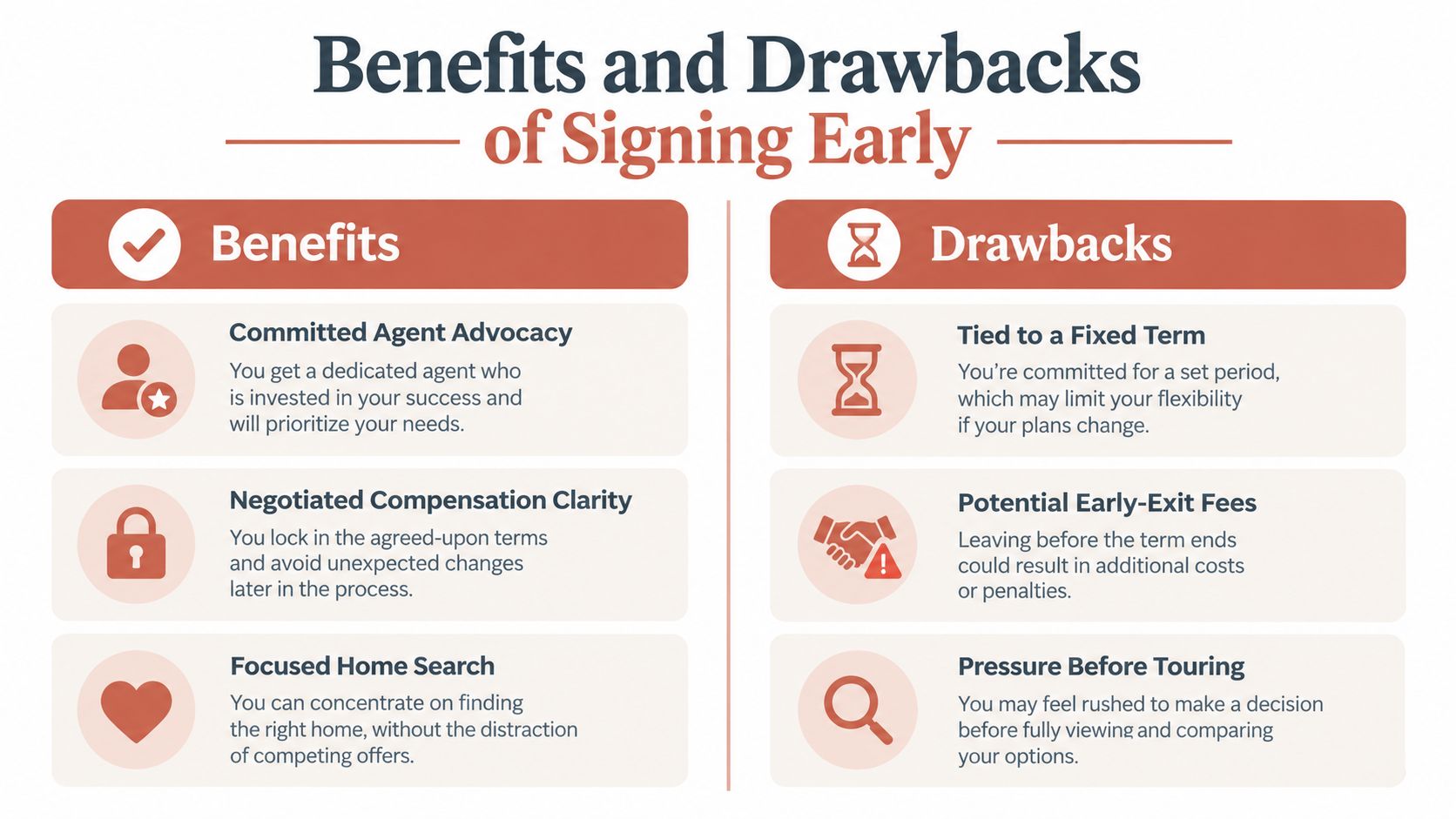
A committed relationship can produce better coordination. One agent can monitor your criteria, arrange tours across multiple suburbs, evaluate comparable homes, prepare an offer, and carry the negotiation through inspection and closing. You also have a defined person to call when a home in Melrose Park or Elmhurst receives competing interest.
The case for signing early
Early clarity can help you budget. If the agreement states the fee, you can discuss whether to request a seller concession in your offer to offset all or part of that amount. The agreement itself still needs a clear fee cap and payment trigger, but the buyer can plan for the possibility rather than discovering the issue after choosing a property.
It can also improve the quality of the search. A buyer agent who understands your budget, commute, property condition preferences, and neighborhood priorities can filter options across Oak Park, Glen Ellyn, and Downers Grove instead of treating each showing as an isolated appointment.
Practical rule: Sign early when you're ready for an active search, but negotiate the agreement as carefully as you negotiate the purchase contract.
The case for caution
The main risk is compensation exposure. Depending on the language, you may owe the agreed fee if you purchase a property you found independently during the term. A protection period can extend obligations after termination for certain properties, so don't assume that ending the relationship erases every possible payment issue.
The other risk is a poor fit. If the agent communicates slowly, doesn't understand the neighborhoods you're considering, or pressures you to make an offer, a long exclusive term can make the search uncomfortable. Request clear termination language before signing.
What the economics do and don't prove
A written agreement creates structure and disclosure, but it doesn't guarantee lower fees. A Federal Reserve-backed analysis found no material or statistically significant effect of buyer representation agreement requirements on advertised commission rates. The same analysis reported that commission rates declined gradually from about 3.0% in the 1990s to 2.7% in 2023, rather than dropping sharply after the policy change, as discussed in this analysis of buyer representation agreements and commission rates.
That evidence supports a measured conclusion. Signing early may improve transparency and service coordination, but buyers shouldn't sign expecting the document itself to produce automatic savings. The negotiation still happens in the terms.
Negotiation Tips for First-Time Buyers
Treat the first consultation as a business conversation, not a test of loyalty. You're evaluating whether the agent's knowledge and service justify an exclusive relationship, and the agent is determining whether the search is a workable fit.
Start with the term. Ask for a shorter initial period if you're still comparing agents or suburbs, with an option to renew by mutual agreement. A buyer who has only toured one home in Melrose Park has a different level of readiness from a relocating family already comparing school, transit, and housing options across Elmhurst and Downers Grove.
Put every important promise in writing
Don't rely on a verbal assurance that “we can work something out later.” Ask the agent to explain and document:
- Term and scope: Identify the start date, end date, geographic area, property types, and whether affiliated agents are included.
- Compensation: Confirm the exact amount or rate, the payment trigger, and whether a seller concession can offset the obligation.
- Independent discoveries: Ask what happens if you find a listing yourself, attend an open house, or contact a builder or seller directly.
- Termination: Clarify notice requirements, mutual release language, possible fees, and continuing duties after termination.
- Services: Define whether the agent will provide search setup, showings, offer strategy, negotiation, inspection coordination, and closing support.
Compensation should be discussed alongside offer strategy. If the seller may be asked to contribute toward the fee, understand how that request affects the overall offer, the seller's response, and your available cash. Read practical guidance on how to make a competitive offer on a house before you assume a concession request is automatically accepted.
Test the agent's local process
Ask how the agent will help you compare neighborhoods rather than just forward listings. A useful answer should include criteria such as property condition, transit access, taxes, likely resale considerations, and the differences between nearby communities.
Technology-enabled search can save time, but the agent still needs to interpret the results. Advanced map filters and MLS data may help identify homes, while local context helps you decide whether a listing in Glen Ellyn fits your priorities better than one in Naperville.
Finally, ask what happens if the relationship isn't productive. A professional should be able to explain the exit process without treating the question as distrust. A buyer who understands the exit terms can commit with confidence instead of signing out of pressure.
Your Pre-Signing Checklist for Western Suburban Buyers
Before signing, read the agreement from the perspective of a buyer who may change neighborhoods, discover a property independently, or need to end the relationship. The document should make those situations understandable.
Use this checklist:
- Confirm the term: Check the exact start and end dates, and make sure they match your realistic search horizon.
- Define the scope: Verify the suburbs, property types, and purchases covered by the agreement.
- Verify compensation: Make sure the fee is objectively ascertainable and understand who may pay it at closing.
- Ask about concessions: Discuss how a seller contribution could offset all or part of the agreed amount.
- Review the protection period: Find out which properties remain covered after termination and for how long.
- Understand termination: Identify notice requirements, release options, and any continuing payment obligation.
- Assess the service: Confirm what the agent will do from the first search through negotiation, inspection, and closing.
- Check local expertise: Ask whether the agent regularly works in Melrose Park, Elmhurst, Downers Grove, Naperville, Oak Park, and Glen Ellyn, or understands the specific areas you're comparing.
A buyer agent exclusive agreement should provide clarity, accountability, and a defined plan, not pressure or surprise obligations. When the terms fit your search and the agent explains them plainly, the document becomes a tool for making decisions with confidence.
Homes By Carmen helps first-time buyers compare western Chicagoland neighborhoods, search MRED listings, arrange tours, and negotiate offers with clear buyer representation terms. Visit Homes By Carmen to request a buyer consultation and discuss an agreement that fits your search in Melrose Park and nearby suburbs.