
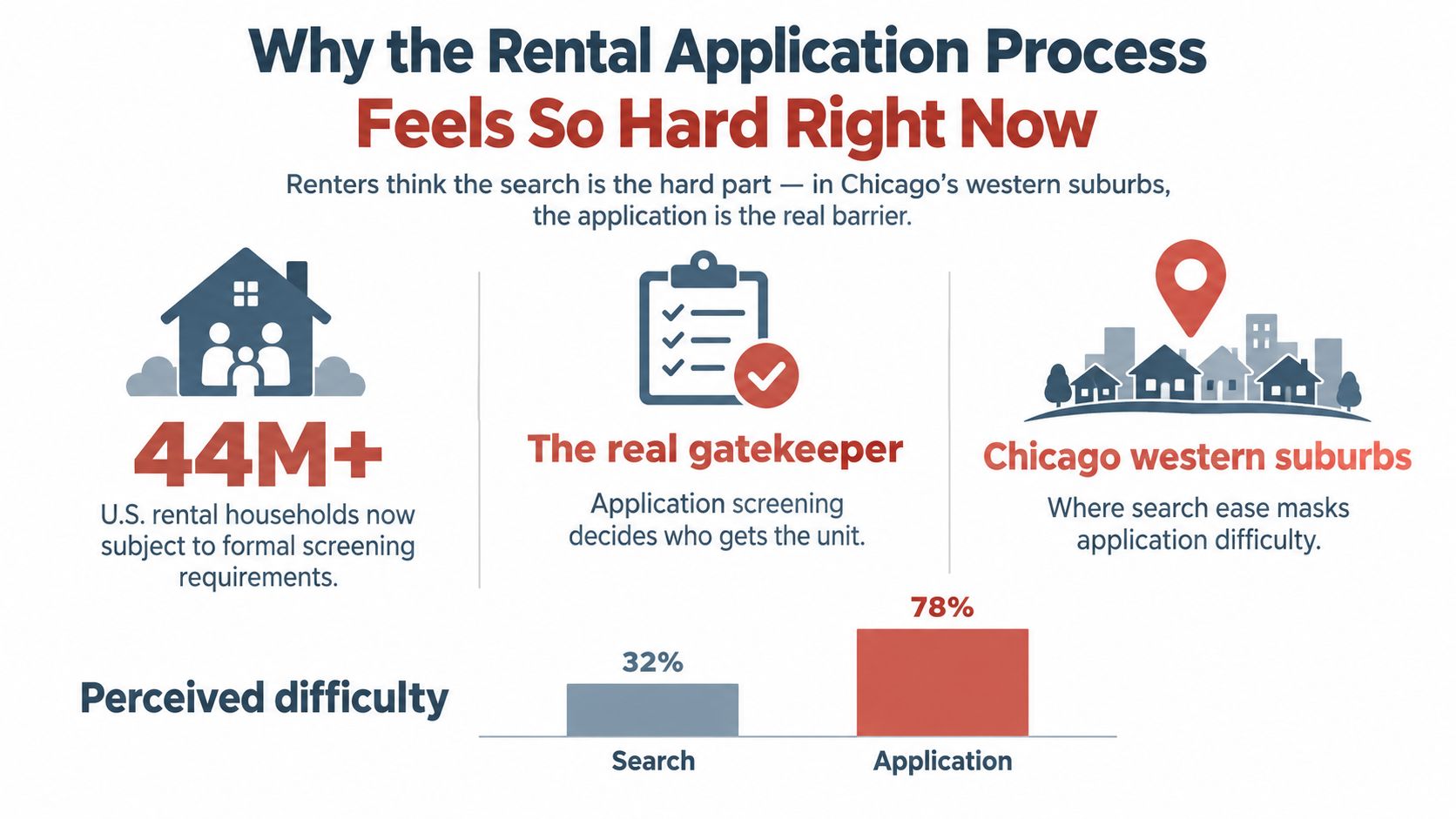
More than 44 million rental households now face pre-tenancy screening, and landlords commonly look for income equal to 2.5x to 3x the monthly rent. In the Chicago suburbs, a strong rental application isn't just about having a good credit score, it's about proving your identity, income, rental history, and references without contradictions.
That distinction matters in places such as Elmhurst, Downers Grove, Glen Ellyn, Naperville, and Oak Park. A desirable listing can attract several qualified applicants quickly, while a missing document or unexplained gap can leave an otherwise suitable renter waiting, rejected, or forced to start over.
The most effective approach is to treat the rental application process like a professional submission. Prepare your records before you apply, understand how verification works, and ask practical questions about fees, review order, and timing. You can't control every landlord's criteria, but you can control how clearly and credibly you present your rental profile.
Table of Contents
- Why the Rental Application Process Feels So Hard Right Now
- Documenting Your Rental Profile Before You Apply
- Navigating Credit Scores and Income Verification
- Avoiding the Three Most Common Reasons for Rejection
- Understanding Fees, Timelines, and the New Fraud Reality
Why the Rental Application Process Feels So Hard Right Now
Rental screening has become a multi-stage verification process. Broader rental screening data and benchmarks help explain why applicants now face checks that extend beyond a credit score. A rental application is an entry point into a standardized risk review, with each record compared against the information supplied elsewhere.
The pressure is practical. You may spend days comparing neighborhoods, commuting options, parking arrangements, and floor plans, then lose a suitable property because a former landlord is difficult to reach or an income document does not match the application. In western suburban markets, where desirable listings can move quickly, an administrative inconsistency can carry the same immediate consequence as a financial concern.
What the screening sequence actually checks
Property managers commonly collect the application, obtain written authorization, verify identity and income, review credit and rental records, contact references, and record the decision. The sequence gives an owner a consistent basis for comparison, while giving an applicant several points to prepare and verify before submission.
Document fraud has also made reviewers more cautious. Altered pay statements, inconsistent employer details, and unreliable references can cause legitimate records to receive closer scrutiny. Applicants can respond proactively by checking that names, dates, addresses, employers, and contact details agree across every document. Keep original records available and be ready to explain a recent job change, address gap, or informal rental arrangement in one clear statement.
A renter who focuses only on the credit requirement can miss these practical failure points. A pay statement may show a different employer name from the application. A previous address may be absent because the lease was informal. A reference may be listed without a current phone number. Each mismatch creates extra work and can slow a decision.
Practical rule: Submit the same story through every document. Your application, identification, income records, bank records, and references should reinforce one another.
Speed depends on preparation
Fast-moving listings reward applicants who are ready, not those who submit the first incomplete form. Before touring, review Chicago housing market trends and decide which neighborhoods, property types, and rent levels fit your budget. Then organize the information a manager is likely to request.
A polished file cannot guarantee approval because criteria differ by owner. It can reduce avoidable questions, support enhanced verification, and show that you will cooperate with legitimate review. The goal is to make your records easy to confirm while keeping control over the details you submit.
Documenting Your Rental Profile Before You Apply
A strong application often wins before the listing gets crowded. The people who move fastest are usually the ones who already have their proof organized, clean, and easy to verify. That matters more now because document fraud has made property managers more cautious, and incomplete files get extra scrutiny.
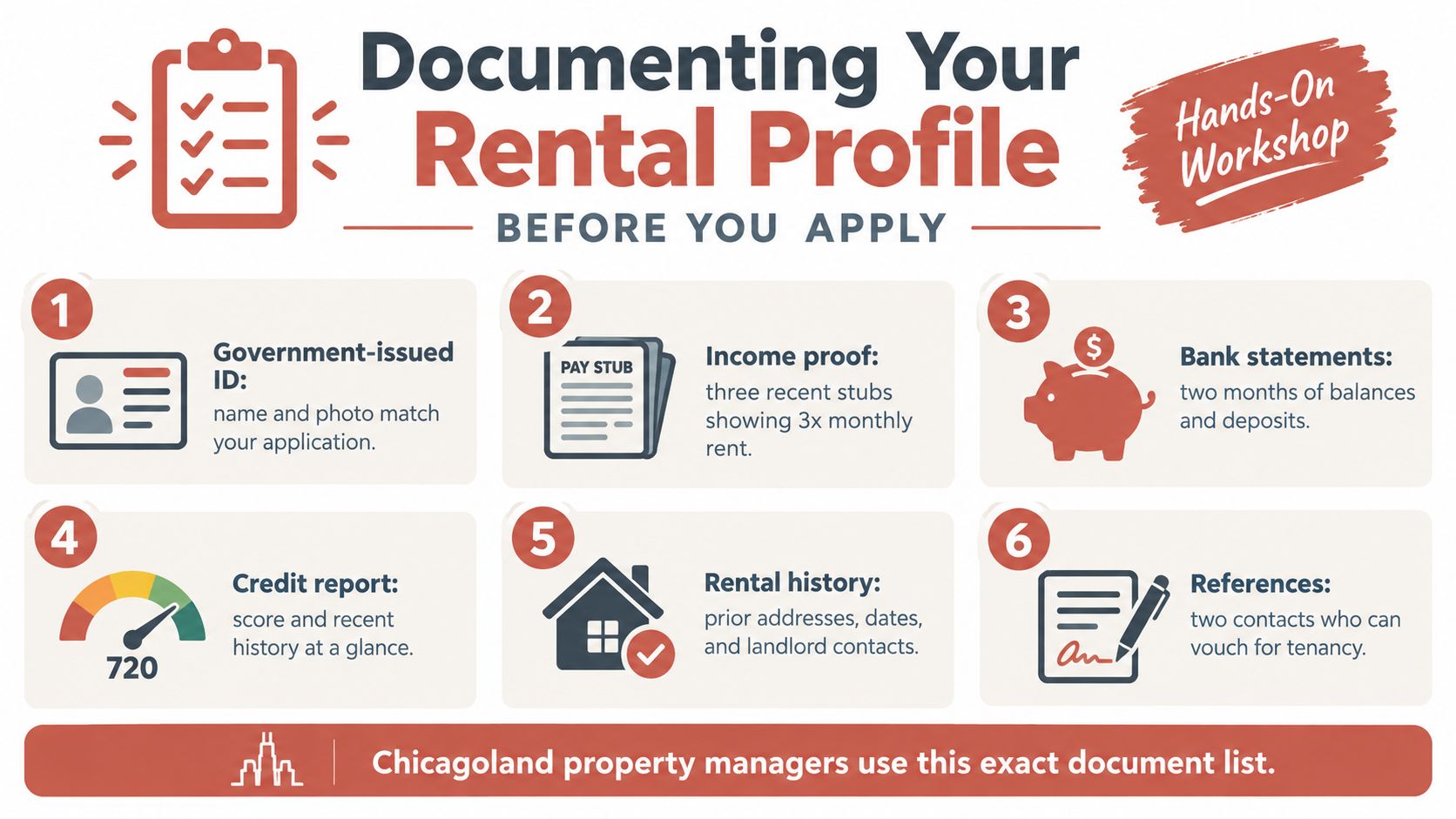
Start with one folder that holds clear copies of your identification, income records, bank statements, rental history, and references. Keep the files readable, current, and named in a way that makes them easy to sort. If a document looks altered, unclear, or inconsistent, a reviewer may slow the file down instead of moving it forward.
The usual review follows a practical sequence. Managers often confirm identity and income first, then move into credit, eviction, criminal, and rental history, before they call references and record a decision. If your materials are ready in that order, you make verification easier at the exact point where many applications stall.
Build the file in verification order
Government-issued identification: Make sure the legal name and date of birth match the application. If your name has changed recently, keep the supporting paperwork ready so the difference does not look like a false identity signal.
Income records: Gather recent pay statements that show your name, employer, pay period, gross income, and year-to-date totals. A reviewer needs enough detail to see whether the income is continuing, not just a single deposit.
Bank documentation: Share statements only through a secure process, and remove unrelated account details when the property manager allows it. The useful parts are usually the account holder name, statement period, deposits, and balances. Do not edit figures or crop out information that may be needed to verify the file.
Credit information: Review your own credit file before you apply so you can catch inaccurate accounts, recent inquiries, or negative items that need context. The screening report used by the landlord may be different, but your review helps you avoid surprises.
Rental history: List each prior address, occupancy dates, landlord or management contact, and the reason for leaving. If you lived with family, rented from an individual owner, or had a gap between leases, say so briefly instead of leaving an unexplained blank.
References: Choose people who can respond quickly and speak directly about reliability, payment habits, property care, or professional conduct. A reference who cannot identify your relationship adds little, even if the person means well.
Make the documents agree
Compare the employer name, job title, address history, and monthly income across the form and supporting records before you submit anything. A shortened employer name or an old address can trigger a request for clarification while another applicant's file is already complete.
Ask which documents are required, how they should be submitted, and whether digital copies are accepted. Confirm that sensitive information will travel through a secure channel. Preparation is not about handing over every financial detail. It is about providing the required proof accurately and keeping control over what you share.
Navigating Credit Scores and Income Verification
Ask which income the property counts before you assemble pay statements. Different managers may review base pay, commissions, bonuses, overtime, benefits, self-employment income, or a guarantor in different ways, and a strong bank balance rarely replaces the stated income standard. Credit and income are reviewed together with identity and rental history, so present them as one consistent financial picture.
A file that matches across every document gives the reviewer less reason to slow down your application. If your income changes from month to month, include the records that show the pattern. If you changed jobs recently, provide the offer letter or employment confirmation when requested. If your credit history has a disruption, prepare a short explanation and proof of current stability before the owner finds it without context.
Clear the income hurdle
Start with the rent-to-income calculation the property uses. Some owners count only base pay. Others accept commissions, bonuses, overtime, or a qualified guarantor. Ask for the standard before you submit anything, because a number that works in your own budget may still miss the written screening rule.
Your proof should show source and continuity. A pay statement that does not match the employer name on the application creates doubt even when the income itself is high enough. For self-employed applicants, organized business and personal records help show how reported earnings connect to deposited funds.
Put credit in context
A lower score may reflect a specific event, thin credit history, medical debt, identity theft, or an account that was later resolved. Keep the explanation factual, brief, and supported by documents. A reviewer needs to know what happened, whether the issue is still active, and why the current application is reliable.
If you are comparing rent with broader household obligations, a home loan repayment calculator can help you pressure-test monthly affordability before you apply. Your affordability and the owner's written screening policy are two separate tests.
Fix missing verification before submission
The most avoidable problem is an application that asks the reviewer to chase basic facts. Confirm that references know to expect a call, that previous landlords have current contact information, and that every uploaded document is legible. A complete file does not erase a concern, but it lets the property manager evaluate the concern on evidence rather than uncertainty.
Fraud checks have become part of the file review in many rentals, so clean paperwork matters. Keep names, dates, addresses, and income figures consistent across the form, pay records, and rental history. If you know a document may need explanation, attach it upfront instead of waiting for the reviewer to question it.
Avoiding the Three Most Common Reasons for Rejection
A rental file can be rejected for reasons that have nothing to do with credit. In practice, the fastest way to protect your application is to make every document easy to verify before a reviewer ever asks a follow-up. Rental history, income records, and identity details have to line up cleanly.
Rental history that can't be confirmed
An unexplained gap is the problem, not the gap itself. Reviewers need to see where you lived, when you lived there, and who can confirm it. If a prior landlord is unavailable, say so plainly and give the next best proof, such as a management company contact or a lease record if supplemental documents are accepted.
Call former landlords before you apply and check that phone numbers and email addresses still work. If a property was managed by a company, use the company's current contact route instead of an old individual contact. Keep rent receipts, a prior lease, or another payment record ready in case the reviewer asks for backup.
Income proof that looks altered or incomplete
Income documents draw close scrutiny because altered files are now common enough to change how applications are reviewed. In one survey of apartment owners, developers, and managers, 93.3% said they experienced fraud in the prior 12 months, and 84.3% said fabricated pay stubs or income records were the most common tactic in the same rental application fraud analysis. Analysts at the same source also reported fraudulent elements in 6.4% of nearly 5 million rental applications, while a separate sample of more than 700,000 applicants found fraud in 3.8% of cases.
That is why a clean pay stub matters so much. A document with odd formatting, missing totals, mismatched employer details, or bank deposits that do not match the stated income can trigger a manual review even when the applicant is legitimate. Submit the unaltered record, then explain any real difference between payroll timing and bank posting.
Missing identity or application verification
Identity checks fail when the form, employment record, and financial documents do not connect. A reviewer may ask for a direct employer confirmation, an ID resubmission, or another supporting record when something does not align. That request is a normal part of tighter screening, not a sign that the application is dead.
Treat the request as a chance to remove doubt. Send exactly what was asked for through the approved channel, keep a record of what you submitted, and answer any follow-up quickly. If one document conflicts with another, disclose the reason before the reviewer has to guess.
Understanding Fees, Timelines, and the New Fraud Reality
A rental application fee is part of the screening process, but it should never feel vague. The Consumer Financial Protection Bureau's tenant background-check report found that applicants typically paid about $40 to $59 per application, and 9% reported paying more than $100. Those fees usually support checks of identity, income, employment, credit, criminal records, evictions, and rental payment history.
The practical question is what you are buying with that fee. Ask whether the unit is still available, what the fee covers, whether your file will be reviewed right away, what documents are required, and when the fee is refundable under local rules. If the manager cannot answer clearly, slow down. Do not send sensitive records until the process is defined.
| Traditional assumption | Practical reality |
|---|---|
| Submit a form and wait for a call | Submit a complete file that can be verified promptly |
| A good credit score carries the application | Credit is reviewed alongside identity, income, and rental history |
| The first applicant is automatically selected | The owner follows a stated screening process and applies criteria consistently |
| A fee means the unit is reserved | A fee may only cover screening and may not guarantee consideration or approval |
Fraud controls have tightened screening across the industry, as the figures above show. That means honest applicants now need a cleaner paper trail, not just a strong score. Keep pay stubs, bank statements, employer details, and ID documents aligned before you apply, because mismatches are what trigger extra review.
Ask about local fee procedures
Illinois and individual municipalities set their own rules on application fees and refunds, so ask the property manager in writing what the fee covers, whether applications are reviewed in the order received, and when a fee is refunded. If you are comparing total move-in costs, use a local planning guide such as this guide to Illinois closing costs to keep each charge in view before you commit funds.
A practical timeline has three stages. First, you submit the form, authorization, and core documents. Next, the property manager checks identity, income, credit, rental history, and references. Finally, the manager records the decision and sends approval, a request for clarification, or a denial.
Speed depends on the property and on how quickly you respond. Send requested documents through the approved channel, keep a record of what you submitted, and answer follow-up questions quickly. If one document conflicts with another, explain the reason before the reviewer has to guess. That is how applicants reduce delays and show they can pass enhanced verification without creating extra work for the manager.