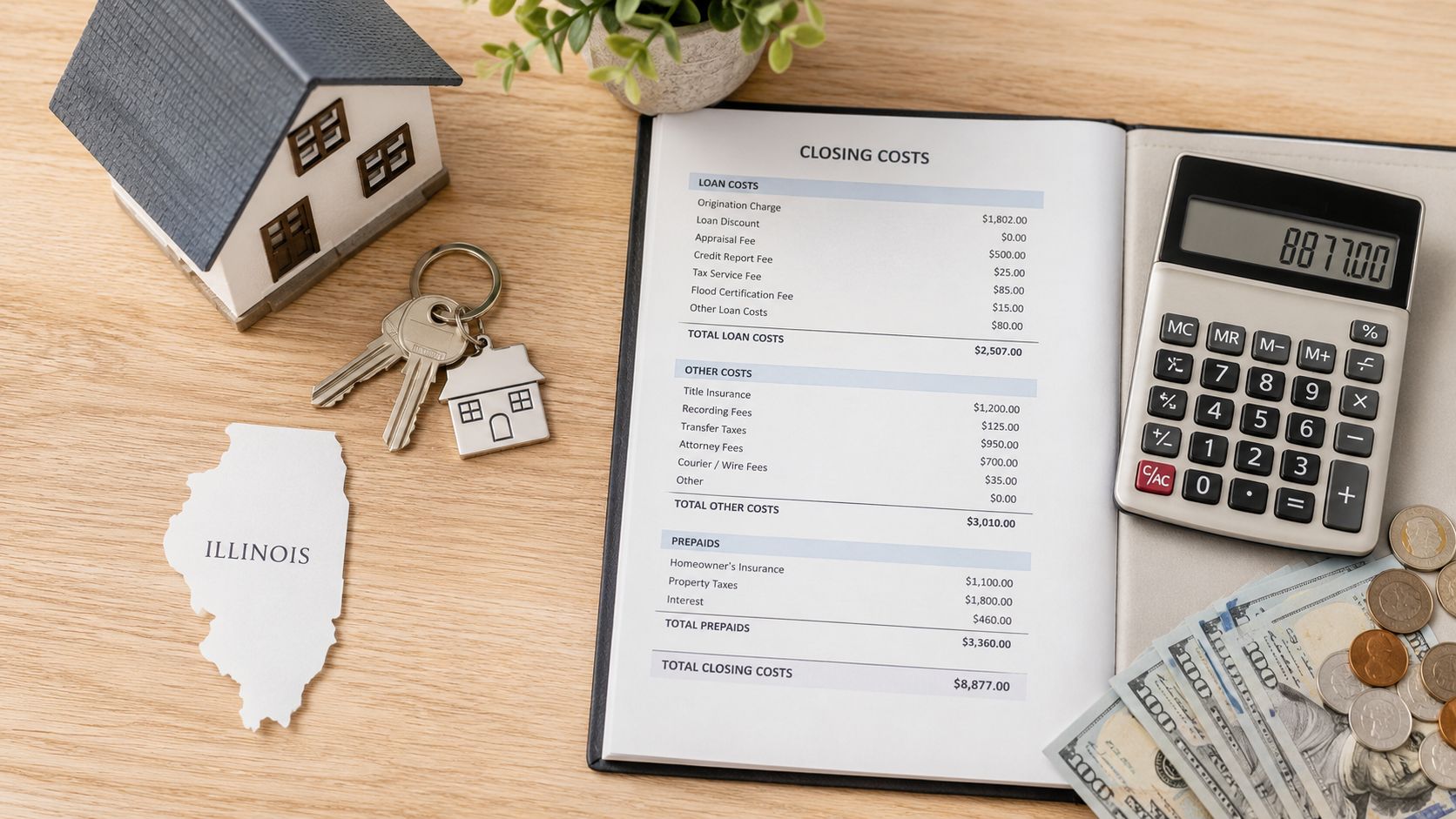
Illinois buyer closing costs typically run 2% to 5% of the purchase price, and Chicago buyers can pay materially more because of the city transfer tax. If you're buying in Illinois, that means you need to budget for the down payment and a second cash bill that can still add thousands at signing, not just one clean number on your lender's quote.
A lot of buyers find this out the hard way. They get preapproved, they like the payment, they write the offer, and then the wire amount lands way above what they expected because the quote from the lender didn't fully reflect local transfer taxes, title charges, and prepaid items. In Chicago, that gap gets ugly fast, while a similar-priced home in Elmhurst, Naperville, or Oak Park can feel much more manageable.
Table of Contents
- What a Buyer's Cash-to-Close Really Looks Like in Illinois
- What Counts as Illinois Closing Costs for Buyers
- The Line Items That Make Up a Buyer Closing Bill
- Chicago vs the Suburbs and Why the Number Jumps
- Sample Buyer Closing Costs at Three Price Points
- How to Plan Your Cash Before You Write an Offer
- When Seller Credits Help and When They Hurt
What a Buyer's Cash-to-Close Really Looks Like in Illinois
A Lakeview first-time buyer often thinks in terms of the down payment and the monthly mortgage. Then closing day arrives, and the wire number is suddenly $12,400 when they had mentally budgeted $7,500. That gap is not random, and it's not unusual in Illinois.
The first force is the statewide rule of thumb. Buyer closing costs in Illinois are commonly estimated at 2% to 5% of the purchase price, with market summaries putting the statewide average near 2.09% to 2.4% of value ConsumerAffairs. The second force is location. Chicago adds a buyer-side city transfer tax that pushes cash-to-close higher than what many flat-percentage guides imply Tally Close.
Why the quote on paper is never the whole story
The third force is lender and title structure. Fee schedules shift based on the lender's pricing, the title company's charge structure, the escrow setup, and whether the owner's title policy is being covered by the seller or by the buyer. That's why two buyers with the same price and same down payment can land at very different closing tables.
Practical rule: If you only look at the loan payment, you're underbudgeting. Cash-to-close includes the down payment, closing costs, and prepaid items.
The key mindset here is simple. Stop asking, “What's the average?” and start asking, “What's my actual city, county, loan type, and title setup?” That's the number that matters when you're writing an offer, because the wire transfer doesn't care what a generic guide said.
What Counts as Illinois Closing Costs for Buyers
Closing costs are every fee and prepaid item beyond the down payment that shows up on your final settlement figures. On a financed purchase, those figures are organized on the lender's disclosure forms, and the vocabulary matters. If you don't know which line is which, it's easy to panic over a charge that was always going to be there.
The lender's paperwork usually separates the bill into five official categories. Those categories are loan origination charges, services you can't shop for, services you can shop for, taxes and government fees, and prepaid items. That framework is what makes a Loan Estimate and a Closing Disclosure useful, because it lets you see where the money is going.
The five buckets that matter
A buyer in Cook, DuPage, or Lake County will usually see some version of the same structure, even if the dollar amounts differ. Loan origination is the lender's charge for making the mortgage. Third-party services cover things like title work and recording-related items. Taxes and government fees are where Illinois gets annoying, especially in Chicago.
Prepaids are not junk fees. They're setup money for things you'll pay anyway, like property tax reserves and homeowners insurance. If your lender collects escrow at closing, that cash is part of your real closing burden even though it doesn't feel like a “fee.”
| The Five Sections of a Buyer Closing Disclosure in Illinois | What It Covers | Typical Illinois Items |
|---|---|---|
| Loan Origination Charges | Lender pricing and underwriting | Origination, processing, underwriting |
| Services You Cannot Shop For | Required third-party items chosen by lender | Appraisal, credit report, lender-required title items |
| Services You Can Shop For | Optional provider choices | Title and settlement services, title search, owner's title policy if not negotiated |
| Taxes and Government Fees | Statutory and recording charges | State transfer tax, local transfer tax where applicable, recording |
| Prepaid Items | Money collected before first payment | Property taxes, homeowners insurance, escrow reserves, per diem interest |
If you're financing, learn to read the Loan Estimate first, then compare it to the Closing Disclosure later. The first one is the forecast. The second one is the final bill.
The Line Items That Make Up a Buyer Closing Bill
Here's the blunt version. Most Illinois buyer closing bills are not blown up by tiny administrative charges. They're moved by a handful of real items, mostly lender pricing, title work, transfer taxes, and prepaid escrows.
The fees that actually move the number
Loan origination is usually one of the first things to check because lender pricing can change quickly. A stronger credit profile and a cleaner file usually help, but the lender's fee structure still matters more than buyers think. If one lender bundles charges differently than another, the quote can look cheaper without being cheaper.
Title work is the next big piece. Title search, lender title insurance, and the owner's title policy can add up fast, and title premium structure varies with the sale price and how the contract allocates payment. In many deals, the seller pays the owner's policy, but that's not something to assume.
Recording and attorney-related services are real, but they usually don't drive the whole budget by themselves. They matter because they stack on top of the bigger numbers. Prepaid homeowners insurance, tax reserves, and per-diem interest can also make the final wire feel higher than the estimate.
Don't dismiss prepaid items just because they're not permanent fees. They still hit your bank account on closing day.
| Line-by-Line Buyer Closing Costs in Illinois | Typical Range | What Makes It Higher or Lower |
|---|---|---|
| Lender Origination | Varies by lender | Loan size, credit, pricing structure |
| Title Search and Lender Title Insurance | Varies by price and local practice | Purchase price, contract split, title company schedule |
| Owner's Title Insurance | Often negotiable | Whether seller pays it, local custom |
| Recording Fees | Modest but required | County and municipal recording rules |
| Property Tax Proration | Depends on closing date | Most recent tax bill, timing of sale |
| Homeowners Insurance Prepaid | Usually collected upfront | Coverage amount, insurer, lender escrow rules |
| Mortgage Insurance | If down payment is under 20% | Loan structure and down payment size |
| Escrow Reserves | Varies by lender | Tax cycle, insurance cycle, lender cushion |
| Illinois Transfer Tax | Statutory | Location and whether the home is in Chicago |
| Chicago City Transfer Tax | Only inside city limits | Sale price and city limits |
Chicago vs the Suburbs and Why the Number Jumps
The cleanest way to understand Chicago closing pain is to compare the same purchase price in different places. On a $400,000 home, the lender, title, and escrow side of the bill may look familiar whether you're buying in Chicago, Oak Park, Naperville, or Libertyville. The geography is what changes the final cash requirement.
Chicago inside the city limits is the outlier because of layered transfer taxation. Illinois has a statewide transfer tax of $0.50 per $500 of consideration, and Chicago adds a buyer-side city transfer tax of $3.75 per $500 inside city limits Tally Close. That city layer alone is why many buyers feel like their quote “doesn't make sense” compared with suburban deals.
What stays flat and what doesn't
Lender origination, title insurance pricing, and most prepaid escrow logic are not magically cheaper just because you cross into the suburbs. What changes is the local tax stack and the way municipal fees are handled. That's why a Chicago buyer can walk into closing with a much larger cash requirement even when the loan size and down payment are the same.
The broader Illinois market data backs up the same point. Buyer closing costs in the state are commonly estimated at 2% to 5% of the purchase price, and one Chicago-area breakdown puts total buyer closing costs on a $400,000 sale in the $5,500 to $8,000 range because of the city transfer tax, title insurance, and recording items Rocket Mortgage. A statewide average can look tame while Chicago piles on extra cash needed at signing.
| $400,000 Purchase: Chicago vs Suburban Closing Cost Comparison | Chicago (City) | Oak Park (Cook Suburb) | Naperville (DuPage) | Libertyville (Lake) |
|---|---|---|---|---|
| Buyer City Transfer Tax | Applies | No city buyer transfer tax | No city buyer transfer tax | No city buyer transfer tax |
| State Transfer Tax | Applies | Applies | Applies | Applies |
| Recording and Title | Applies | Applies | Applies | Applies |
| Prepaids and Escrows | Applies | Applies | Applies | Applies |
| Cash-to-Close Pressure | Highest | Lower | Lower | Lower |
Sample Buyer Closing Costs at Three Price Points
The fastest way to stop guessing is to model your actual price point. A buyer who can handle a $300,000 suburban townhome might get blindsided by the same home in Chicago because the city tax layer hits the cash side immediately. The purchase price is only half the story.
$300,000, $450,000, and $600,000 in real life
Using a conventional 20% down structure, the loan amount rises with the purchase price, and so do the title, lender, and prepaid figures. The transfer tax difference between Chicago and a western suburb is what makes the total jump feel outsized. That's the part buyers usually miss when they compare only the down payment.
At $300,000, a Chicago condo and a DuPage or western Cook suburb townhome can differ by roughly $3,500 to $5,000 in total cash needed at closing. That spread comes from geography, not mystery. By the time you get to $600,000, the dollar gap gets even more painful because the tax formula scales with price.
| Sample Buyer Closing Costs at $300K, $450K, and $600K | $300K Chicago | $300K Suburb | $450K Chicago | $450K Suburb | $600K Chicago | $600K Suburb |
|---|---|---|---|---|---|---|
| Down Payment | 20% | 20% | 20% | 20% | 20% | 20% |
| Loan Amount | 80% | 80% | 80% | 80% | 80% | 80% |
| Lender Origination | Varies | Varies | Varies | Varies | Varies | Varies |
| Title and Settlement | Varies | Varies | Varies | Varies | Varies | Varies |
| Recording | Varies | Varies | Varies | Varies | Varies | Varies |
| Prepaids and Escrows | Varies | Varies | Varies | Varies | Varies | Varies |
| Local Transfer Tax | Higher | Lower | Higher | Lower | Higher | Lower |
| Cash-to-Close Total | Higher | Lower | Higher | Lower | Higher | Lower |
Read your Loan Estimate line by line, then compare it to the Closing Disclosure at the end. The lender controls some charges, the title company controls some, and the government controls the rest. If you know which bucket each item belongs in, you can spot the surprises before they become a problem.
How to Plan Your Cash Before You Write an Offer
Run your cash plan before you fall in love with the house. That's not cautious, it's smart. The best buyers I've worked with treat closing cost planning like a pre-offer checklist, not an afterthought.
The 15-minute routine
First, pull a Loan Estimate within 72 hours of every offer. Section A is where lender charges show up, Section B is where required third-party services appear, and Section G is where prepaids can sneak up on you. Second, add the local transfer tax yourself instead of trusting a lender to catch every local wrinkle.
Third, separate your earnest money, down payment, and any seller credit math. Those are related, but they are not the same thing. Fourth, ask for the title commitment and binder before you write so you know whether the owner's policy cost is already accounted for.
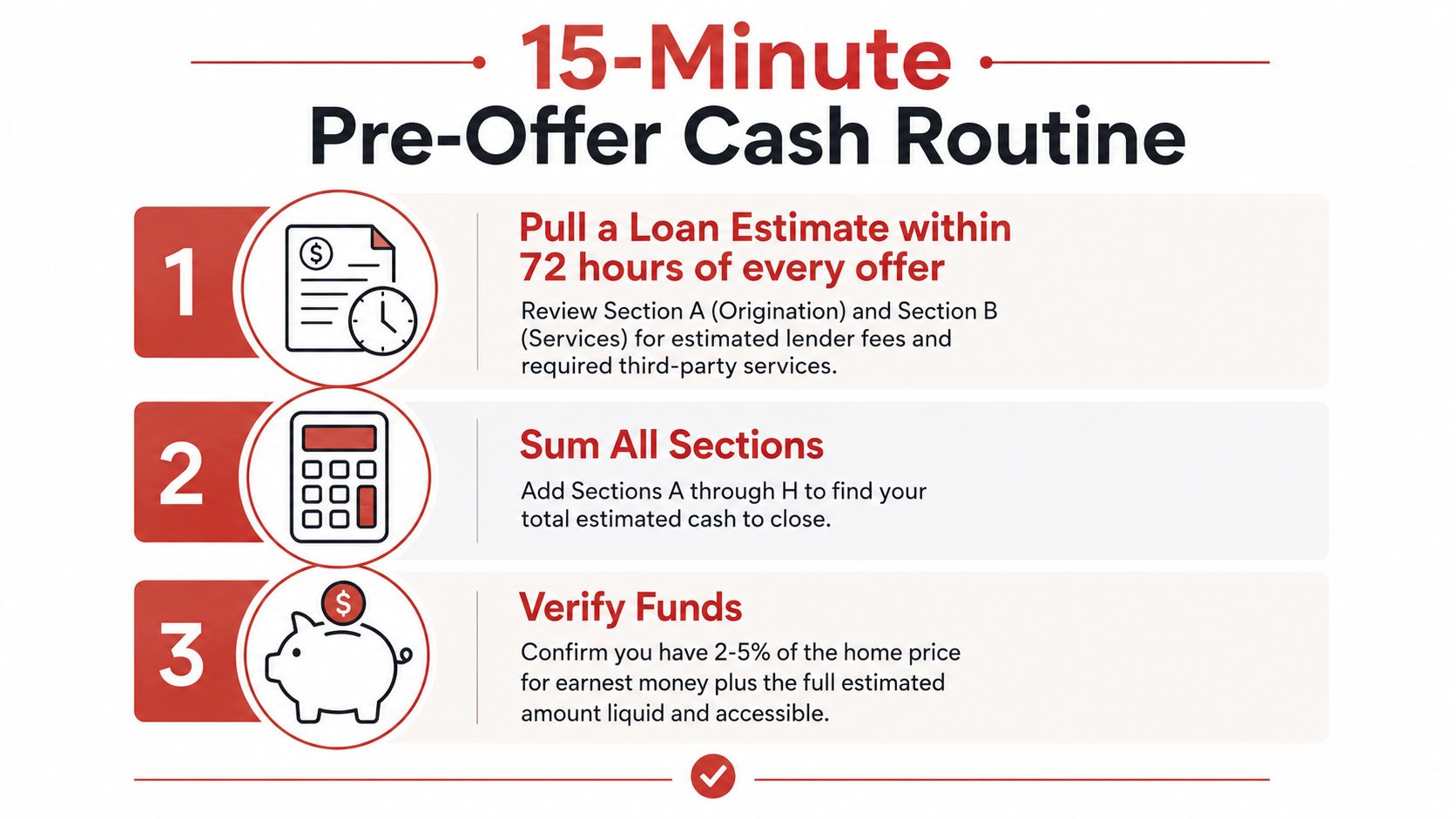
A buyer should also keep a cushion beyond the estimate because final fee tweaks, recording corrections, and interest adjustments can land on the Closing Disclosure. Don't treat the first estimate as gospel. Treat it like a working draft.
Practical rule: If your closing budget is tight, get the local transfer tax and title split confirmed before the offer is signed.
When Seller Credits Help and When They Hurt
Seller credits help because they cut the cash you need on closing day. Buyers like that. The mistake is treating every credit as free money and ignoring what happens to the loan, the appraisal, and the contract price.
A 3% credit on a $300,000 Chicago condo can soften the hit from city transfer tax and other closing costs, but it can also keep the price higher than it should be. A 2% credit on a $450,000 Naperville home is often a cleaner win, especially if it preserves cash without creating appraisal problems. A credit on a $600,000 Lincoln Park deal can be a different story if it pushes the buyer into a jumbo structure or makes the numbers harder to support.
| Seller Credit Trade-Offs at Three Illinois Price Points | Credit Amount | Cash-to-Close Savings | Downstream Risk |
|---|---|---|---|
| $300K Chicago Condo | Higher credit helps cash | Strong short-term relief | Loan balance impact, appraisal pressure |
| $450K Naperville Single-Family | Moderate credit helps materially | Useful cash reduction | Usually manageable if priced correctly |
| $600K Lincoln Park Deal | Credit can be meaningful | Immediate relief at closing | Possible jumbo crossover, underwriting friction |
Compare the seller-credit version with a price reduction before you sign. Credits help your cash-to-close. Price cuts help your long-term loan math. Pick the one that improves the deal you will live with.
For a closer look at how seller concessions play out in practice, run the credit against the purchase price, the appraisal, and the actual closing bill before you commit.