
Chicago's housing story in 2026 isn't just “prices are up.” The deeper read is that Chicago's long-run home values nearly doubled from their 2000 baseline, and the market kept climbing after the pandemic instead of snapping back, which is why timing and segment choice matter so much now (FHFA Chicago-Naperville-Elgin House Price Index). That's the frame buyers and sellers need, because a city that spent six years compounding higher doesn't behave like a market that's only recovering.
Table of Contents
- Where Chicago Home Prices Stand After Six Years of Growth
- What Today's Sales and Supply Numbers Show
- Why Inventory Remains Structurally Tight in 2026
- Chicago City Prices Versus Western Suburb Momentum
- Why Rising Prices Are Hiding Softer Condo and Townhome Demand
- The Rental and Multifamily Picture Behind the Numbers
- What the Trends Mean for Buyers and Sellers in the Western Suburbs
- Reading the 2026 Market as a Whole
Where Chicago Home Prices Stand After Six Years of Growth
Chicago's price arc since 2019 explains a lot about the market buyers face now. The FHFA all-transactions House Price Index for the Chicago-Naperville-Elgin metro moved from 135.03 in 2019 to 201.15 in 2025, a cumulative gain of about 49.0% over six years (FHFA Chicago-Naperville-Elgin House Price Index). That is a sustained appreciation cycle, and it reset the pricing floor across much of the metro.
The pandemic didn't just interrupt the trend, it changed it
The index rose from 136.69 in 2020 to 147.82 in 2021, 166.48 in 2022, 178.44 in 2023, 190.42 in 2024, and 201.15 in 2025. The same FHFA data shows the market accelerating after 2020 and then continuing to post positive year-over-year growth through 2025. In practical terms, the post-2020 run did not erase the older pricing structure. It built a new one on top of it.
For buyers, that changes the old Chicago script. Waiting for a meaningful reset has not produced one at the metro level, and the price floor now sits well above where it did before the pandemic. A home that would have sold for $280,000 in 2019 would now be roughly $410,000 if it tracked the market's cumulative gain in step with the index. The exact price still depends on neighborhood and property type, but the direction is clear.
Practical rule: if a home feels expensive compared with 2019, the market already moved on.
Nominal growth isn't the same as real growth
Nominal appreciation and inflation-adjusted appreciation are not the same thing. Chicago's rise since 2020 looks large on paper, but part of that move reflects the broader inflation environment. The better way to read the shift is through behavior, not just the headline number. Sellers are pricing against a higher base, and buyers are financing against a higher base.
That helps explain why the market still feels tight even when appreciation has slowed from its peak pace. The 2020 to 2022 surge created a new pricing floor, not a temporary spike that fully reversed. Buyers comparing city listings and western suburban options should also read Chicago housing market context and neighborhood-level guidance before assuming one metro-wide trend fits every block (Illinois housing market context and neighborhood-level guidance). Anyone shopping in 2026 has to underwrite that reality first.
What Today's Sales and Supply Numbers Show
The market is active, but it is not moving past buyers. Over the three months ending June 2026, Chicago's median sale price was $430,000, up 7.4% year over year, and homes sold in an average of 46 days on market, down from 49 days a year earlier. A separate July 2026 snapshot showed 5,606 homes for sale, 2,311 new listings, a median sale price of $388,667, and 12 days to pending, with 51.8% of sales going over list price and a median sale-to-list ratio of 1.002. The two views use different windows and geographies, but they point in the same direction.
Competitive, but not frenzied
Chicago housing market trends now look competitive but not frenzied. Homes are still moving faster than the pre-pandemic pace many longtime owners remember, yet they are not disappearing in the handful-of-days rush that defined the hottest stretch of 2021 and 2022. Prepared buyers still have room to act, especially on homes that need updates or miss the neighborhood comp band.
The gap between slower days on market in one report and faster days to pending in another is useful. It signals a split market shaped by price point, condition, and micro-location. Well-positioned homes can still move quickly. Listings that overreach can linger long enough to negotiate.
Working read: the market is strong enough to support price growth, but not so overheated that every listing gets a pass. Buyers who know the local comp story still have a real chance.
A useful table for the current tempo
| Metric | Redfin | Zillow |
|---|---|---|
| Median sale price | $430,000 | $388,667 |
| Days on market | 46 | 12 days to pending |
| Inventory snapshot | Not stated in the brief | 5,606 homes for sale |
| Sale-to-list pressure | Not stated in the brief | 51.8% over list, 1.002 median sale-to-list ratio |
The gap between the two snapshots is useful, not confusing. It shows that Chicago does not move at one speed. Detached homes, attached homes, higher-price listings, and turn-key properties are each meeting a different pool of buyers.
Why Inventory Remains Structurally Tight in 2026
Chicago's for-sale market is still constrained enough that inventory, not demand alone, is setting the tone. One 2026 metro update put active single-family inventory down more than 9% year over year and condominium inventory down nearly 8%, with both segments at about 1.3 months of supply. That's far below the 5 to 6 months usually associated with a balanced market. So even when buyers are more selective, the market doesn't fully loosen.
Why the shortage persists
The most obvious driver is simple: owners who locked in lower borrowing costs are staying put. That rate lock-in effect keeps move-up and refinance-to-sell inventory off the market. New listings also remain thin in many western Chicagoland submarkets, which means buyers are fighting over fewer clean options. When the pipeline is thin, the best homes still attract attention fast.
Builders aren't solving the problem on their own. New supply matters, but not enough of it is arriving in the price bands and locations that most buyers are targeting. The practical outcome is that a well-priced detached home in good condition still has the best chance of pulling strong traffic early, while homes that need work or miss the comp range can sit.
What that means for offers
Practical rule: in a market this tight, the first week matters more than the first month. If a home is priced correctly and shows well, serious buyers need to be ready to act before the listing gets stale.
For sellers, that keeps pricing power alive, especially on turn-key detached homes. For buyers, it means the search process has to be faster and more disciplined than it would be in a balanced market. If a property is priced below neighborhood reality, expect a quick response. If it's priced above it, expect silence.
That's the core of a structurally tight market. Not every home sells instantly, but the market still gives well-positioned sellers a clear edge.
Chicago City Prices Versus Western Suburb Momentum
The broad Chicago story looks stronger when you separate the city from the suburbs. Axios reported that in August 2026, Chicago city median sale price was $425,000, up 13% year over year, while suburban home prices rose nearly 7% and metro sales were mostly flat year over year. That gap is big enough to matter. It says appreciation is not spreading evenly across the metro.
City demand is moving faster than suburban demand
The city is benefiting from tighter neighborhood inventory, slower new construction in many areas, and buyers who are still willing to pay for location, transit access, and renovated homes. Suburban demand is still healthy, but it has to work harder against affordability ceilings, especially where prices were already high. That creates a different rhythm on each side of the market.
The city also has more visible price dispersion. Zillow's city-level value estimate sat much lower than the metro sale-price figures cited elsewhere, which is a reminder that geography and methodology shape the story. You can't read Chicago from one headline number alone. You need the neighborhood.
If you're comparing suburban options, the same principle applies in places like Elmhurst, where local context can change how quickly a home sells and how much room there is to negotiate. Homes By Carmen's Elmhurst neighborhood guide fits that kind of neighborhood-level read.
What the split means in practice
| Metric | Chicago City | Western Suburbs |
|---|---|---|
| Median sale price momentum | Up 13% year over year | Up nearly 7% |
| Sales activity | Stronger city-side pace | Mostly flat metro-wide sales |
| Buyer pressure | Higher in tighter city pockets | More selective in some suburbs |
The takeaway is simple. The city is still drawing stronger bidding pressure in many pockets, while the western suburbs are showing steadier, slower appreciation. That doesn't make the suburbs weak. It makes them more selective. Buyers and sellers need to know which side of the metro they're in before they decide how aggressive to be.
Why Rising Prices Are Hiding Softer Condo and Townhome Demand
Detached homes are carrying much of the metro's price growth, while attached housing is moving with less urgency. Mainstreet REALTORS® data cited in Chicago Agent Magazine on Chicagoland suburbs showed suburban detached sales down 1.9% in April 2026 and attached sales down 3.7%, even as detached median prices rose 7.3% to $434,500 and attached prices rose 4.4% to $281,750. A later Chicago Agent Magazine market update showed detached suburban sales up 4.8% year over year in June 2026, while attached sales were only up 1.8% and pending attached sales fell 3.7%, the first year-over-year decline since January.
The attached segment has a different buyer pool
Condos and townhomes do not trade like detached homes. Buyers for attached product are more sensitive to monthly carrying costs, HOA assessments, and the risk of future special assessments in older buildings. Rising insurance costs can tighten the payment even when the asking price still looks attainable. Some first-time buyers respond by shifting toward smaller detached homes, while others wait.
That leaves attached housing with a softer demand base, even when the broader market still looks constructive. Sellers cannot assume that a higher list price will draw the same urgency. In some North Side and inner-ring buildings, price-per-square-foot gains can flatten while the overall market remains in positive territory.
Why the headline hides the risk
Key takeaway: attached listings often need a tighter pricing strategy than detached homes in the same neighborhood. The buyer pool is thinner, and monthly cost carries more weight in the financing conversation.
That is the segment-specific risk most headlines miss. Rising prices do not mean every property type has the same pricing power. Detached homes with tight supply can still trigger competition. Condos and townhomes usually require more patience, more realistic pricing, and more room for concessions. For sellers of attached product, that difference matters more than the metro average.
The Rental and Multifamily Picture Behind the Numbers
Chicago's rental market is tight enough to keep pressure on tenants, but it's not tight in a chaotic way. One 2026 report showed vacancy near 3.0% in Q2, with 5,025 units of net absorption against 1,064 completions, and asking rent at $2,198, up 4.03% year over year. That's the story in one line. Demand is absorbing new supply faster than developers can deliver it.
What renters should infer
For renters, the message is that competition remains real even when new apartments hit the market. New units are leasing, which means the best-located and best-finished product can still command attention. In the neighborhoods that keep drawing renters because of transit, job access, and established amenities, rent pressure is more likely to stay firm.
What investors should infer
For investors, the supply-demand gap is a sign that newly delivered product is getting taken up, not sitting empty. That supports the case for submarkets with strong access and limited new pipeline. It also tells you that rent growth is still available, even if the rate of growth isn't as sharp as earlier in the cycle. The market is still rewarding well-located assets.
What condo buyers should infer
The rental backdrop also affects condo demand in a subtle way. Some would-be buyers keep renting because the monthly purchase payment, especially with HOA costs layered in, still feels heavier than staying put. That defers demand rather than eliminating it. It's one more reason the attached-sales market can look soft while rents stay firm.
The faster-absorbing submarkets tend to be the ones with the easiest commute logic and the strongest lifestyle pull, including Lakeview, Lincoln Park, Evanston, and Oak Park. Those areas keep showing that a tight rental market and a selective ownership market can exist at the same time.
What the Trends Mean for Buyers and Sellers in the Western Suburbs
The western suburbs don't all move together, and that's the part most broad market coverage misses. A seller in Elmhurst is not facing the same conditions as a buyer in Downers Grove or Oak Park, even if all three are reading the same Chicago headline. The combination of tight supply, uneven attached demand, and stronger detached pricing means each submarket needs its own playbook.
A practical read for the suburbs
In places like Naperville and Glen Ellyn, a clean detached home can still move fast if the price clears the comp band and the presentation is strong. In Melrose Park, investors looking at two- to four-unit properties should read the rent backdrop carefully and assume the best deals go to buyers who know their financing and operating costs before they tour. In Oak Park and Downers Grove, attached and small-condo buyers often have more room to negotiate than detached-home buyers do.
Buyer rule: if you're waiting for a crash, the market has already made that expensive. Your real decision now is which segment gives you the cleanest entry, not whether the whole market suddenly resets.
For sellers, the lesson is sharper. Detached homes that are staged, well-priced, and ready to go can still attract strong interest quickly. Attached listings need more realism on timing and pricing because the buyer pool is narrower and more cost-sensitive. That's especially true in buildings where monthly costs are stacking up.
If you're weighing a move in the western suburbs, the local guidance matters as much as the regional trend. Homes By Carmen's Chicago homebuyer tips are a good fit for buyers trying to separate urgency from noise.
Western Suburb Playbook for Buyers and Sellers
| Submarket | Dominant Trend | Buyer Tactic | Seller Tactic |
|---|---|---|---|
| Melrose Park | Investor interest stays selective | Know cash flow and rehab costs first | Price against local rent support |
| Elmhurst | Detached homes remain well-positioned | Move quickly on clean listings | Stage and list into the comp band |
| Downers Grove | Attached product needs patience | Expect more negotiation room | Be ready for concessions |
| Naperville | Strong demand, higher affordability pressure | Focus on best-fit homes, not broad searching | Use presentation to justify price |
| Oak Park | Attached and small-condo demand is softer | Compare HOA burden carefully | Set realistic DOM expectations |
| Glen Ellyn | Detached homes still draw attention | Be offer-ready before touring | List decisively if the home is turn-key |
The western suburbs are still viable for both buyers and sellers. They just reward precision more than broad optimism.
Reading the 2026 Market as a Whole
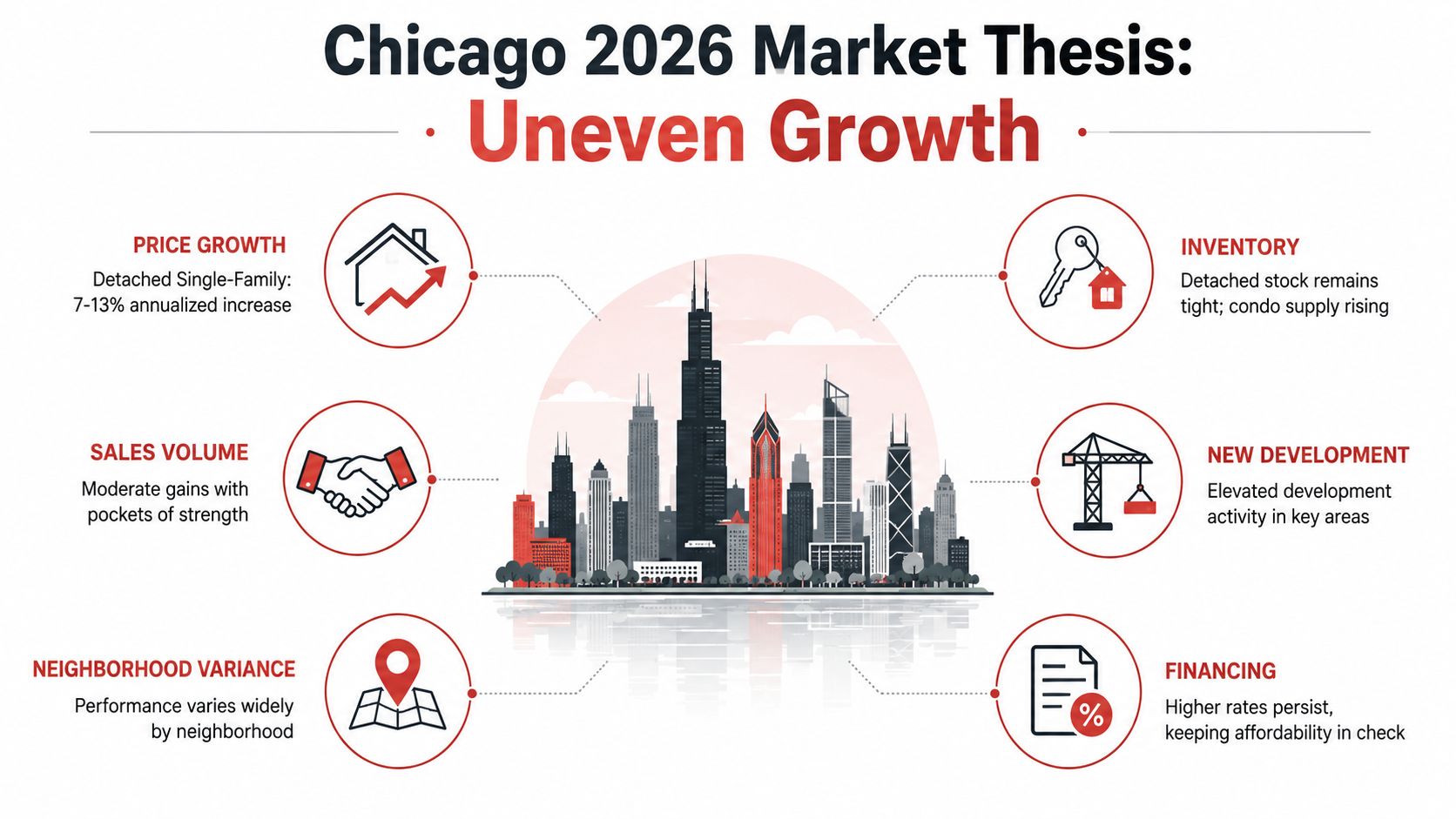
The clearest conclusion from the current Chicago housing market trends is that the metro is strong, but not uniformly strong. Prices are still climbing at a meaningful pace, detached single-family supply remains tight, attached product is softer, and rentals are absorbing new units quickly enough to keep pressure on the ownership side of the market. That combination creates a market with opportunity, but only for people who choose their segment carefully.
The market is uneven by design
Detached sellers with well-located, move-in-ready homes still hold the most pricing power. Attached sellers need to underwrite realistic days on market and expect more scrutiny on monthly carrying costs. Buyers should not start with a zip code. They should start with a segment, then decide where they can compete.
The biggest risk to the bullish case is rate sensitivity. If financing conditions improve enough to pull more sidelined buyers back into the market, supply could tighten further and competition could intensify. The bigger risk to the bearish case is that attached-product softness stays contained and doesn't spill into detached comps in stronger pockets. Right now, the market is telling a split story, not a collapse story.
The right move in 2026 is to treat Chicago like the segmented market it is. Know whether you're buying detached or attached, city or suburb, and then price your expectations around that reality. If you want help reading a neighborhood, comparing comps, or deciding how to time a listing in western Chicagoland, visit Homes By Carmen and connect with a local guide who works these markets every day.