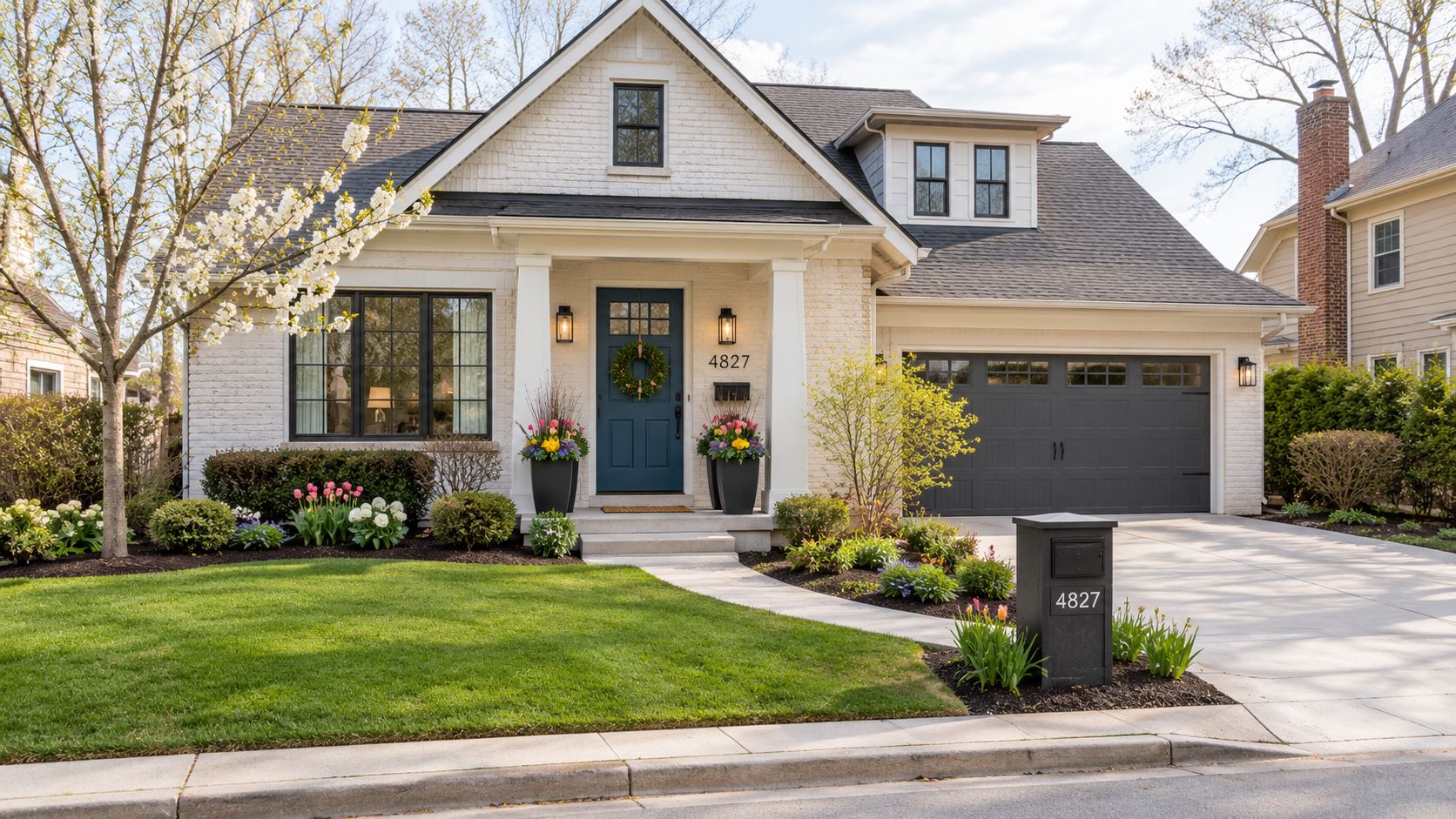
If you're standing in a Naperville or Downers Grove driveway the weekend before photos, you already know the problem. The lawn looks tired, the front door feels plain, the porch light is dated, and the whole house is about to be judged in a glance. That's exactly why how to increase curb appeal has to be treated like a priority list, not a random weekend project pile.
Buyers don't give the exterior a long interview. They read the front of the house, the walk to the door, and the condition of the yard, then decide whether the rest deserves attention. A major 2019 study found that a home's own curb appeal carried a measurable pricing effect, and the combined curb appeal of the home plus nearby properties could explain up to 7% of a house's sale price (Springer study). That's why exterior work often sets the tone before a showing ever starts.
Table of Contents
- Why Curb Appeal Matters When You Sell in Chicagoland
- What the ROI Data Says About Exterior Projects
- The Highest-Impact Fixes to Start With
- Budget Projects Versus High-Impact Upgrades
- Seasonal Timing for Chicagoland Sellers
- Avoiding Over-Improvement on Average Homes
- A Practical Curb Appeal Game Plan Before Listing
Why Curb Appeal Matters When You Sell in Chicagoland
A western suburbs seller usually doesn't lose buyers because the kitchen is small. They lose them because the exterior says, “This home has work ahead.” In a market where buyers compare everything from the street up, the house has to clear the first visual test before anyone is willing to spend time inside. That matters even more in spring, when shoppers move fast but still sort homes aggressively.
The evidence backs up what agents see every week. The 2019 pricing study found that a home's own curb appeal was worth about twice as much as a neighbor's across-the-street curb appeal, and the effect was stronger in weaker housing markets and in neighborhoods where curb appeal was already high (Springer study). In plain terms, the exterior doesn't just look nice, it changes how the whole property is priced in the buyer's mind.
That's also why the front yard, entry path, and visible maintenance issues deserve attention before almost anything else. Buyers notice deferred care fast, and if the front elevation feels neglected, they start assuming the rest of the home will need money too. If you want a useful local lens on value drivers beyond the house itself, this guide on neighborhood amenities that increase your home's value fits the same logic, buyers are always reading the property in context.
Practical rule: fix what buyers can see from the curb before you fix anything they won't notice until after they've already walked in.
For Chicagoland sellers, that means thinking in sequence. Clean and simplify the outside first. Then improve the entry. Then decide whether anything larger is worth the spend.
What the ROI Data Says About Exterior Projects
Exterior work often produces stronger resale returns than interior remodeling, particularly for the mid-market homes common across DuPage, Will, and Kane County. In Zonda's 2025 Cost vs. Value Report, garage door replacement ranked first nationally, recouping 267.7% of its cost. Steel door replacement recouped 216.4%, while manufactured stone veneer recouped 207.9%.
Those results reflect how buyers shop. A kitchen renovation may improve daily life, but sellers do not always recover the same share of that investment. Exterior projects change the first impression, strengthen listing photos, and affect whether buyers feel a home has been maintained before they evaluate appliances, cabinets, or tile.
For a home in the $400,000 to $600,000 band, the practical choice is to fund visible improvements first. Entry systems, garage doors, and carefully selected facade work can make sense when the listing timeline is short. Broad renovation becomes harder to justify if the exterior still shows wear or the project adds construction complexity without changing what buyers notice.
| Mid-Range Exterior Projects: Cost vs. Resale Value (Midwest Region) | |||
|---|---|---|---|
| Project | Typical Cost | Resale Value | Priority |
| Garage door replacement | Report-specific cost not stated in the cited data | 267.7% cost recouped | Highest |
| Steel door replacement | Report-specific cost not stated in the cited data | 216.4% cost recouped | Highest |
| Manufactured stone veneer | Report-specific cost not stated in the cited data | 207.9% cost recouped | High |
The report's broader ranking points in the same direction, with 8 of the top 10 projects by percentage of cost recovered classified as exterior work. That does not make every exterior upgrade a good investment. It means sellers should compare the project's visibility, condition benefit, and likely buyer response before approving a larger budget.
A separate Chicago-focused summary reported that 8 of the top 10 highest-ROI projects in Chicago were exterior projects for the second year in a row. For Chicagoland sellers, the takeaway is straightforward: sequence the spending. Handle low-cost visible defects first, then consider a larger exterior project only when the home's condition and neighborhood support it.
The Highest-Impact Fixes to Start With
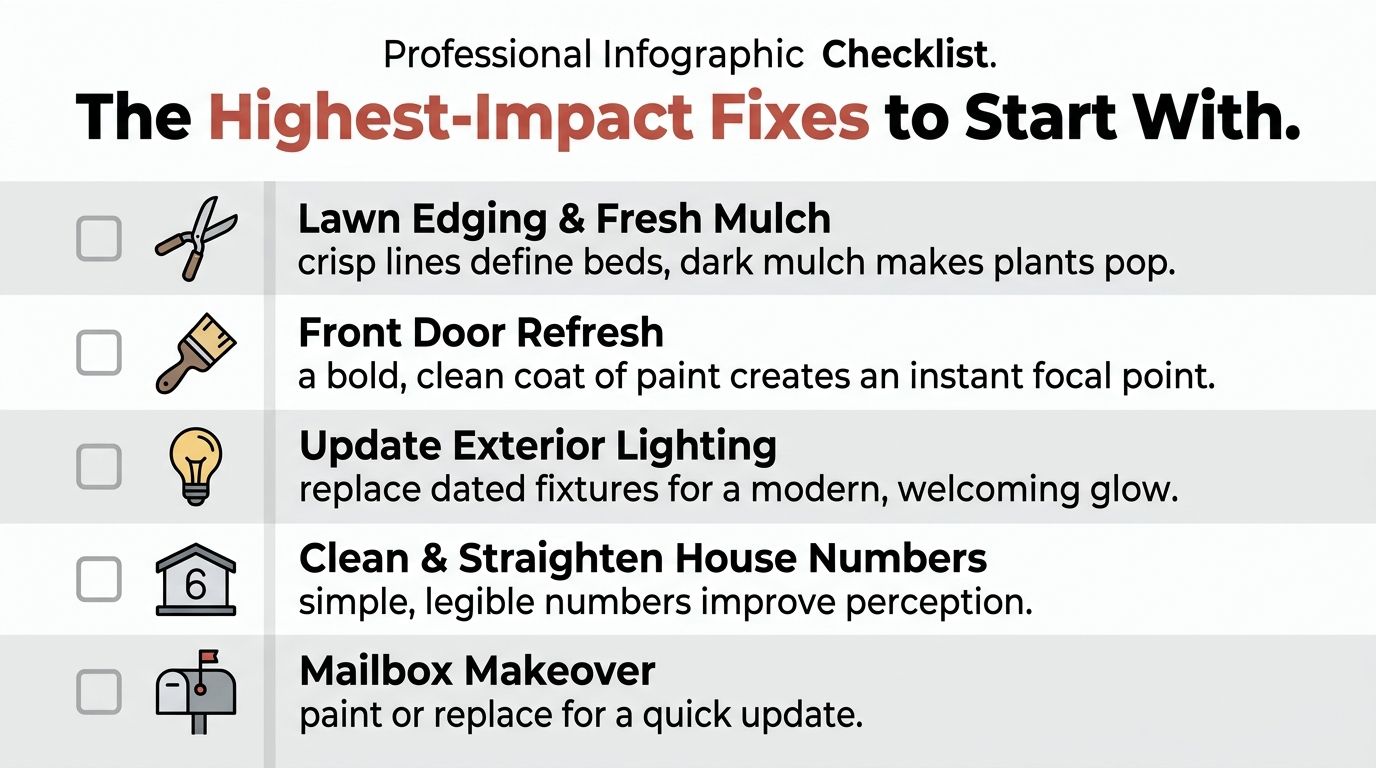
Start with the work that reads instantly from the street. If a buyer can spot the issue from the curb, they'll assume it's part of the home's overall condition. That's why the first pass should focus on cleanup, clear lines, and small details that register in listing photos.
Clean the frame around the house
Fresh mulch, edged beds, and a trimmed lawn do more than make the yard prettier. They define the property, sharpen the photo, and make the rest of the exterior look cared for. Power washing siding, walks, and the driveway has the same effect, it strips away the gray film that makes a house look older than it is.
Then move to the front door. A clean, bold repaint gives the entry a focal point without dragging the rest of the exterior into a bigger project. Keep the color appropriate for the home and neighborhood, not trendy for its own sake.
Best use of one weekend: clean, edge, paint, and replace the small things that look worn every day you drive up.
Tighten the details buyers actually notice
House numbers need to be legible. Mailboxes need to look intentional, not patched together. Porch fixtures should look clean and consistent with the style of the house. These upgrades are small, but they affect how finished the home feels in photos and during a drive-by.
A staged entry mat and a pair of simple planters can help, but only after the basics are handled. Don't start with decorative accents while the siding is dirty or the trim is chipped. The visual hierarchy matters.
For a seller-ready checklist that lines up with what buyers respond to, this internal guide on features that sell a house pairs well with the exterior work here. The right sequence is maintenance first, polish second, decoration last.
Budget Projects Versus High-Impact Upgrades
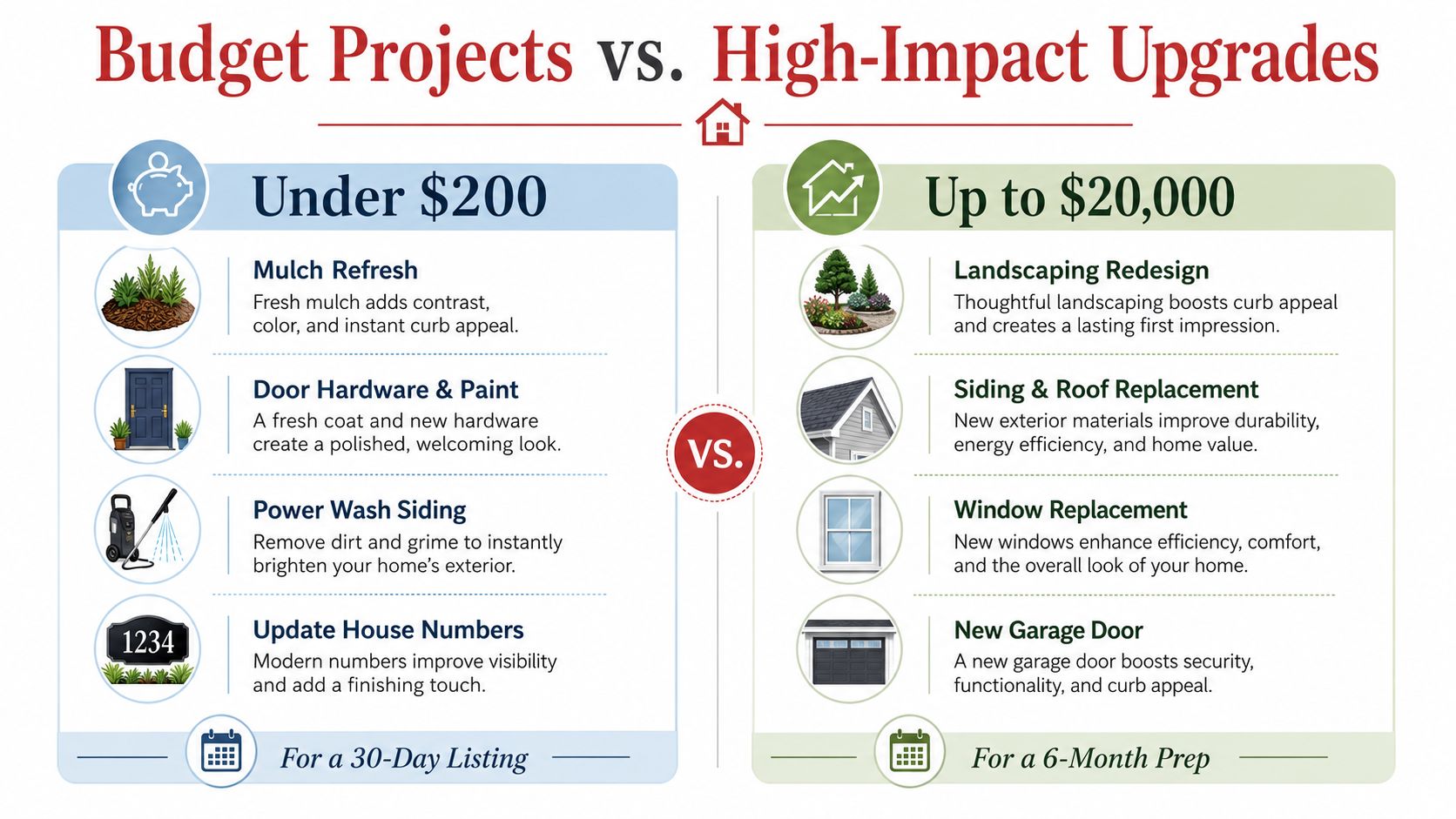
Not every front-yard problem deserves the same spend. A seller who has $200 should make different choices than someone who has a six-month prep window and a house that can support a larger exterior refresh. The right budget depends on the listing timeline, the neighborhood standard, and how close the home already is to competing inventory.
Keep the low-cost lane tight
Under the budget tier, the best work is the kind that signals care without creating a construction project. Mulch refreshes, hardware swaps, power washing, and updated house numbers all fit that role. They're especially useful when the home needs to look market-ready fast, not redesigned.
These fixes make the most sense when the house is already structurally fine and the exterior is mostly presentable. They don't try to change the home's identity, they just make it feel maintained. For many western suburbs listings, that's the right move.
Reserve the bigger spend for real payoff
Mid-tier upgrades, like a front door replacement, a garage door refresh, or improved exterior lighting, can shift buyer perception more strongly. That's where the emotional lift starts to matter, especially in the $400K to $700K range where buyers compare feel as much as finish. Larger projects, such as a garden redesign or wider facade work, only make sense when the comps support the level of finish you're trying to reach.
The same logic applies in Naperville, Wheaton, or Downers Grove. If the home is selling within 12 months and it's competing against similar-aged properties, prioritize the first two tiers over a remodel. Spend where the result shows up in the first glance, not in a long construction story.
Seasonal Timing for Chicagoland Sellers
Timing is part of the strategy here. In Chicagoland, the exterior doesn't perform the same way in every season, and sellers who match the work to the weather usually get a cleaner result. Spring is the most forgiving window, summer demands maintenance discipline, fall rewards prep work before the weather turns, and winter punishes anything sloppy.
Here's the practical sequence for local listings.
| Chicagoland Curb Appeal Timeline by Listing Window | ||
|---|---|---|
| Season | Priority Tasks | Best For |
| Spring | Edge beds, repair thin lawn areas, plant seasonal color, wash siding and walks | Listings going live in late March through May |
| Summer | Water consistently, deadhead flowers, touch up lawn repairs, keep hard surfaces clean | Homes showing through June and July |
| Fall | Clean gutters, wash windows, handle exterior painting if needed, clear leaves early | Sellers prepping for autumn photos and showings |
| Winter | Keep walkways safe, remove snow cleanly, maintain a tidy entry path | Listings during cold-weather months |
Spring is the deadline for anything that needs to establish before photos. Summer is maintenance season, not makeover season. If you're listing in October, resist the urge to start broad outdoor design changes and focus on cleanup, visibility, and access.
That tracks with the seller advice in the broader market too, where 92% of Realtors advise improving curb appeal before sale and 98% believe curb appeal matters to buyers (NAR remodeling impact report). In other words, the timing matters because the first impression matters.
If you're lining up a fall listing, the same logic in this guide to making a house cozy for fall showings can help you pair exterior cleanup with a warmer overall presentation.
Avoiding Over-Improvement on Average Homes
A typical western suburban home rarely needs a dramatic exterior redesign. It needs disciplined choices. On a standard three-bedroom, two-bath home built from the 1960s through the 1990s, an expensive upgrade can make the property look out of place without creating comparable value. Buyers compare it with nearby homes, not with the owner's renovation budget.
That mismatch is the risk of over-improvement.
Common traps that don't always pay back
A custom carriage-style garage door can clash with a plain tract home. Premium stone veneer installed on only part of the facade may look incomplete rather than upgraded. A front-yard redesign that far exceeds neighboring properties can also create a pricing ceiling, because the home begins asking more than local buyers will support.
Start with the condition and proportions already present. The strongest exterior value on an average home usually comes from maintenance, cleanliness, and proportion, rather than dramatic construction. The Phys.org research summary combines two useful findings: a prior buyer survey found 68% considered poor curb appeal a dealbreaker, while design clarity and mature plant size mattered more to perceived value than flashy extras.
That distinction matters in Chicagoland. A well-maintained ranch or two-story colonial can compete effectively when its entry, lawn, siding, and planting beds look intentional. Adding luxury materials to one visible area rarely fixes neglected work elsewhere.
Keep the best-maintained home within three doors in view, then work slightly above that standard. Don't leap so far ahead that the neighborhood has to catch up to you.
Use resale value to screen larger projects, but treat any estimate as a judgment call rather than a guarantee. If an upgrade is unlikely to return at least 70% of its cost, direct the budget toward repairs, staging, and photography instead. Those choices reduce buyer objections without forcing an average home into a price bracket its location and floor plan cannot support.
The goal is a property that looks cared for, appropriately finished, and easy to understand from the street. For average homes, clarity beats ambition.
A Practical Curb Appeal Game Plan Before Listing
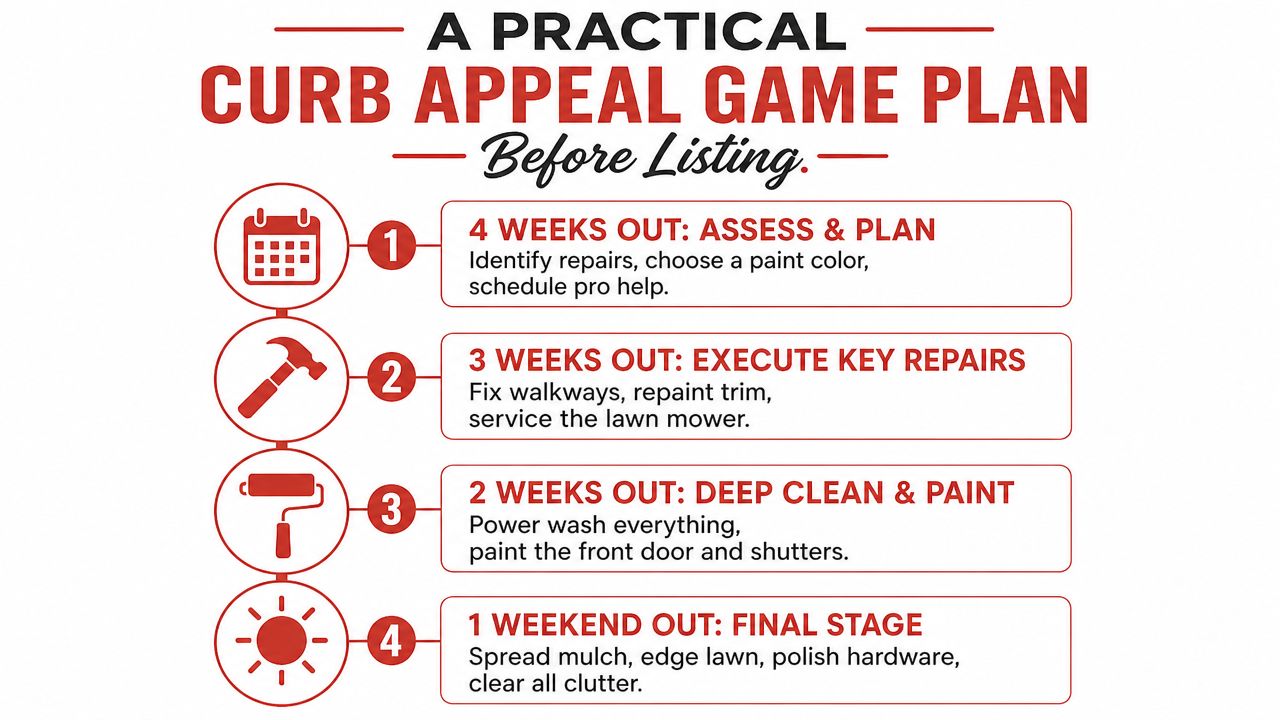
A good listing prep plan starts weeks before the photos are taken. The point is to finish the work in the right order so the house looks settled, not rushed. If you get the sequence right, the exterior reads cleaner in MLS photos and better from the street.
Work backward from the listing date
Four weeks out, assess repairs and choose any paint color. Three weeks out, fix the small mechanical problems and handle anything that affects safety or first contact, like walkways and trim. Two weeks out, do the deep clean, wash the exterior, and paint the front door if it needs it.
One weekend out, finish the last visible touches. Spread mulch, edge the lawn, polish hardware, and clear clutter from the porch and driveway. Those are the tasks that tend to move the needle in the western suburbs because they show up immediately in photos and during drive-by scouting.
The tasks that usually matter most are the ones buyers can read in a second. Clean surfaces, a maintained lawn, and a finished entry beat decorative extras that don't register from the curb. That's true in Naperville, Wheaton, Downers Grove, and Aurora alike.
Photograph only after you've stood at the curb at the same hour most showings will happen. Light changes how the exterior reads, and that can change the whole listing.
A useful recap for the refrigerator or phone screen is simple. Fix what's visible first. Spend modestly before you spend heavily. Finish the cleaning and maintenance before adding color. Then shoot the photos once the house looks consistent from the street, not just from the front step.
If you want a local read on which exterior changes make sense for your home, Homes By Carmen can help you weigh curb appeal against real resale priorities in your neighborhood. Visit Homes By Carmen for seller guidance, neighborhood insight, and a practical next step before you list.