
A typical U.S. home closing now takes about 36.8 to 37 days, or roughly five weeks from accepted offer to closing. That's shorter than the traditional 30-to-45-day expectation many buyers still hear, but your Chicagoland transaction may move faster or slower depending on financing, property details, and coordination.
You've just heard that your offer on a townhome in Oak Park was accepted. The excitement lasts about five minutes before practical questions arrive. When will the inspection happen? Has the lender ordered the appraisal? Can you give notice on your apartment yet? When will someone hand you the keys?
For a first-time buyer in Melrose Park, Downers Grove, Elmhurst, or another western suburb, the closing date on the contract can feel precise. In reality, it's a target supported by several moving parts. The lender, appraiser, attorneys, title company, inspector, seller, and buyer all have deadlines that affect one another.
Local housing conditions matter, too. A home's age, municipal requirements, condo or townhouse association documents, and the availability of professionals can create friction that a national average doesn't show. Reviewing broader Chicago housing market trends can help you understand the market context, but the transaction timeline still comes down to the specific property and loan.

Table of Contents
- What to Expect When Closing on a Chicagoland Home
- The National Baseline Timeline for Closing
- Milestones and Documents from Contract to Closing
- How Loan Type Changes Your Closing Speed
- Why Closings Slip Past Their Target Date
- Practical Ways to Keep Your Closing on Track
- Bringing It All Together for Your Chicagoland Closing
What to Expect When Closing on a Chicagoland Home
A buyer who gets an accepted offer on a Downers Grove ranch may have a very different experience from someone purchasing an older Oak Park condominium. Both may use conventional financing, yet the properties can involve different inspection findings, title questions, association paperwork, and attorney review concerns.
That's why the best answer to “how long does it take to close on a house” has two parts. The national benchmark is about five weeks, but your closing date depends on whether each required task finishes in the right order. A clean, well-prepared file can move efficiently. A single unresolved issue can push several later steps at once.
The contract date is a plan, not a guarantee
Your purchase agreement establishes the target closing date and the obligations each party must meet. It doesn't guarantee that the lender will issue final approval, that the title work will be clear, or that the seller's home will be ready for the final walkthrough.
In Chicagoland, buyers should pay attention to more than the calendar. Your attorney review period, inspection provisions, earnest money requirements, financing contingency, appraisal contingency, and possession terms all affect how much flexibility the transaction has.
Practical rule: Don't schedule movers, terminate a lease, or make nonrefundable travel plans based only on the original closing date. Wait until the lender has cleared the loan and the closing team confirms that the transaction is ready.
The process can feel slow because many tasks happen behind the scenes. Your agent may be coordinating access for an inspector while the lender orders an appraisal and the title company searches public records. Those activities aren't interchangeable, and completing one doesn't always allow the next one to finish.
The National Baseline Timeline for Closing
The current national benchmark is 36.8 to 37 days from accepted offer to closing, according to coverage citing ICE Mortgage Technology data in Zillow's explanation of home closing timelines. In practical terms, that's about one month to a month and a half, with five weeks serving as a useful planning assumption for many financed purchases.
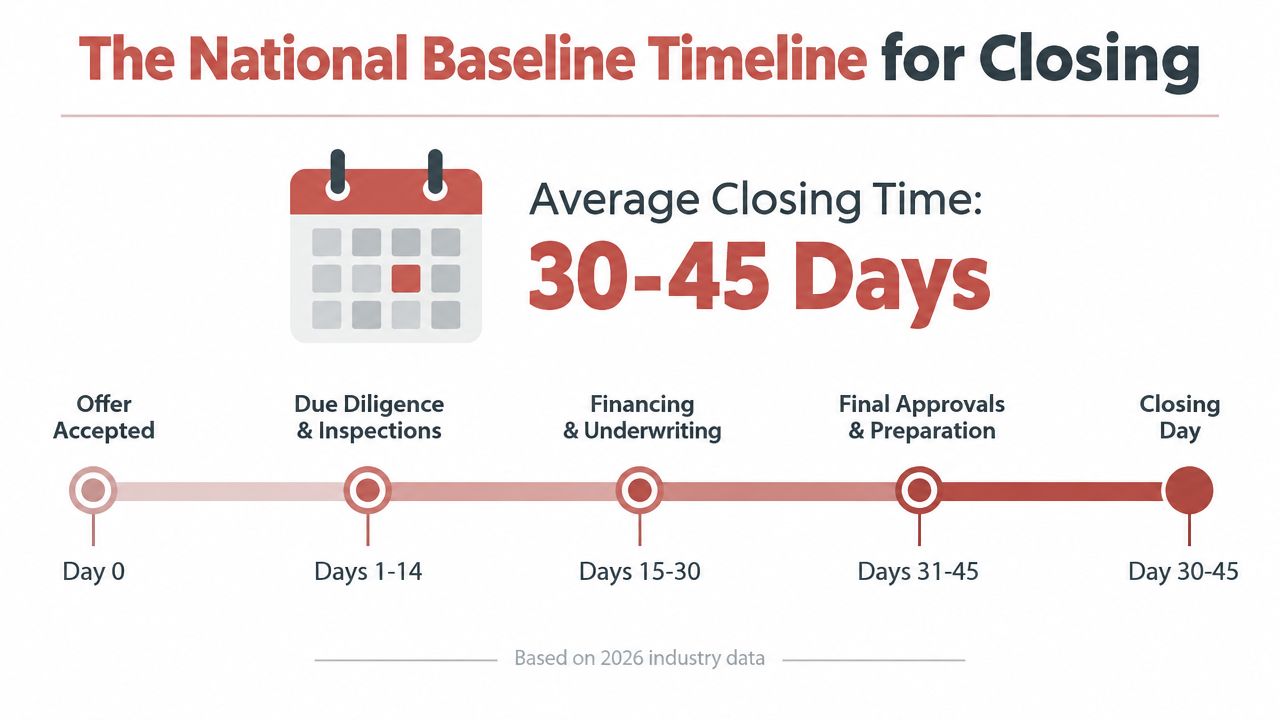
That figure is also part of a tightening pattern. Coverage from 2025 reported an average of about 42 days, while 2026 summaries cite roughly 37 days, a difference of approximately five to six days. Faster underwriting, digital document handling, and more efficient processing appear to have shortened the typical window, although those improvements don't eliminate property-specific problems.
What the average does and doesn't tell you
The benchmark is useful for setting expectations, not for predicting a particular closing. A buyer with a complete application, responsive income documentation, and a straightforward property may finish near the faster end of the normal range. A buyer using a loan with additional review requirements, or purchasing an older home with unresolved issues, may need more time.
The traditional 30-to-45-day range remains common in consumer guidance, but newer summaries suggest that a 30-day contract can be tight rather than routine. Chase's closing guidance places financed purchases around 42 to 43 days, while cash purchases can close in 7 to 14 days because they avoid lender underwriting and related funding steps.
For a western suburban buyer, the sensible approach is to distinguish between the expected timeline and the available buffer. If your move depends on the sale of another home, the end of a lease, school enrollment, or a job start date, tell your agent and lender before the offer is written. A contract date that looks reasonable on paper may leave little room for an appraisal delay or a title question.
Milestones and Documents from Contract to Closing
Closing isn't one event that begins on signing day. It's a sequence of approvals, inspections, searches, disclosures, and signatures. Each party has a separate responsibility, and a delay in one area can affect the people waiting on it.
The sequence after acceptance
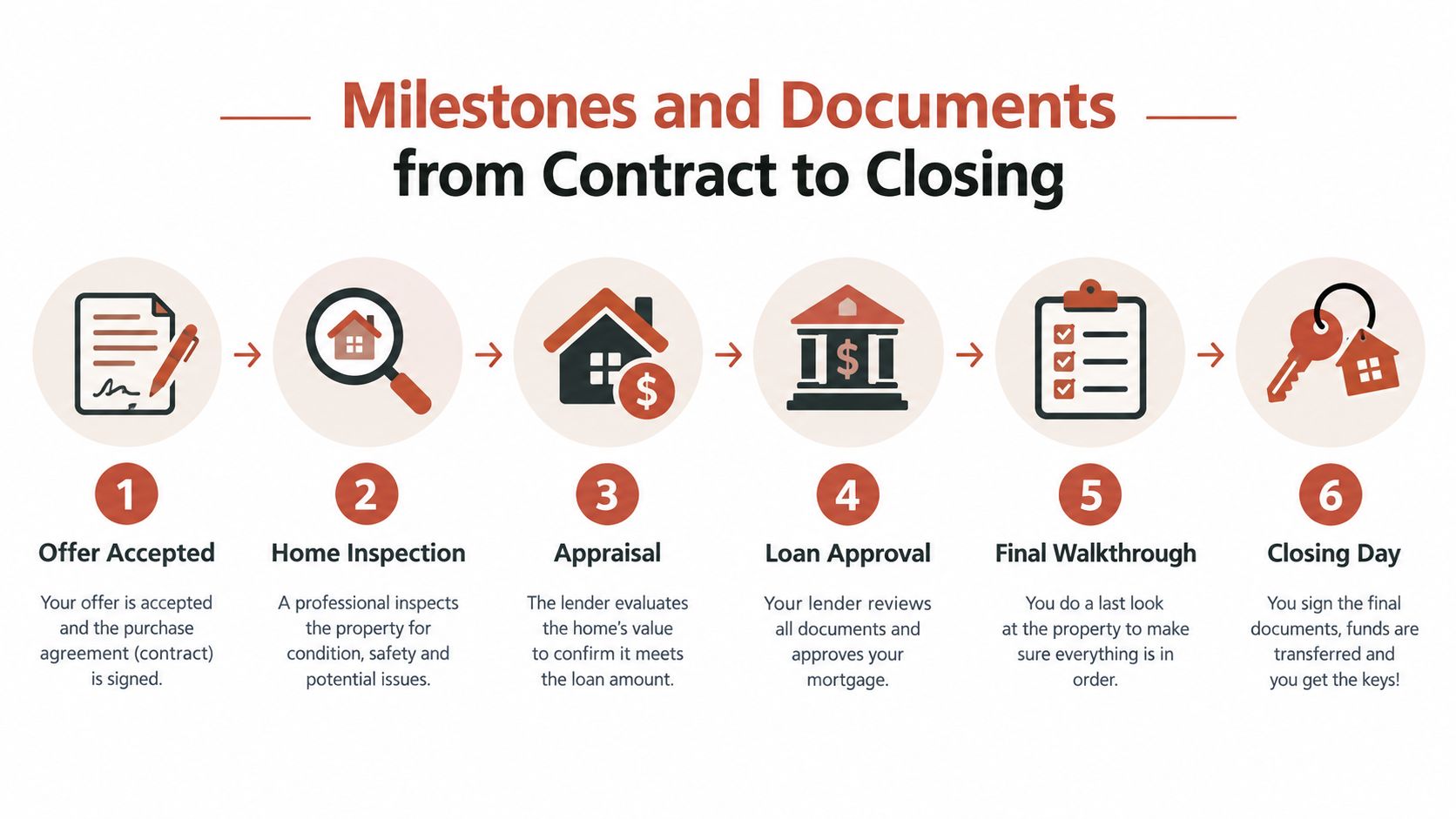
Offer accepted and contract completed. The buyer and seller sign the purchase agreement, and the transaction enters the attorney review and inspection process. The contract identifies deadlines, contingencies, the closing date, and possession terms.
Earnest money is deposited. The buyer delivers the earnest money according to the contract instructions. Keep proof of delivery and confirm where the funds are being held. A missed deposit deadline can create an avoidable contractual problem.
Inspection and negotiations take place. The inspector evaluates the home's condition, including major systems and areas such as the basement, attic, roof, plumbing, and electrical components. In older Chicago-area housing stock, findings may lead to repair requests, credits, or further review. The Illinois closing cost guide for buyers can help you prepare for the financial side of the transaction, but inspection negotiations are property-specific.
The lender orders the appraisal. The appraisal supports the lender's valuation of the property. If the value doesn't support the contract price, the buyer, seller, and lender may need to renegotiate terms or address the difference before the loan can proceed.
Underwriting and title review continue. The lender verifies the buyer's financial information and conditions for approval. At the same time, the title company and attorneys review ownership records, liens, taxes, judgments, and other matters that could affect the transfer.
Final documents and walkthrough are completed. The buyer reviews the Closing Disclosure and confirms the final funds needed. Shortly before closing, the final walkthrough checks that the property is in the agreed condition and that included items remain. At closing, the parties sign the transfer and loan documents, funds are delivered, and the transaction is recorded according to local practice.
The order isn't perfectly linear. An appraisal may be ordered while the inspection is underway, and title work can proceed while underwriting reviews documents. Good coordination keeps these parallel tasks visible instead of allowing one unfinished item to surprise everyone near closing.
How Loan Type Changes Your Closing Speed
Your financing method is one of the strongest predictors of timing. A cash buyer doesn't need mortgage underwriting, while a financed buyer must satisfy the lender's requirements before funds can be released.
| Purchase method | Typical timing described in verified data | Why the timeline differs |
|---|---|---|
| Conventional financing | About 36 to 43 days | Requires appraisal, underwriting, final approval, and funding coordination |
| FHA or VA financing | About 54 to 77 days in some historical datasets | Additional documentation and review can extend the process |
| Cash purchase | About 7 to 14 days | Bypasses lender underwriting and many financing-related steps |
The conventional range aligns with current benchmarks from Chase's mortgage closing overview. It isn't a promise that every conventional loan will close within that window. The lender still needs a complete file, the property must support the loan, and the title work must be acceptable.
Government-backed loans need more patience
FHA and VA transactions can take longer because the lender may need additional documentation and review. Historical summaries report FHA or VA purchase timelines of about 54 to 77 days, depending on the period and dataset, as outlined in Capital One's closing timeline discussion.
That doesn't make these loans a poor choice. They can be appropriate for buyers whose financial circumstances fit their requirements. The mistake is choosing a target closing date without telling the seller and the rest of the transaction team which loan program is involved.
Cash can be faster because the lender's underwriting stage disappears, but speed still depends on title work, inspections, contract terms, attorney review, and the parties' availability. A cash buyer shouldn't assume every seven-to-fourteen-day transaction is automatic. The property still has to transfer cleanly, and the buyer still needs enough time to investigate the purchase.
Why Closings Slip Past Their Target Date
A delayed closing isn't the same as a failed transaction. Recent NAR confidence data cited in coverage of buyer penalties for missing a closing date indicates that about 12% of contracts experienced delayed settlements, while 6% were terminated during the period discussed. The figures show why a short delay can be more common than a cancellation, but they don't predict the outcome of your specific contract.
The risks that deserve attention
An appraisal can arrive below the purchase price, forcing the parties to discuss price, cash contributions, or another contractual solution. Underwriting can also generate additional requests when income, assets, employment, debt, or deposits require clarification. Buyers often experience these requests as sudden, but the lender is working through conditions that must be satisfied before issuing final approval.
Title problems create a different kind of delay. A search may uncover an unpaid lien, an ownership question, a tax matter, a missing document, or an issue connected to prior work on the property. The attorneys and title professionals need time to determine whether the problem can be resolved and what paperwork is required.
Chicagoland friction points
Western suburban homes often have long ownership histories and older construction. That can make inspection findings more consequential, especially when buyers discover aging mechanical systems, drainage concerns, electrical changes, or work that needs documentation. Condominiums and townhomes add another layer because association documents, rules, budgets, fees, and disclosures may need review before the buyer is comfortable proceeding.
Municipal and township practices can also vary across communities such as Melrose Park, Oak Park, Elmhurst, and Downers Grove. A local professional can't control an appraiser's schedule or make a title issue disappear, but can identify who needs an answer, confirm deadlines, and push the right question to the right party.
A closing usually slips because one unresolved item stays invisible too long. Early escalation gives the team options that last-minute discovery removes.
The practical lesson is to plan for some slack. If your housing transition has no flexibility, communicate that before signing and ask the team which milestones must be completed early.
Practical Ways to Keep Your Closing on Track
You can't remove every source of delay, but you can reduce the avoidable ones. Buyers who treat the transaction like a deadline-driven project give the lender, attorney, title company, and agent fewer opportunities to wait on them.
Five habits that protect the timeline
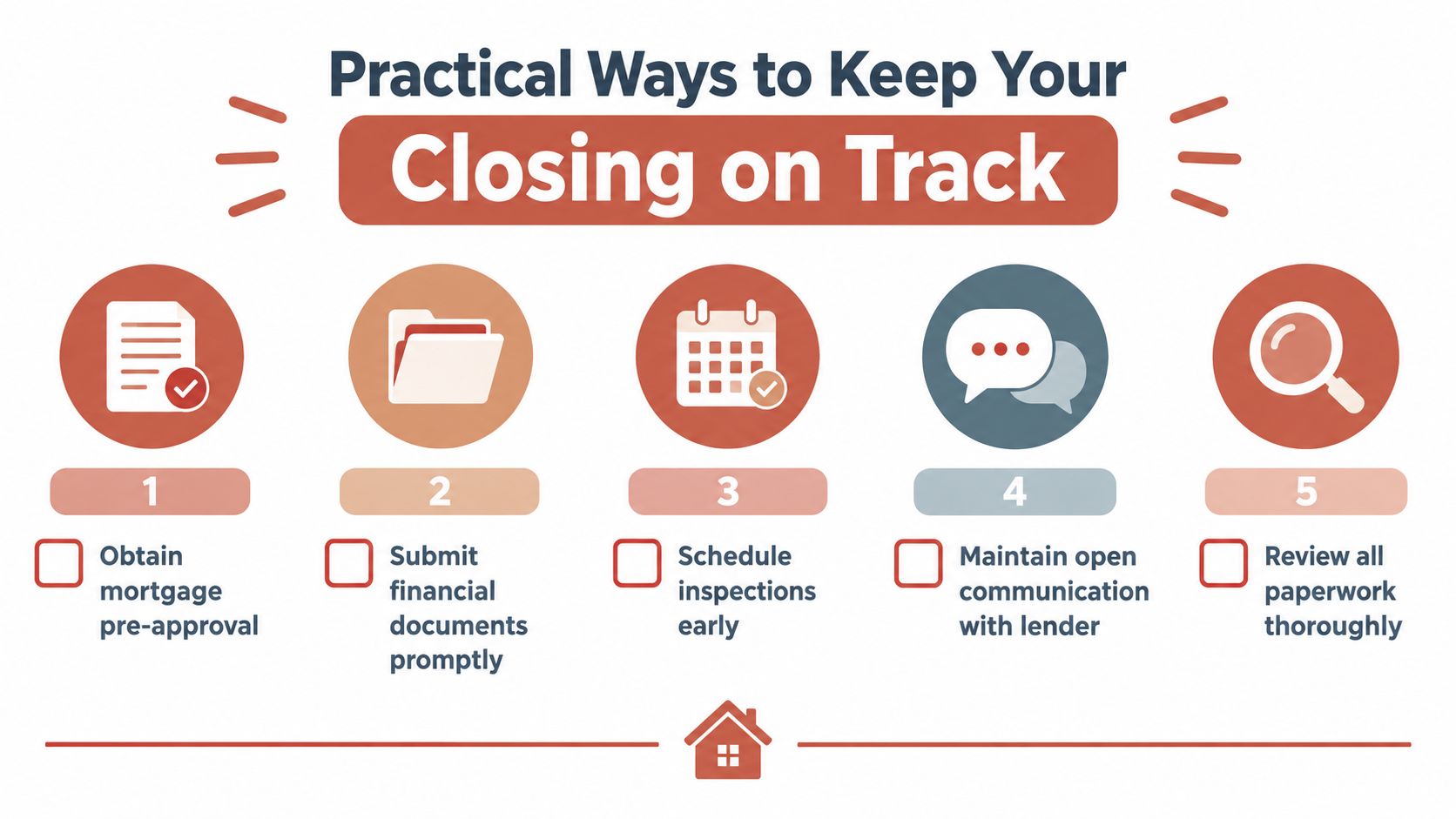
Get fully pre-approved before offering. A pre-approval gives the lender an earlier view of your income, assets, debts, and credit profile than a basic conversation about affordability. Ask what remains outstanding before you begin touring seriously.
Send documents promptly. When the lender requests an updated statement, explanation, or signature, respond as soon as you can. Keep financial records organized in one secure location so you aren't searching for paperwork during underwriting.
Schedule the inspection early. Arrange access immediately after acceptance and understand your contractual inspection deadlines. If the property is older or has unusual construction, ask whether additional specialist evaluations make sense.
Keep your finances stable. Don't open new credit, finance a vehicle, change employment, move money without documentation, or make a large purchase without speaking with the lender first. Even a well-intended financial change can trigger another review.
Confirm every handoff. Ask who is waiting on whom. The lender may need the appraisal, the title company may need information from the seller, and the attorneys may need a revised document. Clear communication makes those dependencies visible.
A local agent's value is often most apparent between milestones. Coordinating inspection access, tracking attorney review, checking appraisal status, and keeping the lender and title team informed can prevent small uncertainties from becoming closing-week emergencies. Use questions to ask a real estate agent to evaluate how a prospective agent handles those responsibilities before you hire one.
Build flexibility into your move, too. If possible, avoid making your lease termination, movers, storage arrangements, or utility changes depend on the original date alone. A modest buffer protects you from having to solve a housing problem while also managing final loan conditions.
Bringing It All Together for Your Chicagoland Closing
For the buyer in Melrose Park or Downers Grove who just received an accepted offer, the clearest planning assumption is about five weeks for a typical financed purchase. Current national data places the average around 36.8 to 37 days, while other industry summaries place financed transactions closer to 42 to 43 days, so an individual closing date should be treated as a working target rather than a fixed promise.
Four principles matter most:
Start with the right baseline. A conventional purchase often fits within roughly a month to a month and a half, but a 30-day schedule may leave limited room for complications.
Match the date to the loan. Cash, conventional, FHA, and VA transactions don't move through the same review process. The financing method should influence the contract timeline from the beginning.
Watch the dependencies. Inspection, appraisal, underwriting, title, attorney review, disclosures, and the walkthrough all need active follow-up. A local transaction professional can spot an unanswered question before it reaches the final week.
Plan for a delay without assuming failure. A missed target date may require an extension or revised arrangements, but it doesn't automatically mean the purchase is over. Keep your lender, attorney, agent, and title contact informed as soon as a milestone starts slipping.
The buyer who stays responsive and asks precise questions usually has more control over the process. You may not be able to control an appraisal schedule or the discovery of an old title matter, but you can prepare documents, protect your finances, schedule inspections early, and build realistic flexibility into your move.
For Chicagoland buyers, local knowledge matters because the property and community affect the work behind the headline timeline. An older Oak Park home, a townhouse with association documents, and a newer Downers Grove property may each require different coordination even when the loan type is identical.
Homes By Carmen helps first-time buyers across Melrose Park and western Chicagoland coordinate showings, offers, inspections, lender communication, and closing milestones with practical local guidance. Visit Homes By Carmen to discuss your purchase plans and build a realistic path from accepted offer to keys.