
You've been saving, watching listings, and trying to decide whether a home in Melrose Park, Oak Park, or another western suburb is within reach. Then a new property appears, and the question isn't, "Can I make the down payment?" It's, "Will the full monthly payment still feel manageable after taxes, insurance, debt, and ordinary life are included?"
That's the question this first time home buyer guide puts first. Buying your first home requires more than browsing listings. You'll need a realistic payment target, a lender-reviewed pre-approval, a focused local search, an offer strategy, and a clear plan for inspections, attorney review, appraisal, and closing. The right preparation won't remove every decision, but it will keep you from making an expensive one under pressure.
Table of Contents
- What Buying Your First Home Really Looks Like Today
- Getting Your Budget and Pre-Approval Ready the Right Way
- Searching the MLS and Touring Homes Like a Local
- Making a Strong Offer and Negotiating With Confidence
- From Inspection to Closing Without Losing Momentum
- Your Next Steps and Downloadable Checklist for Success
What Buying Your First Home Really Looks Like Today
A typical first-time buyer in Melrose Park may begin with a familiar plan: save for a down payment, get approved, and look for the most attractive home within that loan amount. That plan is incomplete. In western Chicagoland, the same purchase price can produce a very different monthly obligation depending on property taxes, insurance, loan terms, condition, and whether the home needs immediate work.
The entry point into ownership has also changed nationally. In 2025, the median first-time buyer age reached 40, compared with 38 in 2024 and the late 20s in the 1980s. First-time buyers represented only 21% of all home purchases, the lowest share since tracking began in 1981, according to the National Association of REALTORS® profile of first-time buyers. Those figures reflect affordability pressure and limited inventory, not a lack of interest in homeownership.
The path from preparation to possession
The process usually unfolds in a sequence:
- Define the payment you can live with. Start with income and recurring obligations, then account for principal, interest, taxes, insurance, and any association costs.
- Prepare for lender review. A pre-approval helps establish a credible price range, but it isn't the same as a personal comfort limit.
- Search with local filters. Compare Melrose Park with nearby communities based on commute, housing type, taxes, condition, transit, and daily routines.
- Tour with a decision system. Look past staging and record the condition, layout, likely repairs, and reasons the home might or might not work.
- Write an offer you can carry. Price matters, but so do contingencies, deadlines, credits, earnest money, and financing strength.
- Protect the transaction after acceptance. Inspections, attorney review, appraisal, underwriting, title work, and final documents all have deadlines.
A downloadable checklist can make this sequence easier to manage. Keep one copy for your lender documents, another for property-specific notes, and a final version for contract deadlines. That simple separation prevents the common mistake of treating every task as one large, confusing project.
Practical rule: A home should fit both your approval letter and your ordinary Tuesday. If the payment only works when nothing unexpected happens, the price is too high.
Local MLS access and neighborhood context matter because online searches flatten meaningful differences. A home near a transit route, a busy commercial corridor, or a particular school boundary may suit one household and frustrate another. A local professional can also connect you with lenders, inspectors, and attorneys who understand the transaction environment, while you remain responsible for choosing the professionals and terms that fit your needs.
Getting Your Budget and Pre-Approval Ready the Right Way
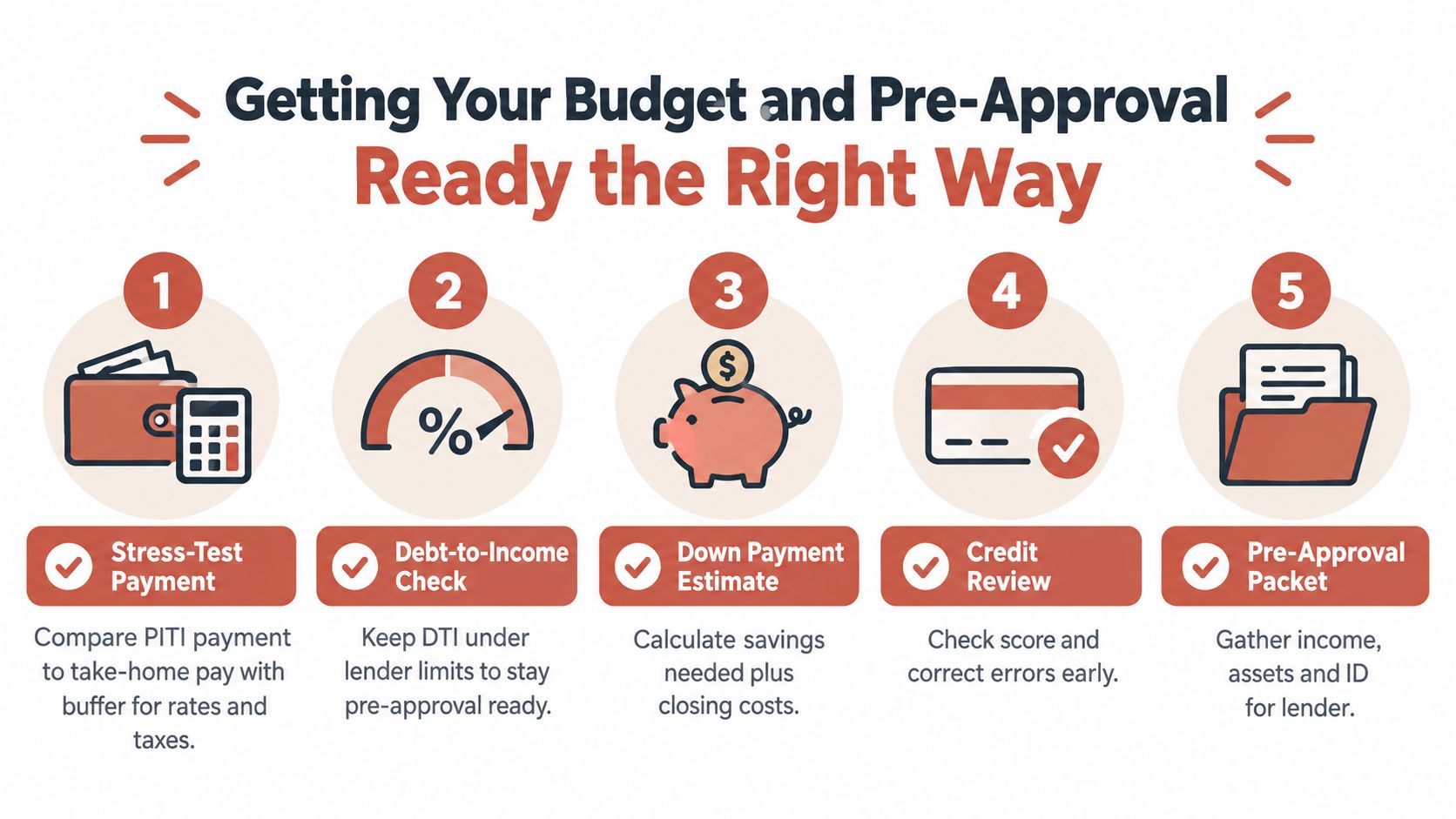
The most useful budget starts with the payment, not the listing price. A lender evaluates what you may qualify for. You need to decide what you can pay while preserving room for taxes, insurance, repairs, savings, and changing rates.
Harvard's 2025 housing report found that a typical first-time buyer needed at least $126,700 in annual income to afford the median-priced home of $412,500, up from $79,300 in 2021. The Harvard Joint Center for Housing Studies report also helps explain why focusing only on the down payment can mislead buyers. In western Chicagoland, property-tax differences can materially affect the payment, so two similarly priced homes may not carry the same monthly burden.
Build a payment stress test
Use a calculator to explore scenarios, but don't treat the first result as your budget. A useful stress test includes:
- Principal and interest: Compare loan amounts and terms using the rate your lender discusses, then test a less favorable rate so you understand sensitivity.
- Property taxes: Ask for the current tax information and confirm how the lender will estimate the escrowed amount.
- Homeowners insurance: Obtain a realistic quote before you make an offer, particularly for older homes or properties with features that may affect coverage.
- Association charges: Condominiums and townhomes may have monthly assessments and special-assessment risk.
- Maintenance reserve: Leave room for ordinary ownership costs and larger repairs. A lender's maximum isn't a maintenance plan.
Your debt-to-income ratio also matters. The lender will compare recurring debt obligations with qualifying income, verify employment and assets, review credit, and examine the documents supporting the application. Don't finance a vehicle, open new credit, move large unexplained amounts, or change employment without discussing the effect with the lender first.
Estimate cash to close
The down payment is only one part of the funds needed. Plan for lender charges, title-related expenses, prepaid taxes and insurance, inspection costs, attorney fees, moving expenses, and an emergency cushion. Your lender and attorney can provide transaction-specific estimates, but you should question anything you don't understand before you're under contract.
First-time buyers remain strongly dependent on financing. In the 2024–2025 profile data, 91% financed their purchase, and 25% used a gift or loan from family or friends for the down payment, according to the first-time buyer statistics summary. If family assistance is part of your plan, document whether it's a gift or loan and give the lender the information early. Undisclosed funds can create underwriting problems.
Use the home loan repayment calculator as a planning aid, then confirm the assumptions with a qualified lender. The finished pre-approval packet should include income records, asset statements, identification, debt information, and explanations for anything unusual. A clear packet helps you move quickly without confusing speed with affordability.
Searching the MLS and Touring Homes Like a Local
A broad search creates noise. A focused MRED-powered search should answer practical questions about where you'll live, how you'll commute, and what kind of maintenance you're willing to accept.
Start with a firm maximum payment, then translate it into a purchase-price range after taxes, insurance, association charges, and condition are considered. Use map search to compare Melrose Park with Elmhurst, Oak Park, Glen Ellyn, Downers Grove, or Naperville, but don't assume a nearby suburb offers the same value. Housing stock, transit access, lot sizes, taxes, school context, and renovation levels can vary sharply from one area to the next.
Set filters that reflect real priorities
Choose only the filters that help you decide:
- Property type: Separate condos, townhomes, and detached homes if the ownership costs or maintenance expectations differ.
- Location: Draw a map around the commute, transit stops, family connections, or services you use.
- Condition: Decide whether you're open to cosmetic updates, substantial repairs, or only move-in-ready properties.
- Space: Set minimum needs for bedrooms, parking, storage, outdoor space, or a home office.
- Payment risk: Review association fees, tax history, major mechanical systems, and signs of deferred maintenance.
A listing page can't tell you how loud a street feels, whether the basement smells damp, or how natural light changes through the day. It also may not reveal the practical cost of an older roof, aging electrical equipment, drainage concerns, or a layout that looks larger online than it feels in person.
For a more detailed walkthrough, use this guide on how to search the MLS. The objective isn't to save every appealing property. It's to create a shortlist where each home satisfies the priorities that matter most.

Tour with a comparison sheet
After each showing, record the same categories:
- Monthly fit: Does the likely payment remain within the range you set?
- Condition: What needs attention immediately, and what can wait?
- Layout: Does the home work for your routine without expensive changes?
- Location: How do transit, traffic, parking, nearby services, and neighborhood feel compare?
- Resale flexibility: Would the home remain useful if your household or work situation changed?
Don't tour every listing that matches a bedroom count. Tour homes that represent a meaningful option, a useful comparison, or a different suburb you're seriously considering. If nothing fits, adjust one variable at a time. Expanding the map may be wiser than raising the payment, while accepting cosmetic work may be wiser than compromising on location.
Making a Strong Offer and Negotiating With Confidence
A strong offer is not automatically the highest offer. It's the combination of price, financing credibility, timing, contingencies, earnest money, and terms that gives the seller confidence while protecting your ability to close.
Start with a comparative market analysis that considers recent nearby sales, competing listings, condition, location, and features. The list price is a reference point, not proof of value. In western Chicagoland, a well-maintained home in a desirable location may attract different interest from an outdated property with a similar asking price.
Affordability remains uneven. First American reported that affordability improved nearly 9% year over year in December 2025, while consumer house-buying power rose 10% year over year. Yet ATTOM found homes were less affordable than historical averages in 99.3% of counties in the second quarter of 2025 and 99% in the third quarter, as summarized in the First American affordability update. National improvement doesn't tell you whether a specific Melrose Park or nearby suburb purchase works for your income.
Offer Tradeoff Decision Matrix
| Offer Element | Conservative Approach | Competitive Approach |
|---|---|---|
| Price | Stay near the supported market value and your payment ceiling | Increase only when the home's value and payment remain defensible |
| Earnest money | Use an amount that preserves cash flexibility | Offer stronger earnest money when your funds and contract protections support it |
| Inspection contingency | Keep a meaningful inspection period and negotiate documented concerns | Use a clear, efficient contingency rather than removing protection casually |
| Financing contingency | Allow enough time for underwriting and appraisal | Match the deadline to genuine lender readiness |
| Closing date | Choose a date that works with your lease, funds, and lender | Offer the seller's preferred timing when you can meet it safely |
| Credits | Request support for legitimate closing or repair costs | Seek reasonable credits tied to findings, financing, or documented needs |
| Appraisal risk | Preserve protection if the price exceeds supported value | Consider additional appraisal planning only after understanding the cash exposure |
Sellers may respond to certainty, but certainty shouldn't come from waiving protections you need. A buyer with a clean pre-approval, responsive lender, organized documents, and realistic deadlines can be competitive without making an impulsive promise.
Counteroffers deserve the same discipline. Compare the revised price with the value of credits, the inspection language, the closing date, and any appraisal exposure. If two homes are similar, the better choice may be the one with fewer immediate repairs, a more manageable payment, or terms that protect your cash after closing.
Survey data indicates that 62% of 2025 buyers prioritized affordability, 64% targeted homes under $400,000, and 47% exceeded budget, according to the First American update linked above. Treat that as a warning about decision pressure, not an instruction to stretch. Your best offer is one you'll still respect after the excitement fades.
From Inspection to Closing Without Losing Momentum
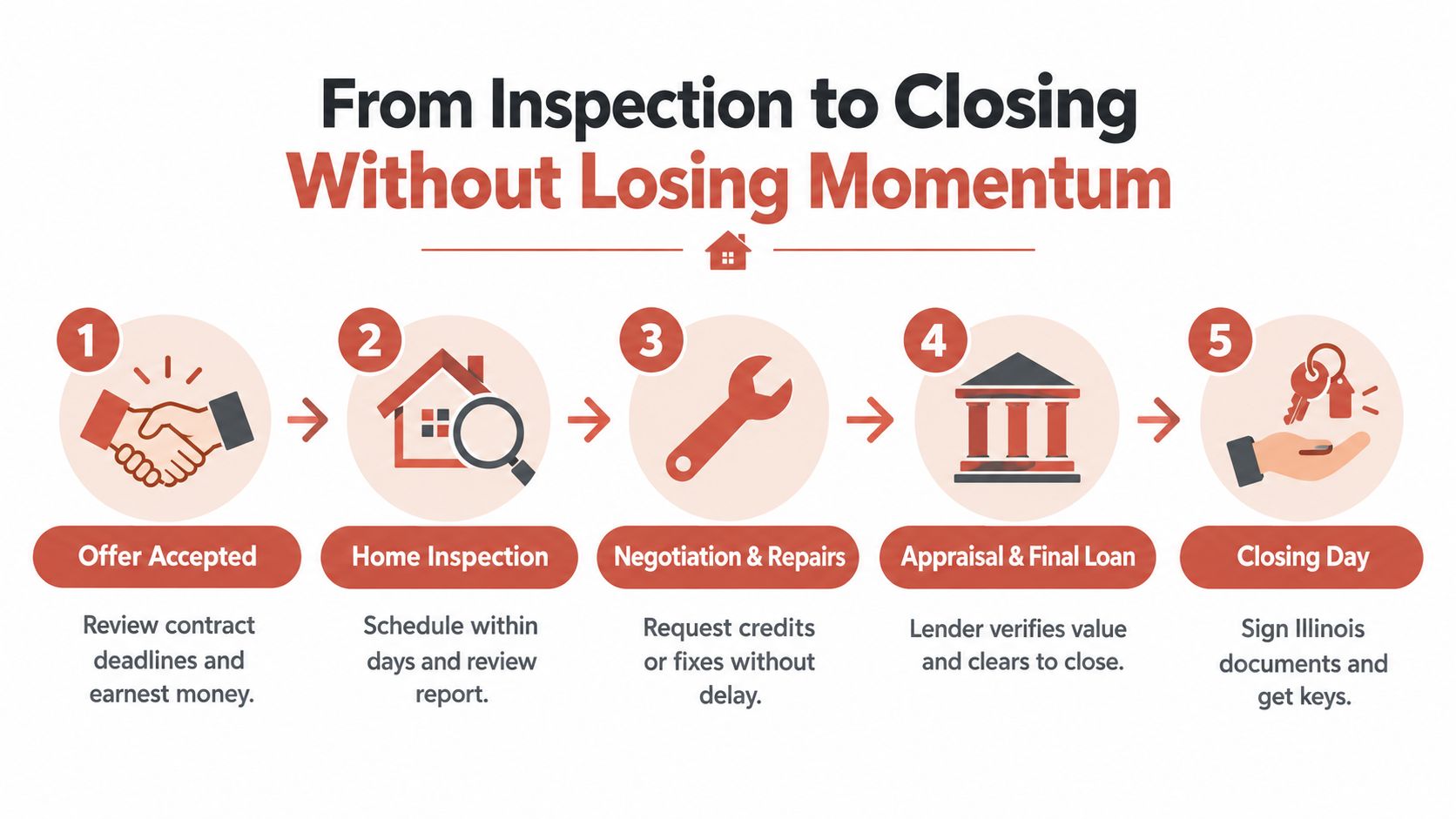
After acceptance, the transaction becomes deadline-driven. Illinois buyers usually work with a real estate attorney during attorney review, and the contract controls the specific obligations, dates, and remedies. Read every document, ask questions early, and don't assume a verbal conversation changes the written agreement.
Keep the first deadlines visible
Create one shared deadline list as soon as the offer is accepted:
- Offer acceptance: Confirm the contract, earnest money instructions, attorney contacts, and every contingency date.
- Inspection: Schedule a qualified inspection promptly. Attend when possible, take notes, and ask the inspector to distinguish safety concerns, active defects, maintenance, and improvements.
- Attorney review: Send the contract and disclosures to your attorney immediately. Don't wait until a concern becomes urgent.
- Repair negotiation: Request specific repairs, credits, or other remedies supported by the inspection and contract terms. Focus on material concerns rather than turning the report into a renovation wishlist.
- Loan and appraisal: Provide every lender document quickly, keep finances stable, and respond to underwriting questions without delay.
- Final preparation: Complete the final walkthrough, verify agreed work, review closing figures, and confirm the time and funds required for closing.
An inspection report is a decision tool, not a prediction of a perfect house. A buyer may accept older components when the price and payment leave room for replacement. Another buyer may prefer a newer system even if that means choosing a smaller home or a different suburb. The right response depends on risk, budget, safety, and the contract.
The lender's appraisal and final approval are separate from the inspection. The appraiser evaluates the property for the lender's collateral decision, while the inspector evaluates physical condition. If the appraisal creates a value issue, ask the lender and attorney about the available contractual and financing options before making a cash commitment.
Prevent avoidable delays
Keep identification, income records, asset statements, insurance information, and deposit documentation organized. Avoid large purchases, new credit, unexplained transfers, or employment changes during underwriting unless you've discussed them with the lender. Confirm that the title company, attorney, lender, inspector, and agent all have current contact information.
Use this overview of Illinois closing costs for buyers to identify questions for your lender and attorney. The exact amount depends on the property, loan, contract, taxes, prepaid items, and negotiated terms, so rely on the transaction-specific disclosure rather than a generic estimate.
Closing day should feel like the final checkpoint, not the first time you see the numbers. Review the settlement statement in advance, bring the required identification and funds, and make sure the property is in the agreed condition before signing.
Your Next Steps and Downloadable Checklist for Success
A successful first purchase doesn't begin with a perfect listing. It begins with a payment you understand, a pre-approval based on complete information, and a search that reflects how you live.
Use a first-time buyer checklist to track the work in four groups:
- Financial preparation: Set your payment ceiling, review debts and credit, gather documents, estimate cash to close, and discuss assistance funds with the lender.
- Search preparation: Choose priority suburbs, set MRED filters, compare property types, review taxes and association costs, and tour with consistent notes.
- Offer preparation: Confirm comparable value, decide which contingencies you need, review earnest money and credits, and establish a maximum offer before negotiations begin.
- Closing preparation: Track inspection, attorney review, appraisal, underwriting, title, insurance, final walkthrough, and closing-document deadlines.

This week, choose a lender, gather your financial records, and write down the monthly payment that feels responsible rather than merely possible. Then compare Melrose Park and nearby western suburbs using the same criteria, including taxes, commute, condition, transit, and future flexibility.
Local guidance is most useful when a decision has several reasonable answers. A buyer may need help interpreting neighborhood tradeoffs, comparing a condo with a detached home, preparing an offer, coordinating an inspection, or keeping contract deadlines visible. You don't need to rush to prove you're serious. You need enough information to move when the right home appears.
Download and use the checklist as a working document, not a one-time worksheet. Mark questions for your lender, attorney, inspector, and real estate professional, then bring those questions to the conversation before you're emotionally committed to a property.
Homes By Carmen offers MRED-powered home searches, suburb-specific guidance, offer and negotiation support, inspection coordination, and closing assistance for first-time buyers in Melrose Park and western Chicagoland. If you're ready to turn your payment target into a practical search plan, visit Homes By Carmen and start with a low-pressure conversation.