Closing costs when buying a home generally run about 2% to 5% of the purchase price, separate from the down payment. In the Chicago area, though, a location-specific estimate matters because municipal transfer taxes can change the amount you need to bring.
You may be looking at a purchase price, a carefully saved down payment, and a monthly payment that appears manageable. Then the lender, title company, and attorney send the final paperwork, and the number labeled Cash to Close is higher than expected. That moment catches first-time buyers across Melrose Park, Oak Park, Elmhurst, and nearby suburbs because a down payment is only one part of the money required to complete a purchase.
Table of Contents
- Why Closing Costs Surprise Most Buyers
- How to Read the Loan Estimate and Closing Disclosure
- Closing Cost Categories That Actually Matter
- Chicago Versus Western Suburbs Transfer Taxes
- Ways to Reduce Closing Costs Without Breaking the Deal
- Timing, Cash Flow, and What Can Change Late
- Your Chicagoland Closing Checklist and Next Steps
Why Closing Costs Surprise Most Buyers
The surprise usually arrives late. A buyer has saved for the down payment, paid for inspections, perhaps kept enough money for moving, and still assumes the remaining balance will be modest. Then the wire instructions arrive, and the buyer discovers that the final amount includes lender charges, title work, recording fees, prepaid interest, insurance, taxes, and escrow deposits.
Closing costs are the settlement expenses required to originate the mortgage and transfer ownership. They're separate from the down payment. The down payment goes toward the purchase price and creates equity. Closing costs pay the professionals, agencies, and accounts involved in completing the transaction.
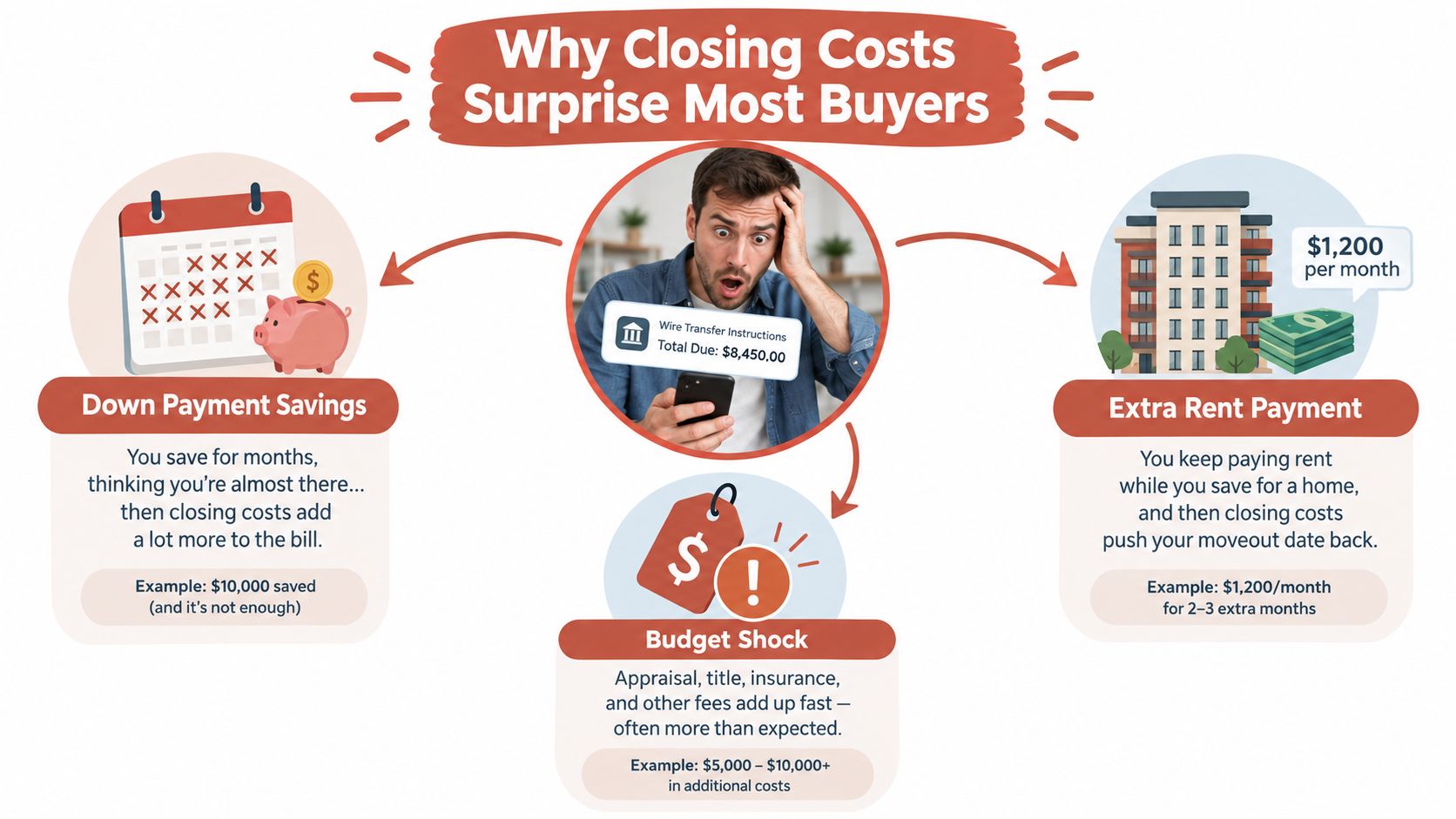
The Consumer Financial Protection Bureau's purchase-planning guidance says buyers should generally budget approximately 2% to 5% of the purchase price for closing costs, although the actual amount depends on the property, location, loan, down payment, and lender charges. That planning range equals roughly $6,000 to $15,000 on a $300,000 home, or approximately $10,000 to $25,000 on a $500,000 home.
The down payment isn't the closing bill
Consider a 10% down payment on a $300,000 property. The down payment is $30,000, but estimated closing costs could add $6,000 to $15,000, according to the CFPB guidance linked above. The buyer may need to plan for both amounts, even though only the down payment becomes part of the initial equity.
Common charges include:
- Lender work: Origination, underwriting, appraisal, and credit-report fees.
- Title and settlement work: Title examination, title insurance, settlement services, and attorney fees.
- Government charges: Recording fees, surveys, and applicable transfer taxes.
- Prepaid and escrow items: Property taxes, homeowners insurance, daily interest, and initial reserves.
A useful plain-English resource on what you'll pay at closing can help first-time buyers recognize the difference between transaction expenses and the down payment. The important habit is to treat the two as separate budget lines from the moment you start looking.
How to Read the Loan Estimate and Closing Disclosure
Closing-cost planning should begin with the mortgage documents, not a flat percentage. After you apply for a mortgage, the lender provides a Loan Estimate with projected loan terms and charges. Before closing, the lender must provide a Closing Disclosure, generally at least three business days before closing, according to the CFPB's mortgage disclosure toolkit.
That review period gives you time to compare what changed and ask who approved the change. The Closing Disclosure is a five-page document that separates loan costs from other costs, including title charges, recording fees, taxes, prepaids, and escrow amounts, as described in the same CFPB document.
Compare the documents in order
Start with the sections that affect both the loan and your available cash:
- Confirm the loan terms. Check the loan amount, interest rate, projected payment, and whether points or credits appear as expected.
- Match lender charges. Compare origination, underwriting, appraisal, and other credit-related services against the Loan Estimate.
- Review title and government charges. Look for title services, settlement fees, recording fees, taxes, and any local transfer charge.
- Check prepaids and escrow. Verify homeowners insurance, prepaid interest, property taxes, and initial escrow deposits.
- Read the cash-to-close calculation. Confirm that the down payment, earnest-money deposit, credits, adjustments, and other transaction items are reflected correctly.
Some charges have tolerance limits. Under CFPB guidance, services the borrower can shop for generally can't increase by more than 10% in aggregate from the final Loan Estimate, subject to applicable exceptions. That isn't permission to ignore a change. Ask the lender to explain every material difference and request a corrected disclosure when appropriate.
Practical rule: Don't compare only the line labeled “closing costs.” Compare the final Cash to Close figure with your available funds, because the two totals measure different things.
The CFPB's illustrative disclosure shows $9,712.10 in closing costs and $14,147.26 in Cash to Close, demonstrating why the second figure can be broader. Your transaction won't use those figures, but the structure is the lesson. The final number may incorporate the down payment, credits, deposits, and adjustments.
Closing Cost Categories That Actually Matter
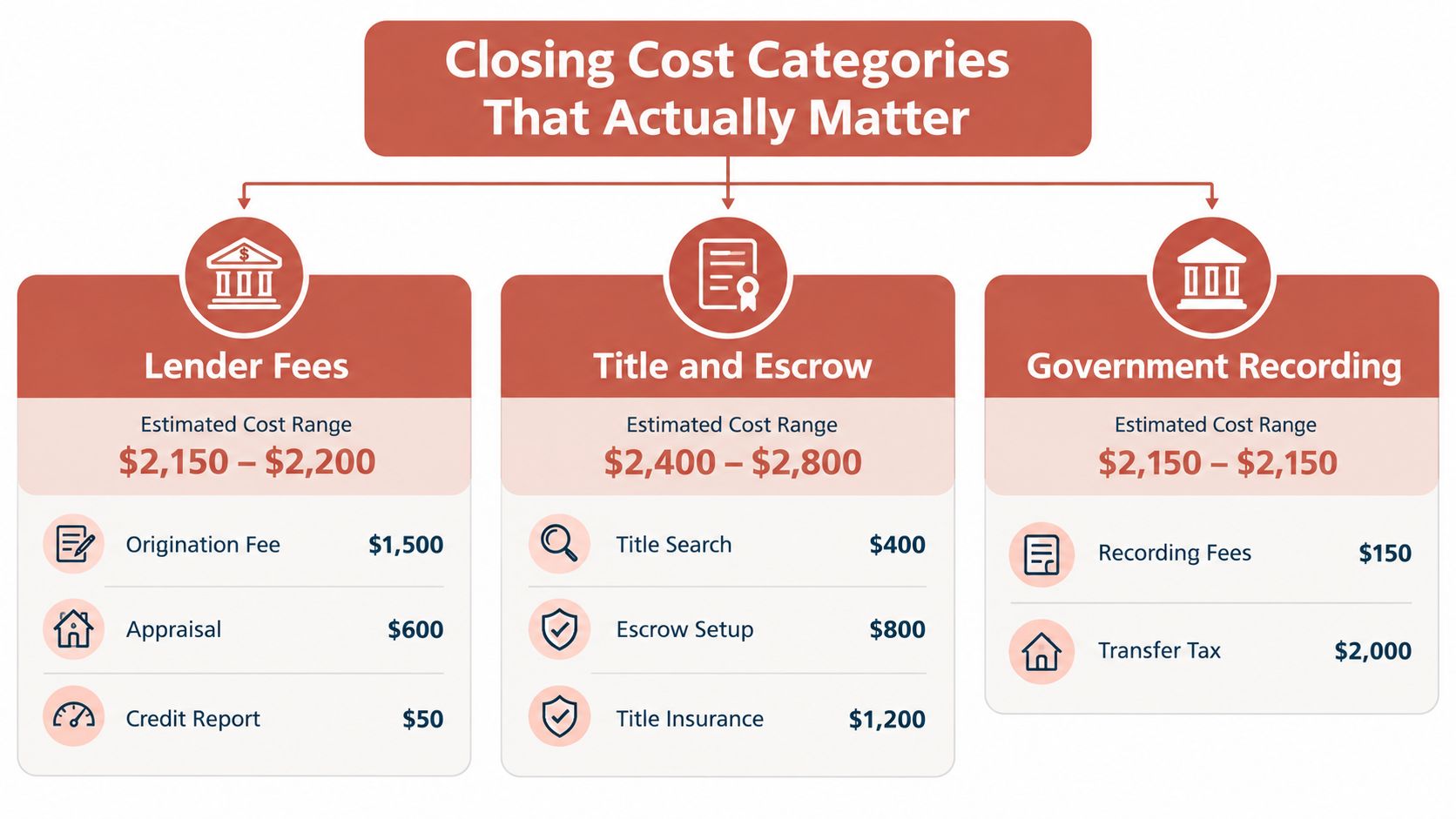
A single total hides the decisions inside it. Buyers get better results when they sort the bill into three practical groups: lender charges, title and settlement charges, and prepaid or escrowed items.
Lender and origination charges cover the work required to evaluate and create the mortgage. They can include origination fees, underwriting, discount points, credit-report fees, and appraisal charges. Some are tied to the lender's pricing, while others pay independent providers involved in the credit decision.
Title and settlement charges support the legal transfer and closing process. These may include title examination, lender's title insurance, settlement services, recording fees, attorney fees, and local transfer taxes. The exact allocation between buyer and seller depends on the contract and local practice.
Prepaid and escrowed items are easy to misunderstand. They can include daily interest through the end of the month, the first homeowners-insurance premium, and initial property-tax and insurance reserves. Some are recurring obligations collected in advance, rather than permanent fees created solely by the purchase.
Where comparison has the most value
Fannie Mae research indicates that lender and origination costs plus title and settlement costs typically make up approximately 67% to 75% of total closing costs (Fannie Mae research). That makes these categories the strongest starting point for comparison and negotiation.
| Category | What it usually covers | Buyer's practical question |
|---|---|---|
| Lender charges | Origination, underwriting, credit report, appraisal, and points | Which charges vary by lender, and what rate trade-off applies? |
| Title and settlement | Title examination, title insurance, settlement, attorney, recording, and transfer charges | Which providers can I compare, and which local charges are fixed? |
| Prepaids and escrow | Interest, insurance, taxes, and initial reserves | How much is being collected now, and what does it fund later? |
The most important distinction is between total closing costs and Cash to Close. According to the Fannie Mae buyer guidance, Cash to Close can also reflect the down payment, deposits, credits, and transaction adjustments. It isn't necessarily the amount shown beside the closing-cost subtotal, and it isn't automatically the same as the amount you must wire until the final disclosure is reconciled.
Chicago Versus Western Suburbs Transfer Taxes
Location can matter more than buyers expect. National budgeting guidance compresses closing costs into a percentage range, but Chicago's municipal transfer tax can make a city purchase require more cash than a higher-priced suburban purchase with a different fee structure.
In Chicago, the buyer-side municipal transfer tax is reported at $3.75 per $500 of purchase price, or 0.75%. On a $400,000 purchase, that equals $3,000, before title, lender, attorney, prepaid-tax, insurance, and escrow items are added, according to this Chicago-area closing-cost explanation.
Illinois's state transfer tax is generally seller-paid, but suburban transactions can allocate taxes and other charges differently. A buyer comparing Chicago with Melrose Park, Oak Park, Elmhurst, or another western suburb shouldn't assume that the same purchase price produces the same cash requirement.
Ask which costs the municipality creates
Use the contract and estimate to separate fixed local charges from negotiable services. A location-specific estimate should identify:
- Lender fees: Origination, underwriting, appraisal, and credit-related charges.
- Title and attorney fees: Title work, settlement services, and legal services.
- Government charges: Recording fees, transfer taxes, and other municipal or county items.
- Prepaid expenses: Interest, insurance, taxes, and initial escrow reserves.
| Cost Driver | Chicago City Example | Western Suburb Example |
|---|---|---|
| Municipal transfer tax | Buyer-side tax reported at $3.75 per $500, or 0.75% | Allocation and amount can differ by municipality and contract |
| State transfer tax | Generally seller-paid | Generally seller-paid, subject to transaction terms |
| Title and settlement | Reviewed alongside city charges | Reviewed alongside village, county, title, and attorney practices |
| Cash to Close | Includes the down payment, credits, prepaids, escrow, and adjustments | Same categories apply, but local charges may produce a different total |
For a broader overview of Illinois closing costs for buyers, focus on the itemized breakdown rather than the headline percentage. The lower-priced home isn't automatically cheaper to close if its municipality adds a charge that the comparison property doesn't carry.
Ways to Reduce Closing Costs Without Breaking the Deal
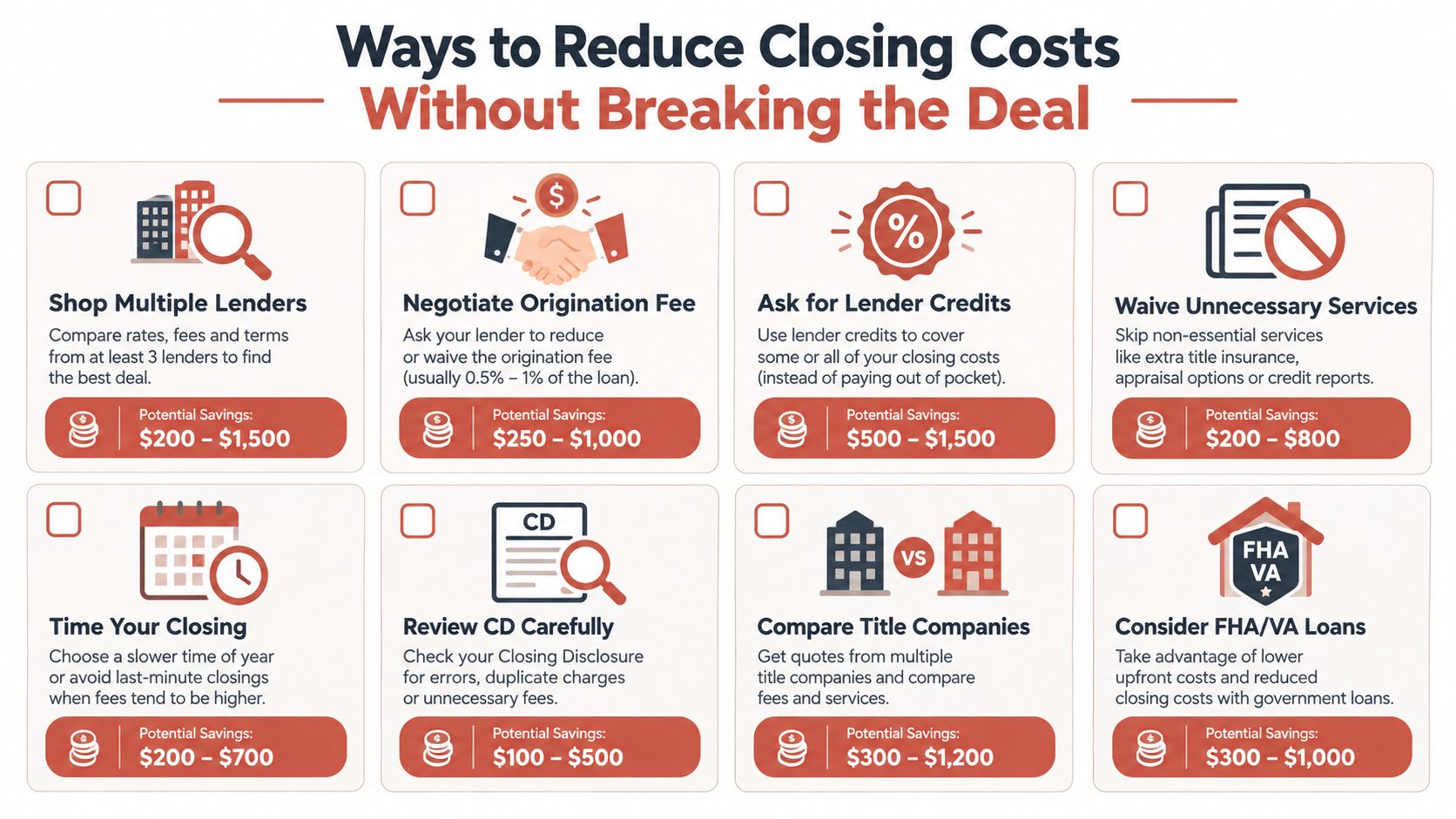
Reducing cash due at closing doesn't always reduce the total cost of the loan. The best approach is to identify which expense is changing, who is paying it, and what trade-off comes with the reduction.
Start by requesting itemized estimates from more than one lender. Compare the interest rate, origination charges, underwriting, credits, and projected cash requirement together. A lower upfront fee paired with a higher rate may cost more over the time you keep the mortgage.
Use credits deliberately
Lender credits can offset eligible closing charges, but they generally come with a higher interest rate. Ask the lender to show both versions side by side, then consider how long you expect to keep the loan. The relevant question isn't “Which option has the smallest fee today?” It's “Which combination fits my expected holding period and cash reserves?”
Seller concessions can also reduce the buyer's upfront requirement when the contract and loan rules permit them. They generally can't be treated as unrestricted cash back. The credit must be applied to eligible transaction costs, and unused amounts may not automatically become spending money after closing.
Repair credits can be useful when inspection findings identify legitimate work. Instead of asking the seller to complete uncertain repairs on a rushed schedule, a negotiated credit may give the buyer more control. The lender and settlement agent still need to confirm how the credit can be applied.
Protect the transaction while negotiating
Some cuts are false economies. Skipping an inspection may save an upfront charge but can remove valuable information about an older home. Choosing an unfamiliar provider solely because the quote is lower can create delays if the work doesn't meet lender or title requirements.
The smart target is not the lowest closing-cost subtotal. It's the cleanest combination of price, rate, credits, and reliable services.
Ask for a revised Loan Estimate or written breakdown whenever a lender credit, seller credit, or repair concession changes. For first-time buyers, a practical Illinois home-buying resource can help organize the questions to raise before making an offer.
Timing, Cash Flow, and What Can Change Late
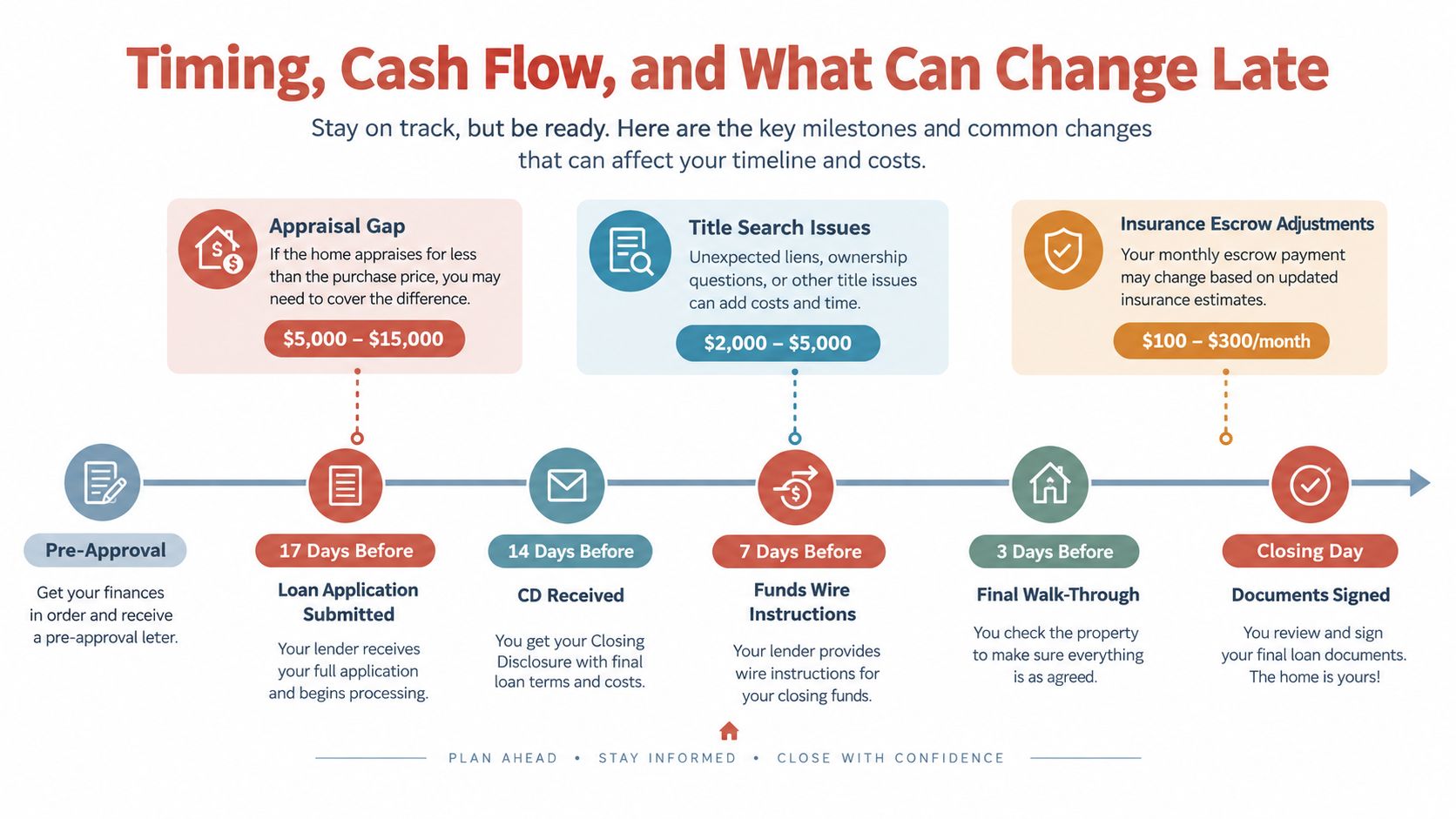
The largest surprise is often timing, not the existence of a fee. The settlement date can affect prepaid interest, and changes in property taxes, homeowners insurance, surveys, flood determinations, HOA dues, or escrow funding can alter the final cash requirement.
Prepaids and escrow deposits aren't necessarily permanent transaction expenses. They establish the loan's payment cycle and reserve account, while taxes and insurance can later be adjusted through escrow analysis. That still doesn't make them optional. The buyer needs the cash when the transaction closes.
Why a percentage isn't enough
Recent national data reported by Allstate show that average closing costs for new-purchase mortgages fell 2.9% year over year in 2025, from $4,661 to $4,528, while the average-priced home produced $13,836 in total closing costs, or 2.24% of its sale price (Allstate's closing-cost calculator resource). Those figures describe different ways of measuring the bill, which is exactly why a single percentage can hide the dollar reality.
Use scenarios instead:
- Base case: The current Loan Estimate with known lender, title, tax, insurance, and escrow figures.
- Change case: A later settlement date, revised insurance premium, updated tax proration, or changed escrow requirement.
- Reserve case: Cash retained for inspections, moving expenses, repairs, utility deposits, and a later tax or insurance adjustment.
Older Chicagoland housing stock can make repair timing especially important. Condos may also involve association charges or special assessments that need to be confirmed before closing.
Keep reviewing after the estimate
The home-closing timeline guide can help buyers organize deadlines, but the documents control the money. Compare the Loan Estimate with the Closing Disclosure, ask about every lender-approved change, and make sure credits appear where you expect them.
Don't empty the account just because the wire amount is known. The purchase may be complete, but the first weeks can still bring repairs, moving costs, deposits, and adjustments that aren't represented by the closing-cost subtotal.
Your Chicagoland Closing Checklist and Next Steps
A reliable closing plan starts with one distinction. The down payment goes toward the purchase price, while closing costs pay for the work and upfront reserves required to complete the purchase. Budgeting only for the down payment leaves a gap that a last-minute credit may not solve.
Use this checklist before authorizing funds:
- Request the itemized estimate. Separate lender fees, title and settlement, government charges, prepaids, and initial escrow.
- Compare the Loan Estimate and Closing Disclosure. Mark every changed line and ask the lender to explain the reason.
- Confirm local taxes. Ask which municipal, county, and state charges apply to the property and who pays each one.
- Review credits. Verify lender credits, seller credits, repair credits, earnest-money deposits, and prorations.
- Check Cash to Close. Don't rely on the closing-cost subtotal as the wire amount.
- Protect post-closing reserves. Keep separate funds for moving, repairs, utilities, inspections, and later tax or insurance adjustments.
The most useful question in a western-suburban transaction is simple: Which costs come from the municipality, and which costs can be negotiated? That question exposes the Chicago-to-suburb transfer-tax difference and forces the estimate to reflect the actual property location.
If you're comparing homes in Melrose Park, Elmhurst, Downers Grove, Naperville, Oak Park, Glen Ellyn, or nearby communities, request estimates for the specific properties rather than applying one percentage to every address. A lender, title professional, and local agent should be able to explain the charges line by line before you sign.
Homes By Carmen helps buyers compare western Chicagoland properties with practical guidance on offers, credits, lender coordination, title work, and final cash to close. Visit Homes By Carmen to request localized buying support for Melrose Park and nearby suburbs, including an itemized review of the costs that can change from one municipality to the next.