You're comparing three two-bedroom rentals before your morning commute, one in Oak Park, one in Elmhurst, and one in Melrose Park. The photos look familiar because two listings are the same unit, reposted with different prices. Then a “too-cheap” home appears, and the person advertising it asks for money before you can see the property.
That's how a rental property search becomes expensive. The listing is only a starting hypothesis. Your job is to test the rent, availability, ownership, application requirements, and total cash needed before you pay a fee or send sensitive documents.
Digital search now drives much of the process. Zillow's 2024 Consumer Housing Trends Report found that 75% of recent renters searched through a mobile website, 64% used a mobile app, and 68% used a desktop or laptop website. The same report found that 79% considered at least one digital feature essential, with property photographs essential to 56% and floor plans to 49% of renters.
A defensible search protects three things: your time, your cash, and your eventual lease. In western Chicagoland, that means filtering deliberately, comparing effective costs, confirming who controls the property, and negotiating only after you understand the screening rules.
Table of Contents
- Why the rental property search feels harder than it should
- Setting up MRED map and filters for a western-suburb rental property search
- Neighborhood criteria that actually change your shortlist
- Comparing total cost, not just advertised rent
- Applications, screening, and the conversation to have before paying a fee
- Negotiating concessions without weakening your application
- Fraud checks that protect you before signing anything
Why the rental property search feels harder than it should
A renter commuting between Melrose Park and downtown recently found a two-bedroom listed well below the other homes she had saved. The photos were polished, the address looked plausible, and the contact person promised a quick approval. The catch came when she was asked to send $1,200 before a tour because “another applicant was ready.”
She searched the exact address and found the same property advertised elsewhere with different contact information. The legitimate listing was connected to a local management office. The cheap version had copied the photos and description. She walked away before losing money, but only because she treated the advertisement as something to verify instead of something to trust.
A listing is evidence, not proof
“Available now” can mean the unit is vacant, expected to be vacant, or still sitting in a database. A price can exclude parking, utilities, pet charges, or mandatory fees. A photograph can show a similar unit rather than the exact apartment you'll lease.
That's why the first pass should answer questions, not trigger an application:
- Who is offering the property? Identify the owner, brokerage, or authorized manager.
- What does the advertised price include? Ask about utilities, parking, insurance requirements, deposits, and recurring fees.
- Can you verify availability independently? Use a second contact channel or a management-company source.
- What happens before approval? Confirm income, credit, occupants, pets, documents, and lease timing.
Underwrite the rental instead of browsing it
Affordability is more than a rent filter. Census Bureau data analyzed by the Pew Research Center found that 49.7% of renter households were housing-cost burdened in 2023, spending at least 30% of household income on housing costs. The same source reported that renters occupied 34.4% of U.S. housing units in the second quarter of 2024.
Use the 30% figure as a warning threshold, not an approval guarantee. Add utilities, transportation, parking, insurance, deposits, and application costs before deciding whether a home fits. A unit that looks cheaper online may require more cash at move-in and leave less room in your monthly budget.
Practical rule: Don't pay to apply until you can explain the property's total monthly cost, likely move-in cash, screening rules, and verified point of contact.
Setting up MRED map and filters for a western-suburb rental property search
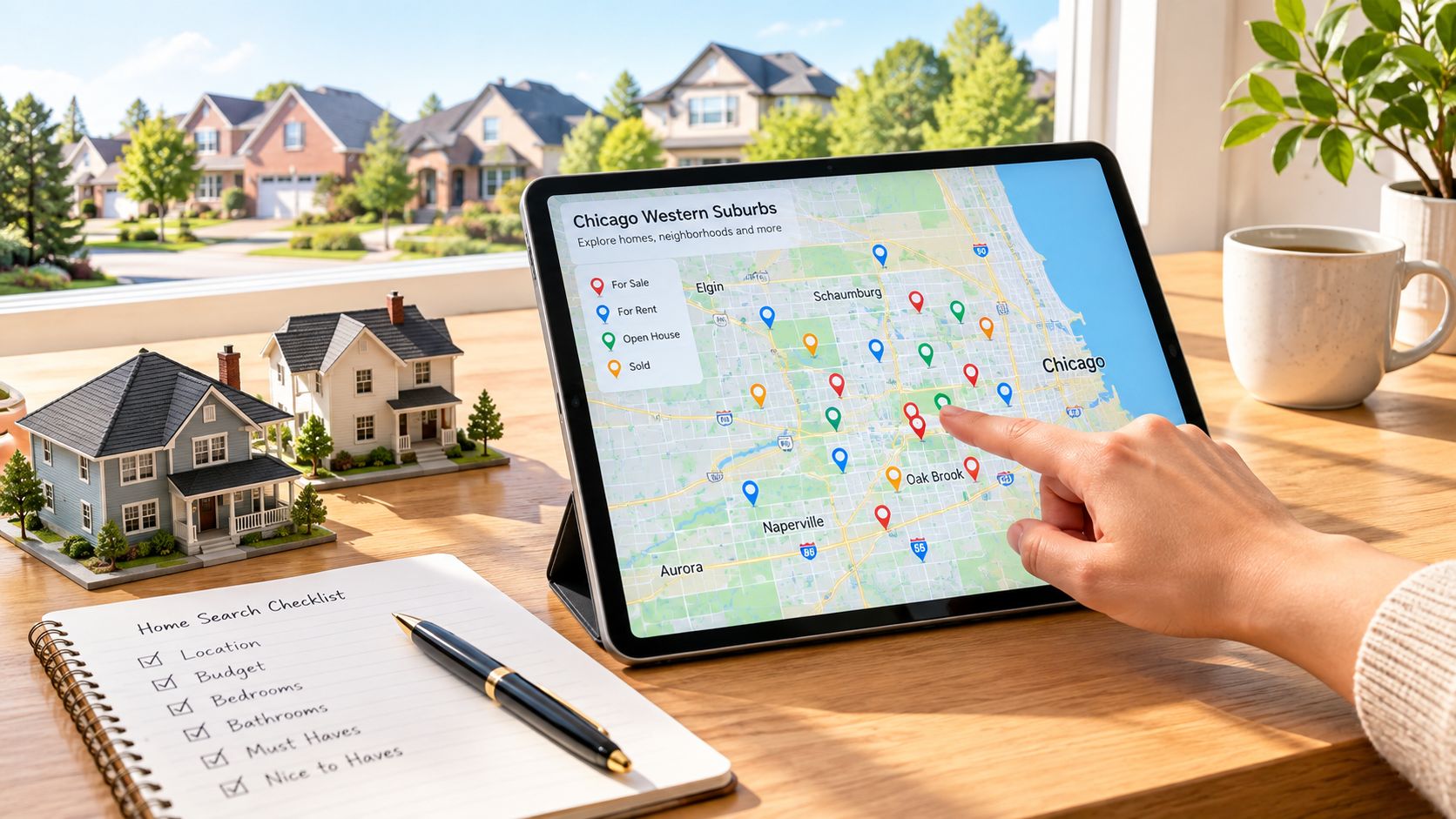
Start with geography, not bedrooms or amenities. On the MRED map, draw a search area from Melrose Park outward toward Elmhurst, Oak Park, Glen Ellyn, Downers Grove, or Naperville, depending on your commute. A renter working near downtown may want to compare Melrose Park and Oak Park first, while someone prioritizing a larger suburban footprint may extend the map toward Elmhurst or Downers Grove.
The order matters because a broad map with narrow filters can hide workable options. A small map with an unrealistic rent ceiling creates a clean-looking search that doesn't reflect the available market.
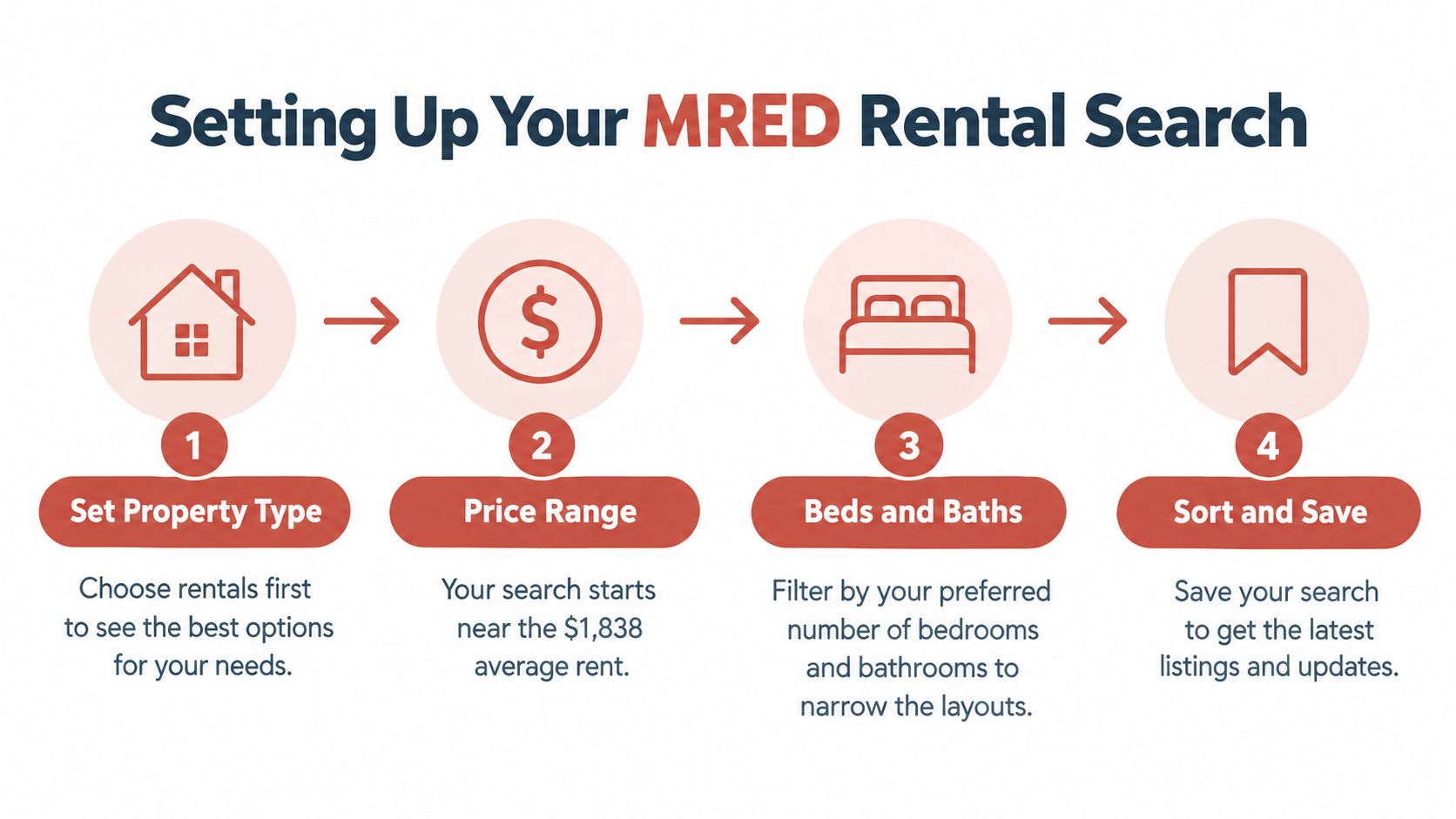
Configure the search in four passes
Draw the commute geography first. Include the neighborhoods you can realistically reach. A renter comparing Elmhurst and Oak Park should consider the actual station, driving route, parking arrangement, and work schedule, not just municipal boundaries.
Set the maximum total housing cost. Begin with your rent ceiling, then leave room for utilities, parking, insurance, and mandatory charges. The HUD Chicago housing market report placed average apartment rent in the Chicago housing market area at $1,838 in the first quarter of 2025, with a 3% year-over-year increase. That figure is a market reference, not a personal budget or a promise that a particular suburb will match it. See the Chicago housing market area report for the underlying context.
Add bedrooms, bathrooms, parking, pets, and property type. Don't select every desirable feature immediately. Start with requirements, such as two bedrooms, one parking space, and pet acceptance. Add preferences after you understand how much the map contracts.
Sort, save, and review on a schedule. Save one broad search and one strict search. Check new matches regularly, remove expired listings, and keep a short comparison sheet rather than relying on browser tabs.
MRED data is useful for broker-listed inventory, but it won't capture every individual landlord, pocket rental, or social-media advertisement. Use separate monitoring for those sources, then apply the same ownership, availability, and payment checks. For a practical explanation of MLS search behavior, review how to search MLS listings.
Mobile search is convenient for alerts and quick decisions, but desktop map search is better for seeing how a boundary affects commute, neighborhood, and inventory. Use the phone to catch a new listing, then use the larger map to decide whether it belongs on your tour list.
Neighborhood criteria that actually change your shortlist
A neighborhood shortlist should start with the constraint that would make you reject a home after seeing it. For one renter, that's a rail commute. For another, it's school assignment, parking, yard space, or the ability to keep a pet. Coffee shops and new finishes can matter, but they shouldn't outrank a commute you can't tolerate or a parking arrangement that adds recurring cost.

Compare the decision factors before touring
| Criterion | Melrose Park | Elmhurst | Downers Grove |
|---|---|---|---|
| Commute fit | Useful for renters balancing western-suburb access with travel toward Chicago | Often appeals to renters prioritizing a more established suburban setting | Worth examining when highway and rail access both influence the work route |
| Transit question | Check the actual walking or driving connection to the station | Verify the specific station access and parking plan | Compare station convenience with the added housing cost |
| Parking | Confirm whether the lease includes a space or charges separately | Ask about garage, driveway, or assigned-space terms | Clarify winter parking, guest parking, and any separate fee |
| Property style | Apartments, condos, and smaller rental homes may appear in the same search | Compare apartment buildings with single-family options | Look closely at lot size, maintenance duties, and lease responsibilities |
| Best first filter | Commute, total cost, and parking | Commute, schools, and building condition | Commute, space, parking, and lease obligations |
Two similar two-bedroom listings can produce very different shortlists once you ask what the rent includes. One may have a lower advertised price but paid parking and higher utility exposure. Another may cost more on the listing page but include parking, have more predictable utilities, or require less cash at move-in.
The HUD figure of $1,838 average apartment rent in the Chicago housing market area in Q1 2025 is useful as an anchor, but it doesn't decide between two homes. Your comparison should include effective rent, commute cost, parking, utility responsibility, condition, lease term, and move-in requirements. Broader guidance on how physical features and amenities influence housing decisions is available in this resource about neighborhood amenities that increase your home's value, although renters should evaluate amenities through their own budget and daily routine.
Decide when local help is faster
Self-searching works well when your criteria are flexible, your documents are ready, and you can respond quickly. A local rental agent becomes more useful when you're comparing several western-suburb markets, relocating from outside the area, or struggling to interpret parking, transit, school, and property-type differences.
Write down your top priorities before asking for help. If you can't identify the few conditions that would eliminate a listing, you'll tour too many homes and compare too little.
Comparing total cost, not just advertised rent
The cheapest listing isn't necessarily the least expensive choice. Compare two hypothetical two-bedroom homes with the same advertised rent. Home A includes one parking space but shifts several utilities to the tenant. Home B charges separately for parking but has more predictable utility responsibility and a smaller cash requirement at signing. The advertised number alone can't select the better option.
Harvard's Joint Center for Housing Studies reported 22.6 million cost-burdened renter households in 2023, defined as spending more than 30% of income on rent and utilities in its rental affordability analysis. Use that threshold to flag a property for closer review, not to declare it affordable for every household.
Fill in the worksheet before applying
For each candidate, record:
- Advertised base rent
- Utilities paid by the tenant
- Parking and storage
- Renter's insurance requirement
- Application and screening fees
- Security deposit or other deposit
- Pet rent, pet fee, or restrictions
- Transportation and transit costs
- Lease length and renewal terms
- Concessions and the conditions attached to them
HUD notes that application fees commonly range from $50 to several hundred dollars, and tighter markets have increased the share of renters applying to more than one property. Those costs belong in your search budget, especially if you're relocating or applying with multiple adults.
For a second perspective on balancing rent with broader financial obligations, use Fintrack's rent affordability guide. The useful question isn't “Can I technically pay the advertised rent?” It's “How much cash will I need before approval, how much will the home cost each month, and what remains after housing and transportation?”
Prepare the application package
Before paying, ask the manager to confirm the required documents and decision criteria. Gather identification, income documentation, employment information, prior landlord references, occupant details, pet records when relevant, and funds for documented fees.
Keep written records of what the manager says. If the worksheet changes your preferred listing, the search wasn't finished when you first chose it.
Applications, screening, and the conversation to have before paying a fee
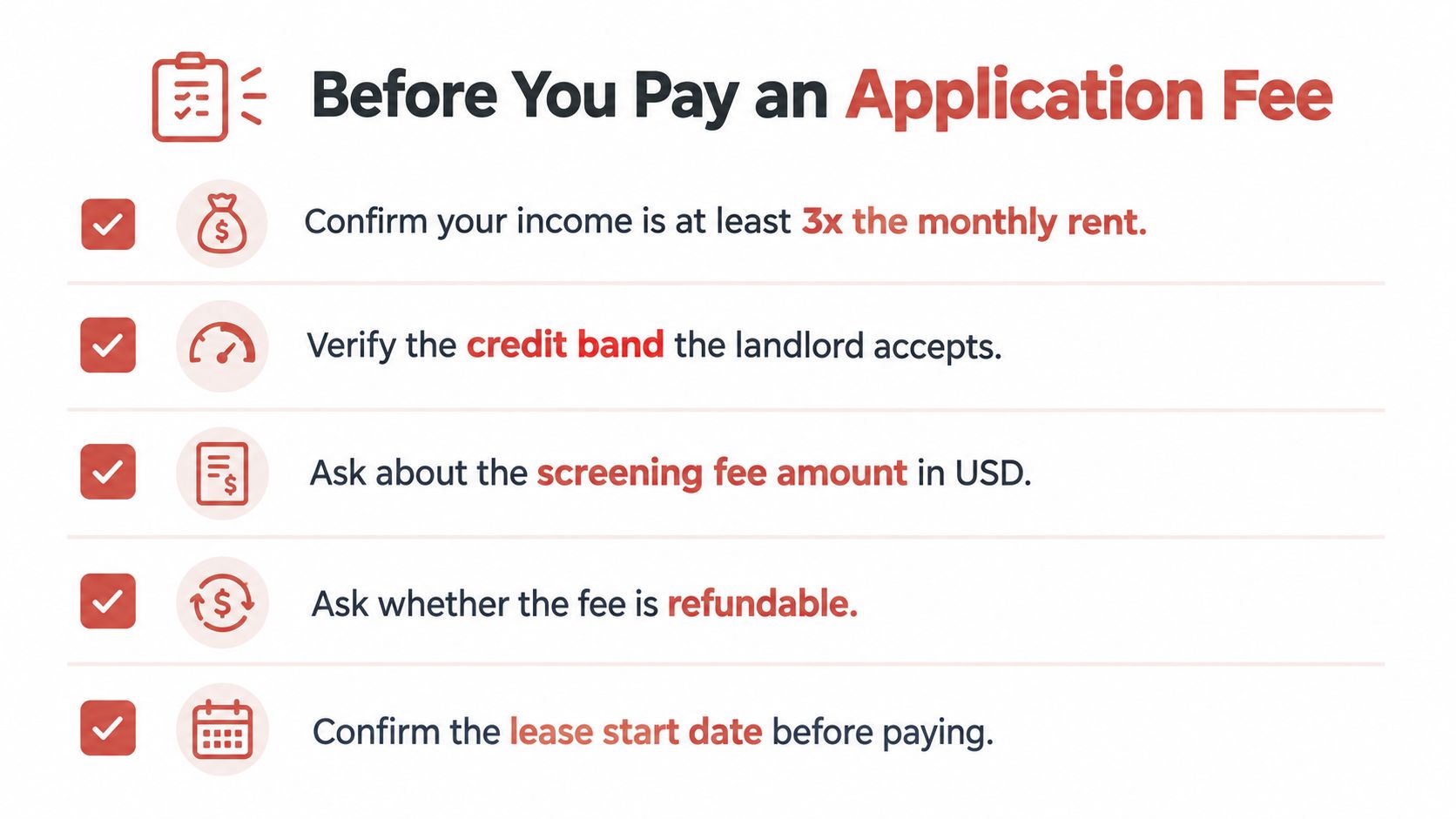
Many renters treat the application as a one-way test. It isn't. Screening is also the point where you can determine whether a property is a realistic match before spending money.
Call or message the property manager with a short, direct script:
“Before I submit an application, can you confirm the income standard, accepted credit range, occupancy limit, pet policy, parking terms, deposit structure, screening fee, refund policy, and earliest lease date?”
Ask the same questions for every candidate. Consistency prevents you from comparing one property's advertised rent with another property's fully disclosed cost.
Build a clean package
A complete package can include:
- Identity documents: Provide the requested identification through a verified application channel.
- Income records: Prepare recent pay documentation and other lawful proof of income.
- Housing history: Include prior landlord contact information when available.
- Occupant and pet details: State who will live there and disclose animals before paying.
- A short cover note: Explain your move date, employment stability, and any relevant context without oversharing sensitive information.
Don't assume every landlord uses the same income or credit standard. One building may accept a profile that another rejects, and a solo owner may handle documentation differently from a professionally managed property.
Negotiate terms, not just rent
Renters often ask for a lower monthly price first. That can be the least effective request, particularly when the property has competing applicants. Ask whether the owner can adjust a concession, parking arrangement, move-in date, deposit structure, or included appliance instead.
Try this:
“The home works for my commute and move-in timing. Before I apply, is there flexibility on the parking charge, deposit, or lease concession if I provide the complete package promptly?”
An MRED-listed property with a responsive agent may move faster because the listing, showing, and application process are coordinated. That doesn't guarantee approval, and it doesn't replace verification. For a step-by-step overview of preparing and submitting documents, see the rental application process guide.
Negotiating concessions without weakening your application
A concession can improve your cash flow without forcing the owner to change the advertised rent. Depending on the property and landlord, reasonable requests may include a rent concession tied to a longer lease, reduced parking cost, a lower deposit, an included parking space, or a clearly documented pet-fee arrangement.
The HUD Chicago-area report places average apartment rent at $1,838 in Q1 2025, with rent up 3% year over year. That context makes total occupancy cost more useful than a reflexive request for a lower sticker price. An owner may resist lowering rent but consider a concession that helps fill a unit or aligns with a specific lease term.
Match the request to the property
Apartment buildings often have standardized rent schedules and fee policies. They may have more room to discuss parking, move-in timing, or a limited concession than to rewrite base rent. A single-family landlord may have more flexibility on lawn care, appliances, deposit timing, or lease start date, but less ability to offer a formal rent promotion.
Send the request after you've toured and confirmed the home fits. Your position is stronger when the manager knows you're a serious applicant with a complete package, not someone collecting discounts from every listing.
A useful negotiation is specific: state the lease term, the concession you want, and what you'll provide in return.
Put every promise in writing
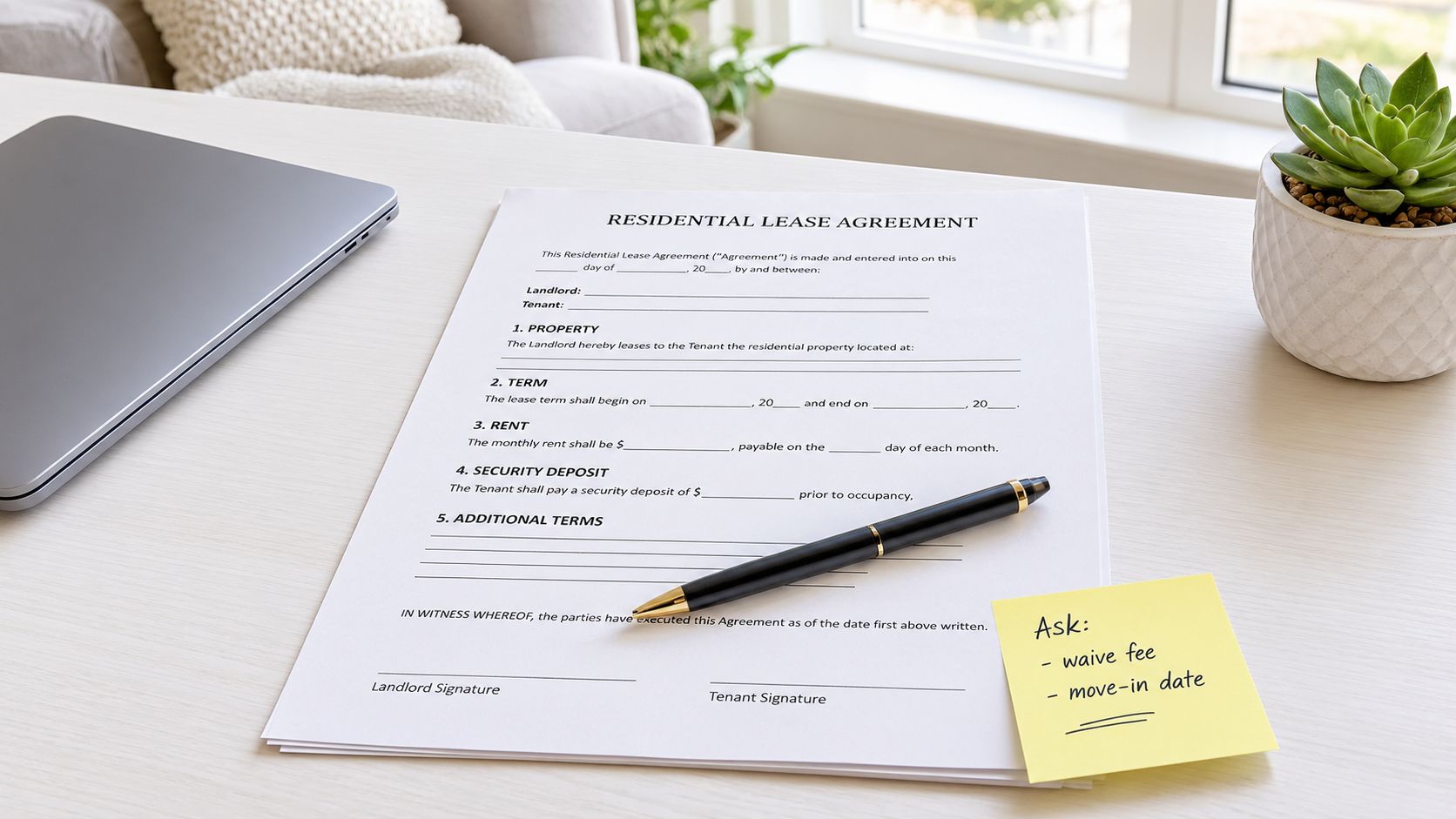
A text message saying “we can probably include parking” isn't a lease term. Ask for the concession, effective dates, fees, deposit treatment, renewal effect, and any repayment condition to appear in the lease or a signed addendum.
Before signing, verify that the legal landlord or authorized agent named in the paperwork matches the person who collected your application and deposit. If the concession disappears from the final documents, stop and ask for a corrected version.
Fraud checks that protect you before signing anything
Fraud prevention belongs inside the rental property search, not in a footnote after you've paid. The Federal Trade Commission reported nearly 65,000 rental-scam reports and approximately $65 million in reported losses since 2020. Its analysis also found that about half of scam reports in the twelve months ending June 2025 began with a fake social-media advertisement, while 16% began with Craigslist listings. See the FTC rental-scam analysis for the reported figures.
A copied legitimate listing can look more convincing than an obviously fake one. The photos may be real, the address may exist, and the floor plan may match the property. The scammer changes the contact information and payment instructions.
Run the four-part verification
First, search the exact address. Compare the price, photos, availability, contact details, and description across listings. Conflicting prices or different “owners” should stop the process until you identify the authorized source.
Second, confirm the manager independently. Find the management company or public-record contact through a source separate from the suspicious advertisement. Call the office using independently obtained contact information, not only the phone number in the listing.
Third, inspect the property. Tour in person whenever possible. If you're relocating, use a verifiable live video tour that shows the exterior, interior, and current date or responds to your specific requests. A polished prerecorded walkthrough doesn't prove that the person advertising the home controls it.
Fourth, pay only after verification. The lease should identify the legal landlord or authorized agent. Pay only a documented fee or deposit through a traceable method directed to that verified party. Keep the receipt, application terms, lease draft, messages, and proof of payment.
Treat pressure as a technical signal
High-risk indicators include rent materially below comparable homes, demands for payment before viewing, requests for cash or cryptocurrency, wire-transfer instructions, unusual payment apps, refusal to identify the legal landlord, and pressure to send identity documents before verification.
For another practical perspective on recognizing suspicious listings early, review this guide to early scam detection. The point isn't to reject every unusual listing. It's to require evidence before money or personal information changes hands.
Use a focused 14-day plan
Days one through three: Set the MRED geography and filters, define the total-cost ceiling, and write your essential neighborhood criteria. Decide which areas deserve tours before saving more listings.
Days four through eight: Tour the strongest candidates, record every fee and included service, and ask the pre-qualification questions before paying an application fee. Decide which properties remain financially viable after the worksheet is complete.
Days nine through twelve: Verify the owner or manager, recheck availability, compare the lease terms, and request concessions in writing. Decide whether the best property still works after screening and move-in costs.
Days thirteen and fourteen: Review the lease carefully, confirm the final documents match the negotiated terms, and seek local professional or legal guidance for unclear provisions. Sign only after the property, party, payment, and paperwork all align.
A focused schedule beats passive scrolling because each phase ends with a decision. You're not trying to save every possible listing. You're narrowing the search until one verified home makes financial and practical sense.
Homes By Carmen helps renters compare apartments, condos, and single-family leases across Melrose Park and western Chicagoland using local knowledge and MRED-supported search. If you want help checking neighborhoods, total costs, tours, and application timing, visit Homes By Carmen and start a rental conversation before you pay to apply.