
You're sitting at the kitchen table with a neighbor's sale price, an online estimate, and a list of improvements you've paid for. The numbers don't agree. Before you choose the highest one, you need to know whether those homes resemble yours and whether their sale prices still reflect what buyers would pay today.
Learning how to do a comparative market analysis means turning those scattered numbers into a documented pricing decision. For a Chicagoland home, that takes more than collecting nearby sales. You need to verify the property details, account for differences, and handle the step that's easy to skip: market movement between the comparable's contract date and your valuation date.
Table of Contents
- The Six Steps From Start to Finished CMA
- Documenting Your Home Before You Pull Sales
- Choosing Comparable Sales You Can Defend
- Adjusting Comparable Prices for Real Differences
- Reading Local Inventory and Competing Listings
- Reconciling Adjusted Sales Into a Price Plan
The Six Steps From Start to Finished CMA
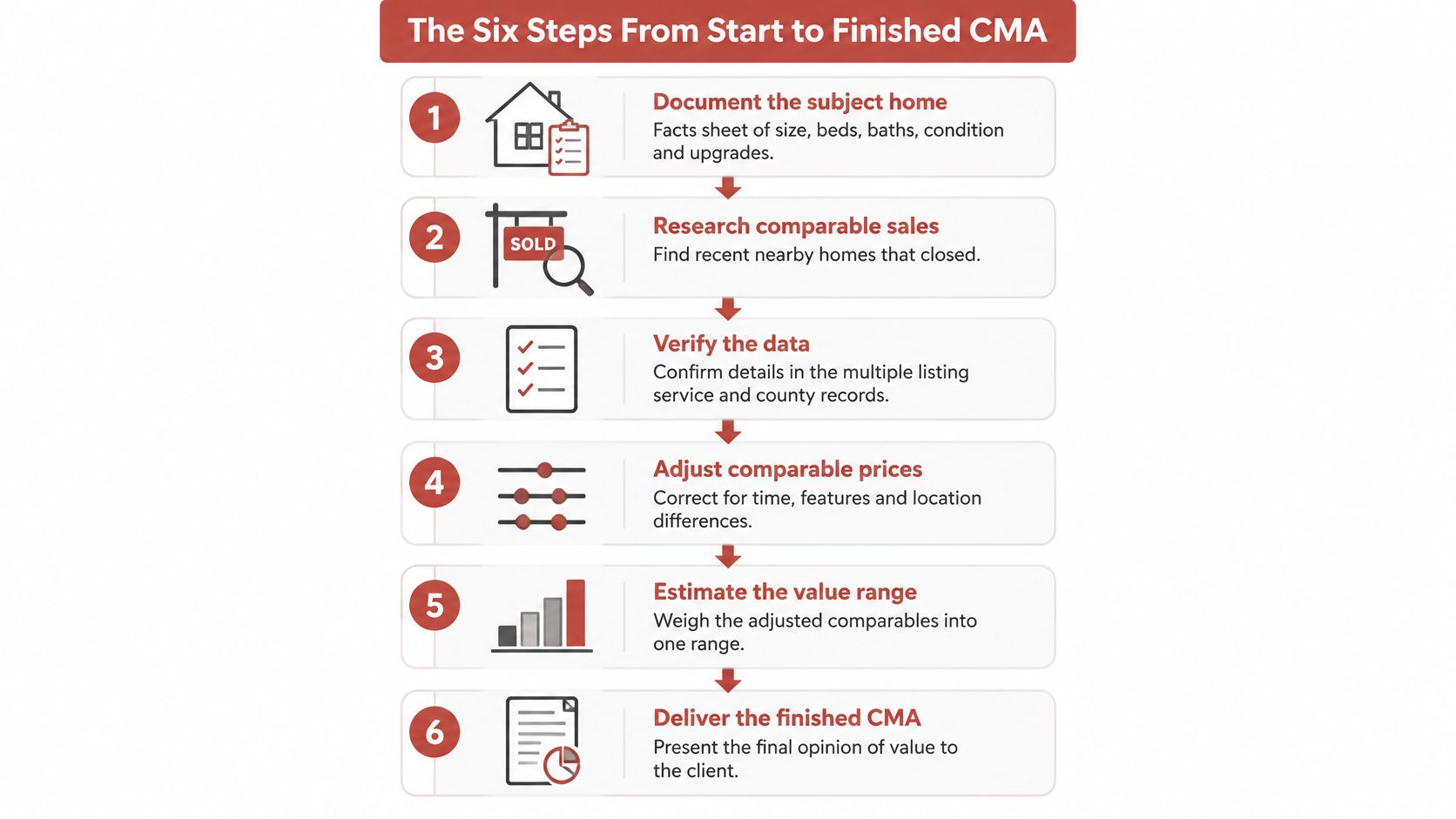
A usable CMA follows a fixed order. Skip a step and the final number loses its defense.
| Step | What you do | Output |
|---|---|---|
| 1. Document the subject home | Record size, age, condition, upgrades and parking | Facts sheet for your home |
| 2. Pull recent closed sales | Collect recent sales in the same area, extending the search when needed | Broad pool of closed sales |
| 3. Select the strongest comparables | Keep a small group of sales that closely resemble your home | Shortlist of comparables |
| 4. Adjust for differences and time | Adjust each sale for property differences and market movement | Adjusted price for each comparable |
| 5. Check active and pending listings | Review current competition and recent pending sales | Picture of buyer choices |
| 6. Reconcile into a range | Combine adjusted prices and pick a strategy | Supported value range and price plan |
Your facts sheet establishes what you are valuing. The broad sales search gives you alternatives, while the shortlist identifies the homes a buyer would reasonably treat as substitutes for yours.
Step 4 carries the most weight. Property adjustments bring each sale closer to your home, and the time adjustment brings each sale forward from its contract date to your valuation date. In a moving Chicagoland market, that second adjustment changes the range. A sale that looked strong at closing can sit above or below today's buyer expectations once market movement is applied. I treat the time adjustment as a required line in the grid, not an afterthought.
Current listings show what buyers can choose instead. Pending sales show which choices are being taken. The final price plan connects that evidence to your timing and priorities.
Practical rule: A finished CMA should let another person follow your reasoning and reach the same supported value.
Keep a working folder containing the property sheet, listing histories, photographs, adjustment notes, and valuation date. Save the evidence behind each major decision, because listing pages disappear and memory drifts.
The finished output is a range with a written rationale, plus a recommended pricing strategy. That range is a planning estimate. The buyer's offer will set the actual price. Use the table as your working checklist, checking off each deliverable before moving on.
Documenting Your Home Before You Pull Sales
Start with your house, not the neighbor's closing price. If you misstate living area, overlook deferred maintenance, or treat basement space as interchangeable with above-grade rooms, even carefully selected sales can produce a misleading conclusion.
Build a usable property facts sheet
Record these details in a spreadsheet or property worksheet:
- Location and lot: Address, subdivision, school attendance area, lot dimensions, usable yard, street exposure, and nearby nuisances.
- Living area and rooms: Above-grade living area, bedrooms, full and partial bathrooms, and any awkward layout.
- Age and construction: Year built, architectural style, additions, and major structural changes.
- Parking and basement: Garage configuration, driveway access, basement finish, ceiling height, and visible moisture concerns.
- Condition and improvements: Roof and HVAC age, kitchen and bathroom updates, flooring, windows, and unfinished repairs.
- Documentation: Renovation dates, receipts, permits where available, and warranties.
Pull the county tax record for lot information and an initial square-footage reference. Then walk every room with a notepad, including utility areas and storage spaces that listing photographs tend to omit.
Compare your notes with the last listing or appraisal. If the records disagree, identify why and use the most reliable measured living-area figure available. Keep above-grade space and basement finish separate, and document unresolved discrepancies rather than choosing the larger number.
Describe mixed condition honestly
Say your bungalow has a renovated kitchen and finished basement, but original bathrooms and worn windows. Calling the entire home updated would steer you toward overly optimistic comparisons. A better description is average overall condition, with an updated kitchen and dated bathrooms.
That distinction also helps you decide what to repair. Review practical options for increasing home value before selling, but don't automatically add renovation spending to your estimate. What you paid and what a buyer will contribute toward an improvement are different questions.
Your completed facts sheet becomes the subject column in the adjustment grid. Every comparable should be evaluated against that same description.
Choosing Comparable Sales You Can Defend
A CMA starts with the homes a buyer would reasonably consider instead of yours. A short list of defensible matches beats a long list of loose ones. That list is also your first defense against the unadjusted median, the number you get when nobody checks whether the market moved between contract dates.
Fannie Mae's comparable-sales guidance requires at least three closed comparable sales for the appraisal sales-comparison approach and recommends sales closed within the previous 12 months, when appropriate. Those are appraisal standards, and they impose useful discipline on a process that otherwise invites cherry-picking.
| Criterion | Strong match | Weak match |
|---|---|---|
| Location | Same subdivision or school attendance area | Different neighborhood or across a major road |
| Sale date | Recent closing with usable contract-date information | Older sale without evidence of intervening market conditions |
| Living area | Similar above-grade living area | Much larger or smaller home |
| Bedrooms and bathrooms | Same counts and comparable functionality | Materially different room counts or layout |
| Lot size | Similar usable lot for the area | Far larger, smaller, or less usable lot |
| Style and age | Same architectural style and era | Different style or construction period |
| Condition | Similar updates and wear | Renovated versus dated |
| Parking and basement | Similar garage configuration and basement finish | Missing a meaningful feature your home has |
Choose similarity before convenience
Location requires more judgment than drawing a circle. In the western suburbs, check school attendance boundaries, access to commuter rail, traffic exposure, and the surrounding housing stock. A nearby sale across a major road may sit in a different buyer pool with different preferences.
An older Elmhurst bungalow and a new construction home can appear close together on a municipal map without being useful substitutes. Different layouts, construction quality, maintenance expectations, and finishes can require so much interpretation that the comparison becomes fragile. A comp that needs a large location adjustment to fit is usually a weaker match than one that needs a small one. The adjustment can rescue the number, but it cannot rescue the comparison.
Rank comparables by how well you can explain each match, with recency as a tiebreaker.
Recency still matters. A well-matched older sale can be more informative than a recent sale with substantial differences, provided the contract date and intervening market movement are documented well enough to defend. That contract date is where market movement enters the analysis, which is why a sale without it belongs in the secondary pile.
Verify before keeping a sale
Check listing photographs, room descriptions, property records, contract and closing information, and transaction remarks available through the MLS. Look for additions, substantial remodeling, unusual sale circumstances, or details that contradict the public record.
Build a compact shortlist rather than padding the report with weak matches. Keep active and pending properties in a separate group for context. Discard any proposed comparable whose relevance you can't explain in a sentence, unless you clearly identify it as secondary evidence.
Adjusting Comparable Prices for Real Differences
Each adjustment asks the same question: What would this comparable have sold for if it had your home's characteristics on the valuation date? Adjust the comparable toward your property, not your property toward the comparable.

Put time into the calculation
Start with the verified closed price, then evaluate market movement. Under Fannie Mae's adjustment guidance, appraisers analyze conditions from the comparable's contract date to the effective valuation date; as a hypothetical example, a $400,000 sale with supported intervening appreciation of 3% indicates approximately $412,000 before property-specific adjustments.
The contract date matters because that's when buyer and seller agreed on the price. A closing date alone can obscure when the transaction reflected buyer demand.
Use paired sales, a relevant local price trend, statistical analysis, or an appropriately matched home-price index to support the adjustment. Don't apply a regional appreciation figure mechanically to a neighborhood or property category that behaves differently.
Adjust features and transaction terms
After the time adjustment, address differences in living area, condition, parking, basement finish, and lot utility. Record the evidence beside each adjustment so someone reviewing the grid can distinguish a supported estimate from an assumption.
| Difference | When the comparable is better | When the comparable is weaker |
|---|---|---|
| Extra bedroom or bathroom | Adjust its price down if buyers value the advantage | Adjust its price up for the deficiency |
| Finished basement | Adjust down if your home lacks comparable finish | Adjust up if your home has superior finish |
| Garage versus none | Adjust down for the garage advantage | Adjust up for the missing garage |
| Larger lot | Adjust down for additional market-supported utility | Adjust up for inferior lot utility |
| Updated kitchen or baths | Adjust down if your home is dated | Adjust up if your home is updated |
| Time since sale | Adjust up if prices rose after the contract | Adjust down if prices fell after the contract |
| Seller concessions | Remove any supported price effect of incentives | Analyze incentives regardless of physical similarity |
The time row describes market direction, not physical superiority. Likewise, concessions require separate analysis: don't assume every seller-paid expense inflated the price dollar for dollar.
Adjustment discipline: A renovation receipt establishes cost. Comparable buyer behavior establishes contributory value.
Avoid fixed dollar allowances borrowed from another market. A garage's contribution, for example, depends on available parking and the alternatives buyers have. Also avoid double-counting a kitchen renovation under both a specific feature adjustment and a broad condition adjustment.
For broader valuation context, use this guide to valuing a home. Your reconciliation should use adjusted indications, not an average of the original sale prices.
Reading Local Inventory and Competing Listings
Historical sales don't tell you everything about the choices buyers have today. Realtor.com's January 2026 housing report reported active listings up 10.0% year over year nationally and 10.3% in the Midwest, while the Midwest median list price rose 1.4%. More inventory and higher asking prices can coexist, so neither measure alone settles your pricing decision.
For a home in Melrose Park or Glen Ellyn, build the competition set around similar properties and actual buyer alternatives. A municipality-wide inventory total can mix condos, entry-level houses, and custom homes that don't compete directly.
| Signal | Where to check | What it changes |
|---|---|---|
| Active listings versus last year | MLS neighborhood inventory report | Rising supply favors a competitive list price |
| Median days on market | MLS sold-data report for similar homes | Longer times favor a price toward the lower-middle of the supported range |
| Share of listings with price cuts | Listing histories for active and sold homes | Frequent cuts warrant checking whether sellers have overshot demand |
| Pending sales count | MLS pending listings for the same area | Strong pending activity can support firmer positioning |
| Closed-sale price trend | Matched closed sales across the study period | Helps establish the direction of the time adjustment |
Read the signals together
A rising pending count means more when active inventory remains limited than when sellers have added substantially more competing homes. Longer marketing times deserve investigation too: are comparable homes sitting, or are unusually expensive and poorly maintained listings skewing the picture?
Walk through the strongest active alternatives as a buyer would. Compare condition, layout, parking, asking price, and likely repair burden. A renovated competitor may attract buyers who won't consider your home unless the price leaves room for improvements.
Use the Illinois housing market overview for broader context, then narrow the analysis to your property type and neighborhood. Consider financing constraints as well, especially when a home needs repairs that could complicate a buyer's loan.
Online visibility isn't evidence of value. Outrank's guide to local real estate rankings explains how real estate businesses approach search visibility, a useful distinction when an online search places a prominent listing ahead of a better comparable.
Separate what sellers ask from what buyers accept. Pending listings can indicate current activity, but their published asking prices don't necessarily reveal negotiated terms.
Reconciling Adjusted Sales Into a Price Plan
Your final estimate should reflect the strength of the evidence, not the middle number in a spreadsheet. This matters especially when older sales carry much of the analysis.
A Federal Housing Finance Agency study examining more than 45 million subject-property records and 228 million comparable-home records found time adjustments were made for only about 10% of properties and were often too small. The practical lesson is to make your market-movement assumptions visible rather than allowing an old price to pass as a current indication.
Build and stress-test the range
Sort the adjusted prices from low to high. Investigate outliers, particularly sales requiring substantial gross adjustments, and give the strongest weight to properties with the best similarity and most reliable verification. Don't discard a lower indication merely because it conflicts with your preferred price.
Keep neighborhood movement separate from property adjustments in the grid. That allows you to test the time assumption without changing your assessment of the kitchen, garage, or basement.
Run a sensitivity check using a weaker, central, and stronger market-movement assumption supported by the available evidence. Recalculate the adjusted indications under each assumption and observe whether the likely range changes materially.
- Stable conclusion: The best-matched sales remain reasonably clustered under the plausible assumptions.
- Time-sensitive conclusion: Modest changes to market movement meaningfully shift the range, so explain that dependence.
- Unresolved disagreement: The indications remain widely dispersed, requiring another check of property details, transaction terms, or comparable selection.
Don't force a narrow band when the evidence is thin. A wide spread may reflect weak comparables, an unusual home, or genuine uncertainty about current buyer behavior.
A defensible range tells the homeowner both what the evidence supports and what could change the conclusion.
Match the price to the decision
Corroborate your conclusion against the actual competition. Active and pending listings can support the direction of your recommendation, but they shouldn't replace completed transactions as the foundation.
| Strategy | Price basis | Best when |
|---|---|---|
| Market-value estimate | Middle of the supported adjusted range | Preliminary refinancing, estate-planning, or household planning discussions |
| Competitive list price | Upper part of the range when condition supports it | Buyer alternatives are limited and pending activity is steady |
| Faster-sale strategy | Lower-middle of the range to encourage early consideration | A relocation deadline is close or competing inventory is rising |
A market-value estimate is a planning opinion, not a substitute for an appraisal or other valuation documentation required by a lender, attorney, or tax professional. A competitive list price needs a clear reason buyers would prefer your property over the alternatives.
A faster-sale strategy trades some negotiating room for a more compelling opening position. It doesn't guarantee an offer or closing date, and an ambitious asking price doesn't guarantee a better eventual result.
Before finalizing, verify contract and closing dates, the effective valuation date, and the treatment of incentives. Write a short rationale naming the strongest comparables, the evidence behind market movement, the important property differences, and the reason for your pricing position.
Have an agent review the condition and location judgments, or involve an appraiser when the property or intended use calls for it. Keep the facts sheet and adjustment grid together so any revision changes the evidence, not just the headline number.
Once your facts sheet and adjustment grid are ready, visit Homes By Carmen to request a free expert home valuation and strategy call. We'll help connect your comparable sales, current competition, and selling timeline to a property-specific price plan, and you can schedule a consultation to get answers to your real estate questions.