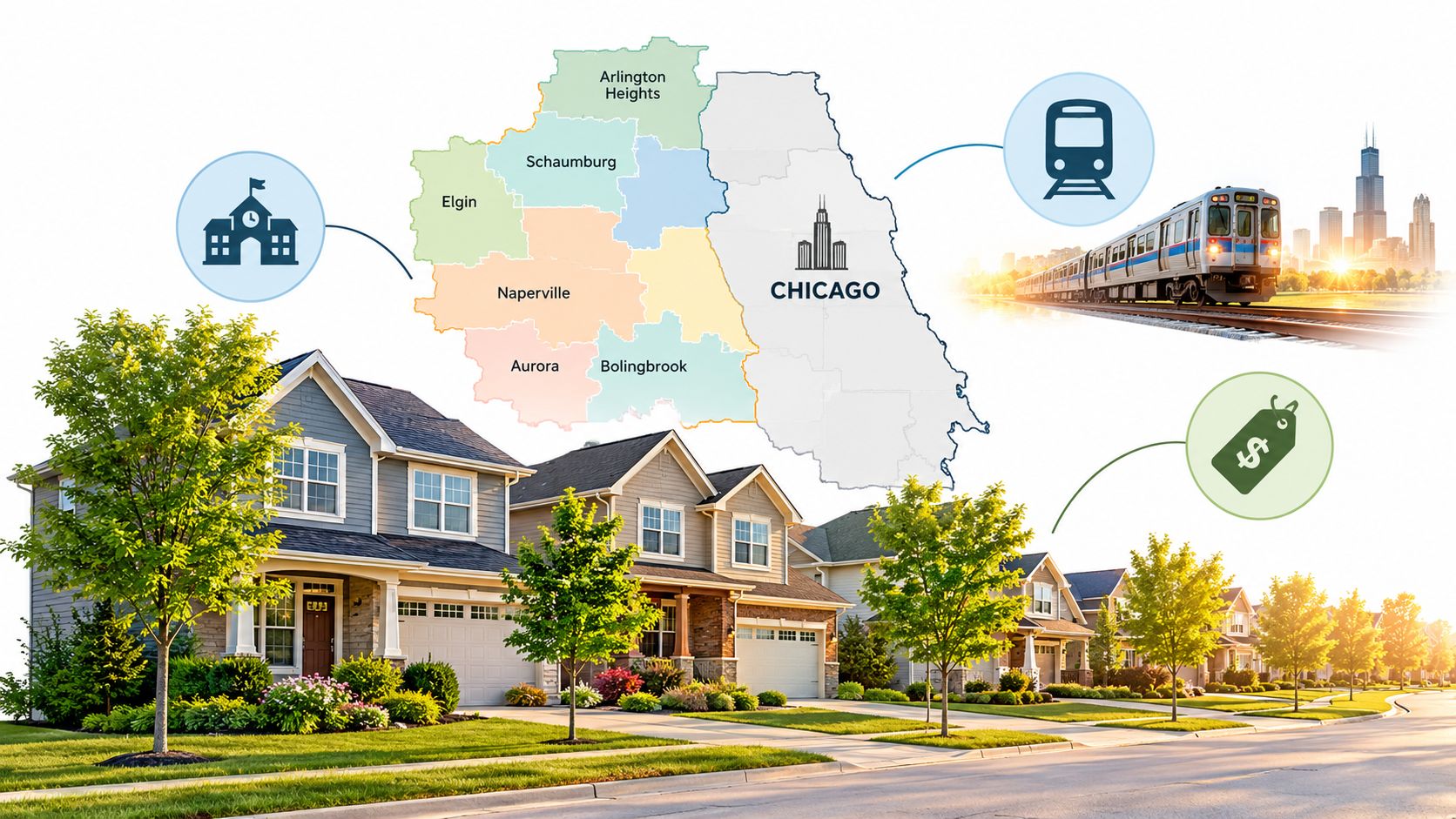
The best suburb of Chicago isn't automatically the one with the highest-rated schools, the largest homes, or the most polished downtown. Those features matter, but they solve different problems. A buyer who commutes by train may value station access over extra square footage. A first-time buyer may accept an older home and more renovation work to stay near employment centers. Another household may prefer newer construction, larger lots, or a school boundary that narrows the search.
This guide organizes ten western-focused suburbs by the decision they help solve: entry value, transit, character, schools, growth, amenities, or estate living. Melrose Park and Berwyn address affordability and urban convenience. Oak Park and LaGrange combine character with commuting. Elmhurst offers balance, while Downers Grove, Glen Ellyn, and Hinsdale appeal to buyers prioritizing established amenities and schools. Naperville serves households seeking scale and growth, and Western Springs targets buyers who want estate-style living.
Treat every description as a starting point, not a substitute for property-level research. School boundaries, taxes, asking prices, home condition, train routes, and actual commute patterns can change from one property to the next. Homes By Carmen can help narrow the search with western Chicagoland knowledge, MRED access, neighborhood context, tours, offer strategy, and transaction support.
Table of Contents
- 1. Melrose Park for urban convenience and affordable entry
- 2. Berwyn for emerging value and calculated risk
- 3. Oak Park for architectural character and an urban-suburban lifestyle
- 4. Elmhurst for balanced suburban living and school priorities
- 5. LaGrange for historic character and dependable commuting
- 6. Downers Grove for amenities, schools, and a complete suburban routine
- 7. Glen Ellyn for upscale family living and green space
- 8. Hinsdale for education-focused households and established amenities
- 9. Naperville for growth, scale, and newer housing options
- 10. Western Springs for estate living and privacy
- Top 10 Chicago Suburbs Comparison
- Turn the shortlist into a neighborhood-specific search
1. Melrose Park for urban convenience and affordable entry
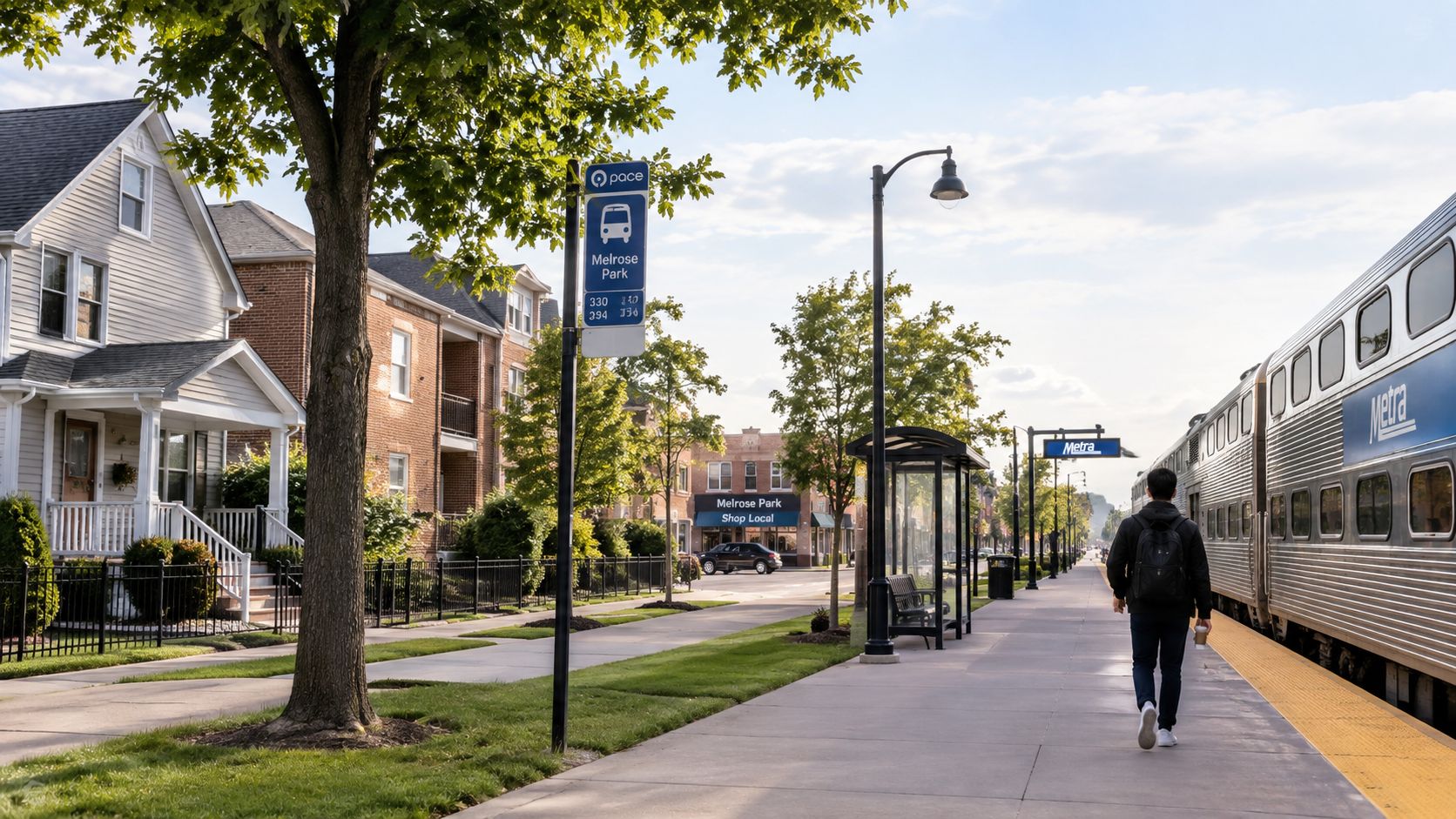
Melrose Park works for buyers who want a suburban address without giving up close-in access to Chicago. Its housing stock, transit connections, and established neighborhoods create a practical entry point for first-time buyers, especially those who would rather purchase an older home than stretch for a newer property farther west.
A starter-home buyer may find the right fit in a smaller single-family home, while another buyer may focus on a two-flat or other multi-unit property. Those options can support different goals, from building equity to creating rental income, but the condition of the building matters as much as the asking price.
What buyers should investigate
Older homes can carry deferred maintenance involving electrical systems, plumbing, roofs, masonry, or foundations. A pre-inspection can help a buyer understand repair exposure before writing an offer, particularly when the home has been renovated in stages.
Block-level differences also matter. Buyers should walk the surrounding streets at different times, review nearby traffic and parking patterns, and compare several properties rather than treating the suburb as one uniform market. A comparative market analysis is useful because list price alone doesn't establish value.
Practical rule: Calculate the full monthly cost, including transit fares, parking, insurance, taxes, and likely repairs, before calling a lower purchase price “affordable.”
For a young family, Melrose Park can offer proximity to relatives, bus routes, rail access, and Chicago employment centers. For an investor, the same location may support a rental strategy, but projected income, code requirements, insurance, vacancy assumptions, and property management need careful review. Renovation potential can be attractive, but it only creates value when the scope is understood before closing.
2. Berwyn for emerging value and calculated risk
Berwyn suits buyers who want an inner-ring location, transit access, and more attainable housing than many premium western suburbs. Its older housing stock and neighborhood variety can create opportunities, but buyers need to distinguish genuine value from a property that needs expensive work.
A first-time investor might consider a rental property in the $280,000 to $350,000 range, while a young professional may prioritize a manageable commute and access to local businesses. Those supplied price bands are planning references, not guarantees. Current condition, block, lot size, updates, and financing terms can move the value considerably.
Where the opportunity comes with conditions
Revitalization can improve a neighborhood's appeal, but it doesn't remove the risks of buying ahead of that change. A buyer should examine active listings, recent comparable sales, rental demand, property taxes, insurance, and renovation costs before assuming appreciation will follow.
For an owner-occupant, the best purchase may be a livable home with room to improve rather than the cheapest property available. For an investor, a cash-flow projection should include realistic maintenance, turnover, utilities, management, and compliance costs. A property manager's local assessment can be more useful than a broad assumption about suburban rents.
- Inspect older construction: Confirm the condition of major systems and identify work that could affect financing or insurance.
- Compare blocks directly: Berwyn's streets can differ in housing condition, noise, parking, and nearby amenities.
- Separate upside from certainty: Treat future improvement as a possibility, not as guaranteed appreciation.
A buyer who accepts renovation risk may find a compelling location here. A buyer who needs immediate predictability may prefer a more established, fully updated home, even at a higher purchase price.
3. Oak Park for architectural character and an urban-suburban lifestyle
Oak Park appeals to buyers who want a walkable, culturally active community with housing that feels distinctive rather than interchangeable. Its architectural heritage, including homes associated with Frank Lloyd Wright, gives the suburb a strong identity. Buyers often accept more complex maintenance and renovation decisions in exchange for character, transit access, and proximity to Chicago.
An architect, designer, or artist may value original details, proportion, and streetscape more than a large newer floor plan. A young professional may care more about reaching the city, walking to local businesses, and living in a neighborhood with an active cultural life. Those priorities can point toward different properties within the same suburb.
Vintage homes require specialized due diligence
A general inspection is important, but buyers of older or historically significant homes should also understand restoration needs. Masonry, windows, roofs, mechanical systems, insulation, and previous alterations deserve close attention. A renovation that looks simple in a newer subdivision can require more planning in a vintage home.
Historic district rules and preservation guidelines may affect exterior changes. Before making an offer, buyers should learn whether proposed work could require review, approval, specialized materials, or a longer timeline. That doesn't make renovation impossible, but it does make early planning essential.
Character is valuable only when the buyer understands the cost of preserving it.
Oak Park also demonstrates why price comparisons across the suburbs can mislead. Two homes with similar bedroom counts may differ sharply in land, architecture, transit proximity, condition, and restrictions. Buyers should compare like with like and review local comparables rather than relying on a regional average.
4. Elmhurst for balanced suburban living and school priorities
Elmhurst fits buyers who want several priorities to coexist: established neighborhoods, parks, family routines, commuting options, and a manageable move from an inner-ring suburb. That makes it a practical choice for a family moving west from Melrose Park, a buyer seeking a traditional residential setting, or an investor who prefers an established community over a speculative location.
The supplied planning notes place a move-up buyer near a $500,000 median home reference. Treat that figure as a planning point, not a current valuation. School assignment, renovation level, lot size, taxes, and access to daily amenities can change the comparison substantially.
Start with the school assignment, then compare the neighborhood
The boundary can matter as much as the address. Verify the assigned schools and current district information directly for every property. A listing description, a nearby school's name, or a seller's informal statement is not enough, particularly when school priorities affect both the purchase decision and future resale expectations.
Elmhurst works best when buyers compare distinct search scenarios rather than treating the suburb as one uniform market. A household that values local businesses and a shorter trip to transportation may prefer a more walkable pocket. Another may accept a longer drive in exchange for a larger yard, quieter streets, or more room to renovate. Families who use parks and recreation frequently should evaluate those routes as part of the daily routine, not as an occasional amenity.
Budget for the full ownership picture. Property taxes belong in the monthly calculation alongside the mortgage, insurance, and expected maintenance.
Tour more than one pocket. Housing character, lot sizes, condition, and pricing can shift within the suburb.
Inspect before committing. An established home may have attractive character, but its mechanical systems, roof, windows, and prior alterations determine the cost of ownership.
For local orientation, see this guide to living in Elmhurst, Illinois. Elmhurst is a compromise rather than a universal answer. It suits buyers who want more suburban structure while remaining connected to Chicago-area employment and family networks.
5. LaGrange for historic character and dependable commuting
LaGrange solves a specific problem. It gives buyers an established community with architectural character and strong train access, while retaining a neighborhood feel that many urban-to-suburban movers want. Historic homes, tree-lined streets, and a recognizable downtown create a setting that feels settled rather than newly assembled.
A commuter may put direct Metra access at the top of the list. Another buyer may be drawn to a distinctive older home, mature landscaping, or a community with long-standing civic institutions. The supplied buyer range of $600,000 to $900,000 describes a planning segment for commuters seeking this combination, not a guaranteed range for every property.
Transit convenience changes the search
Homes near a station can command attention because the commute is part of the lifestyle, not just a transportation detail. Buyers should test the actual route from the front door to the station, consider parking and drop-off routines, and calculate fares alongside housing costs. A home that looks affordable on price may be less attractive if the daily commute requires additional driving and parking.
Older houses also need a clear renovation plan. Buyers should identify whether updates are cosmetic or structural, confirm permits where relevant, and understand any historic review requirements before budgeting for changes. A low offer price doesn't create savings if the buyer has underestimated the work.
LaGrange is most suitable for buyers who value commute access, established character, and community identity enough to accept a potentially older home. It may not suit a household seeking a new-build floor plan, minimal maintenance, or a large inventory of identical properties.
6. Downers Grove for amenities, schools, and a complete suburban routine
Downers Grove attracts buyers who want a well-rounded suburban environment rather than one standout feature. Its appeal comes from the combination of established residential streets, a recognizable downtown, school considerations, transportation access, and community amenities. Move-up buyers from Oak Park or Elmhurst may see it as a step toward more space and a different daily rhythm.
The market also deserves close attention. In June 2026, detached sales in Downers Grove were reported as up 49%, a localized result that reinforces why suburb-level data matters more than a broad Chicagoland assumption. The figure comes from June 2026 suburban Chicago home-sales coverage, and it shouldn't be treated as a prediction for every property or future period.
A strong search still needs discipline
Buyers competing for a well-positioned home should have financing organized before touring seriously. That doesn't mean waiving protections. It means understanding the loan, inspection strategy, earnest money, appraisal exposure, and closing timeline before an offer becomes urgent.
Downers Grove also contains different housing experiences. A buyer near downtown may prioritize walking and train access, while another may choose a larger lot farther from the core. Older homes can offer attractive proportions and established streets, but they may require continuing investment in roofs, windows, mechanical systems, or exterior maintenance.
A polished downtown doesn't make every nearby property equally convenient. Measure the walk, the route, and the ownership cost from the specific address.
An empty-nester may use Downers Grove to trade a larger family home for a lower-maintenance property without giving up local amenities. An executive family may prioritize schools and commute logistics. The right property depends on which of those needs carries the most weight.
7. Glen Ellyn for upscale family living and green space
Glen Ellyn solves a specific buyer problem: finding an established western suburb with green space, a polished residential setting, and room for long-term family living. It suits households moving up from another suburb, relocating for work, or seeking a quieter alternative to a denser community.
The trade-off is cost and upkeep. Larger lots, mature landscaping, older construction, and proximity to parks can support a premium, while also bringing higher maintenance demands. School-age families should verify district boundaries for each address before treating two similar homes as comparable.
A practical Glen Ellyn search starts with the property beneath the renovation. Check drainage, roof age, mechanical systems, additions, permits, and prior maintenance. A finished kitchen can improve first impressions, but it does not resolve water management, aging systems, or unapproved work.
The supplied planning range of $750,000 to $1.1 million describes a likely segment for established-family buyers. It is not a valuation for every home. Lot position, school assignment, renovation quality, and access to parks or transit can change the buying decision substantially.
Consider the daily routine before making an offer:
- School logistics: Confirm the exact assignment and expected travel between home, school, activities, and childcare.
- Green-space access: Walk the surrounding streets and inspect sidewalks, traffic, park connections, and mature tree maintenance.
- Ownership workload: Budget time and money for landscaping, exterior repairs, roofs, windows, and other systems common in established homes.
- Commute reality: Test the actual drive or transit trip to Chicago or another suburban employment center during normal travel hours.
A smaller, easier-to-maintain property may suit empty-nesters who still want local amenities. A growing family may accept more upkeep for bedrooms, yard space, and a stronger neighborhood fit. Buyers can review current inventory and local orientation through houses for sale in Glen Ellyn, Illinois.
8. Hinsdale for education-focused households and established amenities
Hinsdale is a logical starting point for buyers who place school quality, neighborhood presentation, parks, and long-term community fit ahead of entry price. It attracts families relocating for education priorities and move-up buyers who want a more premium version of the established western suburban lifestyle.
The supplied planning range of $750,000 to $1.2 million describes households shopping in this segment. It shouldn't be applied to every home because property condition, lot size, location, and school assignment can alter value significantly.
Verify the reasons behind the premium
Buyers should request current district information and confirm the school boundary for each address. They should also examine taxes, insurance, maintenance, and commute costs before deciding what monthly payment is comfortable. A strong school preference can narrow the search quickly, but it can also reduce flexibility if the household hasn't defined which housing features are negotiable.
Hinsdale's parks and recreational amenities may appeal to families who want organized activities and outdoor space close to home. A commuter may also value train access and the ability to connect with Chicago employment centers. Still, the actual route from a particular property can vary, so buyers should test both driving and transit options during their normal schedule.
A move-up buyer may compare Hinsdale with Elmhurst, Downers Grove, or Glen Ellyn. The useful comparison isn't “which town is best.” It is whether the additional cost buys the specific combination of school assignment, home quality, lot, commute, and community amenities that the household wants.
The best preparation is financial and practical. Get pre-qualified, establish a maximum monthly cost, identify the school boundaries that matter, and decide whether an older home with character is acceptable. That prevents a polished showing from pushing the search beyond a sustainable budget.
9. Naperville for growth, scale, and newer housing options
Naperville solves a different buyer problem than a compact close-in suburb: it offers scale. Households can compare established neighborhoods, newer subdivisions, updated homes, school-focused searches, and broad amenities within one large suburban community. That range helps buyers who expect their housing needs to change, though the address still shapes the daily routine.
Population change provides context, not a forecast. Naperville gained 3,579 residents from the April 2020 baseline, while other suburban communities followed different paths, according to Chicago Tribune coverage of suburban population trends. The figure does not guarantee appreciation or equal performance across neighborhoods.
Choose by the decision you need to solve
Downtown and riverfront areas deserve attention from buyers who value walkability and a more established setting. Farther from the older core, newer subdivisions and updated properties may provide larger or more flexible layouts. Families should confirm school assignments for every address rather than treating Naperville as one uniform school market.
A corporate relocation or move-up buyer should arrange financing before touring higher-priced homes. New construction requires its own review: investigate the builder, specifications, allowances, schedule, warranties, lot premiums, and the completed neighborhood nearby. Model homes can understate upgrade costs and offer little evidence of the final streetscape.
- Compare school assignments: The street address determines the applicable district context.
- Price the full project: Account for design upgrades, landscaping, window treatments, fencing, and ongoing maintenance.
- Test the commute: Routes vary by neighborhood, destination, and travel time, so test the actual schedule.
Naperville can feel too spread out for buyers who want a short, walkable routine, and its western location may lengthen some commutes. For households planning more space, varied housing ages, and room to grow, the trade-off may make sense. Start with current homes for sale in Naperville, then filter by school assignment, commute, property age, and neighborhood character.
10. Western Springs for estate living and privacy
Western Springs addresses the highest-end suburban decision in this list. It suits buyers who want estate character, larger properties, privacy, established schools, and a prestigious residential setting. Executive relocations, business owners, and established families may be drawn to the combination of land, community reputation, and long-term ownership appeal.
The supplied planning range of $1.5 million to $3 million or more describes the ultra-luxury buyer segment. It isn't a valuation for every property. At this level, the home's architecture, lot, landscaping, privacy, renovation history, and location can create major differences between listings.
Luxury due diligence is still due diligence
A large home can hide complex ownership costs. Buyers should review roofing, masonry, drainage, mechanical systems, landscaping, security, insurance, and any specialized features. Jumbo financing may require detailed documentation and a lender familiar with high-value transactions. Pre-qualification should happen before a buyer schedules a concentrated tour of estate properties.
Presentation also matters when sellers prepare a home for market. Professional photography, careful staging, complete property information, and a marketing plan that communicates privacy and architectural quality are more effective than generic luxury language. Buyers need enough detail to distinguish craftsmanship from cosmetic upgrades.
Estate living is a lifestyle purchase, but it still needs a disciplined inspection, financing plan, and ownership budget.
Western Springs may not suit a household seeking low maintenance, a short walk to a dense retail district, or an entry-level purchase. It works best when the buyer values land and privacy enough to accept higher acquisition and upkeep costs. The property should serve the household's long-term plans, not just its first impression.
Top 10 Chicago Suburbs Comparison
| Suburb | Buying Complexity | Resource Requirements (Price & Taxes) | Expected Outcomes | Ideal Use Cases | Key Advantages |
|---|---|---|---|---|---|
| Melrose Park | Low, affordable entry; competitive starter market | $250k–$350k; lower property taxes; budget for older-home repairs; factor Metra commute costs | Entry-level ownership with modest appreciation; strong commuter convenience | First-time buyers, young professionals, small investors, immigrant families | Most affordable gateway; excellent transit; established community |
| Berwyn | Low–Medium, variable by block during revitalization | $250k–$450k; likely renovation costs; moderate taxes | Appreciation upside as revitalization continues; good rental potential | Investors, value-conscious families, young professionals, first-time buyers | Emerging growth; affordability; improving amenities; transit access |
| Oak Park | Medium–High, competitive market with preservation rules | $350k–$650k; higher maintenance for vintage homes; specialist inspections advisable | Steady appreciation and sustained demand; rich cultural lifestyle | Historic-home seekers, artists, urban-minded buyers preferring walkability | Architectural heritage (Frank Lloyd Wright); walkable districts; cultural amenities |
| Elmhurst | Medium, family-focused, school-driven competition | $400k–$700k; moderate–high taxes; limited transit vs inner-ring suburbs | Stable appreciation tied to school reputation and family amenities | Move-up buyers, growing families, school-focused homeowners | Highly-rated schools; balanced suburban lifestyle; parks and community programs |
| LaGrange | Medium–High, historic character with competitive demand | $500k–$1.2M+; maintenance and preservation constraints; higher taxes | Stable appreciation with strong commuter appeal and neighborhood character | Commuters, historic-home enthusiasts, families seeking established community | Direct Metra commute; historic architecture; strong schools and civic amenities |
| Downers Grove | High, premium pricing and competitive offers common | $600k–$1.5M+; high property taxes; strong buyer demand | Strong appreciation and resale; top-tier schools sustain value | Affluent families, executives, school-focused buyers | Exceptional schools; vibrant walkable downtown; consistent appreciation |
| Glen Ellyn | High, upscale market with limited lower-priced inventory | $600k–$1.3M+; high taxes/fees; competitive bidding likely | Consistent appreciation; lifestyle focused on parks and community | Established families, move-up buyers, professionals | Top schools; extensive parks and trails; strong community identity |
| Hinsdale | High, elite market with scarce inventory | $650k–$1.4M+; high taxes; premium maintenance costs | Strong appreciation driven by top-tier schools and amenities | Education-focused families, move-up buyers, professionals | Exceptional school district; parks and commuter access; premium neighborhoods |
| Naperville | High, aspirational market with heavy demand | $650k–$2M+; high taxes; new-construction and premium options | Strong appreciation; vibrant downtown and employment base | Executives, affluent families, corporate relocations | Top-rated schools; lively downtown; robust new development and jobs |
| Western Springs | Very High, ultra-luxury segment, limited inventory | $1.5M–$5M+; jumbo financing often required; high taxes and upkeep | Stable, long-term appreciation for estate properties; exclusivity | Ultra-high-net-worth buyers, executives, families seeking estates | Large lots/estate homes; top schools; privacy, prestige, forest preserve setting |
Turn the shortlist into a neighborhood-specific search
The suburbs of Chicago work best when buyers begin with the decision they need to make, not with a generic ranking. Melrose Park or Berwyn can be sensible starting points for entry value and transit access, especially for first-time buyers willing to consider older homes or renovation. Oak Park or LaGrange fit buyers who want character, walkability, and commuting options, while accepting that historic housing may demand more specialized due diligence.
Elmhurst is a practical balance for households weighing schools, established neighborhoods, parks, and access to the city. Downers Grove, Glen Ellyn, and Hinsdale make more sense for buyers prioritizing established amenities, school considerations, and a more premium suburban setting. Naperville suits households seeking a larger community, newer options, and room to grow. Western Springs is the clearest choice for buyers focused on estate character, privacy, and high-end residential ownership.
The next step isn't to save every appealing listing across ten suburbs. Define a workable budget, a maximum commute, the school priorities that are essential, and your tolerance for repairs or maintenance. Then select two or three suburbs, compare active listings with recent comparable sales, and arrange tours on the same day when possible. That side-by-side experience reveals differences in traffic, housing condition, lot size, walkability, and neighborhood rhythm that online searches miss.
Verify the exact school boundary, current asking price, taxes, property condition, transit route, and likely monthly ownership cost before making an offer. Regional averages can provide context, but the address controls the decision. In April 2026, detached suburban Chicago sales declined 1.9% year over year to 2,424 closed transactions, while the median sale price rose 7.3% to $434,500 and median market time stayed nearly flat at 45 days, according to April 2026 suburban market coverage. Those figures are useful context, but they don't replace neighborhood-level analysis.
Homes By Carmen can help narrow western Chicagoland options, access MRED listings, evaluate value, coordinate tours, prepare offers, negotiate terms, and manage inspections and closing steps. The process becomes more manageable when your agent understands why you're comparing Melrose Park with Elmhurst, or Naperville with Downers Grove, rather than treating every suburb as interchangeable.
Homes By Carmen helps buyers compare western Chicago suburbs through MRED-powered searches, local neighborhood context, tours, offer strategy, inspection coordination, and closing support. Define your budget and preferred commute, then visit Homes By Carmen to start narrowing the right communities and properties.