
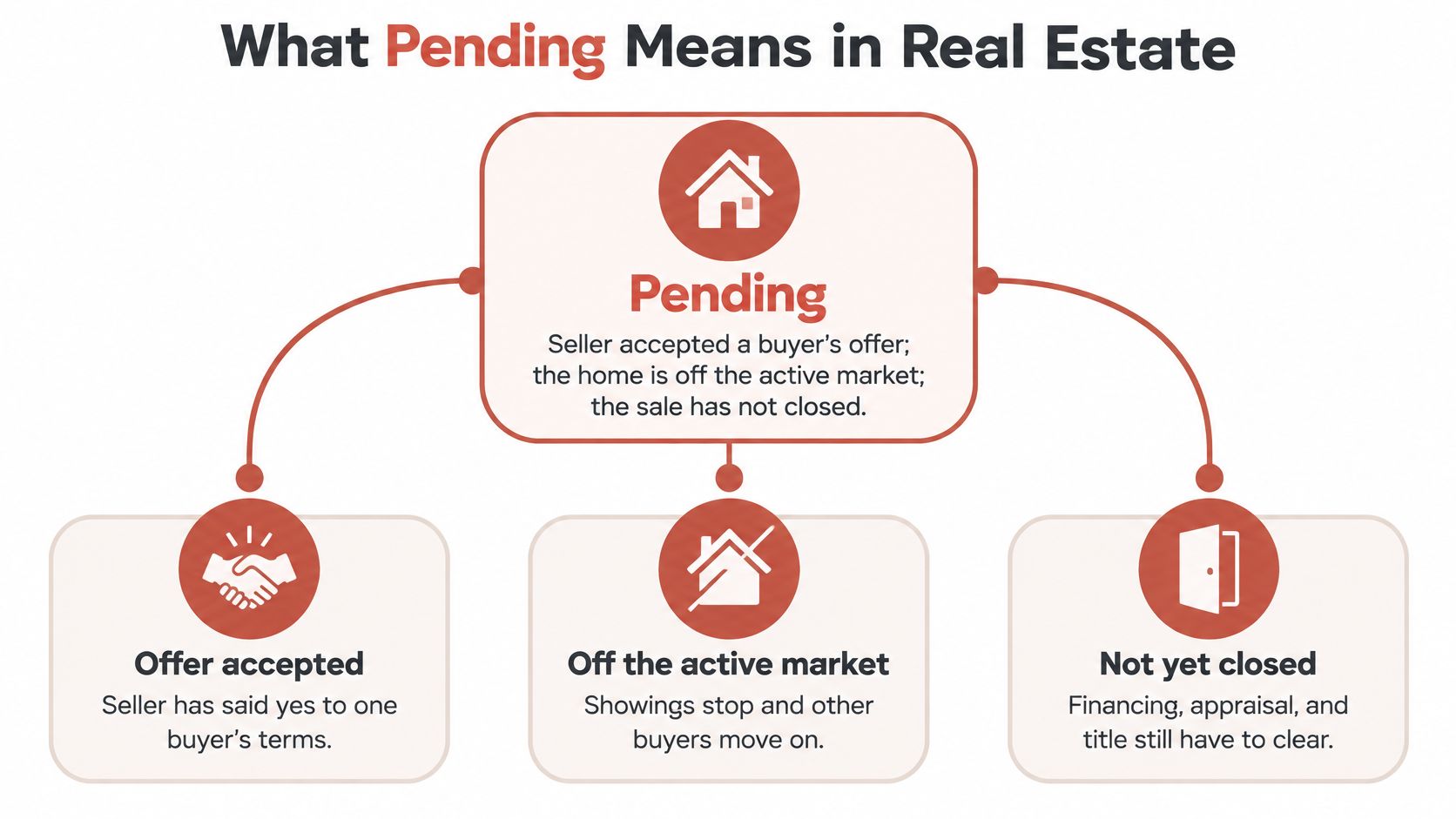
Pending means the seller accepted a buyer's offer and the home is off the active market, but the sale has not closed and ownership has not changed hands. The house still belongs to the seller until the deed records.
A listing can look settled from the outside. A home hits the market on a Tuesday in Elmhurst at a price that finally makes sense. You text your agent, gather the paperwork, and by Thursday afternoon the badge under the photo says pending. It feels like a door slamming. The practical question is how far along that contract is. In Illinois, a pending badge can appear while attorney review and inspection windows are still live.
That gap between the label and the contract affects buyers and sellers in different ways. Buyers may cross off a home that still has a path forward. Sellers may start spending money from a sale that has not closed. A basic explanation often stops at the definition and skips the attorney review window, which can change what happens next. That is why pending deserves a timeline, not just a label.
Table of Contents
- What Pending Means in Real Estate
- How Pending Differs From Contingent, Under Contract and Closed
- What Happens Between Pending and Closing
- Why Pending Deals Fail and What Pending Signals
- Can You Still Make an Offer on a Pending Home
- Your Next Step When a Home You Want Goes Pending
What Pending Means in Real Estate
Start with the working definition. The MLSListings status definitions describe pending as an accepted offer that is expected to close, with the seller no longer accepting additional offers and the home pulled off-market. The same page defines closed as the point where the purchase agreement has been fulfilled. Those are two different moments, and the space between them is where the whole transaction lives.
Pending is also just a label in a listing system. A listing agent types it in, the portals pick it up, and buyers and sellers read it as a verdict. What governs the deal is the purchase contract. In Illinois the status gets flipped by an agent's keystroke, while attorney review and inspection deadlines run on the contract's own schedule. The badge reflects what was entered into the MLS, not which windows are still open.
Three things true at once
A signed contract exists. Price, closing date, and the major terms have been negotiated and agreed, with real deadlines attached to each one.
The seller has stepped back from the market. Showings stop, primary offers stop, and the listing stops competing for attention.
Deadlines are still running. Inspection objections, attorney review, and mortgage commitment dates can all still be in play under a pending label. The label tells you the stage. The contract tells you which of these windows remain.
A pending sale works like a flight that has pushed back from the gate. The door is closed, the seat is taken, the crew is running its checks. It has not taken off, and weather or a mechanical issue can still send everyone back to the terminal.
The labels are also set market by market. Some systems use "under contract" or "active under contract" for the same moment, and a few skip the contingent stage entirely. An Illinois pending listing may not match a national article's description, and it won't always match a portal's either.
If you're buying, a pending home is probably not open for a normal offer, though a backup may be possible. If you're selling, the proceeds reach your account when the deed records, so keep treating the deal as a work in progress until that day. If you're reading market news, count a pending listing as a sale in progress rather than a sale finished; folding the two together is how inventory headlines get overstated.
How Pending Differs From Contingent, Under Contract and Closed
Here's the comparison most buyers need before they call anyone.
| Status label | What it means | Seller considering new offers? | Your next step |
|---|---|---|---|
| Active | Home is listed with no accepted offer | Yes, primary offers welcome | Tour, run comps, prepare an offer |
| Contingent | Offer accepted, but one or more conditions are still open (inspection, financing, appraisal, home sale, third-party approval) | Often yes, especially backup offers | Ask the listing agent whether backups are being taken |
| Under contract | Umbrella term some MLSs use for any accepted offer | Depends on the specific status behind it | Ask which stage the contract is in |
| Pending | Offer accepted, major contingencies satisfied or waived, home off-market | Usually no, backup offers possible | Call the listing agent before writing anything |
| Pending, continue to show | Pending contract with showings allowed in case it falls through | Yes, backups invited | Tour quickly and decide whether to write a backup |
| Closed or sold | Contract fulfilled, deed recorded, ownership transferred | No | Use it as a comparable for your own offer |
The two rows people confuse
Contingent means an offer is accepted but at least one condition is still live, whether that's inspection, financing, appraisal, the buyer's own home sale, or a third-party approval. Sellers in that position often welcome backup offers, because the deal has a documented way to fall apart. If you want the mechanics of that condition, read what a home sale contingency does to a closing timeline.
Pending usually means those major conditions have been satisfied or waived and the home is off-market. The word "usually" is doing real work in that sentence. Some MLSs let a listing go pending with financing or appraisal still open, so the badge alone never proves the deal is safe.
Contingent means conditions are open. Pending means conditions are mostly closed. Closed means the deed recorded. Everything else is local vocabulary layered on top of those three stages.
What Happens Between Pending and Closing
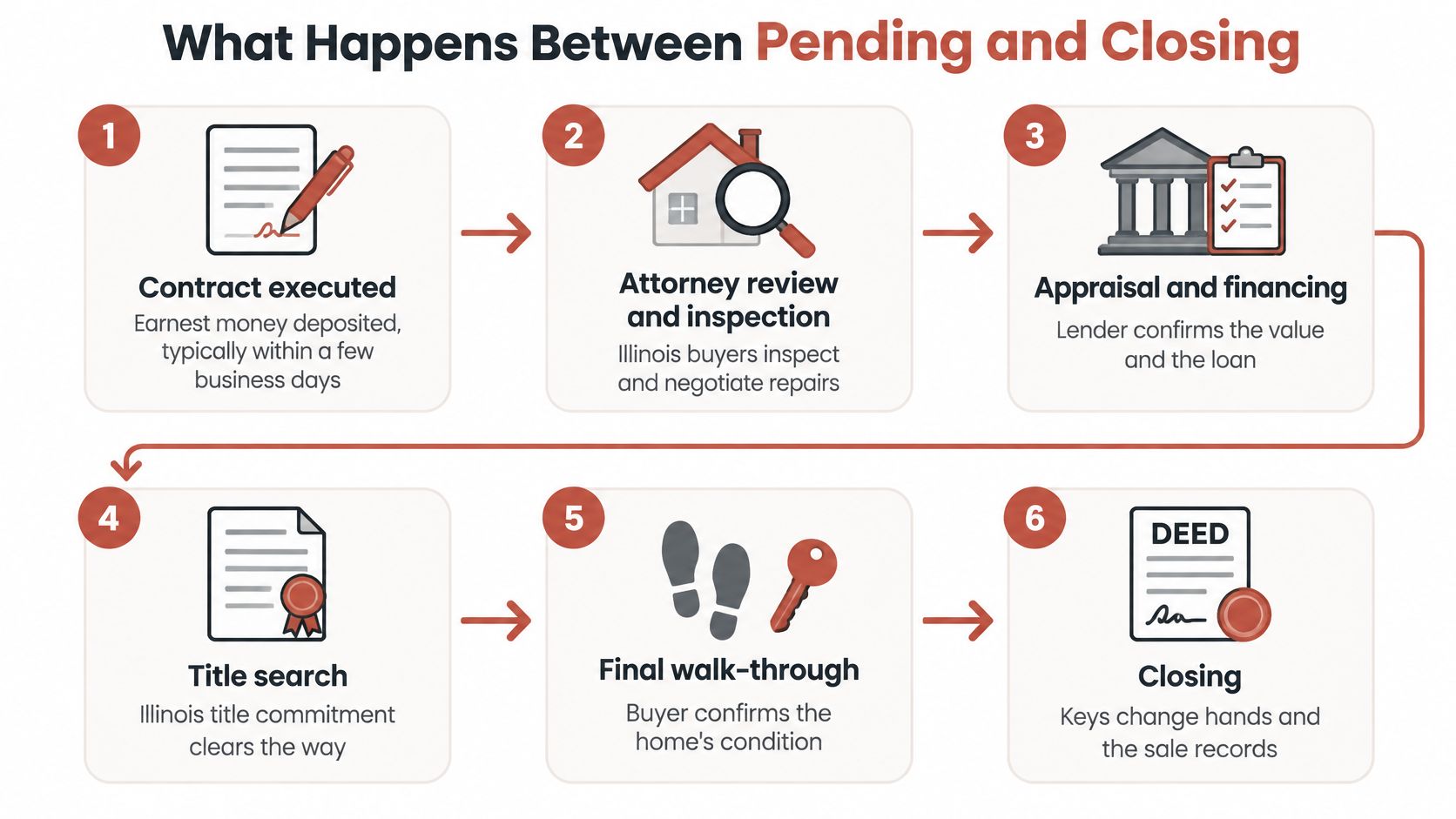
Once the offer is accepted and the status flips, the contract starts running on deadlines. In Illinois that stretch is where the risk sits, because several stages can still undo the deal after the listing already reads pending. Here is the sequence as it runs on a financed purchase, with the timing each stage typically carries.
| Stage | What happens | Typical timing |
|---|---|---|
| Contract and earnest money | Purchase agreement signed and earnest money deposited with the designated holder | Within a few business days of acceptance |
| Attorney review | Either attorney may approve, disapprove or propose modifications under the Illinois Multi-Board contract | Commonly 5 business days after acceptance |
| Inspection | Buyer inspects, then approves, requests repairs or credits, or terminates | Commonly a separate 5-business-day track |
| Appraisal | Lender orders an appraisal; a low value creates a gap the parties must negotiate | Often 1 to 2 weeks |
| Loan underwriting | Lender verifies income, assets and conditions, then issues final approval | Often 2 to 3 weeks |
| Title and association review | Title search and commitment, plus condo or HOA document review where applicable | Typically 1 to 2 weeks, before clear to close |
| Final walkthrough | Buyer confirms condition and agreed repairs before funds move | Last day or two before closing |
| Closing and recording | Funds transfer, deed records, listing changes to closed or sold | Typical total of 30 to 45 days from acceptance |
A few of those rows deserve a closer read.
Earnest money goes to the designated holder named in the contract, typically within a few business days of acceptance. Until the deposit lands, the seller has limited recourse under the contract if the buyer walks.
Attorney review is the stage buyers underestimate. Under the Illinois Multi-Board Residential Real Estate Contract, either attorney commonly gets five business days after acceptance to approve, disapprove or propose modifications, as the Illinois contract and disclosures guide explains. A listing can already display as pending during that window while riders are still being negotiated.
The inspection runs on its own contractual track, commonly five business days as well, and ends one of three ways: approval, a repair or credit request, or termination. The signed contract controls the dates, so count from the acceptance date in your paperwork rather than assuming a standard.
On the money side, the lender orders the appraisal early, then underwriting verifies income, assets and conditions before issuing a final approval. In parallel, the title company searches for liens and ownership problems and issues a commitment. Condo and HOA purchases add a document review with its own clock.
The last two rows move fast. The walkthrough, usually in the final day or two, confirms condition and agreed repairs. Then funds transfer, the deed records, and the listing changes to closed. Plan on roughly 30 to 45 days from acceptance on a financed deal, longer if a home sale contingency or a slow appraisal stretches the calendar.
How a pending week actually looks in Illinois. An offer accepted on a Monday gives both attorneys until the following Monday under the standard five-business-day review. The home shows pending that entire week while either attorney can still modify or disapprove the contract.
Deadlines inside these windows are enforceable. A buyer who fails to deliver a required notice before a contractual cutoff can lose the review or objection right attached to it, and a missed financing date can put earnest money at risk depending on the clause.
If you're mapping your own dates, keep our buying a house timeline open next to the contract so the deadlines line up with the calendar.
Why Pending Deals Fail and What Pending Signals
A pending badge can look settled from the outside. In an Illinois contract, it may still sit there while attorney review, inspection, financing, appraisal, title, or association review are moving. That is why the badge tells you less than most explainers admit. The contract controls the risk.
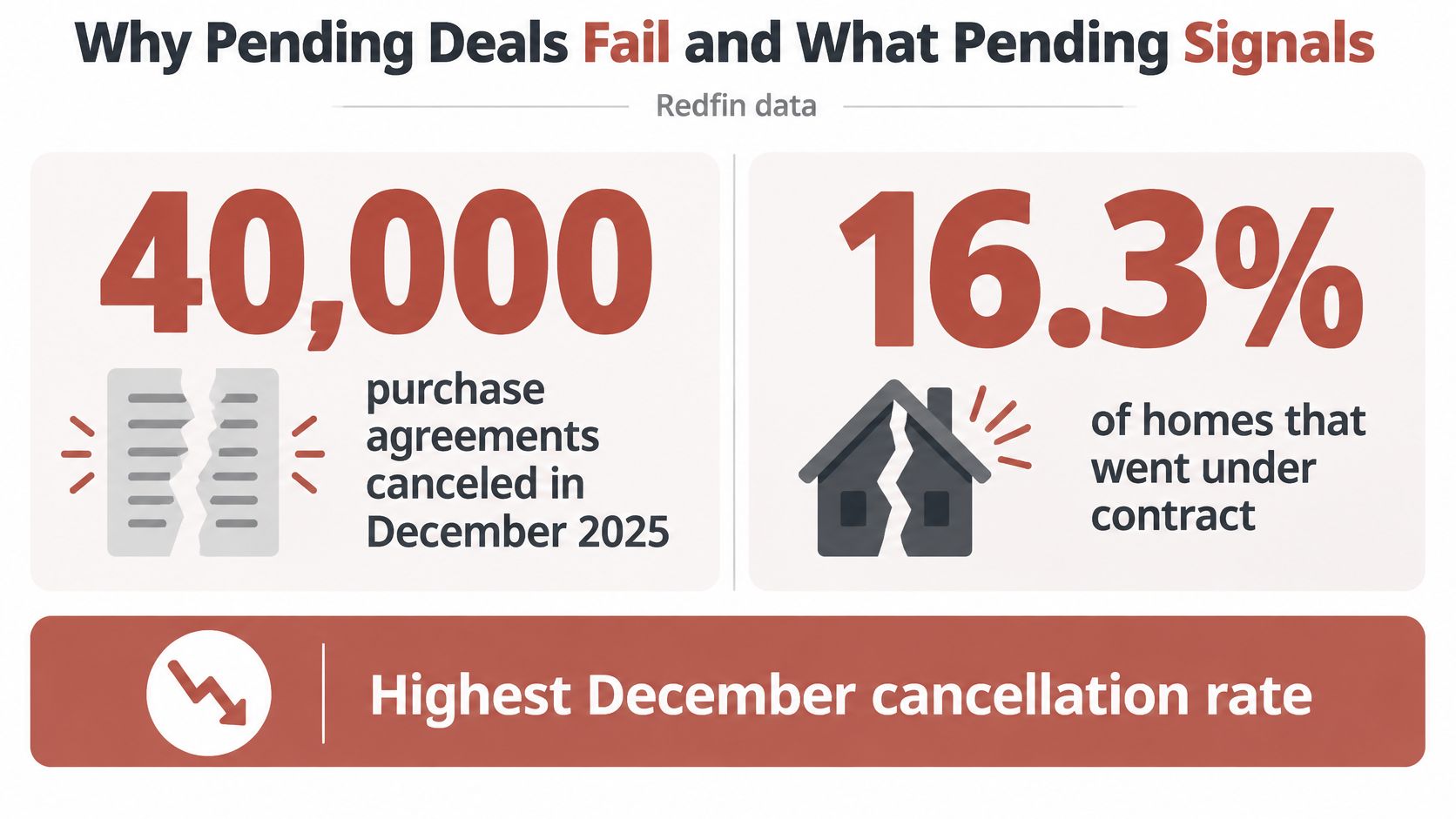
The scale of fall-throughs is not small. Roughly 40,000 purchase agreements were canceled in December 2025, equal to 16.3% of homes that went under contract, the highest December rate in home-sale fall-through data going back to 2017. That is about one deal in six coming back to life as an active listing.
Why the official cause often isn't the actual one
A buyer may terminate under an inspection clause even when the deeper problem is mortgage cost, appraisal value, or a changed financial picture. That makes the formal reason on paper narrower than what broke the deal.
| Cause | What it signals | Who can act |
|---|---|---|
| Financing falls through | Pre-approval was never fully underwritten, or a job or credit change happens after application | Buyer and lender |
| Low appraisal | No appraisal gap coverage in the contract and values tightening in the neighborhood | Buyer and seller renegotiate price or credits |
| Inspection findings | Roof, HVAC, plumbing or structural issues surface in the first week | Seller can offer repairs or credits |
| Title problems | Old liens, unprobated estates or boundary issues appear in the title search | Title company and attorneys |
| Missed contractual deadline | Attorney review, inspection notice or loan commitment date passes without action | Both attorneys, immediately |
| Cold feet or life change | Buyer goes quiet after the inspection response | Listing agent and seller |
The practical point is that a pending listing can fail for a paperwork reason while the economic reason sits underneath it. If you are the seller, a clean offer is not only about price. If you are the buyer, the deadline you save may matter more than the one you negotiate hard.
What a run of pending listings tells you about your suburb
Pending activity is a leading indicator, not just a label. The National Association of REALTORS' Pending Home Sales Index is built from signed contracts on existing single-family homes, condominiums, and cooperatives, and because contracts usually close one to two months later, the index leads reported existing-home sales by one to two months. Cancellations pull that eventual closed total down.
For you, that translates locally. A cluster of pendings in Oak Park or Downers Grove this month points toward closed sales and firmer pricing one to two months out, and toward a spring market where listing photos matter less than speed.
Try a two-minute exercise in your target suburb. Count homes that went pending in the last 30 days. Count the ones that closed. Then watch how fast a new listing flips. Pending homes aren't available supply, so a scarcity headline can overstate what you're competing for.
Closing odds aren't a fixed national percentage. They depend on contract language, how strong the financing is, the appraisal result, property condition, and how carefully the attorney review was handled. Know how your earnest money is protected, and know the deadline that releases it.
Can You Still Make an Offer on a Pending Home
Whether a seller can even consider your offer on a pending home comes down to three things: the listing agreement, local MLS rules, and whether that seller wants a backup sitting in the drawer. The purchase contract controls what happens next, and the badge only signals where to start asking questions.
In Illinois that distinction matters more than most explainers admit. A home can show pending while attorney review and inspection windows are still live, which means the first contract is still being tested. Two listings with identical pending badges can be in completely different legal positions, and the only way to tell them apart is to ask.
Ask these four things before you spend a Saturday touring
Has the first buyer's attorney review window closed? If it's still open in Illinois, the first contract isn't settled yet, and that matters for how seriously to take a backup.
Which contingencies are still open? Financing, appraisal, inspection, title, association documents, and home sale provisions can all still be live, and each one is a different kind of risk to inherit.
Is the seller accepting backups or using a kick-out provision? A kick-out lets the seller keep marketing and take a stronger offer, which changes your negotiating position completely.
What happens to your earnest money if the first deal dies? Get the answer in writing. A backup that ties up your deposit for six weeks with no clear release date is a bad trade.
A short procedure that works
- Call the listing agent directly. Portal statuses lag the MLS by hours to days, and sometimes they're stale.
- Ask the four questions before you tour. If backups aren't being accepted, you've saved yourself a weekend.
- If you tour and write, keep the contingencies you need. Waiving inspection to win second place is a bad trade.
- Keep your loan file moving. A backup buyer who can perform in days beats one who needs three weeks.
- Put an expiration date on your backup offer. An open-ended backup can hold you in limbo while better listings come and go, so give the seller a firm window to respond.
Watch for pending, continue to show listings. Showings are allowed there for exactly this reason, and they're the one pending category where a backup is invited rather than tolerated.
A backup with a strong file and a clean deposit is worth writing. A backup with a weak file and waived protections is a donation.
Your Next Step When a Home You Want Goes Pending
Match the action to your situation and stop refreshing the portal.
If the listing says pending, continue to show, tour within a day and decide that evening whether a backup is worth writing. Speed is the entire advantage.
If showings are closed, set alerts for comparable homes in the same suburb and stay ready to write within 24 hours of a new listing. Run the recent comparable sales now so you can judge a new listing's price on day one. The next house is the actual plan.
If you're the seller on the other side of that contract, keep disclosures, repair negotiations, title documents, and moving arrangements on schedule until the deed records. A deal that falls apart over a low appraisal or a repair credit puts you back at the showing stage, and the sellers who recover fastest already had their paperwork done.
Whatever stage you're at, don't stop inspection, insurance, or title work because a listing changed status. You can schedule a consultation to confirm where a listing really stands before you commit time or earnest money.
The badge on a listing updates faster than the contract underneath it, so treat every status as a claim worth checking before you act on it. Homes By Carmen works with buyers and sellers across Melrose Park, Elmhurst, Oak Park, Downers Grove, Naperville, and Glen Ellyn. Visit Homes By Carmen to schedule a call, run your numbers through the mortgage calculator, or pull the Buyers Guide before your next showing.