
An appraisal contingency is a clause in your purchase contract that protects you if the lender's appraisal values the home below the price you agreed to pay, and it gives you a defined path to renegotiate, bring extra cash, or walk away instead of absorbing the difference alone. If you contract at $450,000 and the appraisal comes back at $440,000, that $10,000 gap has to be settled before closing, and the clause is what decides how.
Most buyers assume the contingency guarantees the home will appraise at their offer price. It doesn't. It's a dated, written procedure: a deadline to act, a notice to send, and a set of remedies the seller already agreed to in advance. Buyers who treat it as a promise get caught by surprise. Buyers who treat it as a schedule of rights usually keep both their deposit and their options.
Table of Contents
- What an Appraisal Contingency Means for Your Offer
- How a Low Appraisal Creates an Appraisal Gap
- Your Options When the Appraisal Comes In Low
- Challenging a Low Appraisal With a Reconsideration of Value
- How the Contingency Works From Acceptance to Closing
- Waiving the Contingency and Confirming Terms Before You Sign
What an Appraisal Contingency Means for Your Offer
Your purchase contract already contains a clause built on the same idea. The inspection contingency protects you on condition: if the roof is failing, you have grounds to act. The appraisal contingency protects you on value, and the trigger works differently. A home inspector is someone you hire, accompany, and question on site. The appraiser is assigned through your lender's ordering process, and their opinion arrives as a report you can challenge only through the procedure the contract spells out.
Why does the contract care about value? Collateral. Your lender orders the appraisal to confirm the house supports the loan amount, and when the appraiser's opinion lands below your contract price, that difference can't be folded into the financing. It gets settled before closing, or the deal ends.
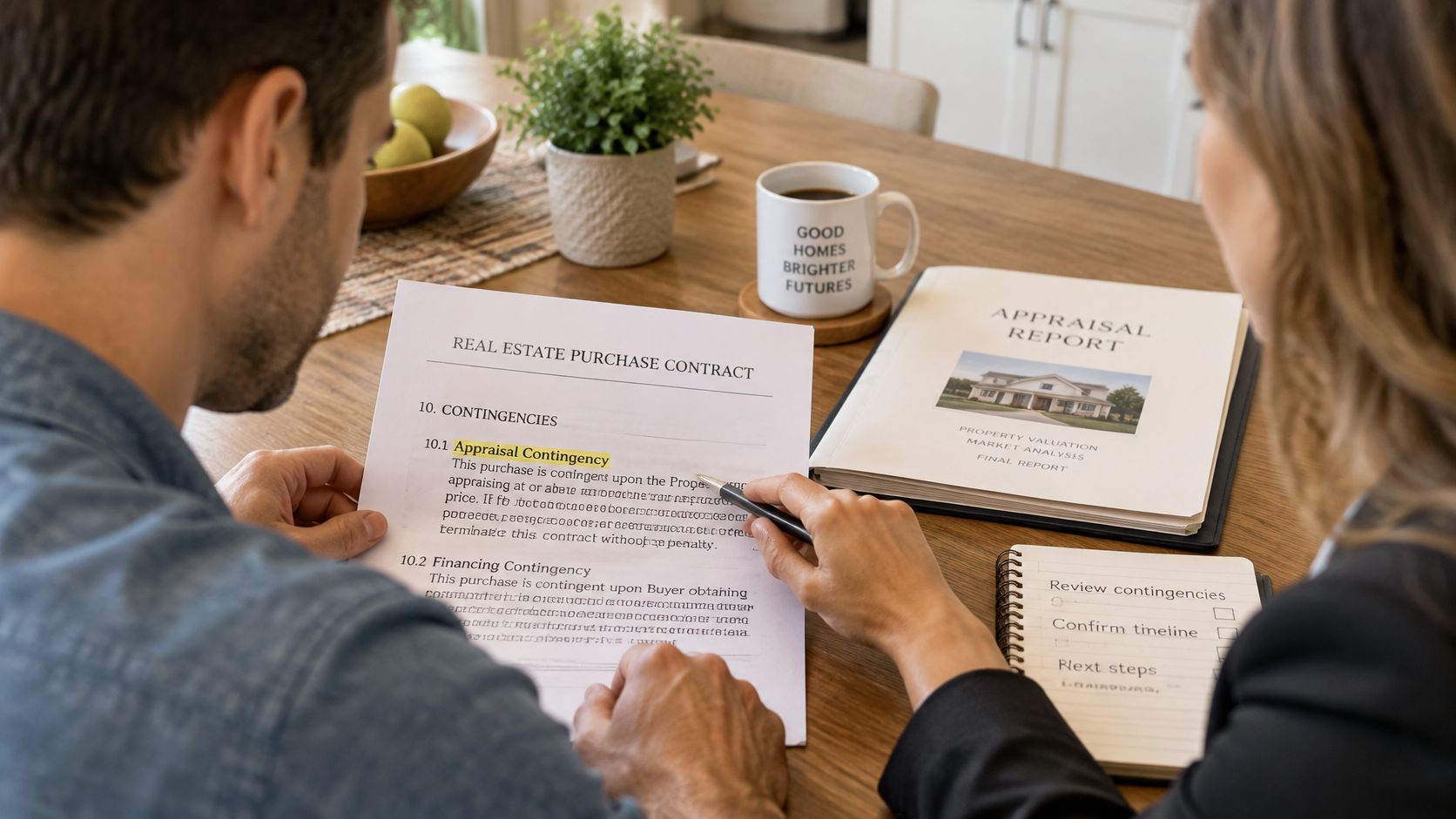
How often does that happen? A 2024 Consumer Financial Protection Bureau working paper reported that fewer than 10% of purchase appraisals came in below the contract price, while approximately 30% exactly matched it. Appraisals tend to track the negotiated price closely, so a low appraisal is the exception. Plan for it anyway. It tends to surface late in the timeline, when your room to maneuver is smallest.
Three details in the wording decide how much protection you bought:
- The appraisal deadline. The date by which the report must arrive and the date by which you must object. Both live in the contract, and both get enforced.
- The notice requirement. Your contract will specify how an objection reaches the seller, and it means a signed written notice delivered before the deadline passes. A phone call to your agent doesn't satisfy it.
- The remedy. Some clauses permit cancellation and return of earnest money. Others permit only renegotiation. Some cap the shortfall you've agreed to cover yourself.
The practical definition: a renegotiation or exit procedure with deadlines attached. It gives you a scheduled right to act on a low appraisal, nothing more.
How a Low Appraisal Creates an Appraisal Gap
A $500,000 offer meets a $485,000 appraisal. The subtraction takes one line, but what that difference does to your loan takes longer to work through. The table below shows how the same math lands differently depending on the size of the deal.
| Contract price | Appraised value | Gap |
|---|---|---|
| $450,000 | $440,000 | $10,000 |
| $500,000 | $485,000 | $15,000 |
| $350,000 | $330,000 | $20,000 |
| $400,000 with an 80% LTV loan | $380,000 | $20,000 |
Why the last row is the one that hurts
The first three rows are plain price differences. The last row produces a loan shortfall, and it behaves differently. A lender generally bases the maximum loan amount on the lesser of the purchase price or the appraised value, so your loan gets calculated from $380,000 rather than the $400,000 you agreed to pay. At an 80% loan-to-value limit, that caps the loan at about $304,000 instead of $320,000, a $16,000 funding gap before you have paid a dollar of closing costs.
Watch the mechanics closely. The price gap is $20,000, yet the loan shortfall is $16,000, because your planned 20% down payment shrinks alongside the loan. The smaller your down payment percentage, the closer the shortfall tracks the full gap. Run the same appraisal at a 90% loan-to-value cap and the maximum loan drops to roughly $342,000 against the $360,000 you expected, an $18,000 hole to fill before closing.
None of that money has a default payer. A low appraisal assigns the problem rather than solving it, and who covers the difference depends on the remedy language in your clause, the deadlines attached to it, and what both sides can still agree to.
Appraisal trouble also stalls deals even when it does not kill them. The CFPB's analysis of appraisal concurrence reports that the National Association of REALTORS® found appraisal issues behind about 15% of contract-settlement delays before the pandemic, a share that peaked at 27% in July 2021 and later eased to 22%. Delays at that frequency are why the dates in the clause belong on your calendar the day you go under contract.
Run this arithmetic on your own offer before you submit it. Pick a realistic low value, apply your loan-to-value limit, and look at the cash number it produces. If that number would empty your reserves, you already know which contingency you cannot afford to waive.
Your Options When the Appraisal Comes In Low
The question buyers ask most is who pays the difference. Nobody owes it automatically. The clause works like a defined procedure: it opens a window for renegotiation and, if talks fail, an exit. Four things decide who absorbs the gap: the contract's exact language, its deadlines, the loan type, and any appraisal-gap promise you signed when you made the offer.
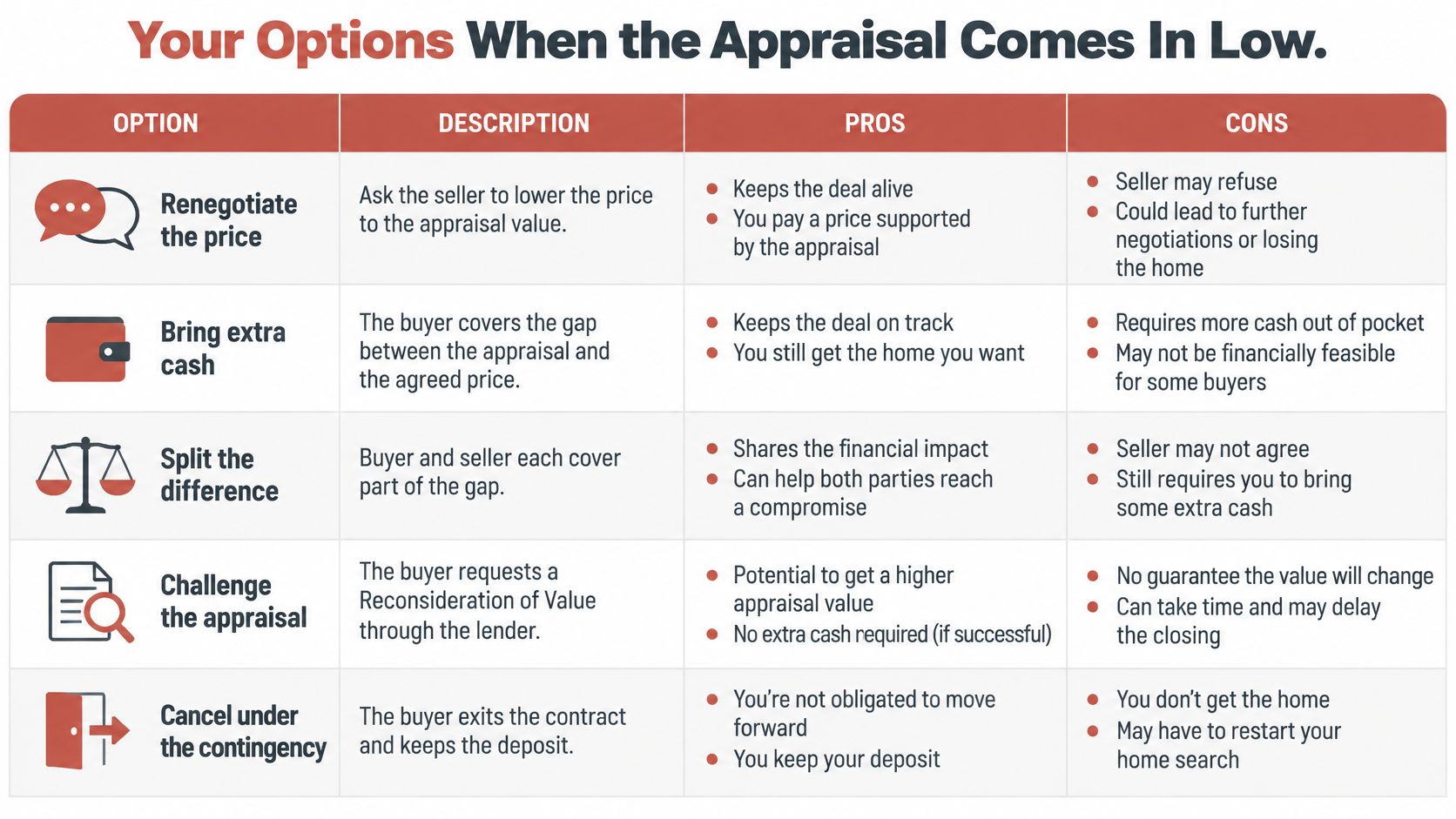
| Option | Who covers the gap | Works best when | Main risk |
|---|---|---|---|
| Renegotiate the price | Seller | The market is slow or the seller has few other offers | Seller may refuse and force a new decision |
| Bring extra cash | Buyer | You have reserves left after closing costs and want to keep the home | You pay above the appraised value out of pocket |
| Split the difference | Buyer and seller | The gap is small and both sides want to close | Needs both sides to agree |
| Challenge the appraisal | Lender review | The appraiser missed comparable sales or property features | No guaranteed change, and it can delay the timeline |
| Cancel under the contingency | No one; earnest money returned | The clause allows it and no deal is reached | A missed deadline can end the protection |
A split is easier to picture in dollars. On a $16,000 gap, a seller who drops the price $10,000 leaves you covering $6,000 in cash rather than the full shortfall, and the loan still sizes off whichever value the lender accepts.
The order to work through them
Moving through these in sequence beats picking whichever feels best in the moment:
- Check the deadline first. Every other decision is measured against that date.
- Ask the lender whether the loan still qualifies at the lower value, and at what down payment.
- Measure the gap against your reserves after closing costs, leaving the funds committed to your down payment untouched.
- Review the comparable sales the appraiser used and the ones they didn't.
- Confirm what the contract permits, whether cancellation, price reduction, or negotiation only.
The loan type changes this list. FHA's amendatory clause and VA's escape clause generally let eligible buyers decline a below-value transaction without forfeiting earnest money, which gives buyers on those programs a built-in version of the exit this contingency creates. That protection matters most to first-time buyers working with tight reserves.
If the seller won't move on price, a credit toward your closing costs is a different lever, and seller concessions run on a separate set of rules than a price reduction does.
Waiving the appraisal contingency leaves your financing and inspection protections intact. Read each clause separately, because they fail independently.
Challenging a Low Appraisal With a Reconsideration of Value
A buyer cannot phone the appraiser and argue the value upward. The appraiser works for the lender, so the challenge has to run through the lender as a formal Reconsideration of Value (ROV). Fannie Mae's appraisal quality guidance requires lenders to keep procedures for borrower-initiated ROVs when an appraisal looks unsupported, deficient, or affected by unacceptable appraisal practices.

Treat the ROV like an appeal file built on documents. The strongest packet usually combines three recent comparable sales near the subject home, proof of upgrades the report missed, and corrections to hard facts such as square footage, bedroom count, or condition. Permits and invoices carry more weight than a paragraph saying the price feels wrong, and a micro-neighborhood edge the appraiser could not see from the street needs a clear comparable sale to prove it. Building that packet is the same discipline as a comparative market analysis, except the audience is a lender reviewer.
If the value stays low, the lender sizes the loan off the appraised number, so the gap becomes added cash, price relief, or a written exit when the clause allows one. Some loans also close through value acceptance or property-data alternatives instead of a traditional report; that can clear one obstacle, but it leaves no appraisal to challenge.
An ROV can raise the value, but it does not force a higher number, and the review can outlive the contract window. Send it early, then keep the backup route alive in writing.
How the Contingency Works From Acceptance to Closing
Once your offer is accepted, the clause runs on the contract's clock, not yours. As Fannie Mae's value acceptance rules show, an appraisal waiver from the lender doesn't automatically erase your contractual protection either, so the two tracks have to be managed separately.
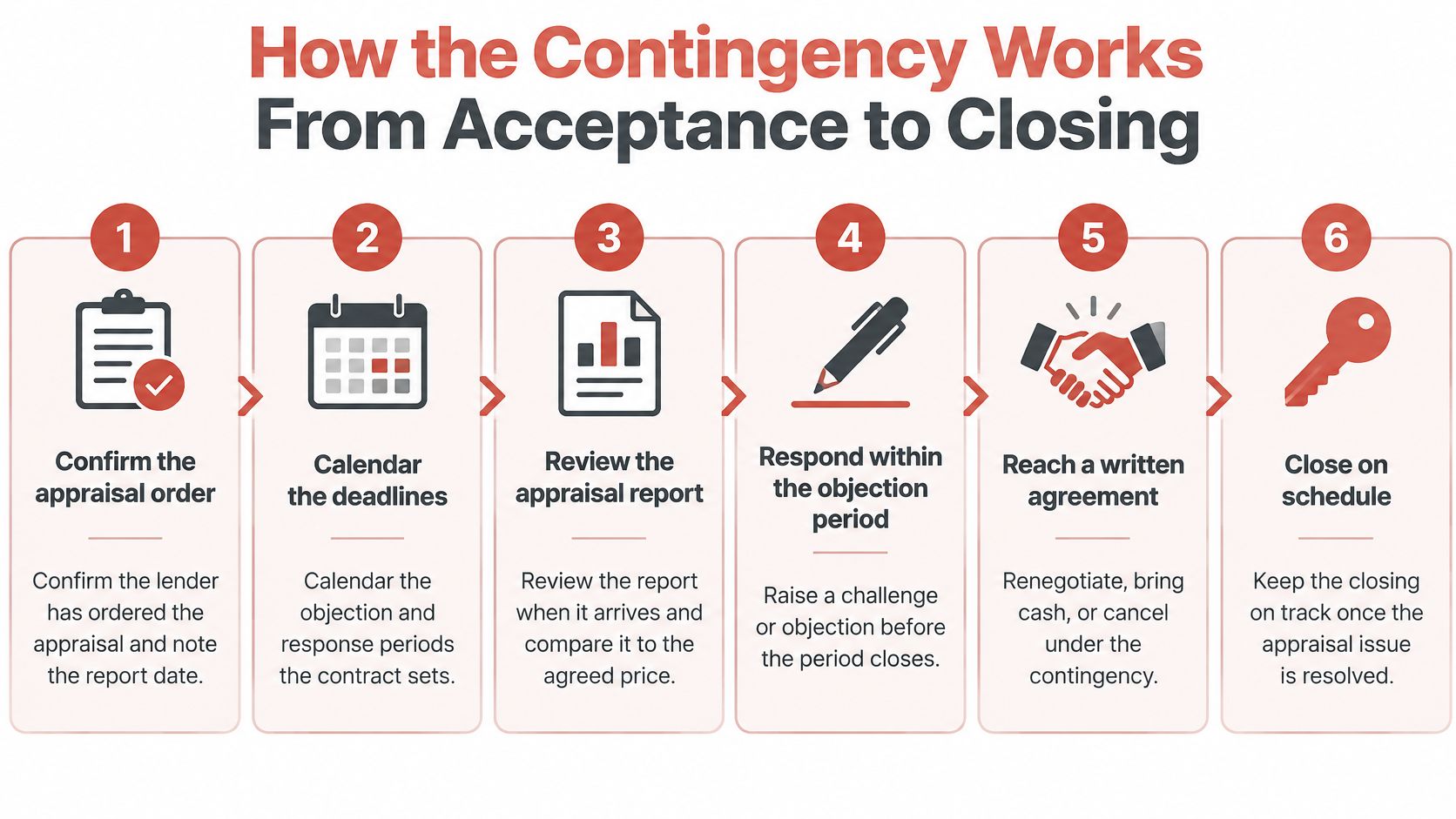
- Confirm the appraisal was ordered and write down the expected report date. If nobody ordered it, the clock still runs.
- Calendar the objection and response dates the same day you learn them. These are the dates that decide whether you keep your remedy.
- Read the report against the contract price as soon as it arrives, not the next week.
- Send written notice before the objection deadline if the value is low, naming the appraised value and the remedy you're choosing.
- Start the reconsideration request with the lender while the response window is still open, not after it closes.
- Get any agreement in writing. A price reduction, a split, or extra cash from you all belong in an amendment signed by both sides.
- Remove the contingency in writing once value and price align, and move to final loan approval.
In Illinois transactions, your final rights depend on the executed purchase form and applicable attorney review, so treat the clause as an enforceable procedure rather than an informal understanding with the other agent. Your closing timeline only holds if these notices land on time, which is why it's worth mapping the sequence against a buying a house timeline before you're under contract.
A missed notice date is how buyers lose the remedy. The clause rarely fails. The calendar does.
Waiving the Contingency and Confirming Terms Before You Sign
Would you still want the house if the appraisal missed your price and the lender would not lend the difference?
In a competitive bidding round, the contingency becomes a bargaining chip, and plenty of buyers spend it. A 2024 report cited by HSH found that 25% of homebuyers waived the appraisal contingency in March 2024, which shows how ordinary the strategy became during tight inventory (HSH on disputing a home appraisal).
Waiving means you agree to fund the gap yourself. The clause is a timed renegotiation or exit procedure, not a guarantee that the house is worth your offer. While the contingency is in place, a low appraisal gives you a deadline to renegotiate, bring cash, or cancel on the written terms. After a waiver, those remedies are gone. The lender still sizes the loan from the appraised value and your loan type. Some programs will not close above that value. Others will close only if you pay the shortfall in cash after approval.
The appraisal system itself got tighter guardrails after the 2008 housing crisis. The Housing and Economic Recovery Act of 2008 added appraiser-independence requirements, and the Dodd-Frank Act later added measures on property inspections, second appraisals in certain circumstances, portability, education standards, and customary fees. Those rules limit pressure on appraisers and inflated collateral values. You cannot bargain the number up by phone, and a waiver does not change the report.
The gap example earlier in this article is the cash to plan for: money you still have to produce even after the loan is approved. Taking it from your down payment can add mortgage insurance and raise the monthly payment. Waiving is a calculated bet when reserves sit well beyond that gap, comparable sales support your price, and the market rewards a clean offer. It is a gamble when savings are thin, the loan program has strict value rules, or the neighborhood has few recent sales to anchor the appraisal.
Before you sign, confirm these terms in the clause itself:
- The appraisal deadline and objection date, written into your calendar.
- The notice method the contract requires, and who must receive it.
- The valuation standard, whether the clause triggers at the contract price or a lower threshold.
- Whether the clause allows cancellation or only renegotiation.
- How earnest money is handled if you terminate.
- A cash reserve sized to a realistic gap, not a best-case one.
- Your lender's position on value for your specific loan type.
Ask one question before the offer deadline: what is the most cash I could need after the appraisal? If the answer makes you uncomfortable, keep the contingency. Carmen works with clients from the first showing through to the closing table. An attorney review of the clause costs far less than a deposit you cannot recover.
If you are weighing an offer in Melrose Park, Elmhurst, Oak Park, or elsewhere in western Chicagoland, you can schedule a consultation with Homes By Carmen and get answers on appraisal gaps, waiver risk, and what your loan type allows. Visit Homes By Carmen to schedule a consultation and get your questions answered before your next offer deadline.