The median home seller in 2025 had owned their property for 11 years, an all-time high, according to the National Association of REALTORS®. That's a long time between sales. The price buyers will pay, the condition they expect, and the paperwork you'll need may look different from when you bought.
If you're searching for how to sell my house in Chicagoland, start with a better question: What will I keep, and what will it take to get there? Choose your selling route, establish a defensible price, and identify necessary preparation before building your net-proceeds budget. Then judge every repair, concession, and offer against that budget, not against an appealing asking price.
Table of Contents
- Choose Between an Agent and Selling Yourself
- Price Your House Against Recent Sales
- How to Prepare Your House Before Listing
- What You Will Keep After Selling
- Handling Offers, Concessions and Price Cuts
- Start With a Free Valuation Before You List
Choose Between an Agent and Selling Yourself
Consider selling yourself only if you have a credible buyer list, time to manage showings, and organized property records. You'll also need to evaluate financing, negotiate inspection requests, and keep contractual deadlines from slipping. Saving a listing commission makes sense only when the saving outweighs your marketing expenses, time, and potential pricing mistakes.
In 2025, 91% of home sellers used an agent or broker, while 5% sold for sale by owner, according to the National Association of REALTORS®. Those figures describe sellers' choices, not a guarantee that hiring an agent produces a better result for every property.
Selling routes compared
| Route | Who Handles Showings and Paperwork | Exposure | Fee Structure |
|---|---|---|---|
| Full-service listing agent | Agent coordinates showings and transaction paperwork; attorney handles legal advice | MLS and major property portals | Negotiated commission |
| For sale by owner | You, with an attorney for legal documents and advice | Portals and yard sign; marketing is on you | No listing commission; you cover marketing costs and any agreed buyer-agent compensation |
| Pocket or off-market listing | Agent, with attorney support | Private agent network before MLS | Negotiated; confirm terms in writing |
Match the route to the work
A full-service agent should do more than upload photographs. Expect a pricing explanation, accurate listing information, a showing process, buyer follow-up, offer comparisons, and transaction oversight. Our guide to what a real estate agent does for a seller helps you turn those responsibilities into interview questions.
An off-market sale deserves consideration when an agent can identify a qualified buyer, not merely promise access to a private network. You may gain privacy and avoid repeated showings, but you'll give up broad exposure and the chance to compare competing offers. Confirm marketing restrictions and the path to a public listing before signing.

Test the agent's plan
Ask how the agent follows up with buyer inquiries and agents who tour the property. For a practical reference on structuring those conversations, Dial Milo's real estate calling scripts can help you recognize the difference between purposeful questions and a generic sales pitch.
I'd lean toward representation when a house is inherited, substantially dated, occupied by tenants, or tied to a hard moving deadline. Those situations add coordination work that doesn't disappear because you skip the listing commission.
Interview question: What happens immediately after launch, who follows up with interested buyers, and what would make you change the strategy?
Price Your House Against Recent Sales
Build the price from closed comparable sales, then test it against what buyers can purchase today. Start with properties on the same block or in the same neighborhood, matching house type, size, age, bedroom and bathroom count, condition, and useful features. Expand the search only when nearby sales don't provide enough relevant comparisons.
Next, adjust for meaningful differences. A finished basement isn't equivalent to unfinished storage, and a renovated kitchen shouldn't be treated like an original kitchen because both houses have similar square footage. Our explanation of a comparative market analysis shows why selecting the right comparisons matters more than averaging nearby asking prices.
Finally, inspect current competing listings. Closed sales show what buyers agreed to pay; active listings show the alternatives they'll compare with yours. A Melrose Park bungalow and a Naperville colonial don't belong under the same broad Chicagoland average.
Separate market value from your preferred number
Your original purchase price tells you what you paid, not what a buyer should pay now. An online estimate can be a starting reference, but it doesn't replace a condition assessment or explain how a busy street, awkward addition, or recently updated mechanical system affects the comparison.
The 2025 NAR Profile of Home Buyers and Sellers reported that recent sellers received a median 99% of their final listing price, with a median four weeks on the market. These are national reference points, not promises for a particular suburb or proof that the original asking price was correct.
The distinction between original and final listing price matters. A sale close to a reduced asking price doesn't establish that starting high was successful. Ask your agent to show price changes alongside comparable sales rather than presenting only the final sale-to-list relationship.
Understand the cost of an unsupported price
Zillow's analysis of overpricing found that homes selling soon after listing closed roughly 1% below list price, compared with approximately 5% below after about two months and 12% below for homes averaging 11 months on the market.
Price gap by time on market
| Time on Market | Typical Sale Price vs List | What It Signals |
|---|---|---|
| Sold soon after listing | About 1% below list | Pricing and presentation may align with buyer expectations |
| About two months | About 5% below list | Price or presentation deserves review |
| About 11 months | About 12% below list | Investigate overpricing, condition barriers, and market mismatch |
These relationships don't prove that time alone caused the discount. They do make a practical case against defending a price that buyers consistently reject.
Before launching, agree on a price-review trigger tied to showing activity, direct competition, and buyer feedback. Don't wait until frustration determines the decision. The strongest asking price is defensible enough to create qualified buyer urgency, not merely high enough to please the seller.
How to Prepare Your House Before Listing
Prepare the house to remove buyer uncertainty, not to win a renovation contest. Separate safety and condition problems from cosmetic preferences, then get written estimates before authorizing work. A dated but clean kitchen calls for a different decision than an active leak beneath its sink.
The preparation checklist should cover documents as well as appearance.
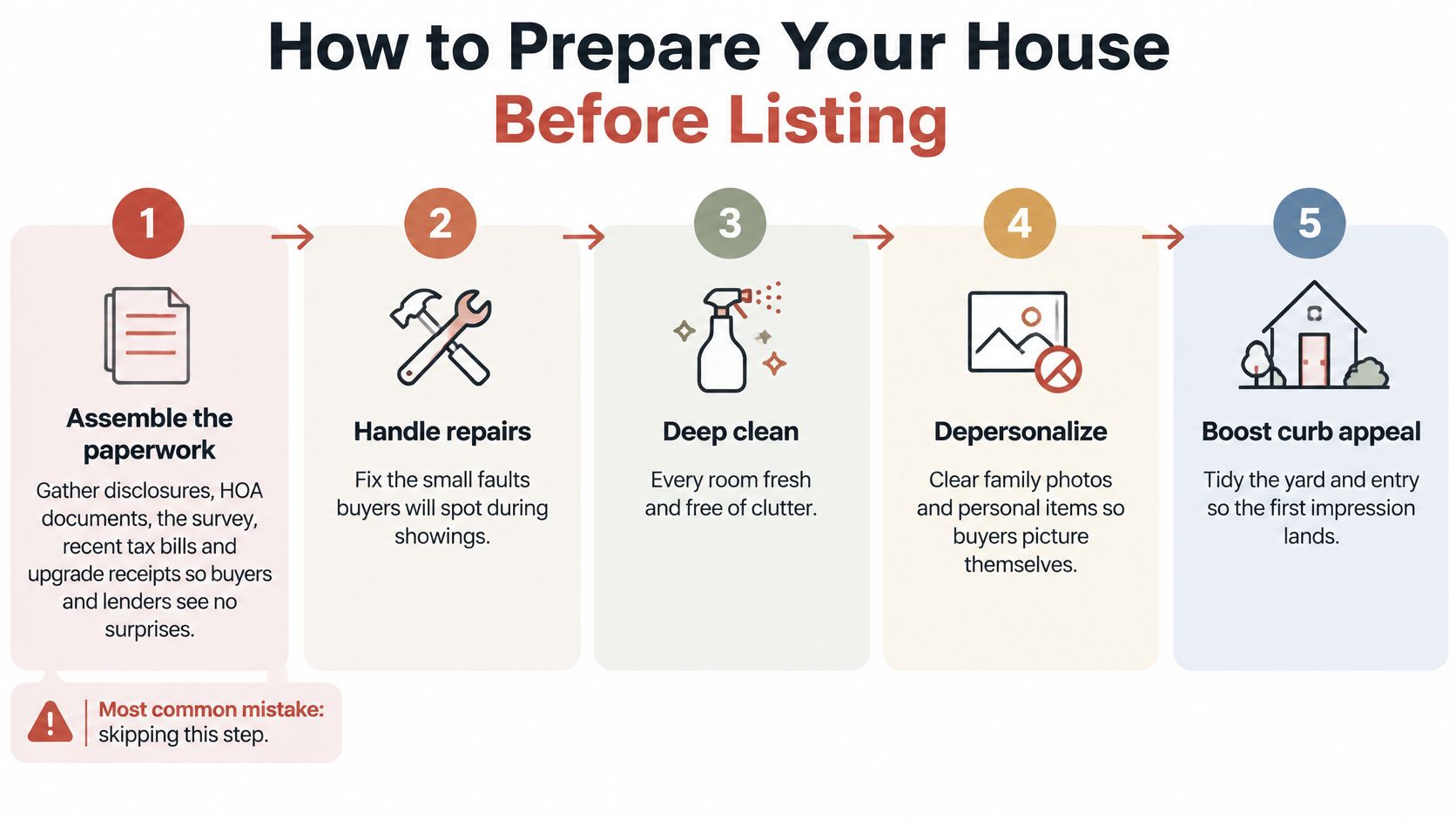
Work through the house in this order
Assemble the paperwork. Gather disclosure information, association documents if applicable, an existing survey, recent property tax bills, warranties, and upgrade receipts; have your attorney identify missing or outdated items. The common mistake is waiting for a buyer to request documents before discovering that an association or outside office must supply them.
Address financing and inspection obstacles. Have qualified contractors evaluate active leaks, roof damage, failing sump pumps, electrical hazards, and missing or nonworking smoke and carbon monoxide alarms. Don't cover staining or repaint around moisture without diagnosing the source, and don't assume selling as-is removes disclosure responsibilities.
Approve cosmetic work by likely payback. Begin with deep cleaning, targeted paint touch-ups, working light fixtures, and a tidy entry before considering substantial remodeling. The expensive mistake is repainting every room or replacing a serviceable kitchen without evidence that comparable buyers will pay enough to justify it.
Make the rooms easy to understand. Remove furniture that obstructs walking paths, pack seasonal belongings, clear countertops, and organize the garage so buyers can assess usable space. Avoid emptying rooms so aggressively that buyers can't understand their purpose or judge furniture placement.
Document improvements accurately. Match receipts and dated photographs to major replacements, repairs, and upgrades, and distinguish cosmetic updates from mechanical work. Don't describe a system as new when you can't substantiate its age, or imply that finished work was permitted without confirming the records.
Book photography and establish launch readiness. Arrange professional photographs and a floor plan after the house is cleaned and arranged, then choose a launch date that accommodates local competition and your showing availability. A common slip is photographing unfinished preparation and assuming replacement images will solve a weak first impression.
Decide what not to do
An older home doesn't need to look newly built to sell. Buyers need a clear picture of its condition, a sensible price, and enough access to evaluate it. For an inherited house, that may mean obtaining contractor assessments and clearing access rather than installing fashionable finishes.
Preparation rule: Fix uncertainty before decorating around it.
Keep a separate list of optional projects with a written scope and estimate. That prevents a modest preparation plan from expanding into a renovation you can't recover at closing.
Before the listing goes live, confirm that photographs are approved, required disclosures are ready, room details are accurate, and showing instructions address pets, keys, alarms, and occupied spaces. The house should be ready when the first buyer asks to visit, not after an inquiry arrives.
What You Will Keep After Selling
Your sale price isn't your take-home amount. Start with a realistic sale-price range and actual repair estimates, then subtract transaction costs, debt payoffs, and moving expenses. Keep optional preparation separate from costs you'll owe regardless of how attractive the listing looks.
Ask for an itemized seller net sheet rather than a verbal estimate. The survey summary published by Real Estate News reports that U.S. sellers who listed within the previous three years spent an average $81,918, versus an expected $26,883, with repairs and renovations averaging $27,649. Those survey averages aren't a budget for your house; use signed agreements, contractor quotes, current bills, and closing estimates instead.
Build the worksheet from documented amounts
Typical seller costs and what changes them
| Cost | How It Is Calculated | Typical Range | What Changes It |
|---|---|---|---|
| Listing and buyer-agent commissions | Apply each agreed fee or percentage to the final sale price | Use negotiated written amounts; no assumed combined rate | Listing agreement and any buyer-agent payment you authorize |
| Repairs and renovations | Add approved contractor estimates | From no optional work to the quoted project total | Condition, scope, and lender or negotiated repair requirements |
| Concessions and credits | Subtract the credit agreed in the contract | From no credit to the permitted, negotiated amount | Buyer financing, appraisal, and contract terms |
| Illinois, Cook County and Chicago transfer taxes | Apply applicable state, county, and municipal charges and seller allocation | Obtain an address-specific closing estimate | Municipality, sale price, exemptions, and allocation rules |
| Title insurance and attorney fees | Add title charges and the attorney's quoted fee | Use written transaction-specific quotes | Services, title issues, and providers selected |
| Prorated property taxes and carrying costs | Apply contractual tax prorations; add ongoing ownership expenses through closing | Use current bills and the expected closing date | Tax agreement, ownership expenses, and time until closing |
Chicago charges shouldn't automatically appear on a suburban seller's worksheet. Have the closing team confirm the municipality, applicable charges, and who pays each item.
Add mortgage and other lien payoffs, inspections you commission, moving and storage, and any separate tax advice your circumstances require. Don't count mortgage principal twice when projecting both monthly payments and the eventual payoff.
Compare choices by net proceeds
Use this calculation for each realistic selling scenario:
Estimated net proceeds = expected sale price − transaction expenses − preparation costs − credits − debt payoffs − moving and holding expenses.
Compare a prepared retail sale with an as-is sale and a sale using a targeted repair credit. Use the same accounting categories so a higher headline offer doesn't conceal larger expenses.
Say a kitchen project would cost more than the additional sale proceeds supported by comparable homes. Selling the existing kitchen clean and functional may leave you better off. Likewise, accepting a lower offer can be sensible when it removes costly work or provides a move-out arrangement you need.
A repair earns its place in the budget only when its expected financial or practical benefit justifies its cost.
Handling Offers, Concessions and Price Cuts
Don't defend the asking price just because you approved it. If early showing activity is weak, investigate pricing and presentation before spending more on promotion. Once an offer arrives, compare the buyer's financing, contingencies, requested credits, closing schedule, and possession terms alongside the price.
Concessions aren't automatically evidence that a seller negotiated poorly. Redfin's analysis of buyer and seller conditions reported that 44.4% of sales included concessions, such as closing-cost assistance or mortgage-rate buydowns. The useful question is whether a particular concession helps complete a sound transaction at an acceptable net.
Reading listing signals
| Signal | Likely Cause | Next Action |
|---|---|---|
| Many online views, few showings | Price or photos | Check photographs, access restrictions, and pricing against verified comparables |
| Showings but no offers | Condition or layout | Review repeated feedback; address the named issue or consider a credit |
| Offers stall at financing | Possible closing-cash shortage or another loan problem | Confirm the lender's actual obstacle before proposing a permitted credit |
| Listing past 60 days with no offers | Possible price or market mismatch | Reassess comparables and presentation; consider a pause and relaunch only with a substantive change |
Match the concession to the obstacle
A buyer short of closing cash may benefit more from an allowable closing-cost credit than from a lower purchase price. But a credit won't repair inadequate income, resolve an unacceptable property condition, or automatically satisfy underwriting. Have the lender confirm what's permitted before you negotiate around it.
Our explanation of seller concessions helps distinguish a closing-cost contribution from a repair agreement or price reduction. Record the agreement correctly rather than relying on an informal promise.
A price adjustment serves a different purpose. If comparable homes offer better condition or more space at the same asking price, a credit discussed only after a showing won't necessarily bring buyers through the door. Correct the public-facing price when the competitive comparison is the problem.
Resolve the actual reason buyers hesitate
Consider a condo where the buyer is waiting for association documents. A price cut won't produce the missing information; obtain the documents and confirm whether the lender has additional association-review requirements.
For a single-family home where buyers repeatedly question basement moisture, get an appropriate assessment and written scope. Then compare completing the repair with disclosing the findings and negotiating an acceptable alternative. Cosmetic staging won't resolve a buyer's concern about water entry.
A relaunch should follow meaningful changes, such as corrected pricing, completed work, or materially better presentation. Confirm listing rules with the agent, and don't assume withdrawing and reposting erases the property's history.
The cheapest concession is the one you make before the listing goes stale.
Start With a Free Valuation Before You List
Request a free expert home valuation and strategy call from Homes By Carmen before committing to repairs or a listing price. Bring your property address, repair list, disclosure and tax paperwork, upgrade receipts, and target move-out date. Ask for a comparable-sales price range and net-proceeds estimates at different price points so you can evaluate the trade-offs.
The point isn't to select the most flattering estimate. It's to connect your house's condition, likely buyer pool, and moving schedule to a plan you can afford. An honest discussion may support light preparation, an as-is strategy, or postponing optional work.
Know what happens after acceptance
The contract and financing determine the exact order and deadlines, but expect these milestones:
- Accepted offer and earnest money. Confirm the deposit instructions, contractual deadlines, and everyone responsible for the next steps.
- Inspection and negotiation. Resolve agreed repairs or credits in writing, with attention to applicable review periods.
- Appraisal and financing. If required, the lender orders an appraisal and completes underwriting; address any valuation or property-condition issue promptly.
- Attorney and title work. Coordinate legal review, title clearance, payoff information, and outstanding liens. Some of this happens alongside inspections and financing.
- Final walkthrough. Arrange access near closing so the buyer can check the property's condition and agreed work.
- Closing and possession. Review the settlement statement, sign the required documents, and transfer possession according to the funded transaction and contract terms.
Carmen works with clients from the first showing through to the closing table. Ask us to coordinate those milestones around your move rather than treating the accepted offer as the finish line.
This week, pull your disclosure paperwork, match repair candidates to what comparable homes justify, and compare net proceeds at different realistic sale prices. Those actions will tell you more than choosing an aspirational asking price.
Homes By Carmen offers a free expert home valuation and strategy call to help you connect pricing, preparation, and what you'll keep after selling. Visit Homes By Carmen and select Schedule A Call to discuss your property, repair priorities, and target move-out date.