
A seller concession is a seller funded credit toward the buyer's eligible closing costs, written into the purchase contract and shown on the Closing Disclosure. It isn't cash handed to you and it isn't the same as cutting the price.
You're likely staring at an offer worksheet right now, trying to decide whether to ask for a lower price or help with fees. You've saved for a down payment, then appraisal, title and lender charges pile on top. That's where this tool fits, and where buyers most often misjudge what it can pay.
Table of Contents
- What a Seller Concession Is and Why It Matters
- Common Concession Types and What Each Pays For
- When a Concession Exceeds Your Eligible Costs
- What a Concession Does to Buyer Cash and Seller Net Proceeds
- How a Concession Moves From Offer to Closing
- Concession Rates and Negotiating in Chicago Suburbs
- Contract Language and Pre-Offer Checks
What a Seller Concession Is and Why It Matters
Think of what is a seller concession like a store coupon for the fees on your bill. It doesn't change the sticker price on the shelf. It pays specific charges at checkout.
The Consumer Financial Protection Bureau guide to loan costs explains that eligible costs can include loan related charges, appraisal fees, credit report fees and title insurance, plus other expenses tied to getting a mortgage and transferring ownership. The credit must be written into the purchase contract and appears as a Seller Credit or as Seller Paid line items.
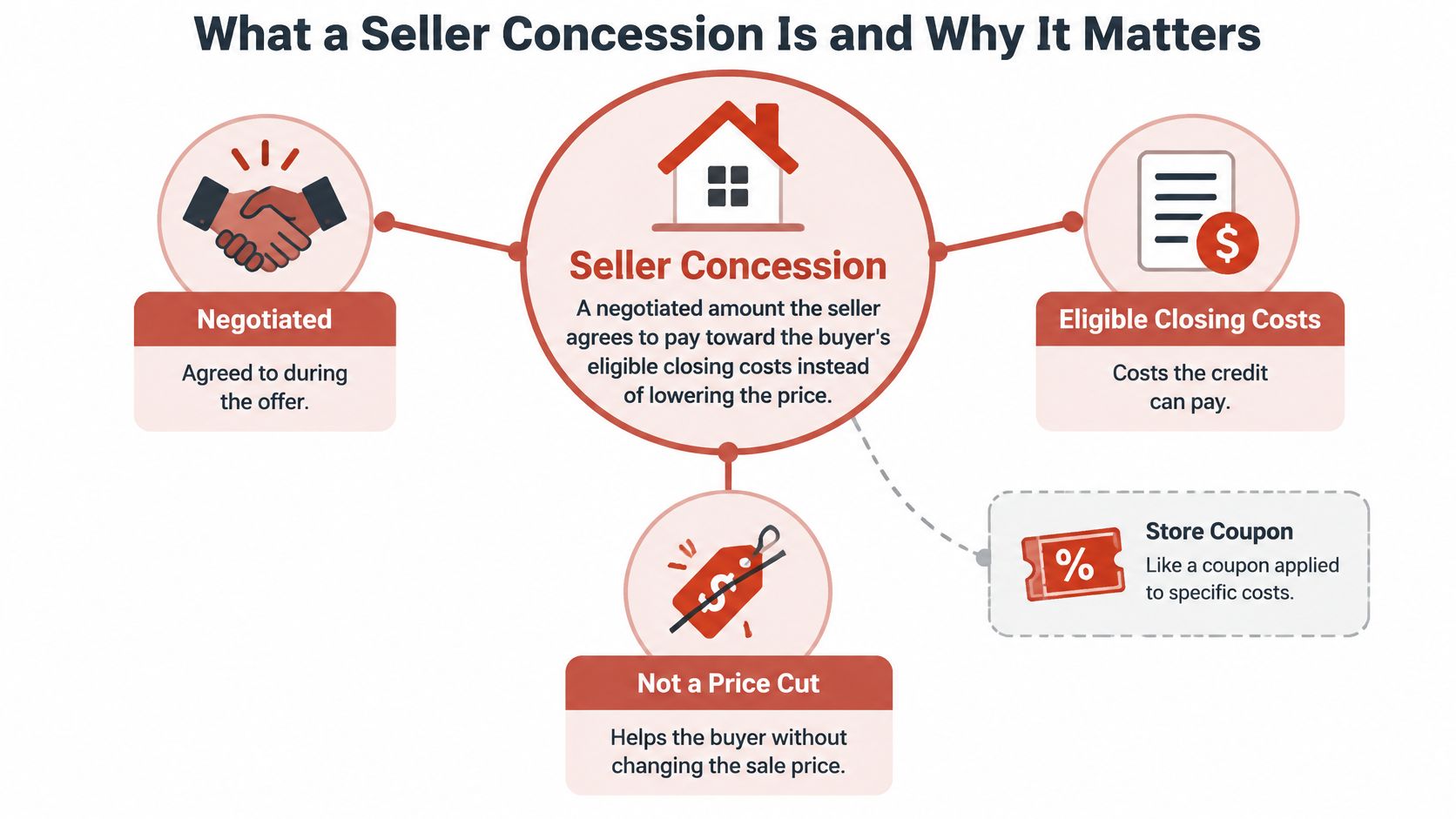
Say a home sells for $200,000 and the seller contributes $4,000, equal to 2% of the purchase price, toward your closing costs. You bring $4,000 less cash to closing. That helps if you're qualified on payment but tight on upfront cash.
The caveat matters just as much. Sellers often require a higher price when they grant a credit, so a seller who might have accepted $196,000 may hold at $200,000 with $4,000 back. If you finance that higher price, you're paying interest on the concession over time. It's a financing tool, not free money, and your lender must approve the amount.
Seller concession vs price reduction vs lender credit
| Feature | Seller concession | Price reduction | Lender credit |
|---|---|---|---|
| Who funds it | Seller | Seller | Lender |
| Where it appears | Seller credit or seller paid lines on the Closing Disclosure | Lower purchase price in the contract | Lender credit on the Closing Disclosure |
| What it covers | Buyer's eligible closing costs | Price for everyone, including the appraisal basis | Closing costs, paid through a higher rate or loan balance |
| Effect on cash at closing | Reduces the cash buyer brings | Reduces the loan amount and cash if financed | Reduces cash now, adds cost over the loan |
Common Concession Types and What Each Pays For
| Type | What It Pays For | Example | Trade-off |
|---|---|---|---|
| Closing-cost credit | Lender fees, title charges, appraisal, prepaid taxes or insurance | $4,000 on a $200,000 home (2%) | Capped at eligible closing costs |
| Repair credit | Fixing defects found during inspection | $1,200 toward a failing water heater | Buyer manages the work and any cost overrun |
| Rate buydown | Lower interest rate for a set period | 2-1 buydown, 2 points lower in year one, 1 point lower in year two | Payment returns to the note rate after the buydown period |
| Discount points | Lower note rate for the life of the loan | One point on a $200,000 loan costs $2,000 | Pays off only if you keep the loan long enough |
A closing cost credit is the most direct option. It pays bills you'd otherwise bring as cash, which is why buyers short at closing usually benefit most from it.
A repair credit works differently. Say inspection finds a failing water heater and the seller credits $1,200 instead of replacing it. You choose the contractor and timing, but you also absorb the risk if the final bill runs higher than the estimate. Get a written quote before you accept a number.
Temporary relief versus a permanent rate cut
A 2-1 buydown lowers your rate by 2 percentage points in year one and 1 point in year two, then it returns to the note rate. That eases early payments when moving costs hit, but you must qualify and budget for the full payment later.
Discount points move the other way. One point equals 1% of the loan amount, so one point on a $200,000 loan costs $2,000 and lowers the rate for the life of the loan. It only pays off if you keep the loan past the breakeven point. Divide the point cost by the monthly savings to find that month.
Don't confuse any of these credits with how your agent is paid. Our guide to buyer agent compensation explains that separate line item, so you don't double count it as a concession.
Choose based on your constraint. Cash short today points to a closing cost credit. Payment short for years points to points, if you'll stay long enough.
When a Concession Exceeds Your Eligible Costs
A negotiated credit can be larger than the costs it's allowed to pay. That's the gap many buyers discover too late.
The CFPB explanation of the mortgage closing process notes that concessions are limited by your mortgage program and can't generally exceed eligible closing costs, with seller paid charges separately identified on disclosures. In its example, a $6,000 concession on a $300,000 purchase equals 2%, but if eligible costs total only $4,500, the remaining $1,500 generally cannot be used as extra proceeds.
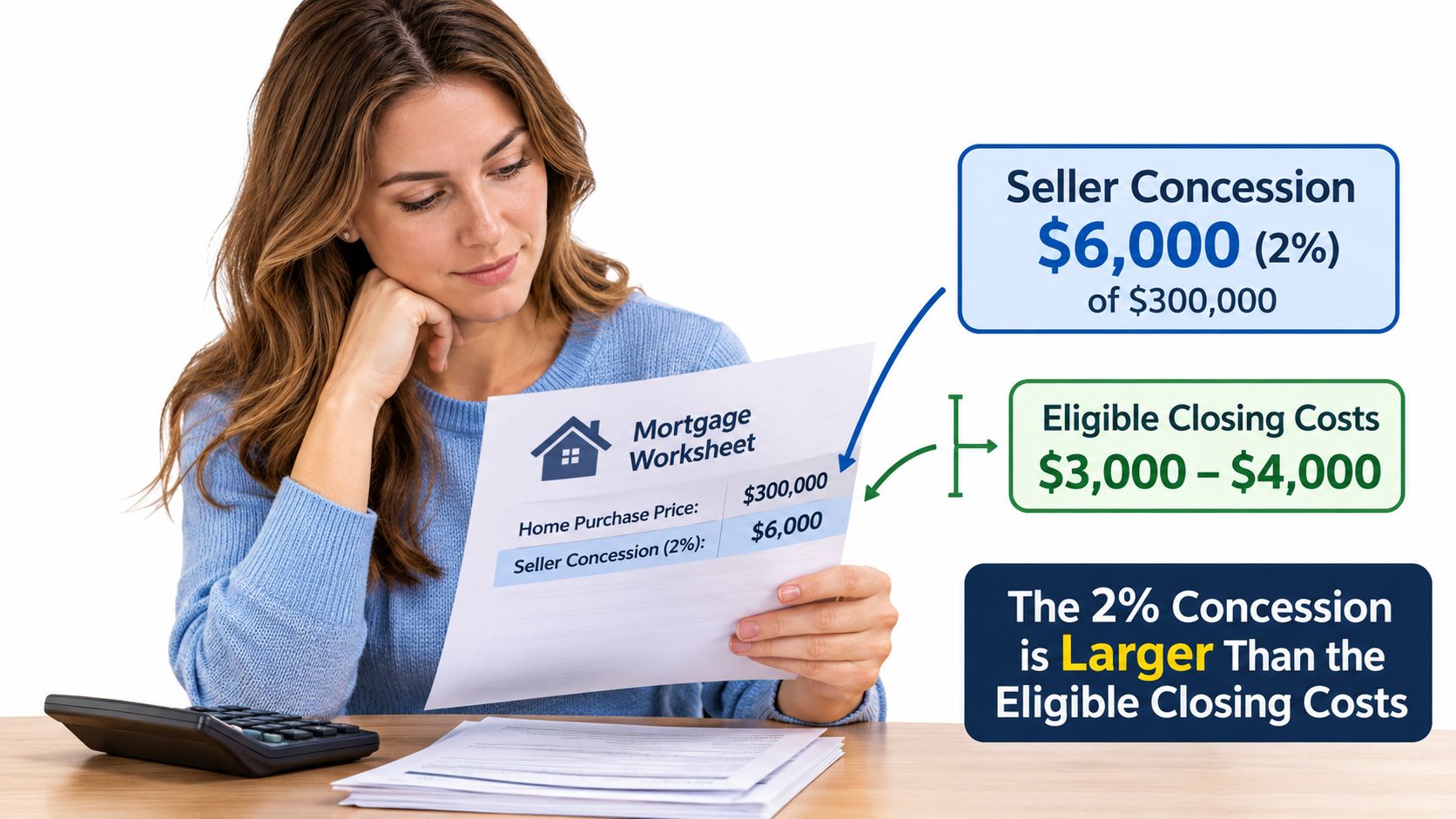
Eligible items typically include lender charges, prepaid taxes or insurance, title services and other permitted settlement expenses. Unused credit normally can't be converted into cash paid to you. Our breakdown of what closing costs include when buying a home helps you list those items before you pick a credit amount.
How a credit larger than eligible costs is handled
| Scenario | Seller Credit | Eligible Costs | Usable at Closing | Unused Amount |
|---|---|---|---|---|
| Credit matches costs | $4,000 | $4,000 | $4,000 | $0 |
| Credit exceeds costs (2% of a $300,000 price) | $6,000 | $4,500 | $4,500 | $1,500, generally not paid as cash |
| Price raised to fund credit | $4,000 on a $200,000 price | $4,000 | $4,000 | $0, but you finance the higher price |
Two fixes prevent waste. Get your lender's written estimate of eligible costs first, then name in the contract where any excess goes, such as discount points or prepaid items, if your program permits it.
What a Concession Does to Buyer Cash and Seller Net Proceeds
Run one example from both sides of the table. Say the price is $200,000, you put $40,000 down and closing costs are $6,000. Without help, you bring $46,000 to closing. A $4,000 seller credit cuts that cash to $42,000. Your down payment doesn't change.
For the seller, that $4,000 comes out of sale proceeds. Before mortgage payoff and commissions, the seller nets $4,000 less than the price. At the same price, that's identical to a $4,000 price cut in net dollars.
Where the two paths split
The split appears when the seller raises the price to fund the credit. A $200,000 price with a $4,000 credit leaves the seller roughly where a $196,000 sale would, though commissions calculated on the higher price can trim net further.
Your loan tells the other half. At 80% financing, a $196,000 price means a $156,800 loan. At $200,000, the loan is $160,000. You finance $3,200 more and pay interest on it for as long as you keep the loan.
- Price cut path: Lower loan, lower appraisal basis, less interest over time.
- Credit path: Same price, less cash due at closing, more borrowed.
Practical rule: Ask your lender to print both versions side by side, monthly payment and total interest, before you choose.
Neither path is automatically better. A buyer who needs cash reserves for moving or repairs may accept more interest. A buyer with ample cash usually gains more from the lower loan.
How a Concession Moves From Offer to Closing
The concession travels through paperwork, so knowing the path prevents surprises. Each document must show the same figure, or underwriting pauses to reconcile it.
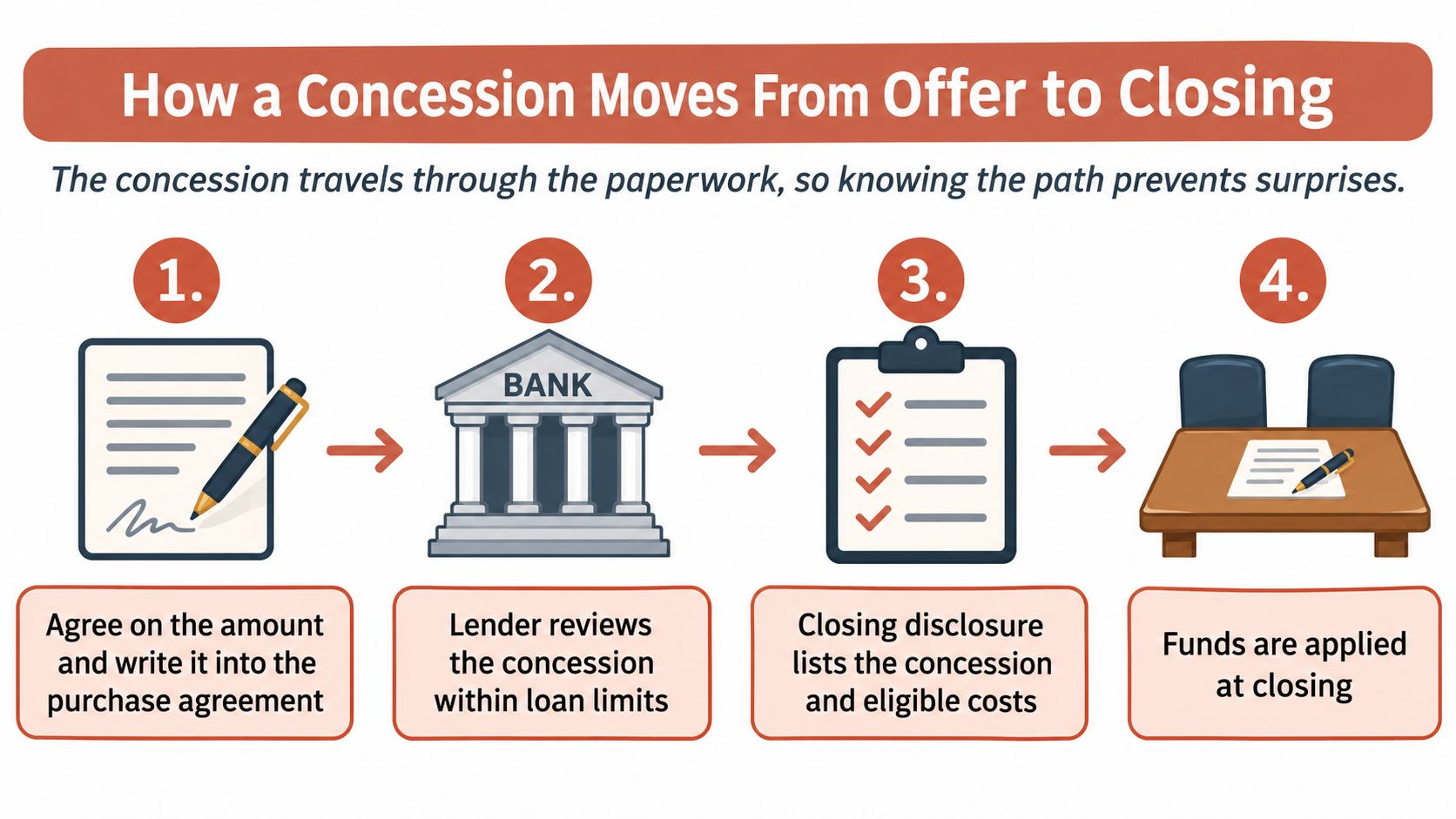
- Agree on the amount and write it into the contract. State it as a seller credit toward eligible closing costs, not as vague help. A contract that says credit with no cost list invites delays.
- Get your lender's written estimate. Match the dollar figure to costs you can use. Guessing high creates unused credit.
- Send the contract to your lender for approval. The lender checks the amount against loan program limits. Don't assume a signed contract means the loan allows it.
- Keep the figure consistent through appraisal and underwriting. The contract, lender disclosures and settlement statement should align. Flag any change in price or terms immediately, since it can affect value and loan to value.
- Check the Closing Disclosure. Look for the seller credit or seller paid line items and confirm they match the contract. Compare line by line, not just the total.
- Apply the credit at closing. The amount offsets listed costs and reduces the cash you bring. Bring funds by the method your closer specifies and keep the disclosure for your records.
Carmen works with clients from the first showing through to the closing table, which helps keep these handoffs coordinated between agent, lender and closer.
What a clean file looks like
- Contract: Dollar amount and permitted uses are spelled out.
- Lender estimate: Eligible costs equal or exceed the credit.
- Closing Disclosure: Seller credit matches both earlier documents.
If one number differs, ask why before you sign. Small mismatches are easiest to fix before closing day.
Concession Rates and Negotiating in Chicago Suburbs
National numbers set context, not your negotiating range. The Redfin analysis of seller concessions in March 2025 reported that sellers provided concessions in 44.4% of U.S. home-sale transactions in the first quarter of 2025, up from 39.3% in the first quarter of 2024, defining concessions as repair credits, closing cost assistance or mortgage rate buydowns.
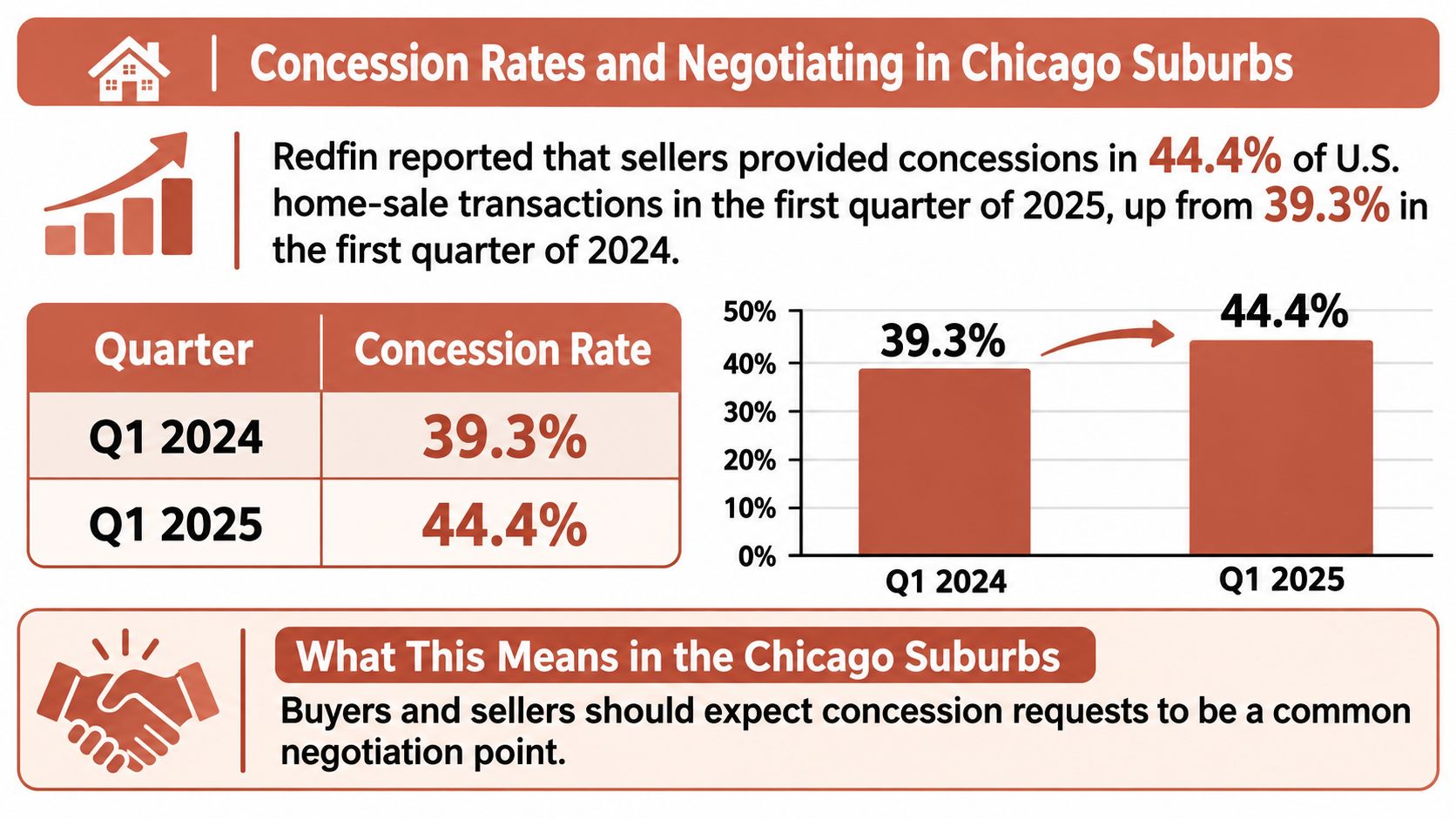
Local gaps are wide. Inman reporting on the Redfin analysis noted that only 5.5% of New York home-sale transactions included seller concessions in the first quarter of 2025. By contrast, The Atlanta Journal-Constitution reporting Redfin data reported that 62% of metro Atlanta home sales included seller concessions in that quarter.
Share of home sales with seller concessions
| Source and Market | Share Offering a Concession | Period |
|---|---|---|
| Redfin, all U.S. home sales | 39.3% | Q1 2024 |
| Redfin, all U.S. home sales | 44.4% | Q1 2025 |
| Redfin, New York metro | 5.5% | Q1 2025 |
| Redfin, metro Atlanta | 62% | Q1 2025 |
| Chicago suburbs | No published figure in these sources | Check recent local MLS sales |
No Chicago suburb figure is given in those sources, so don't borrow Atlanta or New York as a proxy. Pull recent closed sales in your target town, such as Elmhurst, Downers Grove, Naperville, Oak Park, Glen Ellyn or Melrose Park, through the local MLS and note which show credits.
Carmen Salerno is a REALTOR®, and that local pull is where negotiation starts. Our real estate negotiation tips for buyers cover trading a concession request against price, inspection terms, closing date or rate strategy. Sellers should compare a credit's financing effect with a simple price adjustment.
Contract Language and Pre-Offer Checks
Clear wording prevents a generous sounding credit from shrinking at underwriting. Use this sample as a starting point for attorney review, not as legal advice.
Seller shall credit Buyer $4,000 toward Buyer's eligible closing costs, including lender fees, title charges, and prepaid taxes and insurance, as itemized on the Closing Disclosure. Seller's credit shall not exceed the amount permitted under Buyer's loan program. Any portion not applied to eligible costs shall be applied to discount points or prepaid items only as the parties agree in writing before closing.
Each element does a job. The amount sets the ceiling. The permitted uses stop arguments about what counts. The loan program cap protects approval. The unused funds rule decides the leftover in advance.
The Fannie Mae Selling Guide on interested party contributions states that financing concessions cannot exceed the borrower's closing costs, and excess amounts are treated as sales concessions deducted from the sales price for underwriting. It also directs that loan to value uses the lower of that reduced price or the appraised value.
Checks to finish before the offer goes out
- Dollar amount: No larger than your lender's written estimate, unless excess uses are named.
- Eligible purposes: Closing charges, prepaid items, points or approved buydowns, as your program allows.
- Unused funds: Redirect only as agreed in writing, since excess generally isn't paid as cash.
- Consistency: Contract, lender disclosures, settlement statement and appraisal should match.
Disclose every incentive, whoever offers it. Fannie Mae's May 2025 policy update raised the lender incentive threshold from $500 to $2,500 for eligible arrangements, applying to loans with note dates on or after September 3, 2025, and clarified that cash like benefits from an interested lender can be treated as sales concessions. Who provides a benefit affects how it's classified.
Clients can reach out to schedule a consultation or get answers to their real estate questions before submitting. Have a real estate attorney review your final clause and confirm all three documents show the same number.
If you're weighing a credit against a price cut on a home in Melrose Park or the western Chicago suburbs, we can pull recent local sales, coordinate with your lender on eligible costs and draft offer language that holds up through closing. Visit Homes By Carmen to schedule a consultation and run your numbers before you write the offer.