
Private mortgage insurance (PMI) protects the lender, not the borrower, when a conventional loan has less than 20% down, and it's usually paid through the monthly mortgage payment. So if you're paying for insurance that doesn't protect you, why would accepting it ever be the smarter move than waiting until you've saved more?
That's the question most buyers in Melrose Park and the western suburbs overlook. They treat PMI as a penalty to avoid at any cost, then spend years renting while prices move and savings crawl. Sometimes waiting is right. Sometimes paying PMI for a limited stretch costs less than delaying the purchase. You can't tell which is true until you know what PMI on a mortgage covers, what it costs on your loan size, and exactly when it ends.
Table of Contents
- What PMI Protects and Why Lenders Require It
- Calculating Your PMI Cost by Loan Size
- How PMI Changes Your Chicago Monthly Payment
- Piggyback, Lender-Paid and VA Loan Alternatives to PMI
- How to Remove PMI and Why Appreciation Does Not End It
- Decide Whether Paying PMI Makes Sense for You
What PMI Protects and Why Lenders Require It
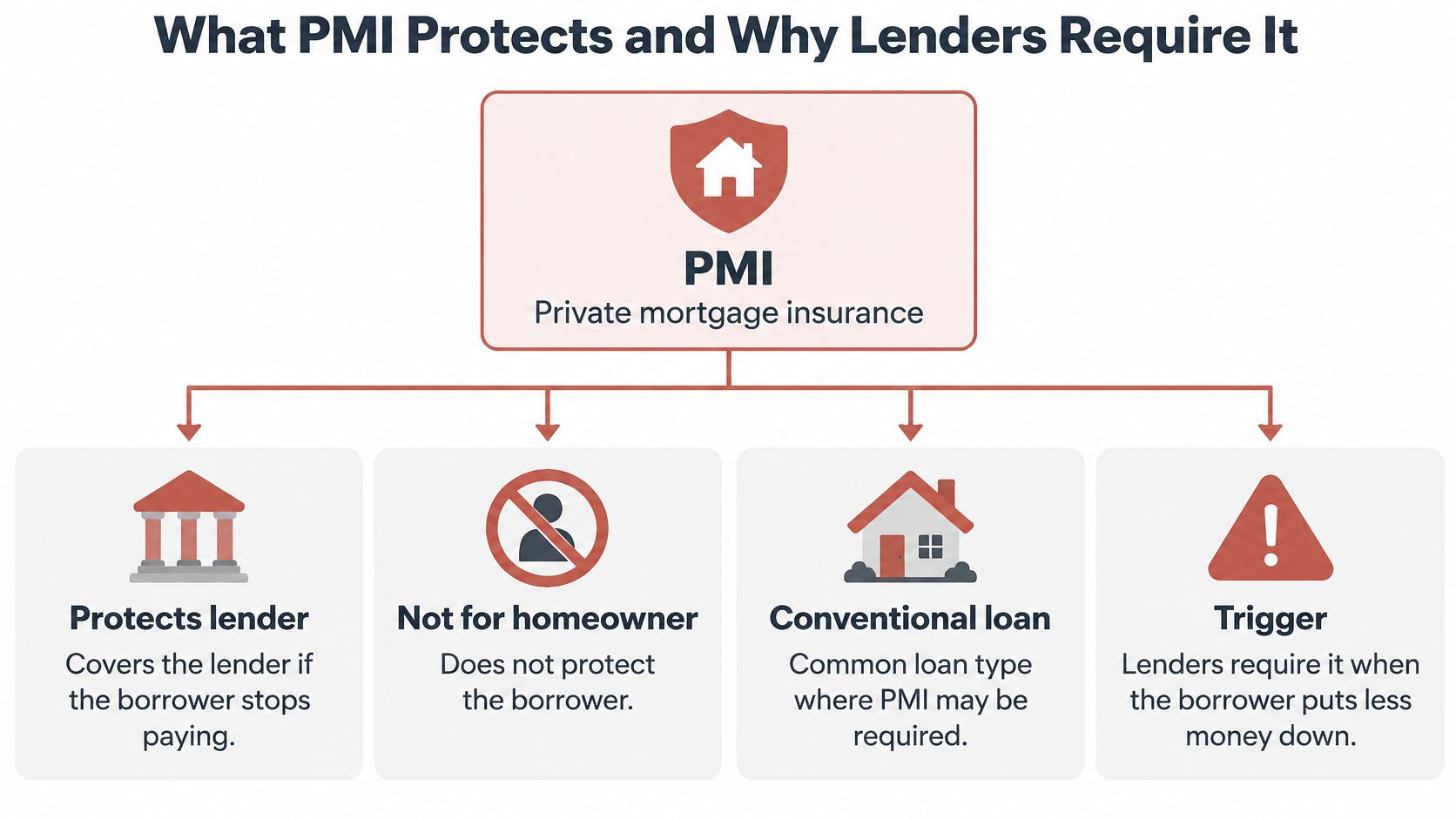
Say a couple in a Chicago suburb buys a $300,000 home with 10% down. They bring $30,000, borrow $270,000, and start with a 90% loan-to-value ratio, or LTV. The Consumer Financial Protection Bureau explanation of private mortgage insurance sets out that same example, and it defines PMI as insurance that protects the lender, not the homeowner, when a borrower defaults on a conventional mortgage.
Look at it from the lender's side. With only $30,000 of borrower equity in the property, a foreclosure sale that nets less than expected can leave the lender short. PMI reduces that loss exposure. That's why lenders commonly require it when the down payment is below 20%, which means LTV starts above 80%.
How you'll usually pay it
Most buyers pay PMI as a line added to the monthly mortgage payment. Two other structures exist. You can pay an upfront premium at closing, or the lender can cover the premium in a lender-paid arrangement and charge a higher interest rate instead. There's no single universal percentage, because cost depends on loan size, credit history, down payment, and insurer pricing.
You pay the premium. The lender holds the protection. Your benefit is earlier access to the loan, not coverage for yourself.
Three insurances buyers mix up
PMI is not homeowners insurance, and it isn't the mortgage insurance on an FHA loan. Homeowners insurance covers property risks such as fire or theft. FHA insurance is formally called mortgage insurance premium (MIP) and follows different rules, including how and whether it ends.
| Insurance | Who it protects | When it applies | How it is paid |
|---|---|---|---|
| Private mortgage insurance (PMI) | Lender | Conventional loan with LTV above 80% | Usually monthly, or upfront or lender-paid |
| Homeowners insurance | Homeowner's property | Nearly every mortgage on a home | Annual premium, often held in escrow |
| FHA mortgage insurance premium (MIP) | Lender on FHA-insured loan | FHA loans regardless of down payment size | Upfront premium plus annual premium paid monthly |
The trade-off is plain. PMI makes ownership possible with less than 20% down, but it raises your recurring monthly cost until cancellation or termination rules are met. Whether that trade is worth it depends on the size of that monthly cost, which you can estimate before any lender quotes you.
Calculating Your PMI Cost by Loan Size
What does this premium add each month, and how does that bill compare with waiting until you have 20% saved?
Many eligible conventional first mortgages need primary mortgage insurance once loan-to-value sits above 80%, unless another qualifying credit enhancement is used. That line is in the Fannie Mae selling guide on provision of mortgage insurance. Under the standard rule, a loan at 80% or below does not carry the premium. Above it, the monthly charge is what you pay for closing with less cash up front.
Estimate it with a planning band of about $30 to $70 per month per $100,000 borrowed. The charge works like a meter on the balance. A bigger loan is not a new kind of fee. The same band runs across more hundreds of thousands.
Divide the loan amount by $100,000. Multiply by $30 for the low end and by $70 for the high end.
The range on common loan sizes
| Loan amount | Low estimate ($30 per $100,000) | High estimate ($70 per $100,000) |
|---|---|---|
| $300,000 | $90 per month | $210 per month |
| $500,000 | $150 per month | $350 per month |
Loan-to-value is the loan divided by the property value used for underwriting. Take a $300,000 loan on a $340,000 home in Berwyn. The price is an example, not a market claim. Divide 300,000 by 340,000 and LTV is about 88%. You are still over the 80% line, so the premium is in the payment. You are not at the thinnest down payment, though, so strong credit often prices nearer the low end of the band. A thinner down payment, or weaker credit, generally prices nearer the top.
What moves you within the range
- Loan-to-value ratio: Less equity means greater lender exposure, so a higher LTV typically means higher pricing or more required coverage.
- Credit score: Stronger credit usually earns a lower premium, weaker credit a higher one.
- Loan type and occupancy: The loan structure and whether you live in the home affect insurer pricing.
- Insurer pricing: Premiums are not identical across insurers, so two lenders can quote different PMI on the same loan.
On that $300,000 loan, $90 to $210 a month is the cost of buying before the down payment reaches 20%. Saving longer can avoid the premium. It can also mean missing the house, or paying more later and giving back what you saved. A rise in value after closing does not turn the premium off by itself. Cancellation still has to meet the loan's own rules, and until it does, the monthly line stays.
Treat the band as a planning range, not a quote. Your real figure appears on the Loan Estimate your lender issues, in the projected payments section. Read that line before you judge affordability by principal and interest alone.
Check the qualifying payment: PMI counts in the monthly payment your lender uses, so it can change your debt-to-income ratio and the price range you qualify for.
If you want to test loan sizes before you talk to a lender, run the numbers with a home loan repayment calculator and enter both ends of the PMI range. Budget against the high end. If the payment still works, a lower actual quote is a pleasant surprise rather than a rescue.
How PMI Changes Your Chicago Monthly Payment
PMI works like a monthly toll for buying before you hold 20% equity. The choice is whether that toll, paid for a few years, costs less than waiting while rent continues and a price you can live with in a west suburb keeps moving.
Take an illustrative $400,000 home in Melrose Park. The price is an example, not a market claim. The 5% case is the $380,000 loan you already priced. The rows below start at the next cash step and use the same $30 to $70 benchmark per $100,000 of loan.
| Down payment | Loan amount | LTV | Estimated monthly PMI |
|---|---|---|---|
| 10% ($40,000) | $360,000 | 90% | $108 to $252 per month |
| 15% ($60,000) | $340,000 | 85% | $102 to $238 per month |
| 20% ($80,000) | $320,000 | 80% | None required under the standard rule |
Each 5% step moves about $20,000 from savings into the house.
At 10% down, the loan is $360,000 and PMI is still a wide band, $108 to $252, because 90% LTV leaves the insurer with real exposure. At 15% down, you are at $340,000 and 85% LTV. The band only eases to $102 to $238, so the monthly drop is modest. What changes more is time: you are closer to 80%, so paying principal down can end PMI sooner. At 20% down, the $320,000 loan sits at 80% LTV and no PMI is required under the standard rule.
A rising value in that suburb does not, by itself, switch the PMI line off. You still pay the premium until the loan meets the cancellation terms on that mortgage.
Putting PMI next to principal and interest
PMI never shows up by itself. Using an illustrative assumption of a 6.5% rate on a 30-year fixed loan, not a quote and not a rate prediction, principal and interest on the $380,000 loan come to roughly $2,402 per month. The PMI on that loan sits on top of that figure.
On the $320,000 loan at the same assumed rate, principal and interest are roughly $2,023 per month, with no PMI line.
Part of the gap is the smaller balance. Part is the missing premium. Taxes and insurance land on both loans. On this same example house, an illustrative escrow of about $480 a month for property taxes and $140 for homeowners insurance adds roughly $620 before any association dues. Leave that out and both payments look cheaper than the check you would write.
The break-even question
Does paying PMI for a few years cost less than waiting to save 20% while your rent continues and prices in your target suburb may rise?
A benchmark table cannot answer that. Ask your lender for side-by-side Loan Estimates at 5%, 10%, 15%, and 20% down. Each should show total cash to close, the full monthly payment with taxes and insurance, the PMI amount, and how long PMI is expected to last. Set those payments next to your rent, and next to how long saving the next $20,000 would take.
Piggyback, Lender-Paid and VA Loan Alternatives to PMI
Three structures remove the PMI line from your payment. None of them removes the cost. Each one moves it somewhere else, and your job is to decide which location suits you.
That framing matters because mortgage insurance isn't rare or marginal. The Urban Institute mortgage insurance data publication reports that mortgage insurance availability has helped more than 40 million borrowers obtain homeownership, and that 60.8% of agency mortgages originated in 2024 had some form of mortgage insurance, including PMI, FHA, or VA coverage. Avoiding PMI is one strategy among several, not a test of whether you're a serious buyer.
| Option | How it works | Monthly effect | Main trade-off |
|---|---|---|---|
| Piggyback loan (80-10-10) | First loan at 80% LTV plus second loan for 10% | No PMI line; second loan payment added | Second loan terms and payment must be checked |
| Lender-paid mortgage insurance | Lender covers the premium in exchange for a higher rate | No separate PMI payment | Higher rate usually lasts unless refinanced |
| VA loan | Government-backed loan for eligible veterans and service members | No PMI | VA funding fee, which can often be financed |
A piggyback loan keeps your first mortgage at exactly 80% LTV, so no PMI applies to it. A second loan covers another 10% and you bring 10% down. You now carry two payments, and the second loan often has different terms, sometimes an adjustable rate or a shorter repayment period. Add both payments together before you compare it with a single loan plus PMI.
Lender-paid mortgage insurance is the quiet option. There's no PMI line, which feels cleaner, but the lender recoups the premium through a higher interest rate. That higher rate usually stays for the life of the loan unless you refinance, while borrower-paid PMI can end. If you expect to stay put for many years without refinancing, that difference can cost more than PMI ever would.
A VA loan carries no PMI at all for eligible veterans and service members. A VA funding fee applies instead, and it can often be financed into the loan rather than paid in cash at closing.
Before you choose, compare four things across every offer you're given.
- Total monthly payment: Include any second loan payment, not just the first mortgage.
- Cash at closing: Count the down payment, closing costs, and any upfront premium or fee.
- How long each cost lasts: PMI can end, a higher rate usually can't without a refinance.
- What changes later: Ask what happens to the rate or second loan if you move, refinance, or pay extra principal.
If you're weighing these structures as a first-time buyer, the guide to the best first-time home buyer mortgage walks through how loan types differ before you commit to one.
How to Remove PMI and Why Appreciation Does Not End It
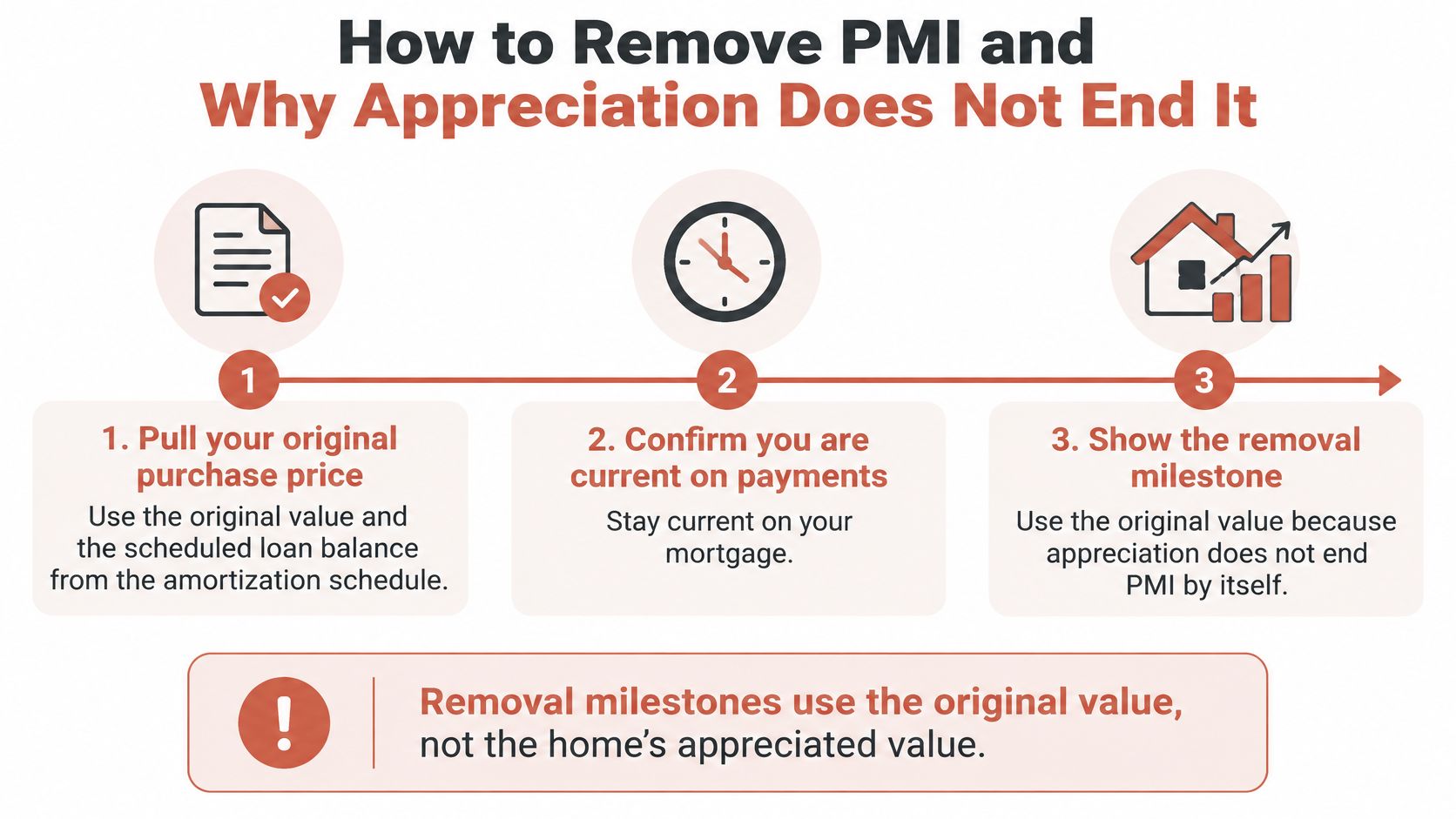
A higher price on the house next door does not cancel PMI. On a conventional loan the premium is temporary, but the dates that end it follow your loan balance measured against the home's original value, the figure used when the loan was made. Prices can climb across a Chicago suburb and still leave the servicer's clock untouched.
The Consumer Financial Protection Bureau guidance on removing PMI explains that a borrower generally may request cancellation when the principal balance is scheduled to reach 80% of the home's original value, and that the servicer must generally terminate PMI automatically when the scheduled balance reaches 78%, if the borrower is current. Original value works like the sticker price on a car loan. The servicer tracks how much of that original figure you still owe, not what a buyer just paid down the block.
The removal steps in order
- Pull your original purchase price and amortization schedule. Both milestones use original value and the scheduled balance. Those two documents are how you calculate the dates before you contact anyone.
- Confirm you're current, with a clean payment history. Late payments can push cancellation back. Servicers check good standing before they look at equity.
- Check for junior liens. A second mortgage or a home equity line sits behind the first loan. Servicers can require that none of those liens remain.
- Watch the 80% date and write to your servicer. Request cancellation in writing once the balance reaches 80% of original value. Extra principal payments move that date earlier, because the balance falls faster than the original schedule.
- Expect a value check. The servicer may require evidence that the property value has not declined. That often means an appraisal or a broker price opinion, and you usually pay for it.
- Know the automatic backstops. If you do nothing and stay current, PMI generally must end at 78% of original value on the scheduled date. A further backstop ends it the month after the midpoint of the amortization schedule, which is year 15 on a 30-year mortgage, even if the balance has not reached 78%.
The Fannie Mae homeowner page on private mortgage insurance lists the conditions a servicer can require for borrower-requested cancellation, including a written request, good payment history, current payments, no junior liens, and evidence that the property's value has not declined. Keep copies of everything you send. A phone conversation does not replace that written file.
Why a rising home value doesn't end it by itself
Owners around Chicago run into this often. Prices in the suburb rise, an online estimate shows a value well above what you paid, and it feels as if the premium should already be gone. The federal 78% automatic termination generally uses the original value, not today's market value. Appreciation is real equity you have built. It does not start that statutory clock.
You can still ask for a review based on current value. Whether the servicer will allow it depends on the investor that owns or guarantees your loan and on that servicer's own rules, which are not the same from one loan to the next. Many of those rules add a professional valuation and a minimum time you must have held the loan. Find the version that applies to you by writing the servicer and asking which investor's guidelines govern the loan, whether current value is accepted at all, and which valuation it wants, plus any waiting period. Approval follows that written answer.
Run the cost before you order anything. A $200 monthly PMI premium is $2,400 per year. If a valuation costs a few hundred dollars and the servicer accepts the higher value, the fee is covered in a couple of months of premiums you stop paying. If the servicer will not use current value, the appraisal is an expense with nothing to offset it. That same monthly figure is also the cost of buying now instead of waiting until you can put 20% down. A few years of it can be smaller than the rent and price increases you absorb while you save, and it ends once the original-value milestones are met.
Ask your servicer in writing which valuation method it accepts and what documentation it requires. An online estimate won't satisfy it.
FHA mortgage insurance does not share those conventional end dates. On many FHA loans the annual premium keeps running for a long stretch, and on some it continues until you refinance or pay the loan off, depending on the original term and how large the loan was relative to value at closing. Put that longer duration next to a few years of cancellable PMI when you compare the monthly cost of buying now with the cost of waiting.
Decide Whether Paying PMI Makes Sense for You
Your decision is straightforward to state. Accept PMI now and buy with less cash down, or wait and save until you reach 20%.
Three criteria settle it for most buyers. First, how long will you stay? PMI for a handful of years in a home you'll keep for a decade is a modest slice of the total cost. PMI on a home you might leave in two years is harder to justify, because buying and selling costs already weigh heavily over a short hold.
Second, how much cash remains after closing? A smaller down payment preserves funds for closing costs, repairs, and an emergency reserve. Draining every account to hit 20% and then facing a furnace failure on a credit card is worse than paying PMI. Third, what's happening to prices and rents in the suburb you're targeting? If rents are climbing and prices are moving while you save, waiting has its own monthly cost, even though no lender itemizes it for you.
Add a fourth check before you commit. Confirm that the PMI line still leaves your debt-to-income ratio within qualifying range and the full payment, taxes and insurance included, within a budget you can hold in a bad month, not just a good one. Our guidance on how to calculate mortgage affordability shows how to test that payment against your income before a lender does it for you.
PMI is usually reasonable when you'll stay several years, you'll keep real reserves after closing, and owning now costs less than continued renting while you save. Waiting fits better when the down payment would empty your accounts or the payment would strain you from the first month. Test your own numbers with the Mortgage Calculator in the Resources section of our website, and read the step-by-step first-time buyer's guide created by Carmen Salerno so the loan conversation starts from your figures, not a lender's pitch.
If you're comparing down payment scenarios on a home in Melrose Park or a nearby western suburb, we can help you run the numbers, interpret Loan Estimates from lenders, and weigh PMI against waiting before you write an offer. Start with the buyer resources and local guidance at Homes By Carmen, then reach out when you're ready to talk through your specific payment, reserves, and timeline.