
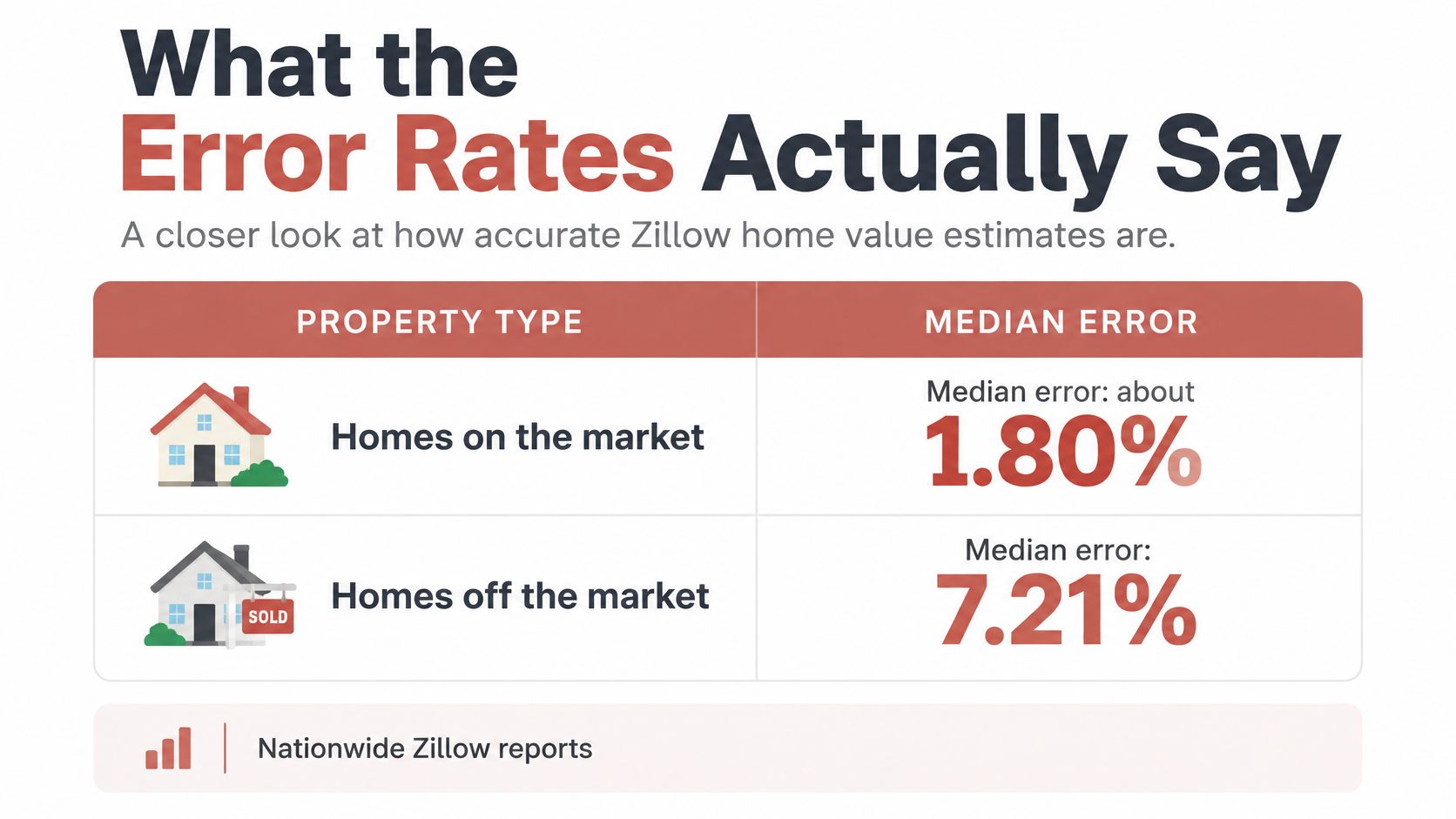
A Zestimate is a reasonable range for a listed home and a weak pricing tool for one that isn't. Zillow's published accuracy data puts the nationwide median error near 1.80 percent for on-market homes and about 7.21 percent off the market, and that split should drive every decision you make with the number.
Searchers asking is Zillow accurate for home values don't need a yes or no. They need to know how many dollars that error could represent on their house, and whether it can safely anchor a list price, an offer, or a decision to wait. In western Chicagoland the answer shifts with listing status, the completeness of the property record, and details no model can walk through: a finished basement, a teardown-quality lot, a school boundary splitting one Melrose Park block from the next. A national median can be right on average and still misprice your bungalow.
Table of Contents
- What the Error Rates Actually Say
- How a Zestimate Gets Its Number
- Zestimate Versus CMA Versus Appraisal
- Why Your House Can Miss the Median
- Where Western Suburbs Break the Model
- How Buyers and Sellers Should Use a Zestimate
What the Error Rates Actually Say
The dollar size of the gap
On a $400,000 home, the medians on the Zillow Zestimate accuracy page translate to about $7,200 for a listed home and about $28,840 for an off-market home. That spread can consume a seller's expected negotiation cushion or leave a buyer short when the appraisal lands.
“Median” means half the estimates land closer than the stated percentage and half land farther away. Your house can sit on the wrong side of that line.
The same published figures break down by month and metro; read the off-market rows as a screen, then price from recorded comparable sales.
| Home status | Median error | Dollar gap | How to read it |
|---|---|---|---|
| Listed and on the market, nationwide | 1.80% | about $7,200 on a $400,000 home | Usable range alongside comparable sales |
| Off the market, nationwide | 7.21% | about $28,840 on a $400,000 home | Too wide to set a price or an offer |
| On the market, July 2025 nationwide | 1.83% | about $7,320 on a $400,000 home | Listed homes stayed near a 2% median |
| Off the market, July 2025 nationwide | 7.01% | about $35,050 on a $500,000 home | Still wide before condition or micro-location |
| Chicago on-market | 2.02% | about $8,080 on a $400,000 home | 82.73% of estimates landed within 5% of sale price and 95.86% within 10% |
Why listed homes score better
A listing feeds the model current information that an off-market record usually lacks. Fresh photos, an asking price, updated room counts, and transaction signals narrow the range. Remove those inputs, and the model leans harder on older public records and nearby sales that may not resemble your house.
Accuracy also varies by location and by the amount and quality of property data available, including square footage, bedrooms, bathrooms, and other characteristics. Two houses can show the same beds and baths on paper while one has a gut rehab, a deeper lot, walkable transit access, and a preferred school boundary. The percentage looks tidy. The houses can sell in different brackets.
A Zestimate can help you spot a broad price range. An off-market figure is a screening tool; the price decision needs an appraisal, a CMA, or recorded comparable sales.
For western Chicagoland, that national median can still misprice one bungalow in Melrose Park when the record misses a finished basement, a teardown lot, or a school boundary drawn mid-block. If your home is listed, typical, and correctly recorded, the estimate deserves a look alongside comparable sales. If it is off-market, inherited, heavily updated, or unusual for the block, treat the number as a screen and price from MRED comparables and property-specific evidence.
How a Zestimate Gets Its Number
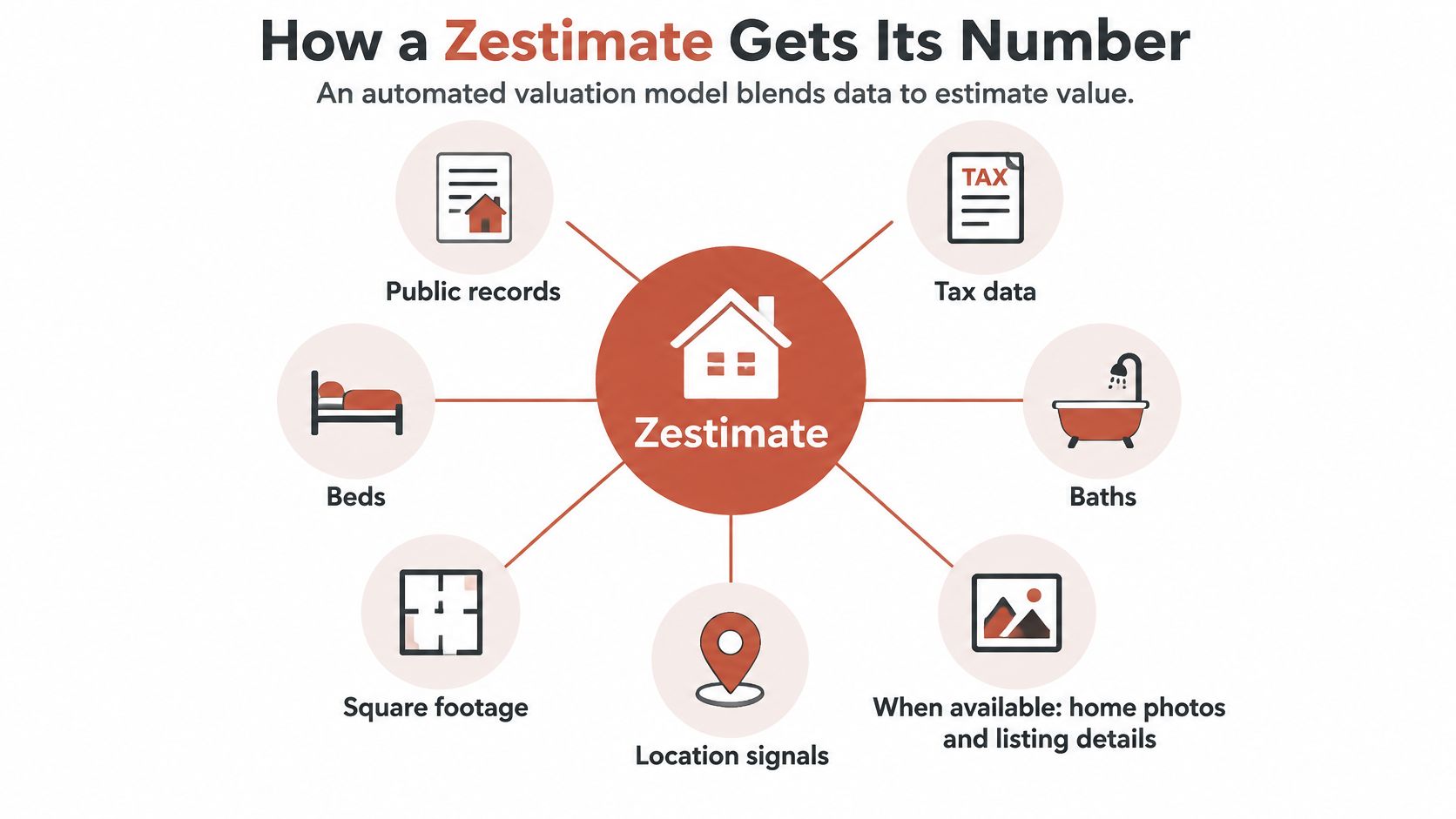
A Zestimate comes from an automated valuation model, or AVM. Zillow's model combines public records, tax data, beds, baths, and square footage with location signals, then adds listing details and transaction information once a home hits the market.
Machine learning weighs those inputs against patterns in past sales. That works well at scale, because the model processes far more transactions than a person could review in an afternoon. The weakness shows up at the address level, where the fact that matters most may never have entered a database.
What improved, and what didn't
The model has gotten better. Zillow's research on putting accuracy in context describes a 2012 analysis of 296,473 home sales occurring between March 1 and June 1, 2012, where the overall median absolute percentage error was 9.2% for the Zestimate versus 5.6% for the initial list price, narrowing to 6.3% and 4.5% respectively as each home moved closer to its sale date.
Zillow has reported steady accuracy gains across later model updates, crediting machine learning, computer vision, and added property and location signals. The progress is real, and so is the pattern underneath it. Even in that historical comparison, the list price a person set stayed closer to the outcome than the model's estimate, and it tightened further as the listing season ran its course.
A seller still needs recent comparable sales, property-specific condition, local inventory, and a comparative market analysis before choosing a number.
The inputs that stay invisible
- A permitted addition missing from the assessor file: the model may price yesterday's smaller house.
- A damp basement or tired mechanicals: public records rarely describe the cost a buyer will price into an offer.
- A narrow buyer pool tied to one boundary: location signals can blur the premium for sitting on the right side of a line.
An address lookup through a home value estimator by address gives you a first reference point. Turning that reference into a list price is different work: recent closed sales matched to the actual house, then checked against what a walk-through reveals. In the western suburbs that usually means pulling MRED comps at the block and boundary level, because two near-identical ranches can trade weeks apart at meaningfully different numbers once the micro-location gets priced in.
Zestimate Versus CMA Versus Appraisal
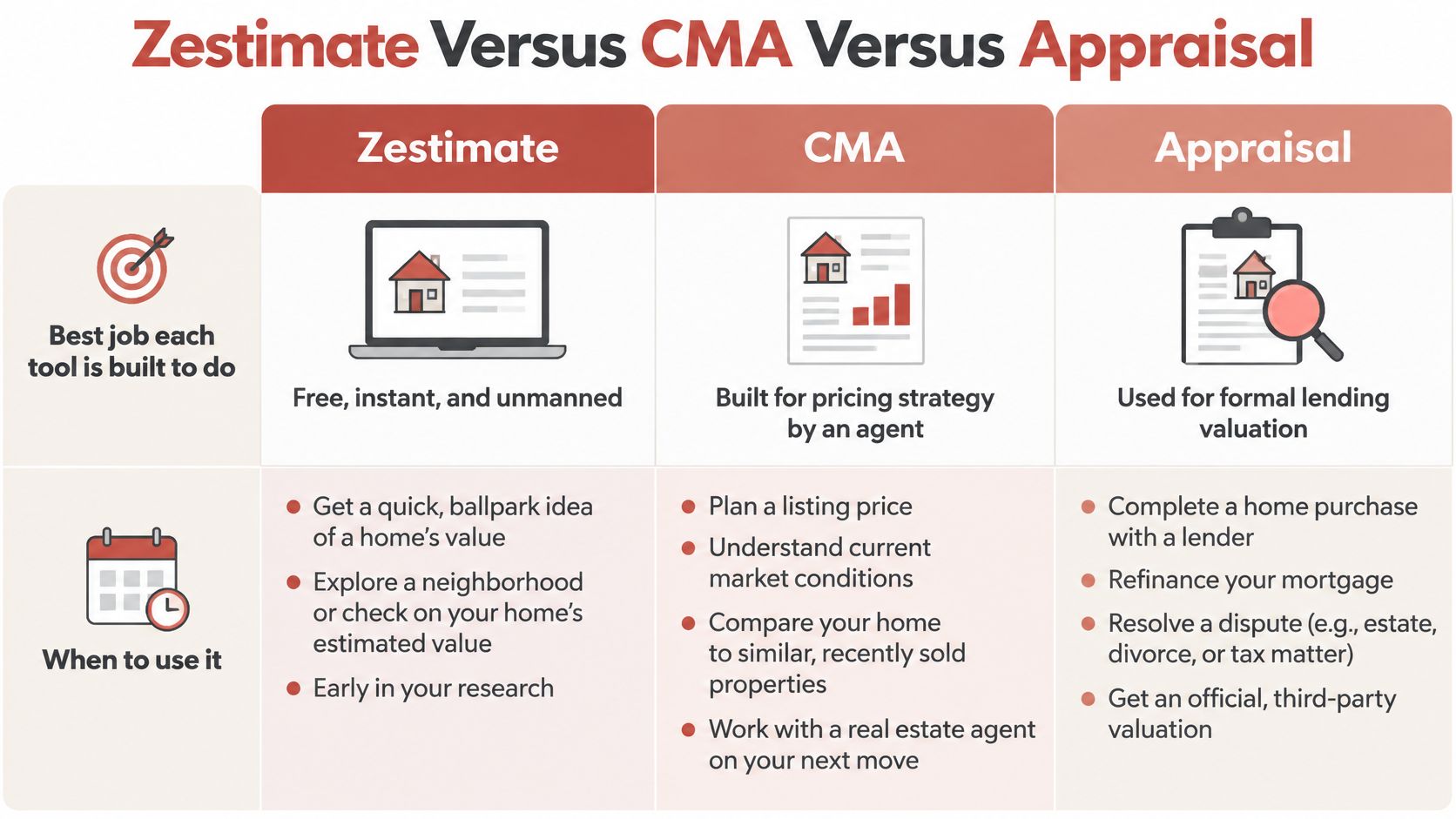
These three numbers get used as if they're interchangeable. They're not. Each one answers a different question, uses different evidence, and fails in a different situation.
| Method | Who produces it | What it can see | Best used for | Weak when |
|---|---|---|---|---|
| Zestimate | Zillow automated model | Public records, listing data, and model signals | A free starting range on a typical listed home | The home is off-market, renovated, inherited, or unusual |
| CMA | Local agent using MRED comps | Recent similar closings, condition, concessions, and micro-location | Setting a list price or an offer | Comps are thin or the property is truly one of a kind |
| Appraisal | Licensed appraiser, usually for a lender | Interior inspection plus adjusted comps | Loan value and refinance | You need a marketing strategy rather than a lending number |
What each tool does well
A Zestimate is free, instant, and unmanned. It's strongest when the home is listed, the record is complete, and plenty of similar homes have sold nearby. It gives you a fast reasonableness check before you spend time on a deeper analysis.
A comparative market analysis, or CMA, is an agent's pricing opinion built from recent, similar closings. If you need the mechanics spelled out, read what a CMA means in real estate before you ask for one. A good CMA adjusts for condition, lot, concessions, updates, and micro-location, then weighs active competition and pending sales to recommend a list price or offer strategy.
An appraisal is a licensed opinion, most often ordered for a lender. The appraiser typically inspects the interior, measures and photographs the property, selects comparable sales, and applies adjustments. It supports a loan decision. It doesn't tell a seller how to position a home in Elmhurst or Melrose Park to create competition.
The split to remember: The Zestimate says what public data suggests, the CMA says what a buyer is likely to pay this month, and the appraisal says what the lender can rely on.
That distinction is also where how human insight shapes property values becomes useful reading, because layout, light, noise, and the feel of a block influence buyers in ways a database field doesn't capture well. A model can count a bathroom. It can't stand in a kitchen at rush hour and hear the arterial road through closed windows.
Two practical situations
Say a fairly uniform listed house in Naperville has accurate records and several near-identical recent sales. Start with the Zestimate, then confirm or move away from it with those comps. In that setting, the automated range and the CMA may land close together.
An inherited house with deferred maintenance or a major renovation calls for the opposite order. Go straight to a CMA, with the condition documented room by room. Expect the appraisal later, when financing requires it, and don't let the online number set expectations for either the estate or the first buyer who tours.
Why Your House Can Miss the Median
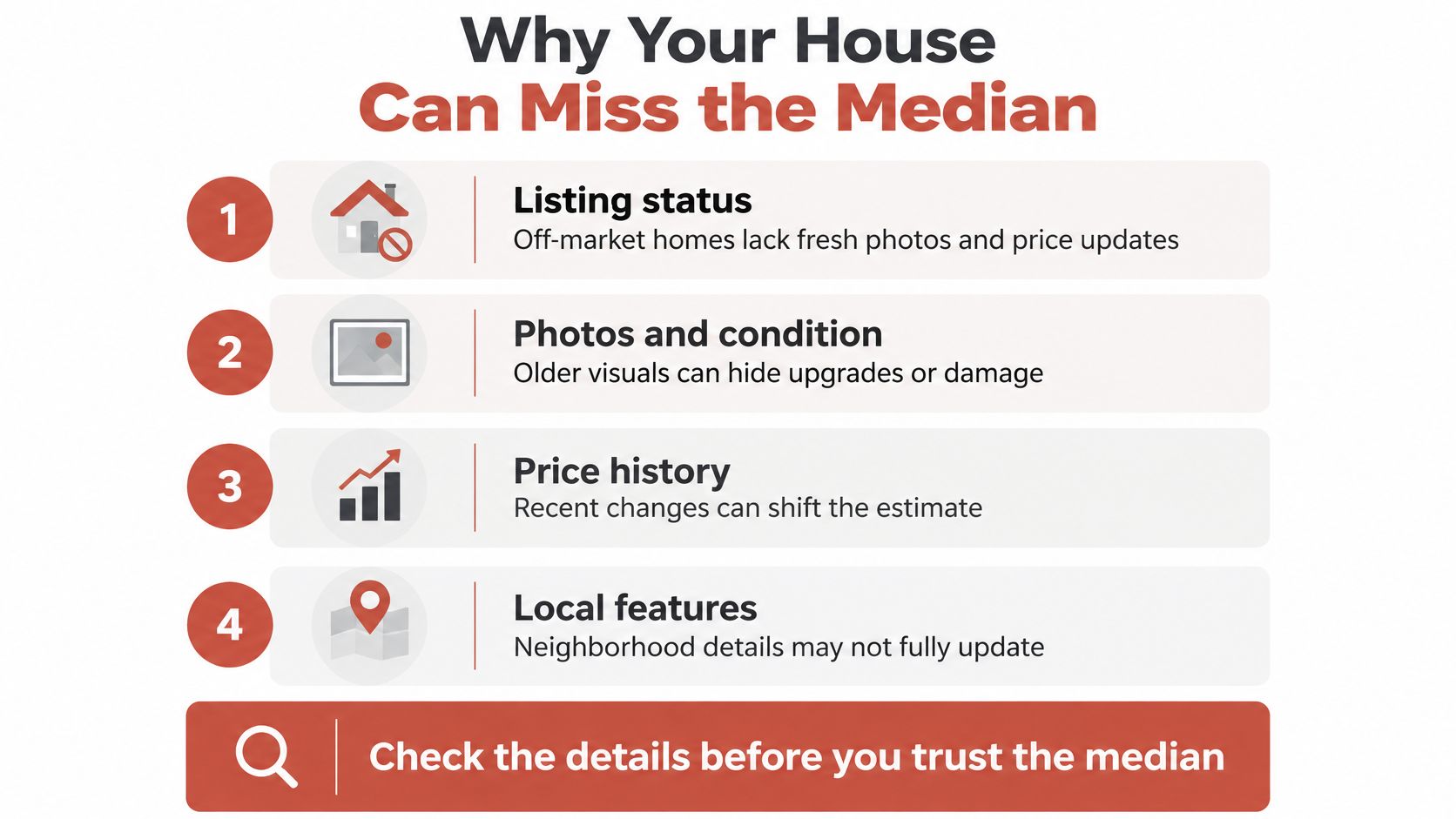
A national median describes the middle of a huge pool. Your pricing decision concerns one house, one lot, and a record that may contain wrong or missing facts. That gap is how Zillow can look accurate in aggregate and still misprice a specific bungalow in Melrose Park.
Check the misses in order
Listing status comes first. An off-market home lacks fresh photos, a current asking price, and the buyer reactions that sharpen an estimate once a listing goes live. Zillow's Zestimate accuracy figures for July 2025 put the nationwide median error at 1.83% for on-market homes versus 7.01% for off-market homes. On a $500,000 home, a 7.01% median error represents roughly $35,050, before unusual condition, additions, finished basements, lot differences, or micro-neighborhood effects enter the picture.
Property facts come second. The model leans on recorded details like square footage, bedrooms, and bathrooms. Wrong above-grade square footage, a bedroom count that ignores a converted space, or a finished basement missing from the assessor record pulls the estimate toward the wrong set of sales.
Condition and legal characteristics come third. Inherited, as-is, renovated, or converted properties turn on facts that outweigh model inputs. A legal in-law unit, an unpermitted conversion, a new roof, or a sewer problem changes both the buyer pool and the price. None of those items carries proportional weight in a simple beds-and-baths comparison.
Place comes fourth. A busy road, a shallow lot, a flood-prone rear yard, walkable transit, or a school boundary can separate houses that look identical in a spreadsheet. Chicago's published figures show listed homes performing far better than the national median, yet a meaningful share of estimates still landed well off the sale price. Two similar ranches on the same Melrose Park block can sell apart because one sits mid-block and the other fronts an arterial. Medians smooth over exactly the block-level differences that move a real offer.
A three-step check before you trust it
- Confirm the assessor facts: Compare square footage, beds, baths, lot size, and year built with the house you can measure.
- List what's changed: Note additions, finished lower-level space, major systems, kitchen and bath work, and anything legal or structural the record missed.
- Test it against closings: Line the Zestimate up against recent, similar closed sales rather than a national median.
If the three checks point in different directions, the closings and the house itself win. The question is how much confidence this estimate deserves for this off-market or atypical home in western Chicagoland, and whether closed sales pulled through the local MRED feed support it. When they don't, a free home valuation and strategy call from Homes By Carmen turns that same record review into a defensible list price.
Where Western Suburbs Break the Model
Nearby suburbs don't give an automated model the same raw material. Housing stock, sale frequency, lot patterns, and boundary lines decide whether the model has clean matches or has to average across homes that buyers wouldn't treat as substitutes. The contrasts below are illustrative, not claims about specific closed sales.
In Melrose Park, bungalows of similar size can look interchangeable online. One may have a new kitchen and a legal in-law apartment, while the next is largely original with older systems. When the record doesn't capture that spread, the model often prices something near the average of the two, which can overvalue the original house and undervalue the improved one.
Elmhurst turns more sharply on micro-location. A house can gain or lose appeal based on which elementary boundary it sits in, and a wide lot may attract a teardown buyer who values land over the existing structure. The model sees a house with recorded rooms and square footage, while the market may be pricing a future build, a school assignment, or both.
| Area | Handles better | Often misses | Local reason |
|---|---|---|---|
| Melrose Park | Similar bungalows with recorded square footage | Heavy rehabs and in-law units | Condition and extra living area are not in the record |
| Elmhurst | Standard updated colonials | Teardown lots and school-boundary splits | Micro-location can outweigh the house itself |
| Naperville | Tract homes with many near-identical sales | Custom homes and premium lots | Uniformity helps; one-off features do not |
| Downers Grove and Glen Ellyn | Recent resales with photos | Estates and inherited as-is houses | Thin or stale comps hide condition |
| Oak Park | Condos with frequent sales | Historic houses with additions | Unique architecture is hard to match |
Naperville gives the model its best local conditions in tract subdivisions where floor plans repeat and sales occur often. A model does well when the last several closings are close cousins of the subject house. It drifts on custom homes, premium lots backing to open space, and houses whose value depends on finish level more than floor plan.
In Downers Grove and Glen Ellyn, recent resales with complete listing photos are easier to estimate. Estate properties and inherited as-is houses are harder, because condition and deferred work can dominate value while comparable sales are thin or stale. Oak Park splits the same way. Condos with frequent sales give the model repeated data, while historic houses with additions, distinctive architecture, and varied lot depths resist clean matching.
Use the interactive home value map to see how sharply values can change across a short distance, then narrow your attention to the right side of the relevant boundary. The fix is the same in every town. Pull similar recent sales, confirm they're comparable in location and condition, then adjust for what a website never visited.
How Buyers and Sellers Should Use a Zestimate
Buyers and sellers get hurt in opposite ways. Buyers use a low Zestimate to justify an offer no seller will take, or a high one to feel safe overpaying. Sellers anchor to a number that never saw their kitchen. Keep the jobs separate.
If you're buying
- Sort listings into a search range: Use the Zestimate to compare neighborhoods and spot listings that deserve a closer look.
- Price the house from MRED closings: Before you offer, compare recent similar sales against the home's actual condition, lot, and location. A renovated comp doesn't support the same price for an original-condition house.
- Plan for the appraisal before you sign: If your offer sits well above likely appraised value, decide in advance whether you'd cover a gap in cash, renegotiate, or walk under your contingencies.
- Don't use Zillow as proof of overpricing: Days on market, showing activity, competing actives, and pending sales tell you more about bargaining power than an automated range.
A Zestimate can still help you ask better questions. If it sits far below the asking price, ask which closed sales support the list price and what condition differences explain the gap. If it sits far above, ask whether the model credited square footage, finishes, or a location benefit the house doesn't have.
If you're selling
- Treat an off-market Zestimate as a conversation starter: It frames the discussion. The list price comes from evidence.
- Price from a CMA: Adjust for updates, lot, concessions, school boundary, and current competition in Melrose Park, Elmhurst, Downers Grove, Naperville, Oak Park, or Glen Ellyn.
- Expect confusion if Zillow sits far above comps: Buyers will tour with that higher number in mind, then discount what they see if condition doesn't support it.
- Don't chase a low estimate downward: If documented updates and strong comparable sales support a higher price, price to the evidence and let listing photos and facts correct the public story.
Investors need a different screen altogether. Underwrite rent, taxes, insurance, repairs, vacancy, and exit value. A Zestimate won't tell you whether a property cash flows or whether a conversion is legal, so run those numbers before the estimate enters the conversation.
A Free Home Valuation, a Mortgage Calculator, a Buyers Guide, and a Sellers Guide cover the planning side. Bring the Zestimate, the address, and a list of what's changed to the pricing conversation. Listing data comes in part from the Broker Reciprocity program of Midwest Real Estate Data LLC (MRED) and is deemed reliable but not guaranteed.
Screen with Zillow, decide with comps, and finance with the appraisal.
That's the order I recommend at the kitchen table. The online estimate earns its place at the beginning of the process, when you're narrowing options and checking whether a price is even in the right neighborhood. It loses its place at the end, when real money depends on condition, boundaries, and the handful of sales buyers and appraisers will use.
Bring us the Zestimate that's raising the question, plus what's changed inside the house, and we'll test it against recent western Chicagoland comps in a free expert home valuation and strategy call. Visit Homes By Carmen to request your valuation and use our buyer, seller, and mortgage planning resources before you list or make an offer.