
You type your address into a free estimator, see a number, and immediately start doing the math. Could you sell and move? Is the house you want overpriced? And why doesn't that number look anything like the value on your property-tax paperwork?
A home value estimator by address gives you a starting point, not a settled answer. For a home in Melrose Park or the western Chicago suburbs, the useful question is what evidence supports the number, what's missing, and which decisions it can reasonably guide.
Table of Contents
- Where Address-Level Home Values Come From
- How to Pull a Value for Your Address Step by Step
- How to Read the Number and Its Likely Range
- Why an Address Estimate Misses and How to Fix It
- What an Agent's Comparative Market Analysis Adds
- Decide What to Do With the Number
Where Address-Level Home Values Come From
An address identifies the property. The model behind the estimator supplies the opinion, using recorded characteristics, location, and sales patterns rather than a walkthrough of your home.
The Cook County Assessor's Office describes a model trained on hundreds of thousands of sales, using features such as building square footage, neighborhood, and school district, followed by residential analysts' neighborhood-by-neighborhood review. That's a useful example of mass appraisal, but it isn't a guarantee of what an individual buyer will offer.
The numbers serve different purposes
Keep these categories separate:
- Algorithmic estimate. A model's calculation based on the information available to it. Correcting the inputs or adding relevant sales can change the result.
- Tax assessed value. A value used in property-tax calculations. The assessor's estimated market value and the assessed value are distinct entries, so read the labels before comparing them with a listing.
- Probable sale range. A property-specific opinion supported by comparable sales, current competition, and verified condition. This is the range to develop before setting a listing or offer strategy.
A higher online estimate doesn't automatically justify a higher asking price. Likewise, a lower tax assessment doesn't prove that a seller is asking too much.
Address value sources compared
| Source | Typical cost | Best use | Main limit |
|---|---|---|---|
| County assessor record | Free public lookup | Tax assessed value and recorded property characteristics | Assessed value is used for taxes and isn't a market price |
| Online address estimator | Free for basic estimates | Quick starting benchmark | Can miss renovations, layout changes, and condition |
| MLS sold-comparable search through an agent | Often included in an agent consultation | Checking nearby closed sales | Search criteria and available records affect relevance |
| Agent comparative market analysis | Often free for prospective sellers | Pricing and listing strategy | Requires sound comparable selection and local judgment |
| Licensed appraisal | Paid professional fee, quoted for the assignment | Lending, legal matters, or disputed value | Requires coordination, time, and a defined scope |
Start with the county record to check the facts, then use an online estimate for a quick benchmark. Before a listing or offer decision, move to an agent's comparative market analysis. If a lender or legal matter requires a formal valuation, confirm the required appraisal scope before ordering one.
How to Pull a Value for Your Address Step by Step
A useful valuation should be reproducible. Someone reviewing your work should be able to identify the property, understand the comparable selection, and follow the reasons behind your adjustments.
The International Association of Assessing Officers' automated valuation model standard supports a workflow built around verified property information, representative sales, similarity-based comparisons, adjustments, and an uncertainty range. A homeowner doesn't need to build a statistical model, but the same discipline makes a self-serve estimate more useful.
Verify the property before comparing prices
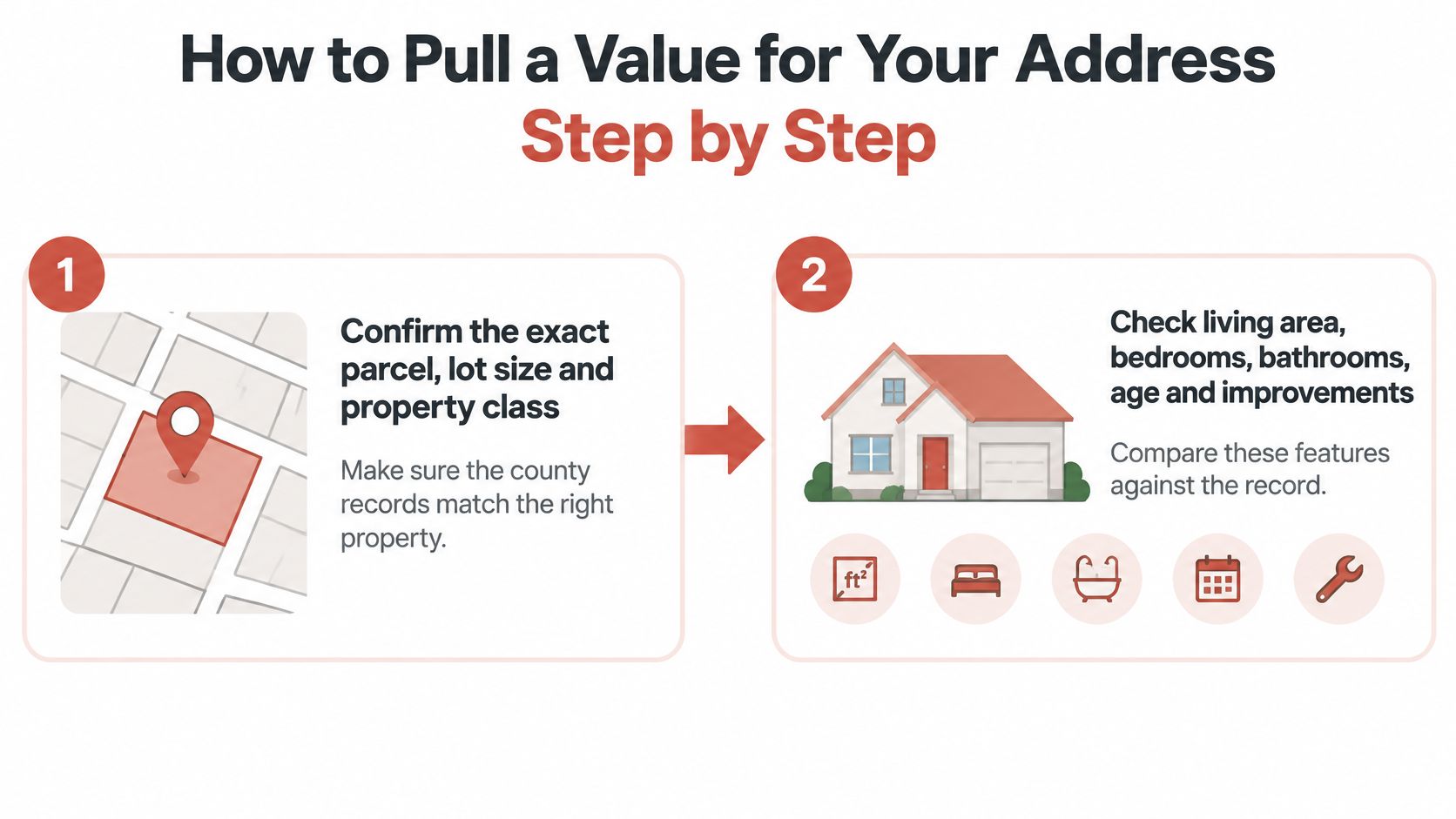
Confirm the parcel. Match the street address to the county parcel record, lot dimensions, and property class. Check unit identifiers carefully for condos and properties with multiple parcels. A correct street address can still lead you to an incomplete property record.
Reconcile the home's characteristics. Compare recorded living area, bedrooms, bathrooms, age, and improvements with the actual property. Keep above-grade living area separate from basement space. Note additions, converted garages, accessory units, and finished areas whose status needs verification.
The first checks are about identifying what you're valuing, not selecting a price.
Build a comparison you can defend
Collect relevant closed sales. Start with recent, arm's-length transactions in the same neighborhood or an economically similar market. Don't treat family transfers as ordinary market evidence. Review distressed transactions separately rather than assuming they represent the same sale conditions as your property.
Rank for relevance, then adjust. Prioritize condition, housing type, layout, location, and recency. Distance helps, but the closest sale isn't automatically the best comparable. Document differences in living area, bathrooms, garage capacity, lot utility, and maintenance, with a reason for each adjustment.
Investigate disagreement. Compare the adjusted sales with the online estimate. If they point in different directions, inspect the inputs instead of automatically choosing the higher number. The comparable analysis is stronger only when its evidence is stronger.
Record the conclusion and its limits. Save a point estimate, a probable range, the date, and unresolved questions. Specify what would change the conclusion, such as confirming an addition's living area or discovering a major repair need.
Finish with a practical audit: does the conclusion fit the adjusted sales, and can you explain every adjustment without relying on a generic renovation percentage?
Practical rule: Match condition before chasing a square-footage match. A similarly sized renovated home can be a poor comparable for a property that needs substantial work.
Keep your notes and supporting photos together. They make a later conversation with an agent more productive than a screenshot of an unexplained estimate.
How to Read the Number and Its Likely Range
An estimate's accuracy depends on the property and the evidence available. A conventional home surrounded by relevant recent sales presents a different valuation problem from a heavily altered home with few close substitutes.
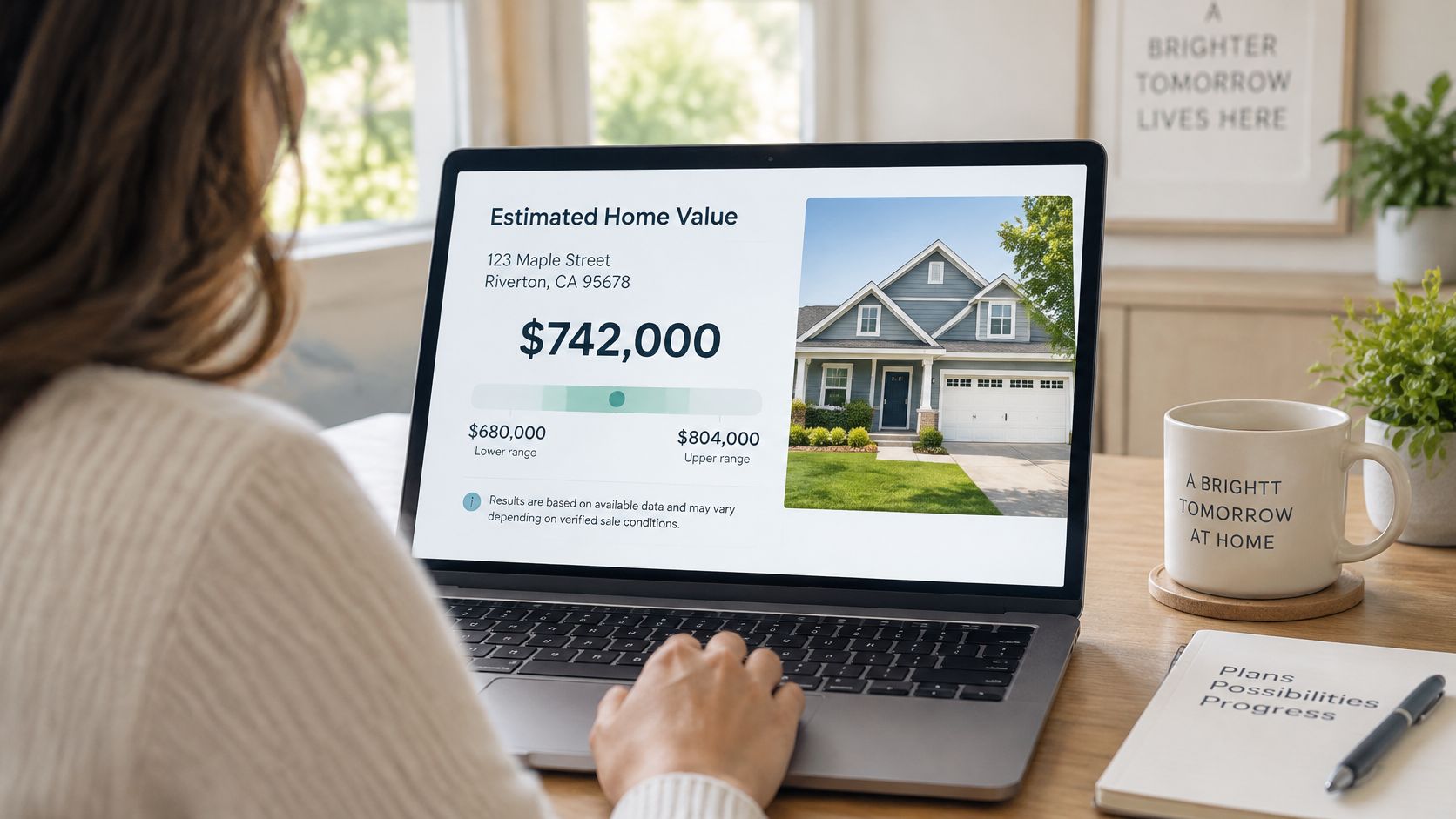
A range communicates that difference better than a precise-looking figure. But a narrow range is useful only if the underlying evidence justifies it.
Quality measures for an address estimate
These measures describe performance across tested properties. They aren't promises about your address.
| Measure | What it tells you | Reported or example value |
|---|---|---|
| P10 | Share of estimates within 10% of a verified sale | A Brookings review of automated valuation models reported that seven providers reached at least 95% on a particular test set, not across every market |
| P20 | Share within a broader percentage tolerance of a verified sale | Ask for the provider's tested coverage and the tolerance used |
| Median absolute error | Typical size of a miss, without treating overestimates and underestimates as cancellations | Ask for the middle absolute dollar error in the relevant test sample |
| Mean absolute percentage error | Average absolute percentage miss across sales | Ask for the tested result and whether the sample resembles your property |
The important follow-up is what was tested. Results from typical homes in a well-documented market may tell you little about an unusual conversion or a property with incomplete records.
Read uncertainty as a decision constraint
Say an estimator produces a midpoint and a range. If the lower end would make your planned move unaffordable, the uncertainty matters even if the midpoint looks encouraging. Don't budget as though the upper end is already an accepted offer.
Relevant, recent comparables can support a tighter conclusion. Sparse or inconsistent evidence calls for more caution, not a more confident presentation.
Verification matters here, too. Our website's listing information is deemed reliable but not guaranteed and should be independently verified. Confirm closing status, recorded size, property type, and material listing details before using a sale as a benchmark.
For financing plans, Quicklending LLC's explanation of how to calculate loan to value helps connect a property value with a mortgage balance. Use it for planning, while recognizing that a lender may use a different accepted valuation.
The range matters more than the point when the decision changes depending on which end proves realistic.
Why an Address Estimate Misses and How to Fix It
A renovated kitchen can be obvious to a buyer and absent from a database. Deferred maintenance, awkward room connections, finished space, accessory units, and unusual lots can create the same mismatch between recorded facts and buyer reaction.
But an estimate can also change without anything happening to the house. The Federal Housing Finance Agency's House Price Index covers single-family values across all states and more than 400 cities, using a repeat-sales method to measure changes for properties sold more than once. Regional price movement supplies context, although it doesn't establish an individual home's listing price.
Estimate symptoms, causes and fixes
| Symptom | Likely cause | Fix |
|---|---|---|
| Estimate is far above nearby recent sales | Record overstates size or gives excessive weight to renovated homes | Review closed sales with similar condition and size, then document adjustments |
| Estimate is low after a recent renovation | Improvement or finished-space information is missing | Check municipal permits and county characteristics, document the work, and review comparable selection |
| Estimate changed sharply over a short period | Local prices shifted or new sales entered the model | Check regional direction, then examine the newest relevant closings |
| Very few sales nearby | Sparse evidence or an unusual property type | Broaden the search thoughtfully and explain why each substitute is relevant |
| Neighboring homes have very different estimates | Condition, lot utility, or layout isn't represented consistently | Review photos and inspect the features that distinguish the properties |
| Estimate has no range attached | Uncertainty isn't visible | Request a range with a written explanation of confidence |
Use the home value map to orient your neighborhood review, rather than treating every nearby property as interchangeable. A municipal boundary, different housing type, or materially different site can make a short-distance comparison misleading.
Escalation point: When several warning signs appear together, stop adjusting the online number by instinct. Get a property-specific comparative market analysis, or an appraisal when the purpose calls for one.
Fixing a record also doesn't mean every estimate will immediately change. Keep the correction documentation so the person preparing your valuation can distinguish confirmed facts from unresolved inputs.
What an Agent's Comparative Market Analysis Adds
Self-serve research reaches its limit when choosing and interpreting the evidence requires more judgment than the estimator can show. A major renovation, unusual lot, inherited property, or thinly traded housing type deserves more than a printout of nearby sales.
A comparative market analysis, or CMA, connects the property to likely buyer alternatives. It should explain not just what sold, but why those transactions help predict how buyers may respond to your home.
What a useful analysis contains
Look for a report with:
- Closed comparable sales. Relevant properties with line-by-line explanations of material differences, rather than a neighborhood average.
- Active and pending competition. Homes buyers can choose instead, with pending prices treated cautiously when final terms aren't available.
- Marketing history. Days on market, asking-price changes, and useful context around each transaction.
- Condition evidence. Photos, walkthrough observations, and a clear distinction between cosmetic updating and unresolved repairs.
- A supported range. A likely sale range, a proposed listing approach, and facts that could change the recommendation.
For a closer explanation of the report's role, our guide to what a CMA means in real estate provides context. The property valuation tips from LendingXpress offer another useful introduction to comparable-based evaluation.
Questions worth asking
Ask why the agent chose each comparable and which plausible sales they excluded. Confirm whether they visited the property, what assumptions remain unverified, and what evidence would move their conclusion upward or downward.
Ask about the MLS source as well. Our website's listing data comes in part from the Broker Reciprocity program of Midwest Real Estate Data LLC, or MRED. Listings held by other brokerage firms are marked with the Broker Reciprocity logo and identify the listing brokers, so don't confuse display on a website with that firm representing the seller.
Check credentials separately from the pricing recommendation. Homes By Carmen is licensed in Illinois, and Carmen Salerno is a REALTOR®. Neither credential replaces the need for a clearly supported analysis.
The main red flags are straightforward: a price without comparables, an inflated number offered to win your listing, and adjustments with no written reasoning. A sound recommendation may be less flattering than the highest estimate, but it should be easier to defend.
Decide What to Do With the Number
Choose the next step based on your decision. A rough estimate can satisfy curiosity, while a purchase offer or listing price calls for closer attention to comparable sales, property details, and market conditions.
If you're buying
Use adjusted comparables to check whether the asking price fits a realistic range. Then weigh repair needs, competing homes, and contract terms before deciding what to offer.
Treat the online estimate as one reference point, not an automatic ceiling or opening bid. If your offer differs, connect that difference to the property's condition, comparable sales, or terms rather than personal attachment to the home.
If you're selling
Compare your own research with an agent's CMA before setting a list price. If the recommendations differ, identify whether the gap comes from comparable selection or property facts. Averaging two opinions can conceal the reason for the disagreement.
Separate buyer appeal from recoverable cost when considering improvements. A kitchen remodel may appeal to local buyers without returning its full cost, while a bathroom addition can be harder to recover if comparable homes do not support a higher sale range. The article on value-boosting home additions offers ideas to consider. Use this guide to increase home value before selling to organize preparation choices.
If you're curious about value
Save the estimate with its date, range, and property details. Review it after relevant neighborhood sales close or when your plans become more concrete, instead of reacting to each automated change.
Keep a brief record of improvements, permits, maintenance, and unresolved property-record issues. These details can help clarify the value if you later sell, refinance, or stay.
Aim for a conclusion you can act on, and state the uncertainty plainly.
Homes By Carmen offers homeowners thinking about selling a free expert home valuation and strategy call. Visit Homes By Carmen to request a review of your address and discuss how the estimate may inform your next step.