
Renting isn't throwing money away, and buying isn't automatically building wealth. Both choices pay for shelter. The financial difference comes from what you keep after housing expenses, investment returns, and the cost of moving again.
For Chicago-area households, the useful question about buying a home vs renting an apartment isn't whether rent exceeds a mortgage payment. It's whether owning the specific property you're considering leaves you better off over your realistic stay, without exposing you to bills you can't absorb. A suburban house can offer stability and control while still being the wrong purchase for a household with limited reserves or an uncertain relocation date.
Table of Contents
- Monthly Costs of Renting vs Buying Side by Side
- Break-Even Timing and How Long You Must Stay
- Risks You Carry Under Each Option
- The 30% Affordability Test and Cash Reserves
- Which Option Fits First-Time Buyers, Families and Investors
- Renting and Buying Across Western Chicagoland Suburbs
- Run Your Own Rent-vs-Buy Numbers Before Deciding
Monthly Costs of Renting vs Buying Side by Side
A lower mortgage payment is not a lower housing bill. Principal and interest leave out property taxes, homeowners insurance, maintenance, and association charges. Compare the complete ownership budget with the complete rental budget for housing that meets the same needs.
An Empower Chicago comparison estimated 2026 principal-and-interest payments of $1,613 against median rent of $2,091, but excluded taxes, insurance, repairs, and purchase and sale costs. Those figures are a starting point for Chicago, not quotes for comparable properties in a western suburb.
Monthly and upfront costs, renting vs buying in Chicagoland
| Cost item | Renting an apartment | Buying a home |
|---|---|---|
| Base housing payment | Chicago median rent estimate shown above; replace with a local lease quote | Chicago principal-and-interest estimate shown above; replace with a lender quote |
| Property taxes | Landlord generally pays through rental income | Use the actual parcel tax bill and investigate potential changes |
| Insurance | Obtain a renter's insurance quote | Obtain a homeowners insurance quote for the specific address |
| Maintenance and repairs | Landlord generally handles building repairs; check tenant obligations | Build a reserve from inspection findings, equipment age, and contractor estimates |
| Utilities | Pay tenant-assigned services under the lease | Budget for all owner-paid services |
| Association dues | Check whether any charges are passed through | Obtain current dues and identify what they cover |
| Upfront cash | Rent due at signing, deposit, and disclosed fees | Down payment, itemized closing costs, prepaid expenses, and reserves |
| Cost when leaving | Moving expenses and any lease-related charges | Moving expenses, negotiated selling charges, settlement costs, and possible preparation work |
The expenses buyers underestimate
Property taxes require an address, not a regional guess. Request the actual bill and identify the taxing district, exemptions, and assessment information. Don't assume the seller's bill will remain unchanged after your purchase, or estimate your obligation solely from the listing price.
Maintenance requires a different approach. A reserve is money you set aside, not a promise that repairs will arrive in equal monthly installments. An inspection identifying aging heating equipment and a worn roof calls for a different budget than a property with documented recent replacements.
Avoid treating a generic percentage of purchase price as a property inspection. The land and location contribute to the price, while the building's condition determines much of the repair exposure.
Compare equivalent housing
A detached house and an apartment may differ in space, parking, outdoor responsibilities, and heating needs. If you choose the larger property, distinguish the cost of owning from the cost of consuming more housing.
- Match the location. Compare properties in the same town and, where relevant, the same school boundary.
- Match the services. Account for parking, laundry, storage, landscaping, and utilities included in rent or dues.
- Separate cash flow from opportunity cost. Total the monthly bills first, then add the return you'd forgo by committing savings to the purchase.
Renters should include insurance, tenant-paid utilities, and disclosed recurring fees. Owners should check whether the lender's quoted payment already includes escrowed taxes or insurance so those expenses aren't counted twice.
Break-Even Timing and How Long You Must Stay
A short stay can make an otherwise affordable purchase expensive. You pay to acquire the property and then pay to leave it, potentially before mortgage repayment or price gains compensate for those transactions.
The Federal Reserve's analysis of homeownership disadvantages identifies high purchase and sale transaction costs, unexpected maintenance, and possible property-value declines as risks relative to renting. That makes your likely departure date a financial input, not merely a lifestyle preference.
Calculate ending wealth, not just payments
Use either a complete cash-flow model or an ending-net-worth model. Mixing the methods can make buying appear artificially attractive.
For a cost comparison, total mortgage interest, property taxes, insurance, maintenance, association fees, purchase and sale expenses, and the opportunity cost of equity. Subtract assumed appreciation, recognizing that appreciation may not occur. Don't subtract principal repayment again from a total that already excludes principal.
Alternatively, track every ownership payment, then credit the owner with net sale proceeds after the remaining loan balance and selling expenses. Compare that result with the renter's accumulated savings and investment balance. Count investment returns consistently rather than crediting the renter and charging the owner for the same opportunity twice.
The timeline illustrates why the departure date matters.
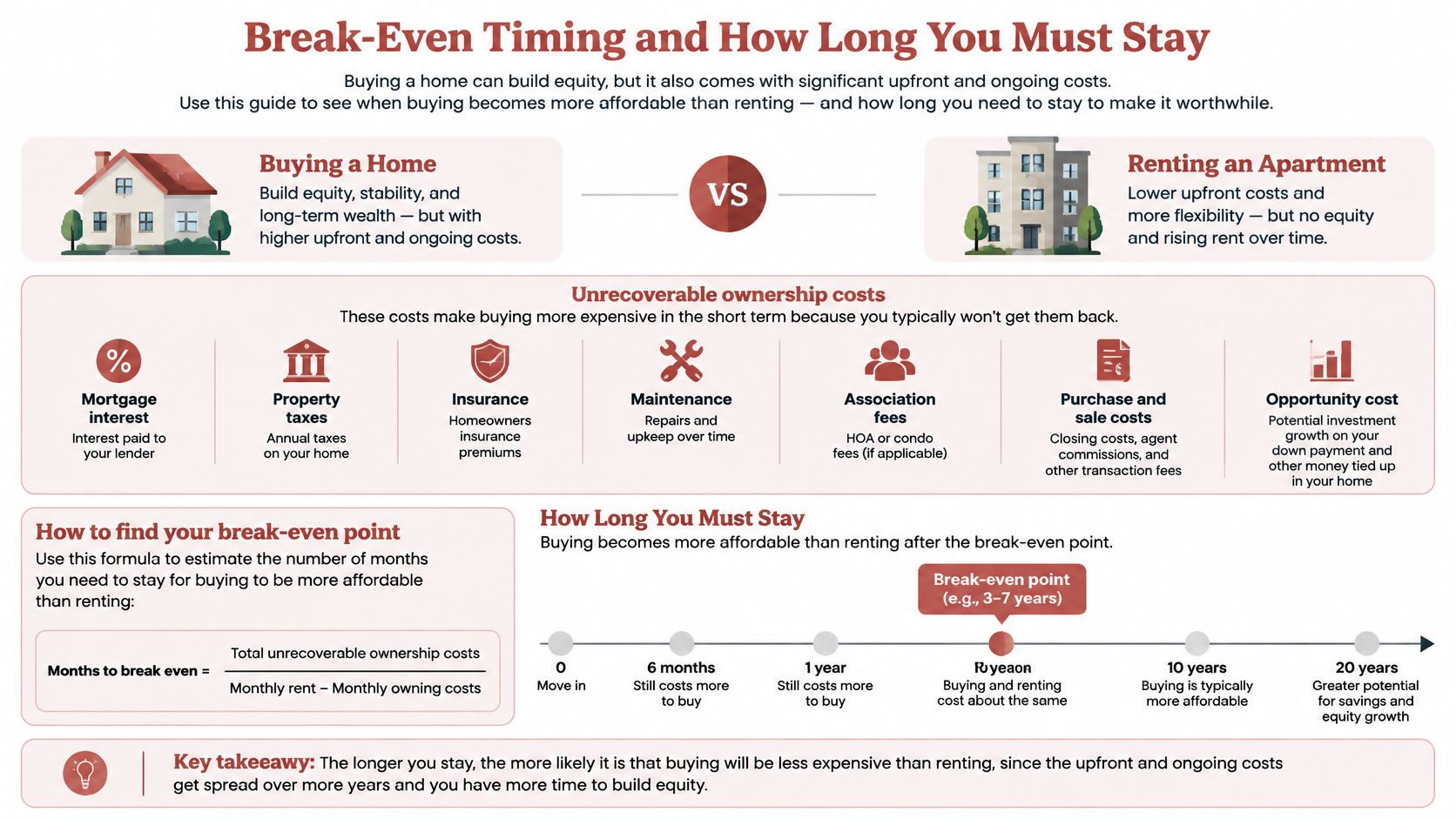
Illustration, not a forecast: Suppose acquisition and eventual selling expenses together exceed the appreciation accumulated before your move. Even if the sale price rises, that gain hasn't yet paid for the transactions, much less interest and upkeep. Replace each assumption with the actual proposed purchase and an estimated exit statement.
Likely winner by planned stay length
These are illustrative planning categories, not evidence of a universal break-even year.
| Planned stay | Usually favors | Why |
|---|---|---|
| Short stay, with relocation already plausible | Renting as the initial comparison | Purchase and sale expenses have little time to be offset |
| Medium stay, with an uncertain departure date | Neither without a property-specific calculation | Financing, repairs, rent, and resale assumptions can reverse the result |
| Longer stay, with stable household needs | Buying merits closer consideration | Principal repayment can accumulate while transaction costs are spread across the stay |
| Extended stay, with an affordable property | Buying may offer a stronger case | Continued occupancy reduces the annualized impact of acquisition and exit expenses |
Test an earlier departure
A job change, growing family, or uncertain residency plan can shorten your stay. Run the model for an earlier move as well as your preferred departure date.
Practical rule: A purchase should survive a plausible change of plans, not merely succeed if you stay as long as you hope.
Test rent increases and renewal uncertainty on the rental side. On the ownership side, test higher carrying costs, an unfavorable repair, and a flat resale price. Write down your most likely stay in years before choosing the category that fits.
Risks You Carry Under Each Option
Owners face large, irregular bills. Renters face less control over continued occupancy and future lease terms. Neither choice removes housing risk; each assigns it differently.
In its report on household housing conditions in 2025, the Federal Reserve found that 23% of renters had been behind on rent during the prior year, while rising homeowners insurance costs led some owners to carry less coverage than desired or go without it. The relevant test is therefore broader than whether you can make an ordinary monthly payment.
Ownership risk arrives unevenly
A roof replacement, sewer repair, furnace failure, insurance deductible, or condominium special assessment may require cash before you've built much equity. An attractive purchase price doesn't establish that the building is inexpensive to operate.
For a Chicago-area property, investigate the risks of the actual structure rather than assuming every suburban house has the same exposure.
- Water and sewer exposure. Ask about basement water, drainage work, sewer backups, and available inspection records.
- Mechanical condition. Document heating equipment, electrical systems, plumbing materials, and maintenance history.
- Insurance terms. Review deductibles, exclusions, coverage limits, and any separate coverage you may need.
- Shared-building obligations. Examine association reserves, planned projects, meeting minutes, and assessment history.
Ask an inspector which substantial expense is most plausible, then obtain a contractor estimate where appropriate. Compare that estimate with the liquid savings you'd retain after closing.
If paying it would require expensive borrowing or selling investments at an inconvenient time, the property may be too risky even when its monthly payment fits.
Renting has a different exposure
A landlord may propose a higher renewal rent or decline to renew, subject to the lease and applicable law. A sale doesn't automatically mean immediate displacement, but you shouldn't assume continued occupancy indefinitely.
Renters also need permission for changes that owners may be able to make, subject to association rules and local requirements. Read the lease for renewal provisions, notice requirements, maintenance responsibilities, and charges associated with leaving.
The stronger question isn't which option builds equity, but which risks your household can withstand.
Name the risks you can't tolerate. A household that needs predictable repair responsibility may prefer renting; one that places a high value on controlling its residence may accept ownership expenses. The sensible choice is the exposure you can finance and live with.
The 30% Affordability Test and Cash Reserves
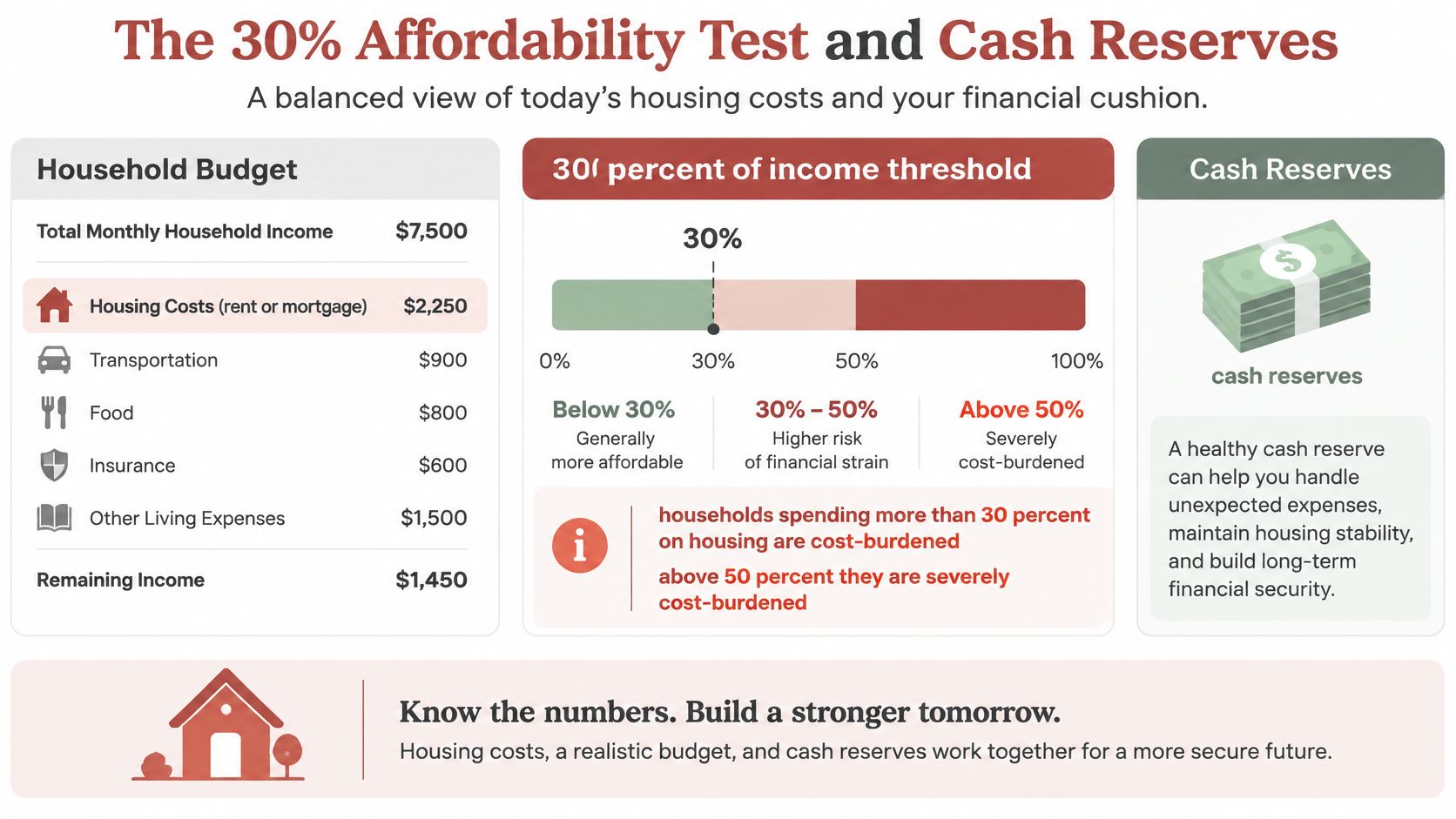
The housing-cost ratio is a useful warning light, not permission to buy. The U.S. Census Bureau's housing-cost guidance identifies households spending more than 30% of income on housing as cost-burdened, and those spending above 50% as severely cost-burdened.
A household can pass that screen and still struggle with childcare, debt payments, medical expenses, or unstable earnings. Your spending plan must work after those obligations, too.
Build the worksheet before choosing a price
Use gross income consistently for the screening ratio, then check the remaining budget against take-home pay. Separate actual housing outlays from opportunity cost so you don't confuse a cash requirement with a financial trade-off.
| Worksheet line | What to enter |
|---|---|
| Loan principal and interest | Lender quote for the proposed loan |
| Property taxes | Address-specific bill with potential changes investigated |
| Homeowners insurance | Property-specific premium quote |
| Maintenance reserve | Planned contribution informed by condition and repair estimates |
| Utilities | Services the household will pay |
| Association dues | Current charges, checked against included services |
| Mortgage insurance or other required charges | Amount shown in the financing estimate, where applicable |
| Opportunity cost | Separate estimate of forgone returns on committed savings |
Illustration, not a household forecast: A proposed purchase can sit above the screening line even when the loan payment alone falls below it. A rental can pass the same screen but still leave insufficient savings after other essential expenses. Neither result substitutes for a complete budget.
The affordability screen and reserve test answer different questions.
Keep reserves separate from closing money
Count only savings that will remain available after the down payment, closing expenses, moving, and immediate work. Equity isn't a substitute for accessible emergency cash.
Households with commission income, variable hours, or dependence on a single earner should allow more room for interrupted income. Size that reserve around essential expenses and realistic recovery time, rather than assuming everyone needs an identical balance.
- Recheck carrying costs. Model a higher tax bill and insurance premium.
- Test the loan terms. For adjustable financing, examine the payment changes allowed by the contract.
- Protect other goals. Keep retirement contributions and necessary household savings in the budget.
Our mortgage affordability guide can help organize the payment calculation. Our website also offers a Mortgage Calculator, Buyers Guide, Sellers Guide, and Free Home Valuation.
A passing ratio is the minimum, not the goal.
Buying is affordable on paper only when the complete budget works with reserves intact. If it fits only when nothing goes wrong, keep renting while you improve the margin.
Which Option Fits First-Time Buyers, Families and Investors
Income and liquidity shape the choice before personal preference enters it. In the Federal Reserve's 2024 household survey, 35% of adults with family income below $50,000 owned their home, compared with 85% whose family income was at least $100,000.
That difference doesn't prove buying causes financial success. It shows why advice to buy whenever possible overlooks households' unequal ability to fund the purchase and carry the risk.
First-time buyers and families
First-time buyers should judge readiness by what remains after closing. A lender's approval addresses financing eligibility; it doesn't establish that your remaining savings will cover the property's needs.
Buying can work when the stay exceeds the calculated break-even point and the household retains an emergency fund. The check that could reverse the verdict is simple: subtract every acquisition expense from accessible savings before deciding the down payment.
At Homes By Carmen, we offer a step-by-step first-time buyer's guide created by Carmen Salerno. Use our first-time home buyer guide to organize the process without treating loan approval as the finish line.
For families, stability may justify a housing choice that doesn't produce the highest modeled return. But verify that the property provides the stability you're paying for.
- School assignment. Confirm the target address with the district rather than relying on the town name.
- Space needs. Consider whether an additional bedroom, accessibility requirement, or work arrangement could force another move.
- Daily logistics. Test the commute and transportation arrangements before committing.
Relocating professionals and investors
Renting is a practical default when a job assignment or relocation date remains unsettled. The decisive check is how confidently you can commit to staying, not whether you could technically obtain a mortgage.
An investor needs a different comparison. A rental property must compete with alternative uses of capital after vacancy, management, taxes, insurance, repairs, financing, and eventual sale expenses.
Positive cash flow is only a starting condition. Calculate cash-on-cash return using all cash committed, and examine the return without assumed appreciation. A property that works only with uninterrupted occupancy or unpaid owner labor isn't as profitable as its advertised rent suggests.
The common thread is financial capacity, not buyer identity. First-time buyers, families, and investors can each make a sound purchase, but the condition that reverses the verdict differs.
Renting and Buying Across Western Chicagoland Suburbs
Don't rank Elmhurst, Downers Grove, Glen Ellyn, Naperville, Melrose Park, or Oak Park as universally better for renting or buying. Compare actual addresses. A town-wide label can conceal differences in building condition, school assignment, association obligations, and the kind of rental available.
Start with our Chicago suburb community pages to narrow the search area. Then build a matched set of rental and purchase options that satisfy the same household requirements.
Compare buildings before comparing town names
When examining an older home in Melrose Park, Oak Park, Elmhurst, Downers Grove, or Glen Ellyn, request available inspection history and documentation of roof, plumbing, heating, and sewer work. Ask whether a sewer scope is appropriate. Don't infer the condition of concealed systems from renovated kitchens or fresh paint.
For a subdivision property in Naperville or another western suburb, establish whether an association applies and what responsibilities it retains. A newer-looking building still requires an inspection, and shared amenities may create ongoing charges.
For condominiums, read the reserve study alongside the budget and meeting minutes. A low monthly assessment isn't necessarily an advantage if owners have postponed funding major work.
Address-level verification checklist
- Tax documentation. Obtain the current bill and investigate exemptions and potential changes.
- Building records. Review roof, sewer, water-intrusion, and mechanical-system history.
- Association finances. Request reserves, planned projects, pending assessments, and relevant rules.
- School boundaries. Verify assignment for the exact address.
- Rental terms. Record included utilities, parking, deposits, renewal provisions, and recurring fees.
Use market context without substituting it for a quote
Regional charts can help you ask better questions about pricing and inventory. Virtual Tour Easy's Midwest market charts for brokers offer broader market context, but they aren't a replacement for comparable properties and address-specific expenses.
A useful local comparison also distinguishes asking prices from completed transactions and advertised rent from the full lease obligation. Record the date of each quote so you aren't comparing a current purchase opportunity with an outdated rental listing.
Choose a pair of towns and apply identical financing, investment-return, and resale assumptions. Change only the inputs that the actual properties justify. If you assume stronger appreciation for the town you already prefer, you've built your preference into the answer rather than tested it.
Run Your Own Rent-vs-Buy Numbers Before Deciding
A workable decision needs a completed worksheet, not perfect knowledge of future prices. Gather a lender quote, an insurance quote, property documents, and a comparable rental proposal. Keep uncertain inputs visible so you can see which assumption determines the result.
Complete the decision this week
Set your realistic stay. Choose the departure date that best reflects employment, household needs, and relocation plans. Include an earlier-exit case if moving is plausible.
Price the complete purchase. Fill the ownership worksheet using the actual address and proposed loan. Resolve missing taxes, association charges, and insurance before treating the monthly total as usable.
Model the rental alternative. Use a comparable apartment's full lease costs and track what happens to savings not committed to buying. Apply investment assumptions that reflect how you would hold and invest the money.
Check affordability and retained cash. Run the housing-cost screen, then test essential spending against take-home income. Confirm that emergency savings remain available after acquisition and immediate work.
Apply an adverse scenario. Recalculate with a substantial identified repair, a less favorable renewal, and financing changes where applicable. For a fixed-rate loan already in place, don't model a market-rate increase as though it automatically changes principal and interest.
Choose the option that remains workable. Buying is reasonable when the complete plan survives your likely stay and plausible setbacks. If success requires optimistic appreciation, a future refinance, or exhausted reserves, keep renting and strengthen the budget.
Decision standard: Prefer the option you can sustain under ordinary disappointment, not the one that looks best under ideal assumptions.
If the results remain close, bring both property options and your worksheet to a consultation. We can help check assumptions against current listings and rentals in the towns you're considering. Homeowners planning a sale can also request a free expert home valuation and strategy call to clarify the equity available for their next move.
Homes By Carmen offers buyer representation and rental support, so you can evaluate both paths against your budget, planned stay, and preferred suburbs. Visit Homes By Carmen to schedule a consultation or get answers to your real estate questions, and bring the purchase and rental options you want to compare.