
You've found a home with the space you need, the commute you want, and a layout that finally works. But your down payment is tied up in the house you still own, and you haven't even scheduled listing photos. Waiting could mean losing the new place. Buying now could mean paying for both.
The practical answer to how to buy a house before selling yours starts with cash flow, not your estimated equity. You need a financing route, a realistic sale budget, and a written limit on how much a delayed sale can cost before you make an offer.
Table of Contents
- Compare Sell First, Contingent Offer and Bridge Routes
- How Lenders Count Two Homes in Your Approval
- Calculate Your Real Net Proceeds Before You Offer
- Stress-Test a 30, 60 or 90-Day Sale
- Lock Down Contingencies, Deadlines and Kick-Out Clauses
- Decide Whether Buying First Fits Your Situation
Compare Sell First, Contingent Offer and Bridge Routes
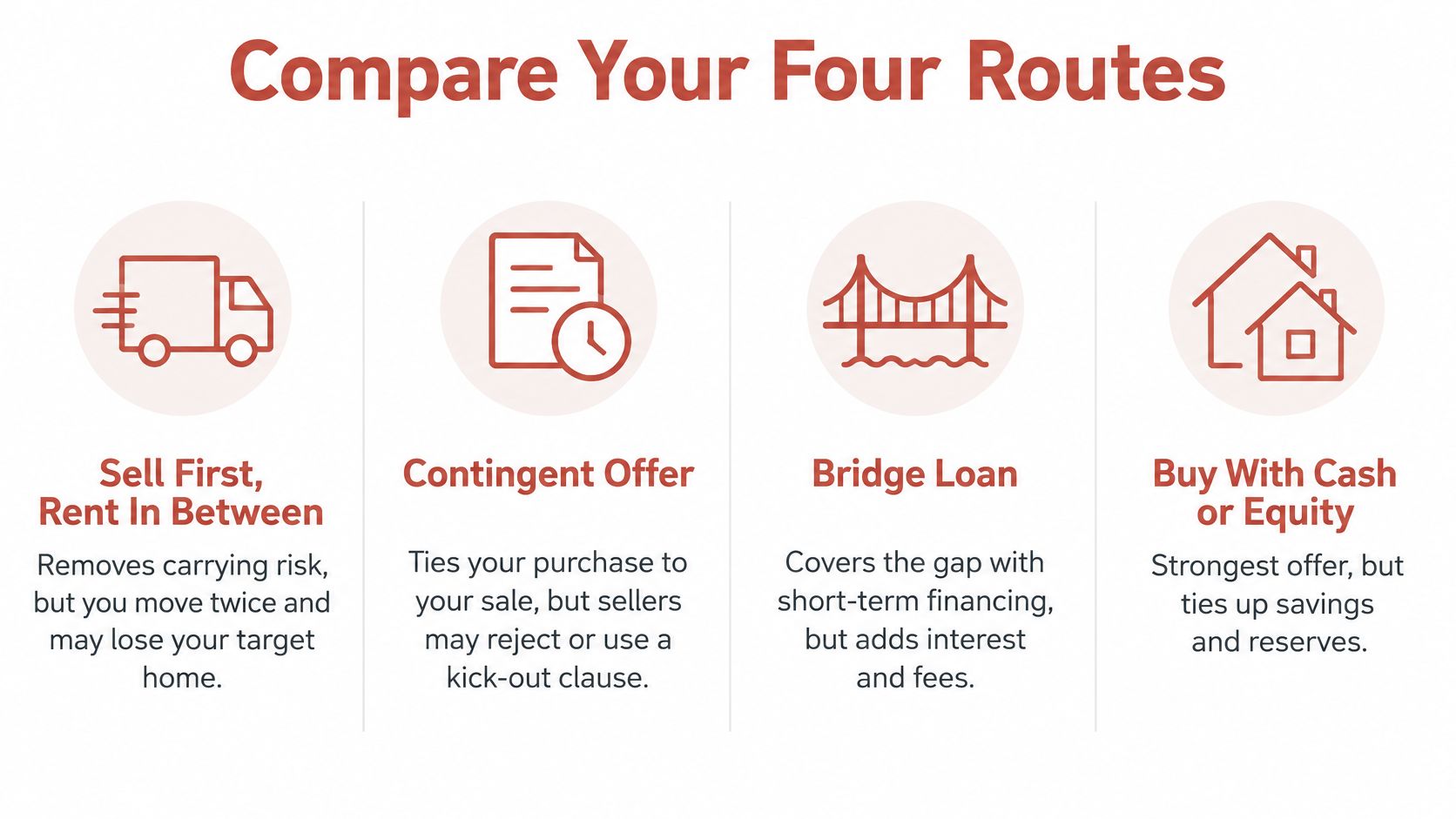
Four ways to buy before selling
| Route | How it is funded | Main risk | Best fit |
|---|---|---|---|
| Sell first and rent | Proceeds from the current home sale | Two moves and rent in between; may lose the new home | Stable finances and flexible timing |
| Contingent offer | Proceeds from the current home at closing | Sellers may reject it in a competitive market | Buyers who can accept a weaker offer position |
| Bridge loan while listing | Bridge loan repaid from the sale | Interest, fees and overlapping mortgages | Strong equity and cash reserves |
| Home-equity line plus reserves | Credit line and savings | Added monthly debt that can lower approval | Buyers with reserves and clear qualification |
The routes solve different problems. Selling first removes the uncertainty around your sale proceeds. A contingent offer connects the transactions contractually. Bridge financing or a home-equity line gives you access to money before the sale closes, but neither makes the ongoing costs disappear.
Choose the inconvenience you can afford
Selling first and renting temporarily is often the cleanest financial option. You know what you've netted, your old mortgage is paid off, and you can shop without depending on an unfinished sale. The trade-off is disruption: temporary housing, storage, another move, and no guarantee that your preferred replacement home will remain available.
A home-sale contingency lets you pursue the next home without committing unconditionally before yours sells. In 2024, 23% of surveyed U.S. buyers made an offer contingent on selling their old home first, according to Zillow's consumer housing survey. That makes it a familiar approach, not an automatic deal-breaker, although a seller comparing otherwise similar offers may prefer the buyer without a sale dependency.
A bridge loan addresses a different obstacle: you have equity but need access to funds now. The purchase can move forward while the old home is listed, with repayment planned from the sale. You're paying for that flexibility through financing charges and exposure to a delayed closing.
Cash access isn't the same as financial safety
Using savings can avoid temporary borrowing, but spending nearly all your liquid cash on the purchase leaves little protection against repairs or a stalled sale. A home-equity line preserves some savings while creating another payment the lender must evaluate.
Don't choose solely by which route produces the strongest offer. Compare the full transition cost, including temporary housing, financing fees, moving expenses, and the cash you'll retain afterward.
The deciding question: How many months can you carry both properties without needing the old home's sale to close?
Answer that with accessible money, not an estimated property value. If the answer is uncomfortable, a less competitive contingent offer may be the better offer for your household.
How Lenders Count Two Homes in Your Approval
Your approval needs to cover the months when you own both homes. Tell the loan officer that you plan to buy before selling, so the application reflects the actual timing and financing.
Under Fannie Mae's bridge-loan guidance, bridge proceeds may fund a new principal residence before the current home sells. The lender must document your ability to carry the existing home, new home, bridge loan, and other debts. The bridge obligation generally counts as recurring monthly debt. Fannie Mae's guidance provides an exception when you supply a fully executed sale contract and evidence that financing contingencies have cleared.
Ask for approval under the unsold-home scenario
Lenders typically count the current mortgage until you document a signed sale contract and meet the applicable underwriting conditions. They cannot count an asking price as cash available for closing. A listing agreement alone does not establish that your current home will sell or provide proceeds by a particular date.
Debt-to-income ratio, or DTI, compares qualifying monthly debt payments with qualifying monthly income. Borrowing against existing equity may provide funds for the purchase while adding a payment to the DTI calculation.
For budgeting context, California Loans for Heroes describes the 28% and 36% ratio benchmarks. Your lender's approval depends on the mortgage program and your full application.
Use this guide to calculate mortgage affordability and organize your budget before applying.
Get answers that change the purchase plan
Ask the lender these questions before touring homes seriously:
- Qualification scenario: Will you underwrite my purchase while my current home is unsold and not under contract?
- Housing obligations: Which mortgage payments, taxes, insurance costs, and association dues will you include?
- Bridge treatment: How will you calculate the bridge-loan obligation, and what documents could change its treatment?
- Post-closing reserves: How much eligible cash must remain after the down payment and closing costs?
- Approval conditions: What still needs underwriting review before I commit to a closing date?
Ask the lender to put the assumptions in writing alongside the preapproval. A preapproval based on selling first does not establish that you qualify to buy first.
Your preapproval should match the financing sequence you plan to use, not just the purchase price you hope to reach.
Once your current home has an accepted offer, send the contract and its remaining conditions to the lender promptly. The lender can then assess whether the documented sale changes how your obligations count.
Calculate Your Real Net Proceeds Before You Offer
Equity is not your next down payment. Your usable proceeds are what remain after debts, transaction expenses, and other sale-related obligations are paid.
The Federal Reserve's residential mortgage table separately tracks residential mortgages and home-equity borrowing. For your planning, that distinction matters at the property level: an equity loan or credit-line balance belongs on the payoff side of your worksheet, not just in your estimate of available buying power.
Build a seller's net sheet
Start with a conservative sale price. Use a comparative market analysis that considers condition, recent comparable sales, and competing listings. Our website offers a Free Home Valuation, a Mortgage Calculator, a Buyers Guide, and a Sellers Guide. Use the valuation to begin the conversation, then account for the property's actual preparation needs.
Request the mortgage payoff statement and identify every additional secured balance. Include home-equity borrowing and any bridge payoff that will be due from the sale. A statement balance alone may not capture the amount required on the intended closing date.
Subtract the full selling budget. Include negotiated agent compensation, applicable transfer taxes, attorney and title charges, repairs, buyer credits, and moving expenses. Our breakdown of seller closing costs helps organize the categories without treating every transaction as identical.
Compare the remainder with the replacement home's down payment and closing costs. Then separate the cash you must retain from the cash you can spend. A positive balance isn't automatically a comfortable reserve.
Run a lower-price version. Use a plausible weaker offer based on competing homes, not an arbitrary worst-case number. Recalculate the proceeds and determine whether you could still complete the transition without emergency borrowing.

Keep closing cash separate from eventual proceeds
Consider a hypothetical worksheet, not a local cost estimate: a $500,000 sale, minus a $300,000 mortgage payoff and $40,000 in selling expenses, leaves $160,000. A $100,000 down payment and $12,000 in purchase closing costs would leave $48,000 before other obligations or reserves.
The arithmetic works, but the timing still matters. Those proceeds aren't available before the sale closes unless approved financing provides the needed funds. If bridge borrowing supplies the down payment, show its repayment clearly and don't count that money twice.
Potential tax liability deserves a separate review because a settlement statement doesn't necessarily describe your final after-tax position. The Allied Tax Advisors home sale guide provides context for a conversation with your tax adviser; don't assume the entire gain is available to spend.
If there's a shortfall, identify the exact funding source before offering. Additional equity borrowing, refinancing, or borrowing against investments needs its own cost and risk review.
Plan with net proceeds, not gross appreciation, and distinguish future proceeds from money available on purchase day.
Stress-Test a 30, 60 or 90-Day Sale
Bridge interest by time to sell
The interest figures below are a hypothetical illustration, using an assumed annual rate of 8% on a $420,000 balance and simple daily interest calculated as principal × rate ÷ 365. They aren't a lender quote and exclude origination charges, extensions, and other ownership costs.
| Days until the old home sells | What to check |
|---|---|
| 30 days | Illustrative interest of about $2,762. Confirm both housing payments are covered and the home is listed. |
| 37 days | Illustrative interest of about $3,406. Confirm the lender's extension cost before it becomes urgent. |
| 59 days | Illustrative interest of about $5,431. Apply the planned price-reduction trigger if buyer response warrants it. |
| 78 days | Illustrative interest of about $7,180. Recheck affordability against remaining cash. |
| 90 days | Illustrative interest of about $8,285. Prepare for a lower sale price or another documented fallback. |
The balance reflects the $420,000 median buy-before-you-sell loan reported by AFC Mortgage Group's bridge-loan report, which recorded a 59-day median payoff period, with the middle half repaid in 37–78 days. Those are payoff observations, not a promised selling timeline for your Chicago-area property.
Model the cash leaving your account
Bridge interest is only one line. Add both mortgage payments, property taxes, insurance, association dues, utilities, maintenance, and any preparation expenses still unpaid.
Avoid double-counting taxes and insurance already included in escrowed mortgage payments. Also distinguish charges due monthly from interest collected at payoff: deferred collection may reduce immediate cash needs, but it still reduces eventual proceeds.
Use this worksheet structure for each timing scenario:
- Starting liquidity: Cash remaining after the purchase, excluding funds committed elsewhere.
- Ongoing shortfall: Combined ownership expenses less the amount your regular income can comfortably cover.
- Exit costs: Bridge payoff, possible extension charges, remaining selling expenses, and a lower-price allowance.
- Protected cash: Money you won't spend because you need it for household emergencies.
Your workable runway ends when the next delay would consume protected cash, not when your bank balance reaches zero.
Set the response before the pressure builds
Choose a written review date for the listing and define what would justify repricing, such as weak showing activity or consistent objections about condition. Don't wait until financing maturity to discuss a reduction.
Ask the lender for the maturity date, extension conditions, extension cost, and consequences if the sale hasn't closed. Confirm whether any extension requires fresh approval.
Use our guide to how long closing takes to distinguish finding a buyer from completing the sale. For the physical move, TLC Moving & Storage lets you browse moving timelines by countdown, helping you keep packing and utility arrangements aligned with the transaction rather than an optimistic listing date.
Lock Down Contingencies, Deadlines and Kick-Out Clauses
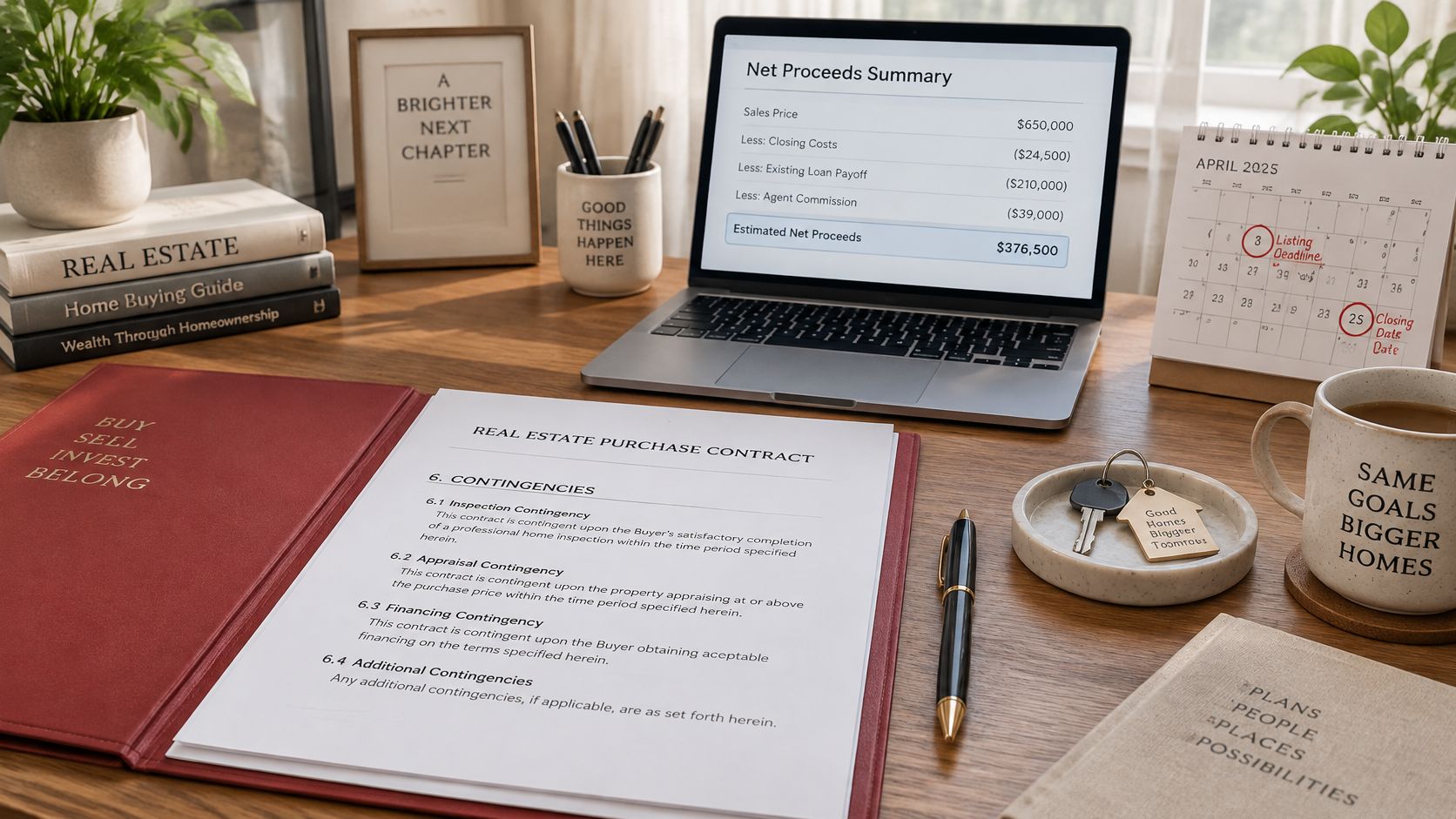
Suppose your offer depends on bringing cash from your current home, then the sale closes for less than expected or the proceeds arrive after your purchase must be funded. The contract needs to say what happens in both cases. Keep financing and inspection protections unless you understand the specific risks of waiving them. The Consumer Financial Protection Bureau's homebuying guidance explains how these contingencies protect buyers if financing fails or serious defects emerge.
Make the sale dependency specific
Write down what must happen, the deadline for each step, and what happens if a deadline is missed. Ask your agent and attorney to address when the home must be listed, when you need a signed sale contract, what settlement conditions apply, and how either side can request an extension or cancel.
If the purchase requires a minimum amount from your sale, specify that amount in the funding plan and contract discussions. For example, if you need $80,000 in proceeds to close and the sale leaves you with $70,000, you have a $10,000 shortfall to cover before the purchase can fund.
A kick-out clause may allow the seller to keep marketing the property and require you to respond if another acceptable offer arrives. Confirm how notice is delivered, how long you have to respond, and what proof is required to remove the contingency. Don't promise to remove it unless your lender has approved the replacement financing and you can access the funds.
Give each task an owner and deadline
Put the execution steps on a shared calendar:
- Compare lender proposals: Request written options based on the same purchase and sale assumptions, including temporary financing charges.
- Order payoff information: Confirm which debts must be paid and update payoff figures for the expected closing.
- Prepare the sale: Complete the comparative market analysis, prioritize necessary repairs, and prepare the listing materials.
- Set the listing date: List before or shortly after the purchase offer unless your documented financing plan supports another sequence.
- Coordinate settlement: Ask the closing professionals to confirm in writing that sale proceeds will be disbursed before the purchase funding deadline.
- Document the fallback: Set listing review dates, pricing responses, and responsibility for informing the lender and attorney about changes.
Negotiate around the seller's real concern
For a Melrose Park or western-suburb purchase, review recent pending sales on the same street or nearby blocks. Check whether those transactions involved sale contingencies, how long they took to go under contract, and whether the homes were in similar condition. That gives you a closer comparison for discussing your terms with the seller.
A prepared property and credible asking price can make the sale side of your offer easier to assess. The seller may still prefer an offer with fewer dependencies, so consider whether a later closing or documented temporary occupancy arrangement addresses the seller's timing needs. A longer inspection period alone may not.
Check for an equity deficit before relying on sale proceeds. If your home is worth less than its mortgage balance, the sale may require you to bring cash instead of providing funds for the next purchase. A short sale requires servicer approval, so resolve that issue before making an offer that depends on proceeds.
Decide Whether Buying First Fits Your Situation
You have lender approval for the purchase, but your current home has not sold. Before making an offer, check whether your available cash can cover the overlap if the sale takes longer than planned. Net worth may look strong on paper while your monthly cash flow is too tight to carry two homes.
Use a proceed-or-pause test
| Proceed when | Pause or change the sequence when |
|---|---|
| The lender has reviewed the actual funding plan | Approval assumes a sale that hasn't happened |
| Accessible reserves cover a meaningful delay | Ordinary delays would require emergency borrowing |
| A weaker sale price still leaves a workable outcome | A necessary reduction would erase the funding plan |
| Loan maturity and fallback terms are understood | Repayment depends on an unconfirmed extension |
| Your home is ready to compete for buyers | Repairs, pricing, or listing preparation remain unresolved |
Choose a sell-first or contingent-offer route when the cash cushion is thin, the home needs substantial preparation, or a price reduction could leave you short. Do not make a full-price offer you cannot cover with the delayed-sale budget.
A valuable property adds to net worth, but it may not provide cash for overlapping bills. Set aside the money needed for the purchase and moving costs, then identify what remains available for mortgage payments, taxes, insurance, utilities, and loan repayment if the sale runs late.
Turn the decision into action this week
Gather your mortgage statement, equity-line information, recent income documents, and accessible-account balances. Write down the purchase cash you need and the amount you want to keep available after the move.
Homes By Carmen offers a free expert home valuation and strategy call for homeowners considering a sale. Use neighborhood comparables to inform your sale assumptions, then ask your lender to review approval with the current home still unsold. Confirm the funding and closing timeline before making an offer.
You do not need certainty about the sale date. You need enough cash to manage a delay, clear contractual protections, and an agreed response if the sale takes longer than expected.
Homes By Carmen offers a free expert home valuation and strategy call to help you evaluate selling your current property while planning the next purchase. Visit Homes By Carmen to schedule a consultation, review your likely net proceeds, and discuss a buying-and-selling sequence to confirm with your lender.