You've found a unit you can live with, run the numbers against your budget, and the rent comes back a couple of hundred dollars above what feels fair. Or your renewal offer lands with an increase that looks copied from a different building. Most renters accept it. The ones who don't tend to fall into two camps: those who send an emotional email about loyalty and get a polite no, and those who show up with verified comparables, a clean application, and a specific number everyone can evaluate.
The second group wins far more often, and not because they're tougher negotiators. They win because they've worked out what the landlord is weighing: the cost of a vacant unit versus the cost of a small concession, and whether the person asking looks like a safe bet for twelve months. The pattern holds across Chicago and the western suburbs. Price talk fails when it ignores the market, the paperwork, or the renewal clause. It works when you make a defensible ask at a moment when the landlord has something to lose.
Table of Contents
- Read the Market Before You Ask for a Lower Rent
- Build a Comparable-Rent Packet the Landlord Will Trust
- Negotiate Lower Rent Step by Step and Sign Only on Verified Terms
- What to Ask For When Base Rent Won't Move
- Concessions That Expire and What They Cost at Renewal
Read the Market Before You Ask for a Lower Rent
A landlord with several empty units and a slow month will hear a lower number. A landlord whose last vacancy filled in nine days will not. Before you write a single sentence about price, find out which building you are talking to. That read decides whether a base-rent cut is a reasonable ask or a request that burns goodwill and still gets refused.
Start with the national backdrop. The U.S. Census Bureau's housing vacancy reporting puts the rental vacancy rate at 10.7% in the fourth quarter of 2009, during the housing crisis, when renters had the most room to push. That fell to 6.4% by the fourth quarter of 2019, hit 5.8% in the first quarter of 2022, and has since loosened to an annual rate of 6.6% in 2024 and 7.1% in 2025. Higher vacancy means a landlord who says no to a small cut risks a unit sitting empty, so concessions get easier when availability climbs.
National numbers tell you the mood. Local numbers tell you the price. Chicago has been running its own weather.
The Chicago signals that matter more
Multifamily vacancy in the city sat at roughly 4.4% in the second quarter of 2026, while neighborhood concessions averaged only 0.60% of asking rent, down from 1.03% a year earlier, according to REjournals' coverage of the Chicago multifamily market. By the third quarter, average effective rents had risen 4.3% year over year and neighborhood concessions had narrowed to 0.84% of asking rent, about $24 a month. Limited supply, rising rents, thin giveaways.
I judge every offer by total effective cost and by renewal exposure, not by the advertised monthly rent. A small first-year cut that resets to a higher base in twelve months costs more than a modest concession written into the term you will pay.
| Market condition | Vacancy or concession signal | What it means for your ask |
|---|---|---|
| Loose national market, Q4 2009 | 10.7% rental vacancy | Renters had the most room to ask for a base-rent cut |
| Tight national market, Q4 2019 | 6.4% rental vacancy | Fewer concessions; focus on fees and lease terms |
| National annual figure, 2025 | 7.1% rental vacancy | Moderate room to negotiate; check how long the unit has been listed |
| Chicago multifamily, Q2 2026 | About 4.4% vacancy; concessions 0.60% of asking rent | Base-rent cuts are unlikely; ask for add-ons |
| Chicago neighborhood concessions, Q3 2026 | 0.84% of asking rent (about $24 a month) | Concessions are small; total effective cost matters more |
Read the table from loosest market to tightest. In a 10.7% vacancy environment, a straight request for lower rent is a normal business conversation. In a 4.4% environment with about $24 in average concessions, it usually is not. Move the ask to line items the building can change without repricing the asset: fees, parking, utilities, and lease dates. Pushing a headline cut in that second market often backfires. The landlord hears an unserious number, the talk stops, and the renewal language you skipped is what raises the rent next year.
Three checks you can run in an afternoon
You do not need a subscription database to grade your own building. Three looks are enough.
- How many comparable units are listed right now in the same building or within a few blocks. Five or more with similar specs means the landlord is competing for tenants. One or two means the building is full.
- How many weeks the target unit has been advertised. A listing that keeps reappearing has an owner already counting vacancy cost.
- What you bring to the table. A qualified applicant with documents ready, in a tight building, offers speed and certainty rather than a cheaper rent. A half-empty building in a soft month puts price on the table.
For a wider read on how vacancy, rents, and household formation move together, the Statlyst housing statistics library keeps the national series in one place. That context helps when your neighborhood is tracking differently from the metro headline. Get the steps in the rental application process in order first. An incomplete file gets ignored no matter what the vacancy rate says.
Build a Comparable-Rent Packet the Landlord Will Trust
An unsupported request for a discount is a negotiation about feelings. A packet is a negotiation about numbers. The landlord can disagree with a packet, but they have to engage with it, and engagement is what you want.
Start with three to five currently available units that match your target on location, size, condition, amenities, lease length, and included utilities. Pull them from the same building first, since that kills the easiest objection, then from nearby western-suburb listings if the building is thin. The Academic study of tenant renegotiation outcomes is a useful reality check on how these asks land: among tenants who tried to renegotiate an existing tenancy, 29% persuaded the landlord to lower the rent, 57% paid the same, and 14% paid more afterward. A specific, data-backed proposal is what separates the first group from the third.
Adjust every comparable line by line
Raw asking rent is a bad comparison. Here's the checklist I'd use, and the adjustment each factor requires.
| Factor | What to match | How to adjust the comparison |
|---|---|---|
| Location | Same building or nearby neighborhood | Adjust for commute time and transit access |
| Size and layout | Same bedroom and bathroom count, similar square footage | Divide rent by square feet to compare fairly |
| Condition and amenities | Appliances, in-unit laundry, parking | Subtract the value of any amenity the target lacks |
| Lease length | 12-month term versus 15 or 18 months | Compare monthly cost, not headline rent |
| Included utilities | Heat, water, trash, internet | Add the estimated cost of utilities the target unit excludes |
| Move-in timing and fees | Days on market, application and pet fees | Calculate effective rent after one-time costs |
Say you're comparing a $1,950 two-bedroom in the same building against your target unit at $2,100. Identical square footage, but the comparable includes heat and a parking space while yours charges for both. If heat runs about $90 a month in winter and parking is $75, the comparable's real cost to you is closer to $2,115, which means your target isn't overpriced at all. That's the kind of line-by-line adjustment that stops you from making an argument you'll lose.
Now run it the other way. If the comparable is $1,950 with heat and parking included and your target is $2,100 with neither, your effective gap is roughly $315 a month, and you have a real case for a base-rent conversation.
The one-page rule: If your packet needs a second page, the landlord won't read it. One sheet, one row per comparable, one total at the bottom.
What goes on the sheet
List each unit with its address, asking rent, every adjustment, and its effective monthly rent after concessions. Include a listing link or a dated screenshot the landlord can verify in thirty seconds. Verified only. An overstated competing offer is the fastest way to lose credibility in a conversation that runs on it, and property managers talk to each other about applicants who waste their time.
Carry two numbers into the negotiation: the average effective rent of your verified comparables, and the gap between that average and your target unit's asking rent. Everything you say afterward is a discussion about that gap.
Finding candidates worth comparing takes more than one aggregator. Use a rental property search that lets you filter by building, transit, and amenities so your comparables are comparable on features rather than merely nearby.
Negotiate Lower Rent Step by Step and Sign Only on Verified Terms
You have a complete application, verified comparable rents, and a unit you're ready to take. Now make a specific offer the landlord can assess, then get every accepted term into the lease. The order matters: a strong application reduces perceived risk, while a concrete offer gives the landlord a clear decision.
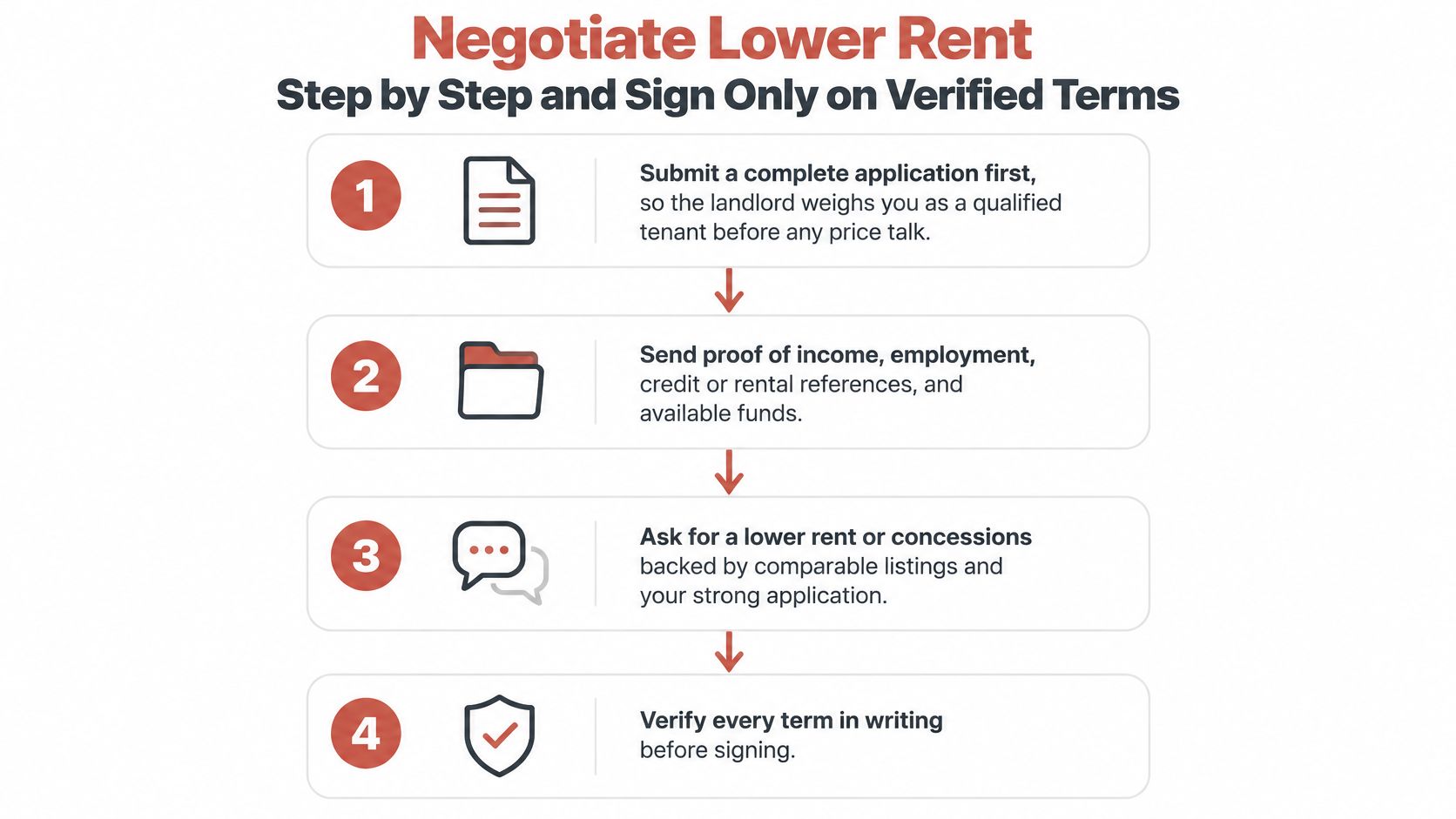
The five-step sequence
1. Submit a complete application first. Have your application ready before opening a rent discussion. A landlord is more likely to consider a concession when they can assess you as a qualified applicant rather than an uncertain prospect.
2. Provide documents that support your application. Share proof of income, employment verification, credit or rental references, and evidence of available funds for the deposit and first month. A clear, complete file makes it easier for the landlord to judge the risk of approving you.
3. Cite verified comparable effective rents and name a number. Say: “The three closest comparable units average $1,880 effective, and this one is listed at $2,050.” Then pause and let the landlord respond.
4. Offer something in return. A 15- or 18-month lease, a flexible move-in date that fills a vacancy, or prompt signing may make your proposal more attractive. Only offer terms you can keep, and consider how the longer commitment affects your ability to move later.
5. Put any concession in writing. The lease or a signed addendum should state the value, start date, and whether the concession affects the deposit or renewal calculation.
Show the landlord the math they already run
A concession is a cost the landlord chooses to pay to avoid a bigger one. Reporting on the 2024 apartment glut put average leasing concessions at roughly 5% of annual rent. A landlord-focused analysis estimated an eviction costs about $3,500, including two to four months of lost rent plus court, labor, and cleanup expenses, according to The Guarantors' analysis of vacancy versus bad debt.
Compare those costs in your own offer. A $100 monthly reduction on a 12-month lease costs the owner $1,200. One month of vacancy at $2,000 costs $2,000, before marketing and turnover. A landlord may prefer a modest reduction if it helps secure a tenant and avoid an empty unit. Keep the case focused on the numbers.
Concessions are more plausible when comparable inventory is available, the unit has been listed for several weeks, or your move-in date reduces vacancy. If none of those conditions apply, the landlord has less reason to accept a discount.
Make the ask conditional
A conditional offer gives the landlord a clear exchange to consider: “I'll sign a 15-month lease today at $1,950.” Set your walk-away point before the conversation, based on total effective cost and renewal exposure. A lower advertised rent can still be a poor deal if fees or a rent increase at renewal erase the savings.
If the full package does not beat your best verified comparable, keep looking. Your rental packet can support the next offer, too.
What not to do
- Don't invent competing offers. A landlord may check, and a false claim can damage your credibility.
- Don't accept verbal promises. A waived parking fee has no value at move-in unless the lease or a signed addendum records it.
- Don't prepay excessive rent to buy a discount. You give up cash and flexibility, while the renewal terms still need attention.
- Don't trade away inspection or documentation protections. A lower rent does not justify accepting a unit you cannot verify or a defect you cannot document.
- Don't push hard when the building is full. When several applicants are ready, a complete file and prompt decision may matter more than a low opening offer.
Chicago renters dealing with a dispute over repairs, a deposit return, or a lease term can review out-of-court help for Los Angeles renters for an example of how a third party can help restart a stalled conversation. Keep your own negotiation factual and documented, and protect the relationship where possible.
A client said Carmen negotiated their price down by $100 per month plus one month of rent-free. Judge any offer by the total cost across the lease and what happens at renewal, not just the advertised monthly rent.
What to Ask For When Base Rent Won't Move
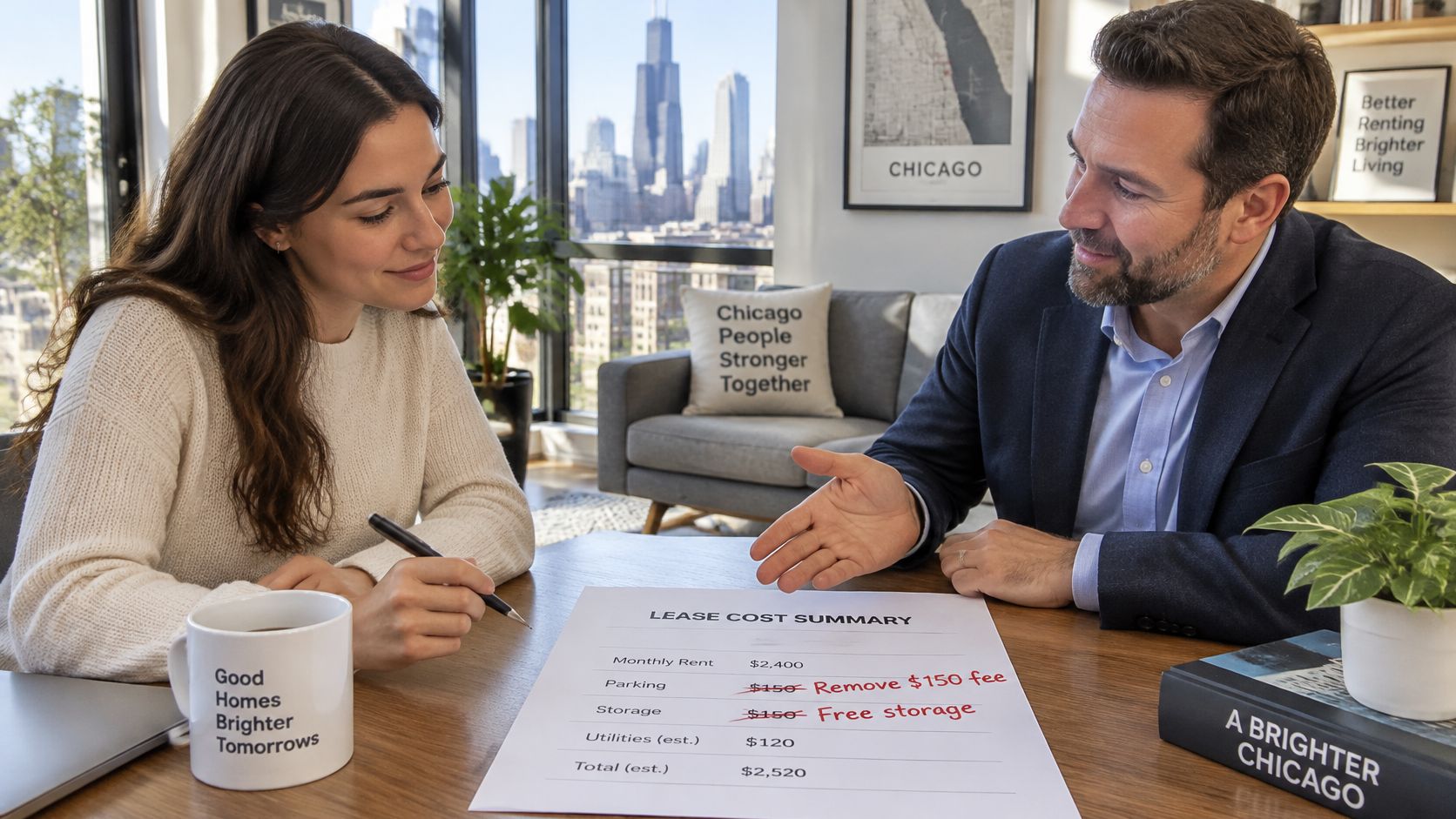
A landlord may refuse to lower monthly rent but agree to include parking or cap the next increase. With concessions thin, the base rent is often the last term to move. Judge every offer by its total cost over the lease and what it leaves you facing at renewal.
Ask, “What can change besides the rent?” Then compare the value of each option with what you would otherwise pay. A concession can look generous upfront and still cost more if it expires or shifts expenses elsewhere.
| Concession | Approximate value | Best when | Possible drawback |
|---|---|---|---|
| One month free on a 12-month lease | One month's rent | The unit has sat empty for several weeks | May be followed by higher rent at renewal |
| $100 monthly reduction on a 12-month lease | $1,200 over the lease | Comparable units support a lower price | Landlord may resist changing base rent |
| Waived application or admin fee | The fee amount, often a few hundred dollars | Several applicants compete for the unit | Value depends on local fee rules |
| Parking or storage included | The monthly fee you no longer pay | The building has unused spaces | Availability may be limited |
| Utilities included | Estimated monthly utility cost | The building already pays for heat or water | The cost may be added to rent |
| Renewal increase cap | Limits the second-year increase | You expect a renewal negotiation | May require a longer term |
The arithmetic behind a free month
On $2,000 rent over a 12-month lease, one free month saves $2,000, about 8.3% of the annual cost. That can outweigh a small monthly reduction, while giving the landlord a way to preserve the advertised rent and comparable prices. The trade-off is duration: the credit ends, and the rent may return to its full amount at renewal.
Apply the same calculation to any one-time credit. A $1,500 move-in credit on a 12-month term is worth $125 a month in year one and nothing in year two. Compare that with a recurring reduction or a written renewal cap before deciding.
Match the concession to your situation
Choose based on your cash needs and how long you expect to stay. If your income and credit are strong but cash is tight, ask about splitting the deposit or delaying a move-in payment. If you have cash and plan to stay, a renewal cap may protect you longer than a free month. If the unit has been listed for weeks, asking for a free month may be more practical than insisting on a lower base rent.
Pick the concession that lowers your total two-year cost, not the one with the biggest first-month headline.
When to stop pushing
A highly occupied building, a unit with a waitlist, or a landlord who has stated that the price is fixed leaves less room to bargain. Make one reasonable request, submit a complete application, and be ready to decide. Repeated pressure can work against you when the landlord has other applicants and values a straightforward lease process.
If rent may be difficult to sustain with a subsidy or voucher, review rental assistance basics before agreeing to terms. Make sure the monthly obligation and any renewal increase fit your budget, rather than relying on a temporary concession to make the first year affordable.
Concessions That Expire and What They Cost at Renewal
Here's the trap that catches careful renters. A concession can lower your first-year cost while leaving renewal rent untouched or higher. Win the headline, lose the second year.
Work the numbers on a unit advertised at $2,000 with one month free on a 12-month lease. First-year cost is $22,000, which works out to about $1,833 a month. Excellent. Now assume the renewal returns to the full $2,000 and the landlord applies a 5% increase. Year two costs $2,100 a month, and you've lost more in the second year than you gained in the first unless you negotiate again.
Compare both years before you sign
Put two figures on one line and look at them together: first-year effective rent and likely renewal exposure. Ask the leasing office directly whether the advertised incentive changes the renewal rent, and whether any renewal cap is written into the lease. Get the answer in writing. A cap tied to a longer initial term is often available and almost never offered unless you ask.
The deposit is its own negotiation. A national market report found landlords' strongest guardrail was refusing to waive the security deposit entirely, even when vacancy encouraged other concessions, per Realtor.com's August 2026 rent research, which also found that 43.5% of listings for zero- to two-bedroom homes across the 50 largest U.S. metros offered concessions in August 2026, up from 40.4% a year earlier. So the practical versions of that ask are a split deposit or a later payment date, subject to local law and landlord policy, not elimination.
Concessions are common. Their terms are not standard, which means nobody will volunteer the expiration date if you don't ask.
Existing tenants have the better seat
If you're already in the unit, your position is different and often stronger. No screening risk, no vacancy gap, no turnover cost. In the fourth quarter of 2023, 34.17% of renters attempted to negotiate a rent increase at renewal and 19.85% of renewing renters succeeded, according to Avail's 2023 annual rental report. Start the conversation well before your notice deadline, ideally two to three months out, and come with the same verified comparables you'd use as a new applicant. A landlord looking at a possible vacancy in ninety days is a different negotiator than one with your renewal signed.
If you'd rather not run this solo in a market this tight, Homes By Carmen works with renters across Melrose Park, Elmhurst, Oak Park, Naperville, and the surrounding western suburbs on search, applications, and the terms themselves. We help clients buy, sell, and rent homes, and that includes building the comparable packet, timing the ask, and reading the renewal clause before you sign it. Reach out to schedule a consultation or get your real estate questions answered, and visit Homes By Carmen to start the conversation before your next lease term begins.