
An as-is sale does not give either side a free pass. The buyer accepts the home in its current condition, and the seller generally will not make repairs or provide repair credits. Illinois disclosure duties and the inspection or financing terms written into the contract still matter. The advice to either fix everything before listing or refuse to discuss condition can create problems for sellers in Melrose Park and the western suburbs.
As-is changes who carries the repair bill and how much room each side has to negotiate. Buyers may still have an inspection contingency, and sellers still have paperwork to address. The contract, not the listing label, determines where the parties have bargaining power. Understanding that split makes what is an as-is home sale a practical pricing decision, not a warning label.
Table of Contents
- What an As-Is Home Sale Means in Practice
- Inspection Rights That Survive an As-Is Clause
- Illinois Disclosure Duties an As-Is Clause Cannot Erase
- How As-Is Pricing Shifts the Repair Bill
- When As-Is Helps and When It Costs Too Much
- Three Hypothetical Chicagoland Homes Sold in Current Condition
- Decide Your As-Is Move with Local Numbers
What an As-Is Home Sale Means in Practice
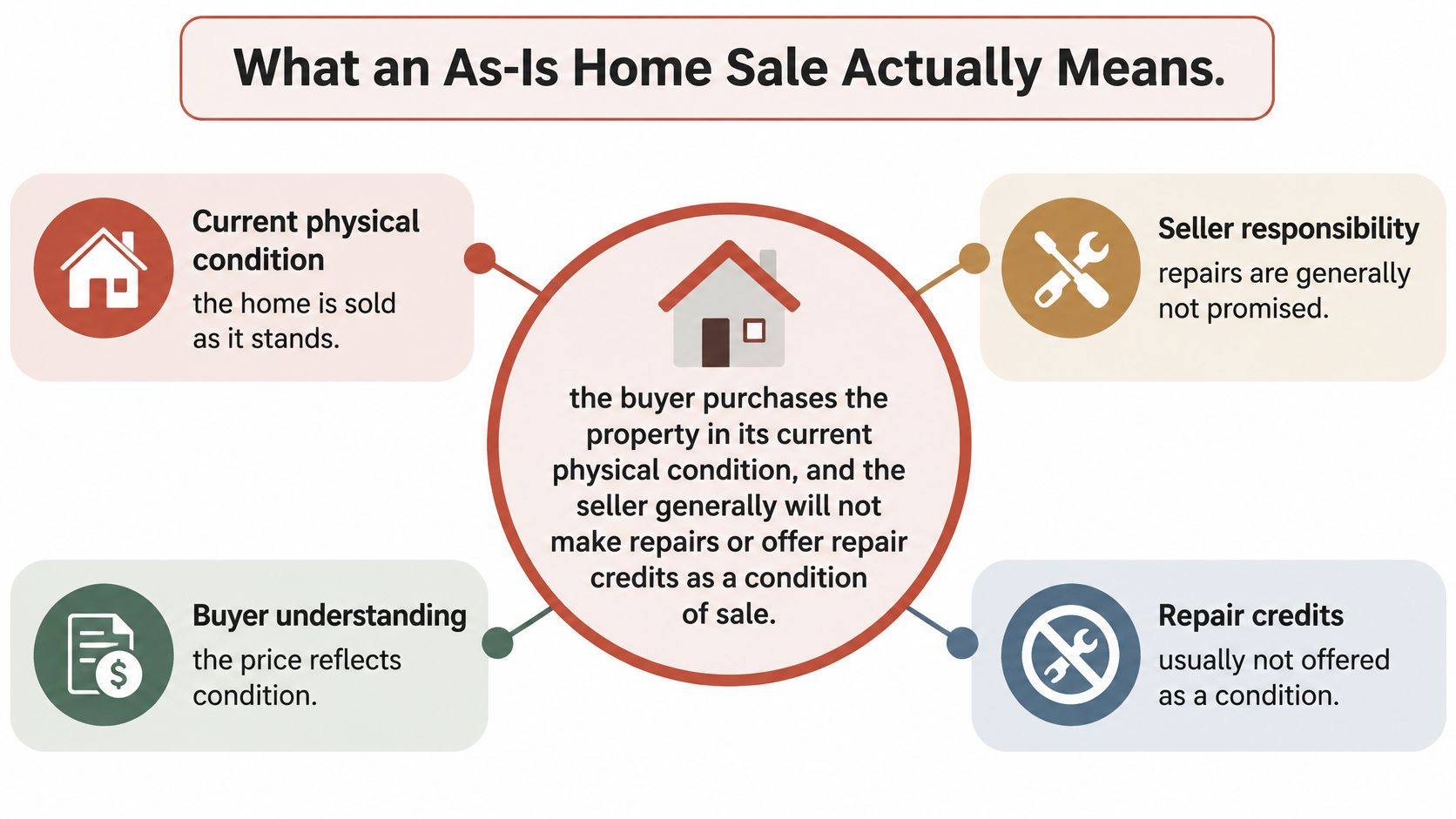
An as-is label is a starting position on repairs, not a complete set of deal terms. The buyer purchases the property in its current physical condition, and the seller generally does not agree to make repairs or offer repair credits as a condition of closing. The signed contract still determines what each side must do.
A used car sold without a promise of new brakes is not automatically sold without a chance to inspect it first. The same distinction applies to a home: accepting its condition does not, by itself, settle every inspection or contract question.
Three Questions an As-Is Label Does Not Answer by Itself
| Question | What as-is usually means | What still applies | Who should check it |
|---|---|---|---|
| Repair obligation | Buyer accepts current condition; seller generally declines repairs and repair credits | Parties can still negotiate credits if the contract allows them | Contract repair and credit language |
| Disclosure obligation | Listing label does not waive known material defects | Illinois sellers of covered homes must disclose known material defects; fraud and misrepresentation still apply | Residential Real Property Disclosure Report and seller knowledge |
| Contract remedies | Not an automatic waiver of inspection, financing, or cancellation | Inspection, financing, and cancellation rights exist only if the contract says so | Offer deadlines, contingency wording, and attorney review |
The first row concerns condition risk. A buyer takes the house as it stands, whether that means a dated kitchen, a tired furnace, or a worn roof. The seller is not promising to update the property to a renovated standard before closing.
Disclosure is a separate matter. Calling a property as-is does not erase what the seller knows about it. The applicable disclosure duties and forms still matter, so buyers should distinguish known property issues from the seller's position on repairs.
Contract remedies depend on the signed terms. The offer's deadlines and contingency wording determine whether a buyer may inspect, request a concession, or cancel. In a Melrose Park or western suburbs deal, the label on the listing does not settle those questions; the contract does.
The label states the seller's starting position on repairs. The contract tells you what either side can do next.
The Consumer Financial Protection Bureau home inspection guidance recommends arranging an independent inspection promptly. A serious defect, such as a cracked foundation, may change the buyer's decision and expected costs. Inspection findings deserve attention even when the seller does not plan to make repairs.
Inspection and Appraisal Do Different Jobs
An inspector evaluates the home's physical condition and flags potential repair problems for the buyer. An appraiser estimates market value for the lender. Loan approval does not establish that the house is in sound condition, because the two professionals assess different things.
Ask about flooding, prior damage, and improper past repairs. What a seller must disclose depends on applicable law and the forms used, while the buyer still needs to budget for the property's condition. In western suburbs with older homes, those questions are practical due diligence, not an accusation.
Before pricing a listing or submitting an offer, identify the issue in front of you: repair costs, the seller's knowledge, or the rights written into the contract. They are separate parts of the transaction, and treating them as one can blur where the actual cost and negotiating room lie.
Inspection Rights That Survive an As-Is Clause
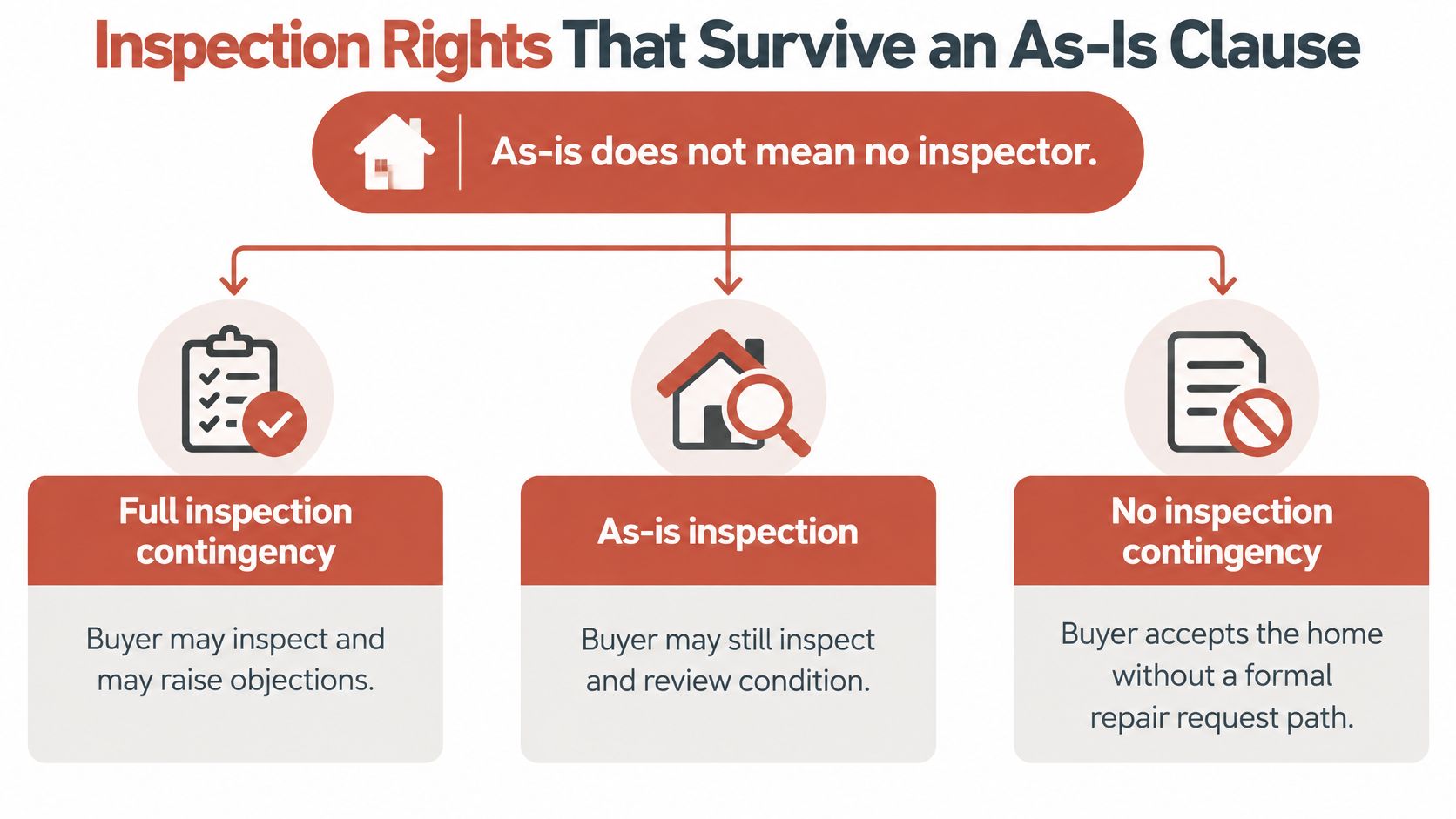
Read the inspection right first. An as-is clause shifts repair risk, but the contract decides whether the buyer can inspect, object, or cancel. Most sellers still accept an inspection contingency, so an as-is label alone does not mean a buyer must waive one.
What an As-Is Offer Can Still Let the Buyer Do
| Offer path | Inspection | Repair or credit request | Way out if defects are serious |
|---|---|---|---|
| Inspection contingency with objection rights | Yes, within the contract deadline | Possible if the contract allows repairs or credits | May cancel if the contract gives that right |
| As-is with inspection, no repair obligation | Yes, to assess the property | The buyer can ask, but the seller is not required to fix anything | May terminate only if the contract allows it |
| Waived inspection | No professional inspection after acceptance under this path | No | No inspection-based exit unless the contract provides one; financing is separate |
With objection rights, the buyer has a defined window to inspect and respond. The parties can discuss repairs, a credit, or cancellation only as the contract permits. For practical steps on making a focused request, see this guide to how to negotiate repairs after a home inspection. Tie any request to specific findings rather than a general demand to improve the property.
The as-is inspection path serves a different purpose. The buyer can learn about the home and decide whether its condition fits the budget, but cannot compel the seller to make repairs. Whether the buyer can still walk away depends on the termination language, not on the phrase “as-is.”
Waiving inspection gives up a useful chance to assess the home's condition after acceptance. That trade-off may suit a buyer who already understands the property and has allowed for unknown repairs in the offer, but it leaves less room to respond to surprises.
Sellers Still Accept Inspections More Often Than Buyers Expect
The Illinois State Bar Association guide to buying a home explains that a buyer's options to seek repairs, renegotiate, or terminate depend on the contract. It does not establish a specific recommended inspection-contingency period. If inspection cannot happen before an offer, spell out the deadline and the buyer's rights in the contract rather than relying on general guidance.
Zillow's 2025 Consumer Housing Trends data reports that 54% of sellers received at least one inspection-waiving offer. Yet 64% of sellers overall and 61% of sellers receiving such an offer ultimately chose an offer with an inspection contingency, and 58% of accepted offers were contingent on passing a home inspection. Those figures show why buyers in Melrose Park, Elmhurst, and Oak Park should not assume that every as-is seller expects a blind purchase. A strong price, dependable financing, and a short, clearly written inspection window may still make an offer attractive.
Four Lines to Find in the Paperwork
- Deadline length: Check the exact number of days to inspect and submit objections. Do not rely on a verbal summary.
- Who pays: Confirm who orders and pays for the inspection. The contract controls.
- Credit or cancellation: Determine whether objections allow a repair discussion, a credit request, termination, or some combination.
- Financing stays separate: Resolving the inspection terms does not settle loan approval or appraisal issues.
A lower price does not replace a careful contract review. Compare the discount with the repairs the buyer may have to fund, then confirm whether the written inspection terms still allow an exit if the findings exceed the budget.
Illinois Disclosure Duties an As-Is Clause Cannot Erase
Illinois sellers still owe accurate disclosure on an as-is sale. The clause may shape who pays for repairs, but it does not remove the seller's duty to report known material defects. That distinction can matter after closing.
The Illinois Residential Real Property Disclosure Act provision states that the disclosure report does not prevent the parties from agreeing to sell property in “as-is” condition. Covered sellers must still disclose known material defects before the contract is signed. A seller can decline to make repairs and still has to give the buyer accurate information.
What Counts as Material
A material defect is a condition that substantially harms the property's value or significantly affects occupants' health or safety, unless the seller reasonably believes the condition was corrected. That standard is narrower than every scuff, squeak, or dated fixture.
Known issues such as recurring basement seepage, a failing roof, or structural movement belong in the disclosure conversation. Sellers are not expected to inspect the home for problems they do not know about. The duty concerns what they know.
Practical rule: As-is answers who fixes it. Disclosure answers what you knew and when you said it. Keep those questions separate.
The buyer generally accepts the home's existing physical condition and cannot automatically require the seller to correct defects. A seller may still face liability for knowingly false or omitted information. That is the difference between condition risk and knowledge-based misrepresentation.
The Form Does Not Replace an Inspection
The disclosure form says it is not a substitute for inspections or warranties. A completed form is not a clean bill of health, and rushing through it as a formality can leave important facts unclear.
Timing matters, too. The contract and the timing of disclosure affect whether a buyer can terminate or renegotiate, so late delivery of accurate information may reopen questions a seller believed were settled. If relevant conditions change or new information comes to light after disclosure, ask an attorney whether and how the buyer should be updated.
A seller who disclosed basement dampness in March then sees water coming through a wall in June has a new fact to address. The original form does not describe the later water intrusion. The seller should raise the change with an attorney promptly rather than assume the signed disclosure settles it.
A Seller Workflow That Holds Up
- Complete the report from actual knowledge. Review each room and system, and describe what you know without polishing the answer.
- Keep the supporting paperwork. Gather repair invoices, prior inspection notes, permits, and warranty documents in one folder.
- Write the as-is clause precisely. Confirm whether it addresses repairs, credits, inspection objections, or some combination. A vague label does not settle those terms.
- Confirm timing with an attorney. Have the disclosure delivery and contract language reviewed before accepting an offer.
For an inherited or long-held home in Melrose Park or the western suburbs, records may be limited. State what is known, identify what is uncertain, and avoid presenting a guess as fact.
How As-Is Pricing Shifts the Repair Bill
An as-is price reflects a negotiated split between known condition and unknown repair risk. The label alone says little about the home's quality or the size of its repair needs. Buyers should compare the purchase price plus immediate repairs and later work against the cost of a similar home in better condition. If the repairs consume the discount, the buyer is paying for deferred maintenance rather than getting a bargain.
Where the Repair Bill Can Still Land
| Cost or hurdle | Usual as-is result | Can still change the deal | Buyer action |
|---|---|---|---|
| Known repairs the seller refuses | Built into a lower price | A credit only if the contract allows one | Get bids before the contingency ends |
| Hidden or deferred systems | Buyer's budget after closing | Cancellation if the inspection contingency allows it | Separate immediate work from later maintenance |
| Appraisal below price | Lender values the home, not the as-is slogan | Renegotiation, more cash, or a failed loan | Keep financing contingency separate |
| Insurance or lender condition | Not cured by the seller's refusal to repair | Delay or denial even after a signed contract | Ask insurer and lender early |
As-is sales are not limited to distressed properties. In the Clever Offers 2025 survey, 51% of 500 Americans who sold homes between early 2024 and early 2025 sold their homes as-is without significant repairs or upgrades. The same survey found that half of the sellers skipped significant repairs, a reminder that sellers may choose to save time and cash rather than prepare a house for the market.
Why a Steep Discount Can Disappear
Three costs can quickly narrow the gap between an as-is price and a move-in-ready home. Contractor bids may exceed the rough estimates made during a showing. An insurer may object to an aging roof, outdated electrical service, or water history, and a seller's refusal to repair will not resolve that concern. A lender may also require work that the parties did not account for when setting the price.
The inspection and appraisal affect the deal in different ways. Inspection findings help the buyer estimate the repair budget, while a low appraisal raises a lender's valuation concern. Either can put pressure on the transaction, even when both parties agreed to an as-is price. Whether the buyer can seek changes or walk away depends on the contract's contingencies.
Price the house against homes in similar condition. A renovated neighbor is not your comparable, no matter how close the driveway is.
Sellers weighing targeted repairs against an as-is discount can review how to increase home value before selling and compare repair costs with the likely effect on the sale price. A furnace repair or safety fix may make the home more appealing to buyers; the expense may also exceed the value it adds. The numbers, not the label, should guide the choice.
Buyers should separate must-do-now systems from routine maintenance before counting any discount as savings. A leaking roof, failed sewer line, or dead furnace can demand prompt attention. Interior paint and tired landscaping can often wait. Write down both categories and their bid ranges before the inspection deadline expires, then check the contract to see what options remain.
When As-Is Helps and When It Costs Too Much
The choice isn't good house versus bad house. It's whether the money and time you save outweigh the price you give up or the risk you take on.
The Seller Side of the Ledger
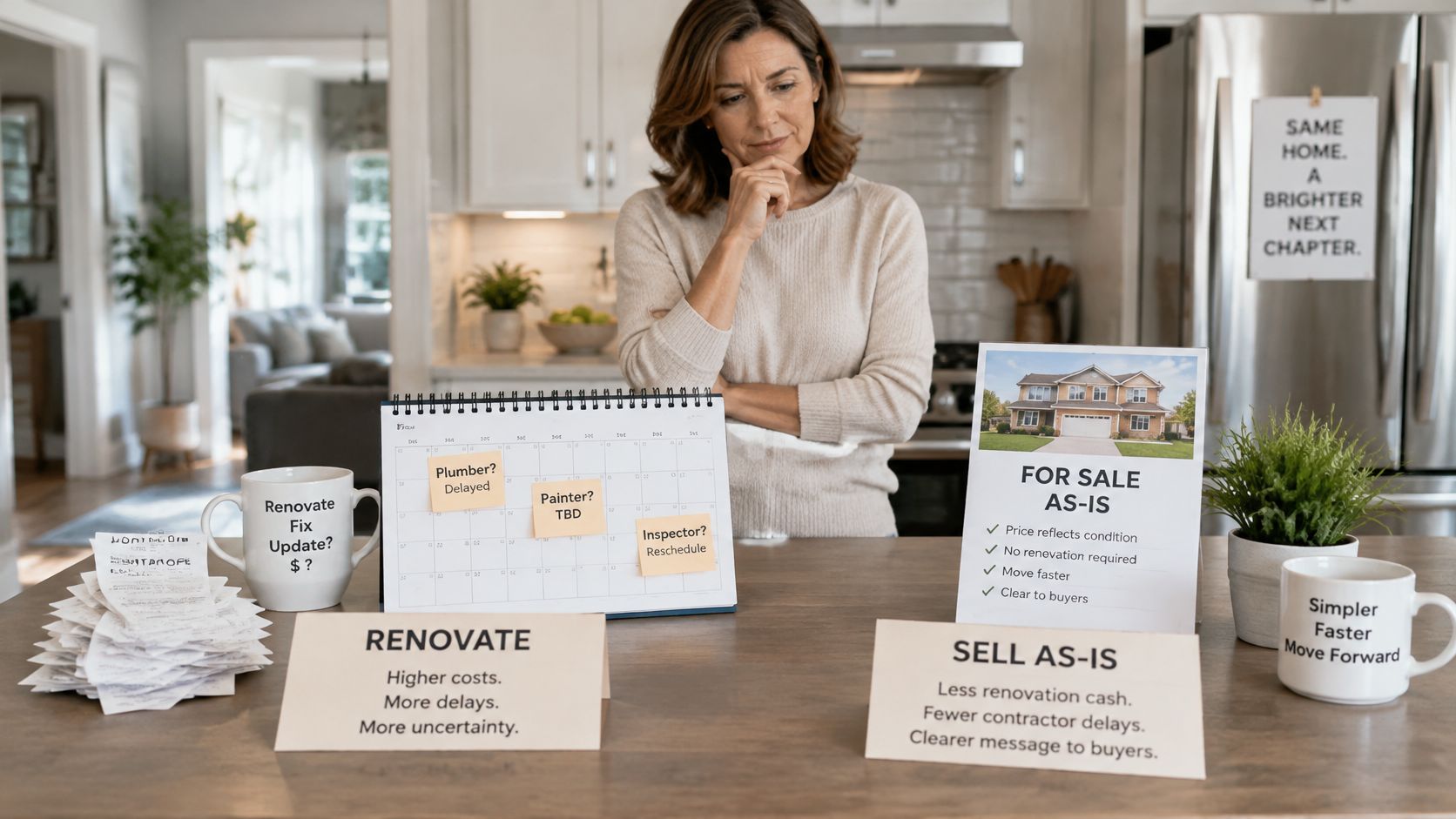
Sellers gain two clear advantages. They keep renovation cash in their pocket and avoid contractor delays, permit waits, and weeks of living around half-finished work. They also send a clean message that the price already reflects condition, which can cut down on unrealistic repair lists.
The costs are just as real. The price will usually sit below a prepared comparable, and buyers may still inspect and push back within their contract rights. A sloppy disclosure can also cost a seller more than an honest repair credit would have, in renegotiation, delay, or legal exposure.
The Buyer Side of the Ledger
Buyers gain a discount and, often, less competition, because many shoppers won't touch a house that needs visible work. For a buyer with skills, trusted contractors, or patience, that thinner crowd is the opportunity.
Buyers pay for it with cash reserves, time managing projects, and possible friction with an insurer or lender over systems the seller won't touch. They also give up any automatic right to force a fix. If the contract doesn't grant a credit or an exit, the problem becomes theirs at the price they signed.
A Plain Fit Test
As-is can suit an heir who doesn't want to renovate a Melrose Park bungalow from a distance. It can suit an investor who prices repairs into the offer on day one, or a move-up seller whose kitchen is dated but whose systems are livable.
It's a poor fit for a first-time buyer with no reserve left after the down payment. It's also a poor fit for anyone whose loan program or insurer will require work before closing that the seller has already refused to do.
Choose as-is when the discount or the saved renovation clearly exceeds the risk you're personally able to carry. If you have to hope nothing else is wrong, the risk already exceeds your budget.
Three Hypothetical Chicagoland Homes Sold in Current Condition
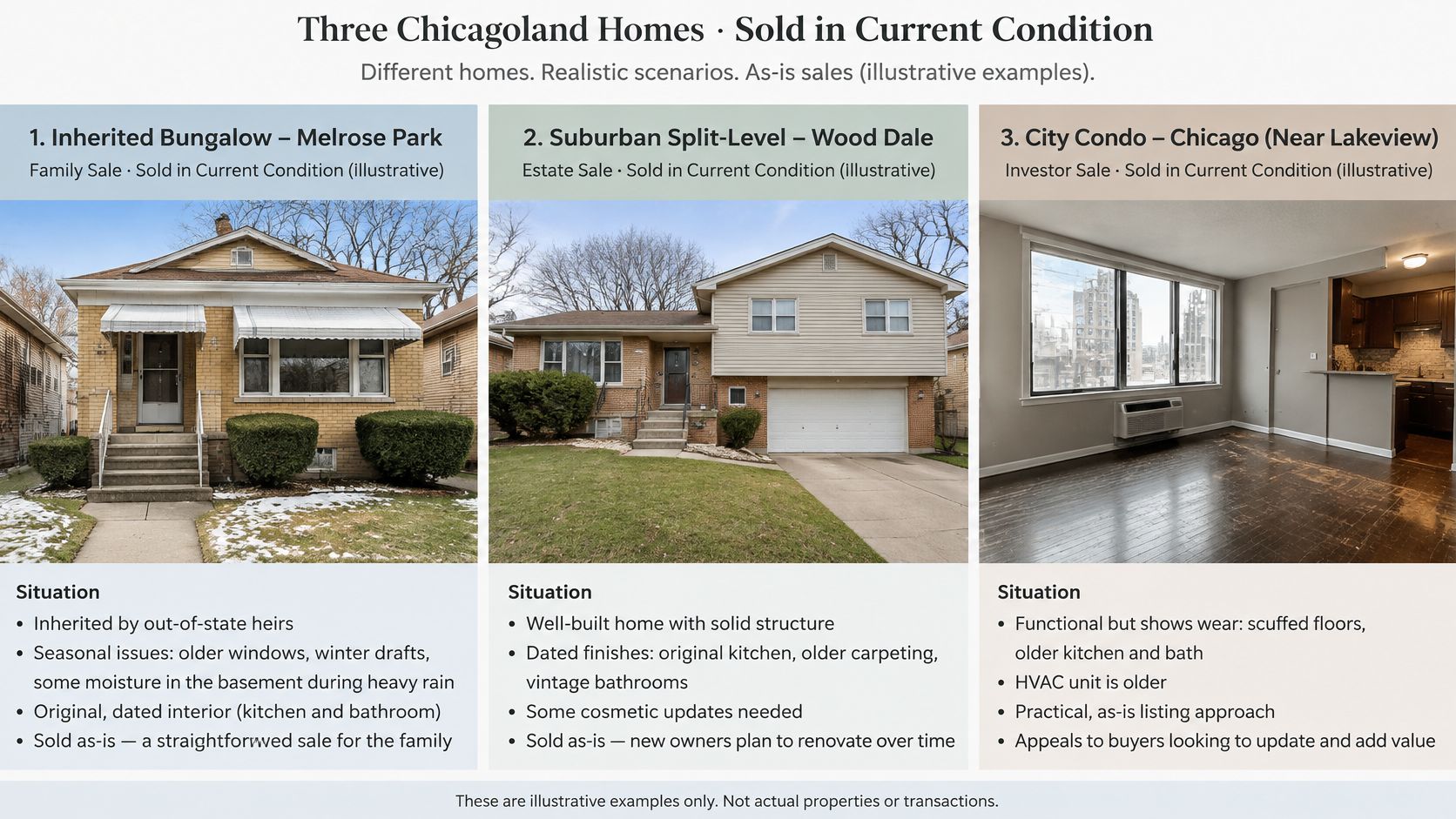
These three hypothetical Chicagoland sales show how the as-is label shifts repair risk without settling every contract question. In Illinois, it does not erase known-defect disclosures or automatically end an inspection contingency. The contract, not the listing label, determines what each party can do.
An Inherited Melrose Park Bungalow
A brick bungalow in Melrose Park has seasonal dampness along one basement wall. The heirs disclose what they know, price below renovated homes on nearby blocks, and accept an offer that allows the buyer to inspect and cancel within the deadline but offers no repair credit.
The buyer gets a waterproofing bid and decides the discount makes the risk workable. Here, accurate disclosure and clear inspection terms keep the known condition from becoming a dispute. The buyer still has a choice under the contract, while the heirs avoid promising repairs they do not intend to make.
An Elmhurst Roof the Seller Wants to Call Old
A stained bedroom ceiling and an old roofer's note put an Elmhurst seller on notice that the roof may be near the end of its life. Calling the stain historic and listing the house as-is does not make that known concern disappear. It belongs on the disclosure.
If the buyer's inspector or a neighbor brings it up late, the buyer may revisit the contract's exit rights and the price the parties agreed to. Putting the roof issue in writing early may bring a lower offer, but it gives both sides a clearer basis for negotiating. A higher offer based on an undisclosed problem can be harder to close cleanly.
An Oak Park Two-Flat Priced for an Investor
Deferred window work and an electrical service upgrade shape an investor's offer on an Oak Park two-flat. The investor inspects within the deadline, gets an electrician's estimate, and accounts for both jobs in the proposed price.
The repair budget matters before the inspection contingency expires. An as-is label does not tell the buyer whether the work is minor or costly, and it does not itself remove inspection rights. If the estimates exceed the amount allowed for, the contract's terms determine whether the investor can renegotiate or exit.
In all three examples, the terms do more work than the label. Write down what is known, what the price assumes, and what the contract allows if inspection findings change the calculation.
Decide Your As-Is Move with Local Numbers
Before listing or making an offer, write down what the house and the contract will require. Sellers should gather known disclosure facts and recent repair invoices, then set a realistic budget for repairing or leaving the roof, basement, furnace, and electrical service as they are. Buyers should note available cash after the down payment, systems they need in working order, and whether their lender and insurer will accept those systems in their current condition.
Price against sales of homes in similar condition in Melrose Park and the western suburbs, not renovated houses nearby. A comparative market analysis for real estate can help frame that comparison. Then make the contract terms specific: name any repairs, credits, or inspection objections. The as-is label alone does not settle those terms or determine who has room to negotiate.
Carmen Salerno is a REALTOR®, and homeowners considering a sale can request a free expert home valuation and strategy call from Homes By Carmen to discuss pricing and timing. Use the website's "Schedule A Call" button to arrange a conversation. Have an attorney review contract language and an inspector assess the property when needed.
For a Melrose Park or western suburban home, compare the likely sale price as-is with the cost and time of repairs before choosing a path. Buyers should weigh the same trade-offs against inspection rights, available cash, and financing requirements. A clear budget and contract language make the decision more grounded than the listing label alone. Start with Homes By Carmen to arrange a valuation or discuss your real estate questions.