
You've cleared the kitchen counters, taken photos, and started drafting a post about selling your house. You might assume the next step is uploading everything to a website and putting a sign in the yard. But getting onto the MLS starts with an agreement, not an upload, and advertising too early can create a deadline before your paperwork is ready.
Knowing how to list your home on the MLS means deciding who will submit it, checking the facts buyers will search, and choosing who should see it at launch. In Chicagoland, those decisions need to match the local MLS rules.
Table of Contents
- Why Only a Broker Can Put Your Home on the MLS
- The Seven Stages of an MLS Listing
- How to Prepare the Home and Paperwork Before Launch
- Building the MLS Fields, Photos and Price Strategy
- Full MLS, Delayed or Office Exclusive
- Managing Showings and Staying in Touch With Your Agent
- Confirm the Listing Agreement Before You Go Live
Why Only a Broker Can Put Your Home on the MLS
Say you've photographed your home and found a public website where you can advertise it. That creates an advertisement, but it doesn't necessarily create an MLS listing. Most homeowners can't open an MLS account and submit their own property.
The process generally begins with a written listing agreement authorizing a licensed broker to market the home and submit it to the appropriate MLS. Your broker assembles the property details, photographs, disclosures, asking price, and access instructions, then manages the listing record.
MLS access is a brokerage function
In the Chicago area, Midwest Real Estate Data, or MRED, accepts broker-submitted listings within its service territory and, at the listing broker's option, certain areas beyond it. The system supports cooperation: a listing broker shares a property so other brokers can introduce buyers. It isn't another advertising page.
The timing trap matters before you start promoting the property. According to the Chicago Association of REALTORS® MLS guidance, MRED rules historically required entry within 48 hours of the effective listing date or 24 hours after the broker publicly advertises the property, whichever comes first, and a for-sale sign counts as public advertising.
Before the sign goes up: Ask your broker to confirm the effective listing date, the receiving MLS, and the applicable submission deadline in writing.
Don't assume an informal social post is harmless preparation. Coordinate public promotion with the broker so your advertising, agreement, and submission schedule work together.
The Seven Stages of an MLS Listing
| Stage | Who leads | Key output | Typical timing |
|---|---|---|---|
| 1. Choose a broker and sign the listing agreement | Seller and broker | Signed agreement authorizing MLS submission | After service terms and launch strategy are agreed |
| 2. Prepare the home and complete repairs | Seller | Repaired, cleaned, decluttered home | Before photography and planned activation |
| 3. Verify property data and documents | Broker with seller | Checked facts, disclosures, and tax figures | Before final pricing and MLS input approval |
| 4. Set the price and marketing plan | Broker with seller | Agreed list price and exposure approach | Before the listing is published |
| 5. Shoot photos and enter the MLS | Broker | Photos, remarks, and complete MLS record | Within the applicable local submission deadline |
| 6. Activate the listing and manage showings | Broker and seller | Live listing, access schedule, and feedback | At activation and throughout active marketing |
| 7. Review offers and status updates | Broker and seller | Offers, counteroffers, and closing path | As offers arrive and through closing |
The sequence isn't a rigid assembly line. You can gather documents while arranging repairs, and your broker can begin evaluating comparable sales before the photographer arrives. What doesn't work is making the agreement effective without coordinating the remaining work.
Where mistakes become expensive
Property verification and MLS entry deserve separate approvals. During verification, you establish which facts are supported; during entry, you check that the broker placed those facts in the correct fields. Copying an old listing can carry an old mistake straight into a new sale.
Preparation takes longer when contractors, association documents, or ownership questions are involved. Closing also depends on the accepted contract, financing, inspections, and title work, not the date you hoped to move.
Use the table during your first broker conversation. Ask who owns the next task, what document proves it's complete, and what could prevent activation. A named person and a clear deliverable are more useful than a general promise to get everything ready.
How to Prepare the Home and Paperwork Before Launch
A clean house photographs well. A clean file keeps the listing defensible when buyers, inspectors, and appraisers start asking questions.
The MRED Rules and Regulations state that an inaccurate or incomplete listing entry may be subject to a fine. For the seller, the practical cost can also include a misleading price comparison, a disappointed buyer, and corrections after public distribution.
Build the property file
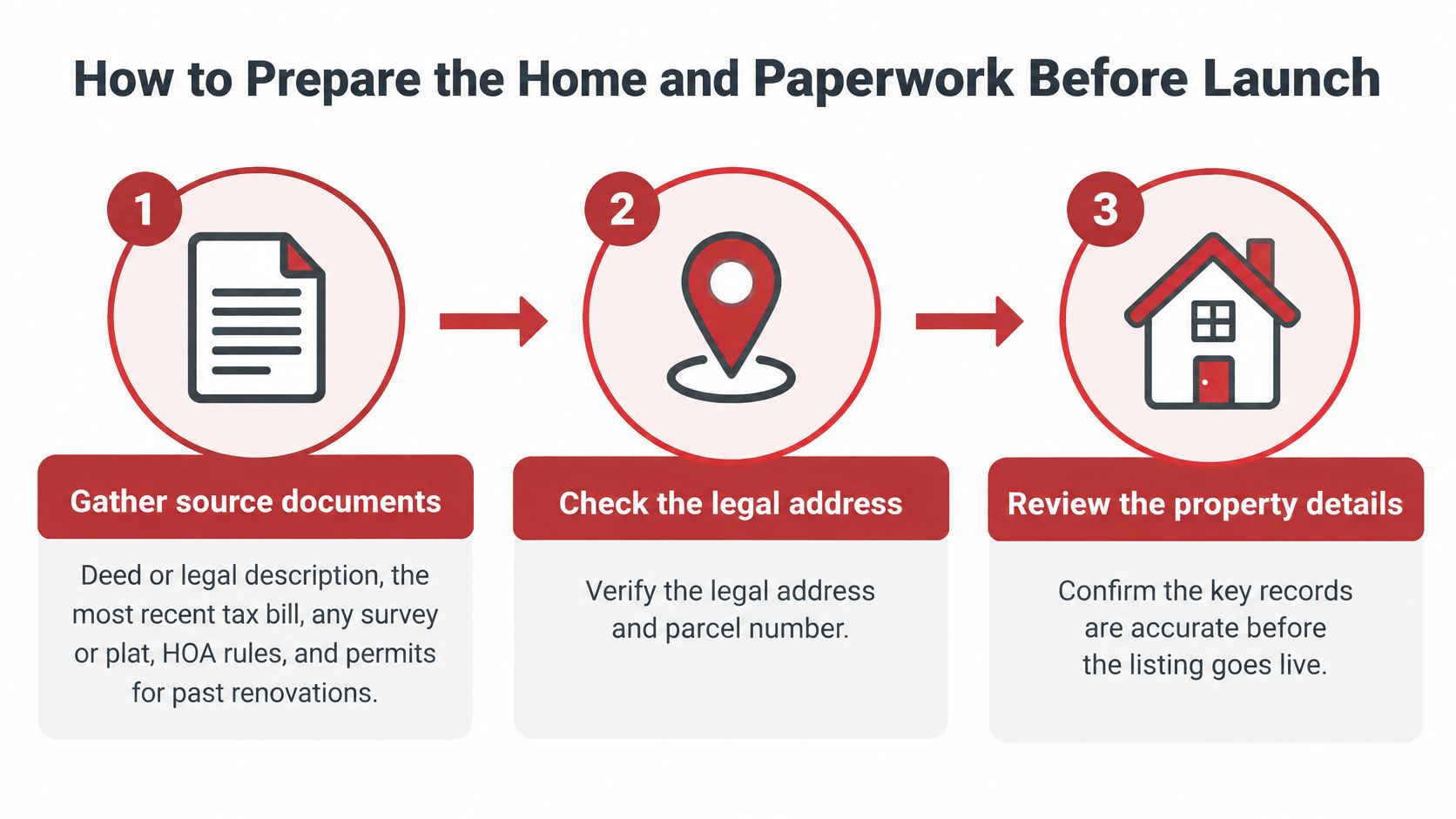
Gather the underlying documents. Collect the deed or legal description, latest tax bill, survey or plat, association documents, and renovation permits. Keep them in a shared folder with clear filenames so the broker isn't relying on information scattered across texts.
Match the property identity. Check the legal address, parcel number, and property type against county records and ownership documents. A townhouse-style building may have condominium ownership, so appearance alone shouldn't determine the category.
Reconcile measurements and room counts. Compare square footage, bedrooms, bathrooms, and room descriptions with records and permits, then flag discrepancies for the broker. Tax records aren't infallible, and finished basement space shouldn't be added to above-grade living area without checking the applicable measurement conventions.
Write down what stays. Identify appliances, window treatments, mounted fixtures, sheds, and removable items you intend to take. Don't leave an expensive light fixture in the photographs while assuming everyone understands it's excluded.
Resolve questions before photography
Complete disclosures carefully. Give your broker accurate information about known defects, occupancy, leases, and potential title concerns. Ask your attorney about legal questions rather than treating a short MLS description as a substitute for disclosure.
Set workable access rules. Decide whether showings require appointments, how notice will work, where pets will go, and who confirms access. An occupied home needs instructions that protect residents without making appointments unnecessarily difficult.
Repair what creates uncertainty. Fix a broken latch, secure loose hardware, and investigate a ceiling stain before painting over it. For budgeting decisions, use this guide to increasing home value before selling to separate useful preparation from projects that may not justify their cost.
Approve the actual input proof. Read the broker's completed MLS draft, including private showing instructions, rather than approving only the public description. Check each disputed fact against its supporting document and resolve open questions before activation.
Aim for no material errors at launch, not merely a listing that passes the system's required fields.
Keep transaction preparation organized beyond publication, too. The real estate closing checklist from BoloSign can help you organize later paperwork and responsibilities alongside your broker's and attorney's instructions.
Building the MLS Fields, Photos and Price Strategy
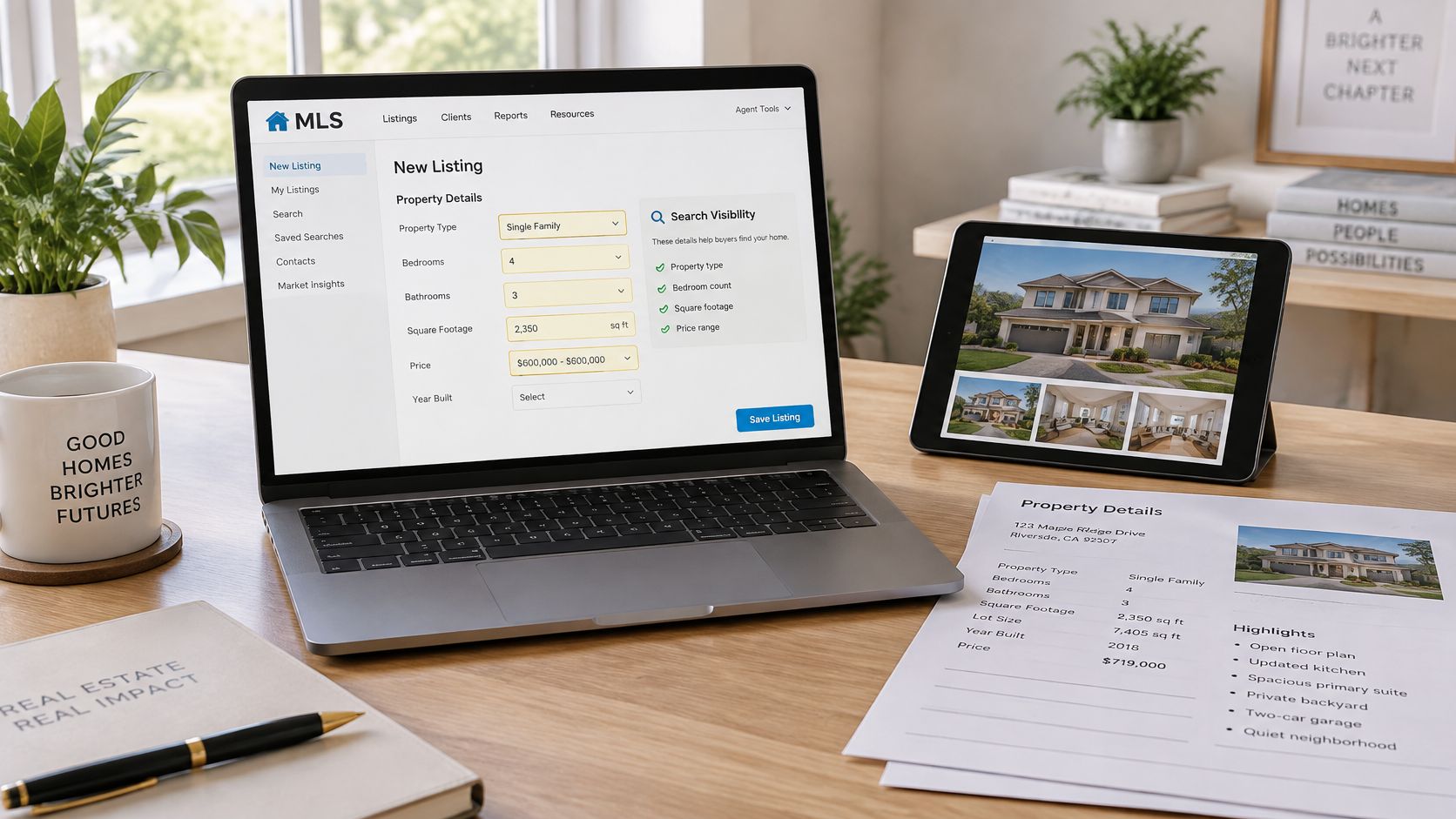
Buyers often narrow their search by property type, bedroom count, size, and price before they read a description. Those fields determine whether a home appears in a buyer's results at all. In a Chicago-area condo market, for example, the property's legal type can affect which search filters include it, even if it looks like a townhouse.
| MLS field | How it affects buyer searches | Typical error to avoid |
|---|---|---|
| Property type | Directs the listing into the right category and search results | Choosing townhouse based on appearance when the property is legally a condominium |
| Bedroom count | Lets buyers filter by the number of bedrooms | Counting a room that does not qualify as a bedroom |
| Square footage | Helps buyers set minimum or maximum size filters | Entering a figure that does not match the supported measurement |
| Price | Places the listing within buyers' selected price ranges | Setting a figure outside the search band for the intended buyers |
Make the photographs match the property
The first image should give buyers a clear, accurate view of the home. For a front exterior, schedule the photo when daylight reaches the facade evenly, rather than shooting into harsh glare or deep shadow. Then order the first five images to show the exterior, main living area, kitchen, primary bedroom, and a useful feature such as the yard. The sequence gives buyers an immediate sense of both the home and its layout.
Ask the photographer to keep vertical lines straight and colors close to the actual finishes. Repeating similar angles uses up space without helping buyers understand the rooms, storage, or outdoor areas. Image enhancement can improve presentation, but edits should not conceal defects or add features that are not there. The guide to AI enhancement for real estate photography covers ways to improve images while keeping them faithful to the property. Have the broker check local MLS requirements for altered or virtually staged images.
Choose a price buyers can find and support
A price affects both the search results a listing enters and how buyers compare it with similar homes. Ask the broker to explain the proposed range using recent closed sales, competing inventory, and the search bands the price reaches. A comparative market analysis for real estate can organize that conversation around comparable properties rather than an online estimate.
The National Association of REALTORS® reports that in 2025, agent-assisted homes sold for a median of $425,000, compared with $360,000 for FSBO homes. Those figures describe different groups of sales, not the value representation will add to an individual property.
The practical test is whether the broker can explain the asking price through comparable properties and meaningful differences. An unsupported high starting price can put the listing outside the search range of likely buyers, then require a correction after they have already moved on.
Full MLS, Delayed or Office Exclusive
You don't have to treat exposure as an all-or-nothing decision. A standard launch generally combines broker access with public website distribution, while other arrangements prioritize controlled timing or privacy.
The National Association of REALTORS® Multiple Listing Options for Sellers policy created a delayed-marketing exemption effective March 25, 2025, allowing public distribution to be postponed while a listing remains available to MLS participants and subscribers.
| Option | Other MLS members | Public websites and syndication | Best fit |
|---|---|---|---|
| Standard MLS listing | Yes | Yes, at launch, subject to feed processing | Sellers seeking broad early reach |
| Delayed marketing | Yes | Postponed for the locally permitted period | Repairs, privacy, or relocation timing |
| Office exclusive | No | No | Private marketing kept within the listing brokerage |
Choose the audience deliberately
Delayed marketing postpones display on public brokerage search websites and third-party listing sites. The local MLS determines the permitted delay, and the seller signs a disclosure acknowledging the benefits of immediate public marketing being waived.
An office exclusive is different: the property isn't disseminated to other MLS participants. That distinction matters if you want discretion but still expect outside buyers' agents to discover the property through their MLS searches.
A delay may suit an owner finishing repairs, heirs organizing an inherited home, a landlord managing an occupied rental, or a family coordinating relocation. Privacy-sensitive sellers may also prefer a more controlled release of photographs and property information.
Broader exposure and tighter control solve different problems. Choose the problem you need to solve before choosing the marketing arrangement.
The trade-off is fewer immediate consumer views and potentially less early showing activity. Testing demand with a limited audience also doesn't tell you exactly how the full buyer pool would respond.
Before signing an exemption, ask your broker to confirm current MRED implementation, the permitted delay, the release trigger, and the expected audience during the restricted period. Don't accept a national policy description as a complete local launch plan.
Managing Showings and Staying in Touch With Your Agent
Agree on the communication routine before activation: how requests reach you, who approves appointments, and when you'll discuss results. Use a recurring review call rather than relying on scattered messages whenever someone remembers a question.
Showing requests usually come through the broker's scheduling process. Electronic lockbox records can help establish which credential accessed the property and when, although an access record doesn't resolve every dispute. Most sellers should leave during appointments so buyers can discuss the home without feeling watched.
Turn feedback into decisions
Ask your agent to request comments promptly and distinguish an actual buyer objection from an agent's passing observation. Repeated concerns about condition, layout, or value deserve attention; an isolated dislike of your paint color may not.
According to NAR findings summarized by Virginia REALTORS®, in 2025 sellers typically sold for a median of 99% of the listing price, and recently sold homes spent a median of four weeks on the market. These national medians provide context, not a local promise or a deadline for accepting an offer.
- Keep a showing log. Record requests, completed appointments, cancellations, and access problems.
- Identify feedback clearly. Note which buyer's agent supplied each comment and whether their buyer remains interested.
- Set a review trigger. Agree before launch what evidence would justify changing the price, presentation, or access rules.
- Investigate a quiet calendar. If requests stop, check listing visibility and appointment restrictions before assuming price is the only problem.
Use this guide to open houses and showings to prepare the home and plan access. Ask for a written recommendation when your broker proposes a change so you understand both the evidence and the intended result.
Confirm the Listing Agreement Before You Go Live
Before signing, settle the terms that affect your costs, responsibilities, and ability to change course. Local MLS rules determine the details, so make sure the written agreement matches the plan you discussed.
- Term and cancellation. Check when the agreement starts and ends, how either party can cancel, and which obligations continue after termination. Clarify whether you would still owe costs already committed if you withdraw.
- Compensation. Confirm the listing broker's fee and any separate authorization for buyer-broker compensation. Keep those decisions clear in the agreement rather than assuming they belong in the MLS remarks.
- Marketing costs. Specify who pays for photography, floor plans, staging, and advertising, and what happens to those costs if the listing is withdrawn.
- Correction approvals. Agree on who can request or make changes to factual details, price, and status. Set a practical approval method so an incorrect square footage or other material error can be corrected promptly.
These terms matter most if plans change or an error appears after the listing is submitted. Homes By Carmen offers seller representation and a complimentary valuation for owners in Melrose Park, Elmhurst, Downers Grove, Naperville, Oak Park, and Glen Ellyn.
Get the launch plan in writing
Record the target launch date, outstanding tasks, and who is responsible for each one. If photography, ownership documents, or repairs are unresolved, set the date only after you know how those items affect readiness.
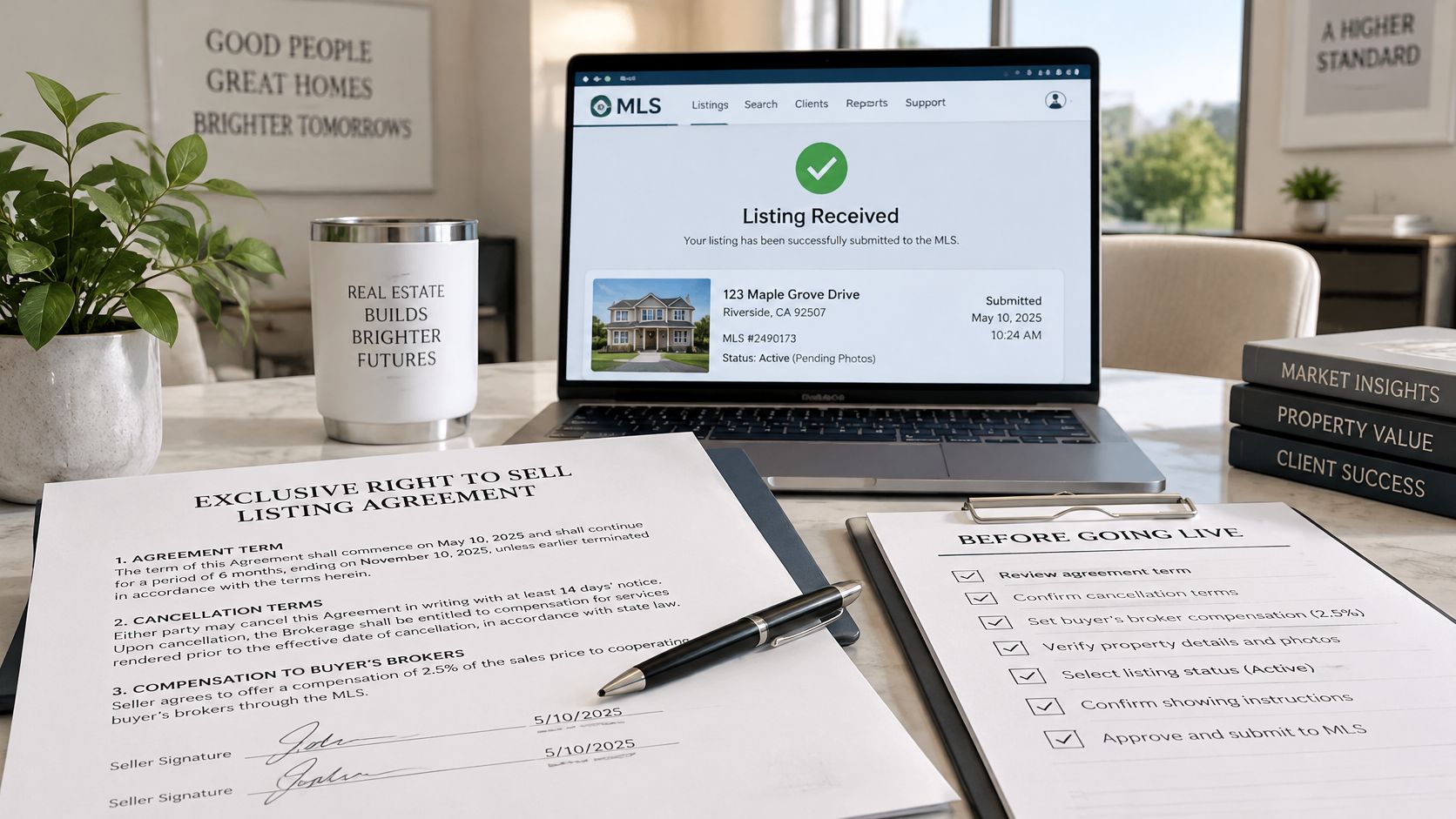
A clear agreement gives you a record of costs, cancellation terms, and who can approve corrections. Visit Homes By Carmen to request a complimentary home valuation and discuss seller representation through closing.