
You've found a home that fits your budget, and your agent is preparing the offer. Then the questions start: Will you keep the inspection contingency? Cover an appraisal gap? Make the purchase conditional on selling your current home? It can feel like you're choosing between protecting yourself and getting the house.
Home purchase contingencies are contract conditions with deadlines. They can give you a way to investigate a problem, negotiate a solution, or leave the transaction under specified terms. The useful question isn't just which protections to include. It's what each protection lets you do, when that right expires, and how much cash you could need without it.
Table of Contents
- Standard Contingencies and What Each One Protects
- Financing and Home-Sale Contingencies Explained
- How to Act on a Contingency Before Its Deadline
- Inspection Contingency Scope and Hidden Defects
- Appraisal Gap Math Before You Offer Above Value
- Waiver Rates and What Waiving Costs You
- Insurance, the Contingency Most Checklists Miss
- Work Backward From Closing and Confirm Deadlines Before You Sign
Standard Contingencies and What Each One Protects
Standard contingencies, risks and remedies
| Contingency | Risk it covers | Deadline | Remedy if not met |
|---|---|---|---|
| Financing | Mortgage approval not granted on contract terms | Set in contract | Terminate and recover earnest money, per contract and state law |
| Appraisal | Home appraises below contract price | Set in contract, coordinated with loan commitment | Renegotiate price, pay a specified gap, or terminate |
| Inspection | Physical, safety, or structural defects | Set inspection period | Request repairs or credit, or terminate |
| Home sale | Buyer must sell current home first | Set in contract | Terminate or obtain an agreed extension if the sale doesn't close |
| Insurance | Coverage unavailable or unaffordable | Set in contract | Secure an acceptable policy, negotiate, or terminate if permitted |
These are ordinary contract protections, not unusual demands: the National Association of REALTORS® reported that the average residential purchase contract in 2024 contained two to three contingencies, most commonly financing, appraisal, and inspection, and that 80% of buyers used mortgage financing, as summarized by Greater Milwaukee Association of REALTORS®.
The remedies in the table are possibilities, not automatic entitlements. Your signed contract and applicable state law determine your exact rights, including whether you can recover earnest money, the deposit held during the transaction.
Match the protection to the risk
Loan-approval risk belongs under financing. A buyer might qualify initially but still need the lender to finish reviewing income, assets, debts, and the property before issuing approval.
Value-shortfall risk belongs under appraisal. The price you agree to pay and the value the lender accepts aren't necessarily the same, so your offer needs to address what happens if they differ.
Physical-condition risk belongs under inspection. This protection gives you a defined opportunity to investigate the home rather than relying on a showing or the seller's description alone.
Practical rule: A contingency should identify the condition, the deadline, and the action you're allowed to take if the condition fails.
Sale-proceeds risk belongs under a home-sale contingency. If the purchase requires money from your existing home, the contract should recognize that dependency rather than assuming both closings will align.
Coverage risk belongs under insurance. A house can be suitable to live in yet difficult or expensive to insure on terms you and your lender can accept.
Before comparing offer strategies, list every contingency in the draft and write its deadline beside it. If you can't identify the remedy or the expiration date, ask your agent and attorney to clarify the wording before you sign.
Financing and Home-Sale Contingencies Explained
A financing contingency ties your purchase obligation to obtaining the mortgage described in the agreement. A preapproval letter isn't a substitute for that protection because the lender still has underwriting work to complete.
Ask your lender for a written estimate of when a loan commitment can be issued. Then compare that estimate with the proposed financing period, including how the contract counts days from acceptance and what documentation you must provide.
When your purchase requires another closing
A home-sale contingency makes the purchase conditional on selling your current property under the terms stated in the agreement. Be precise about the milestone: finding a buyer, signing a sale contract, and receiving proceeds at closing aren't interchangeable.
Our explanation of how a home-sale contingency works can help you distinguish those conditions before preparing an offer. If your purchase requires the proceeds, the wording should address the completed sale, not merely an accepted offer.
A seller may request a kick-out clause, allowing continued marketing and giving you a specified response period if another acceptable offer arrives. You may then have to remove the condition or allow the contract to end, according to its terms.
Removing a home-sale condition doesn't create the money you expected from your sale.
Before accepting that trade-off, confirm whether you could close without those proceeds. Discuss available funds with your lender, the sale timeline with your agent, and the clause's consequences with your attorney.
An extension requires agreement unless the contract expressly provides otherwise. Don't assume the seller must wait because your buyer's closing has been delayed.
How to Act on a Contingency Before Its Deadline
A calendar reminder alone won't protect you. You need enough time to receive information, understand it, choose a response, and deliver the required notice.
The process begins with the signed agreement, not a remembered conversation about the offer.
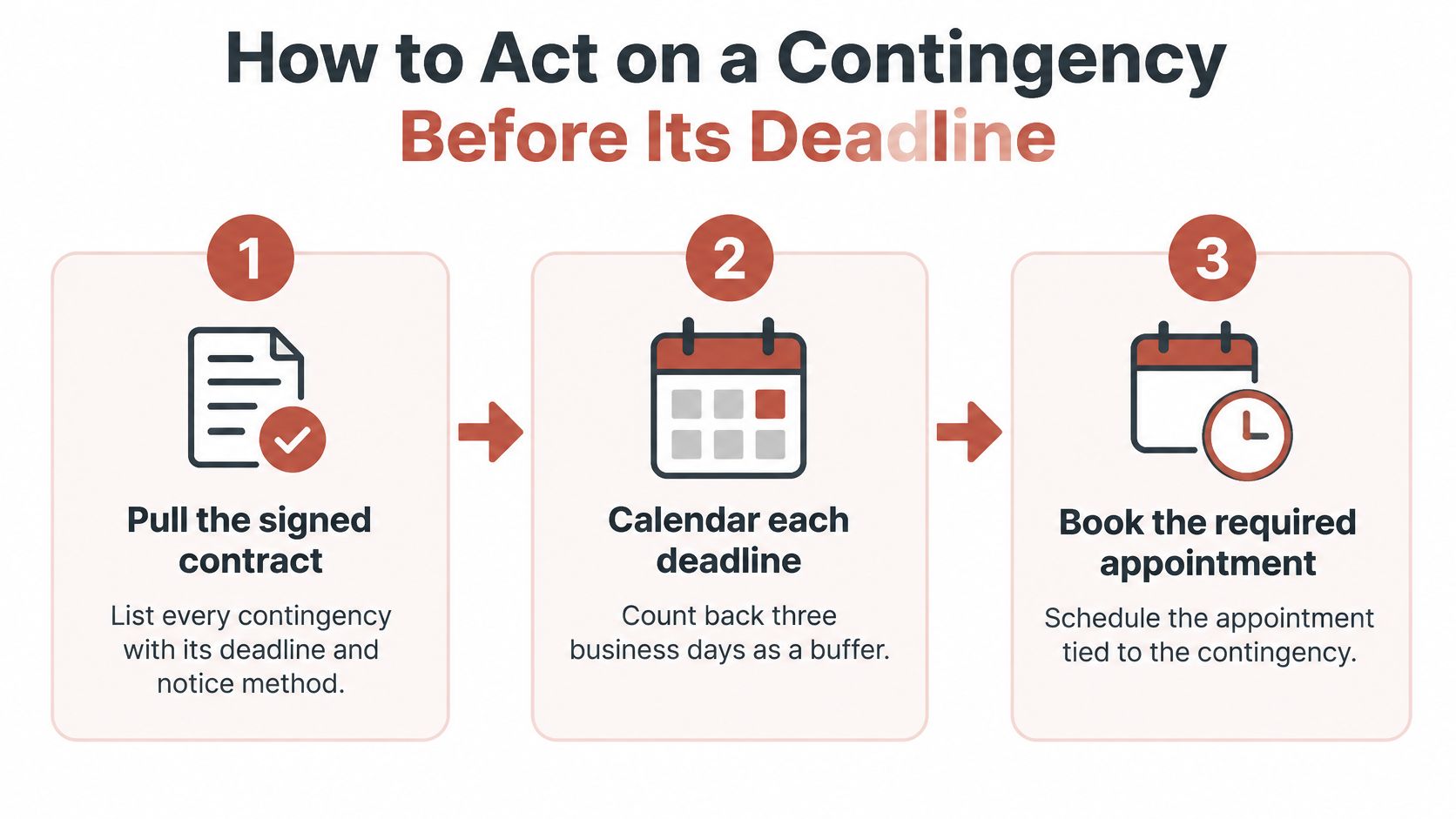
Build a decision-and-notice routine
Pull the complete signed contract. Include counteroffers, riders, and amendments, then record every contingency's triggering event, deadline, notice recipient, and permitted delivery method. A date copied from an earlier draft may no longer control.
Calendar the deadline and an earlier review buffer. As a planning example, set an internal reminder three business days before the contractual deadline, without treating that buffer as a legal extension. Check whether the agreement uses calendar days or business days and how it handles weekends, holidays, and time of day.
Arrange the required work promptly. Book the inspection and coordinate with the lender on ordering the appraisal so reports can arrive while you still have time to respond. An appointment scheduled before expiration isn't necessarily enough if the report arrives afterward.
Compare the result with the actual clause. Decide with your agent, lender, and attorney whether to proceed, request a change, invoke a permitted termination right, or seek an extension. Don't assume every disappointing result qualifies under the wording you signed.
Deliver notice through the required channel. Use the method and recipient specified in the contract, whether that's designated email delivery, delivery through counsel, or another procedure. Telling someone verbally that you're unhappy may not satisfy a written-notice requirement.
Confirm delivery and document the resolution. Keep evidence of receipt and obtain signed amendments for agreed repairs, credits, changed dates, or other modifications. A negotiation email isn't necessarily a completed contract amendment, and a signed waiver can be difficult to reverse.
Keep negotiations from consuming the remaining time
A seller's willingness to discuss a repair doesn't necessarily pause your cancellation deadline. If you need more time, have the appropriate parties document an extension before the existing period expires.
Give each task a named owner. The buyer supplies financial records, the lender tracks underwriting and appraisal work, and the agent coordinates transaction milestones; legal notices and interpretations should be handled with appropriate attorney guidance.
Your finished transaction folder should contain a dated, written disposition for every contingency. Save reports, notices, delivery confirmations, signed amendments, and any executed waivers together so you can establish what happened and when.
Inspection Contingency Scope and Hidden Defects
An inspection report isn't a guarantee that the house has no hidden problems. Nor does permission to enter the property and inspect automatically give you permission to cancel afterward.
An inspection contingency should establish the inspection period, permitted evaluations, notice procedure, negotiation process, and termination rights. For applicable transactions described in Fannie Mae's value-acceptance guidance, the lender must obtain and review an inspection sufficient to evaluate safety, soundness, and structural security, and certain defects may require repair before loan delivery; that guidance isn't a universal inspection requirement for every mortgage.
Separate the general inspection from specialist work
A general inspection may identify warning signs without determining their full cause or cost. Concealed sewer damage, radon, termite activity, mold concerns, structural movement, private-well conditions, and septic-system problems may require specialized evaluation.
For an older western Chicagoland home, discuss basement moisture, grading and drainage, masonry, electrical systems, and sewer-line condition before finalizing the inspection scope. A sewer camera inspection or structural evaluation is a separate task, not something to assume comes with a general report.
Request access and permission for appropriate tests in the contract. Otherwise, you could discover that the evaluation you need requires additional seller approval while your inspection period is already running.
Check the response process before signing
- Inspection period: Confirm its length, starting event, and final notice deadline.
- Specialized inspections: Identify the evaluations the property warrants and whether invasive testing needs separate consent.
- Payment responsibility: Establish who pays for inspections, specialist visits, and any agreed follow-up.
- Seller refusal: Understand your options if the seller declines repairs or a credit.
- Completion standards: Specify documentation, qualified contractors where appropriate, and any reinspection rights for agreed work.
Use the findings to distinguish a safety problem from routine maintenance or cosmetic preferences. Our guide to negotiating repairs after a home inspection explains how to organize that discussion.
If you waive the contingency, budget for both disclosed deficiencies and conditions nobody has identified yet. An inspection-only right can provide information without providing an exit, so have your attorney explain the difference before accepting that arrangement.
Appraisal Gap Math Before You Offer Above Value
Extra cash needed when a low appraisal cuts the loan at an illustrative 80% loan-to-value
| Contract price | Appraised value | Valuation gap |
|---|---|---|
| $400,000 | $400,000 | $0 |
| $400,000 | $380,000 | $20,000 |
| $400,000 | $360,000 | $40,000 |
This hypothetical table extends the $400,000 purchase and $380,000 appraisal example discussed in Fannie Mae's appraisal guidance; its final row subtracts the same valuation difference again to illustrate a larger shortfall.
For this worked example only, assume the lender finances 80% of the appraised value, a scenario assumption rather than a quoted lending requirement. The table shows the valuation gap, not the additional cash required after recalculating the loan.
That distinction matters. Under the illustrative assumption, the loan falls from $320,000 to $304,000 when the appraisal falls from $400,000 to $380,000, so purchase cash rises from $80,000 to $96,000 before closing costs, an additional $16,000 rather than the full $20,000 valuation gap.
Decide which response you can afford
The buyer usually agrees to the purchase price before the lender obtains the appraisal. If the lender accepts a lower value, the parties must address the shortfall within the contract's available options.
- Renegotiate the price: Ask the seller to reduce the price or agree to another permitted adjustment. The seller isn't automatically required to accept.
- Pay a specified gap: Commit to a defined amount under carefully drafted language, after confirming how the lender will calculate your required funds.
- Terminate when permitted: Exercise the appraisal clause's cancellation procedure within its deadline, including any requirements for supporting documentation and earnest-money recovery.
Our explanation of what an appraisal gap means can help you distinguish a capped promise from an unrestricted commitment.
Calculate your maximum additional cash
Start with liquid funds you can use. Subtract closing costs, the lender's required contribution, moving expenses, and the reserves you intend to keep after closing.
Ask the lender to model a lower appraisal using your actual loan program. Don't assume a gap clause and your down payment are separate checks that can be added without reviewing the loan calculation.
Keep financing approval distinct from collateral value. Before offering above list price, calculate the maximum additional purchase cash you can contribute without exhausting your protected reserves.
Waiver Rates and What Waiving Costs You
Buyer waiver rates in 2024 NAR surveys
| Period | Inspection waived | Appraisal waived |
|---|---|---|
| March 2024, prior month | 22% | 25% |
| April 2024 | 19% | 18% |
| August 2024 | 18% | 20% |
The National Association of REALTORS® survey figures, including the prior-month comparison in its April 2024 REALTORS® Confidence Index, show that waivers were a minority practice, not a universal requirement for purchasing a home.
A seller comparing competing bids may prefer an offer with fewer opportunities for the buyer to withdraw. But the buyer pays for that apparent certainty by accepting obligations that a contingency might otherwise address.
Price the obligation, not just the offer
An appraisal waiver can require you to proceed despite a valuation shortfall, subject to the remaining contract terms. Your lender doesn't have to increase the loan because you promised the seller you'd close.
An inspection waiver can reduce your contractual ability to seek repairs or terminate over discovered defects. You may still face other legal issues or remedies, but you shouldn't budget on the assumption that a later dispute will solve an expensive property problem.
A stronger-looking offer isn't affordable if you can fund the purchase but not the risks you accepted.
Before waiving, ask whether your available reserves could absorb a serious repair or a lower-than-expected loan amount. A reserve that covers only routine maintenance isn't the same as money available for a major system failure.
Use a written decision test
- Cash capacity: Have your lender confirm the purchase-funds implications, and retain money for property problems.
- Property knowledge: Where feasible and permitted, complete appropriate evaluations before removing inspection protection.
- Accepted responsibility: Have your attorney explain the waiver and document your understanding of the risk.
If you can't tolerate the potential expense, change the offer structure or reconsider the property. Competition doesn't reduce the cost of being wrong.
Insurance, the Contingency Most Checklists Miss
The familiar checklist of financing, appraisal, inspection, and home sale leaves out an important question: can you insure this particular property on acceptable terms? In Zillow's 2025 Consumer Housing Trends Report, 53% of buyers reported including an insurance contingency in their final offer, matching the reported share including an appraisal contingency.
A home can satisfy your condition and valuation expectations while still creating an insurance problem. Coverage may be unavailable, the premium may undermine your budget, or exclusions and deductibles may leave you carrying more risk than expected.

Define acceptable coverage in the clause
Obtaining a quote isn't the same as having a contractual remedy if that quote is unacceptable. Ask your attorney to make the standard clear rather than relying on a general expectation that insurance will work out.
- Coverage deadline: By when must you obtain acceptable coverage or deliver notice of a problem?
- Lender requirements: Must the policy satisfy specified lender conditions as well as your own needs?
- Affordability: What happens if premiums or deductibles exceed the limits described in the agreement?
- Exclusions: Can you respond if an important exposure isn't covered?
- Additional protection: How will you evaluate flood, wind, sewer-backup, and ordinance-and-law coverage?
Connect underwriting to the actual property
Older roofing, electrical, and plumbing systems can require closer insurance review. Prior claims and severe-weather exposure can also affect the questions an insurer asks.
For Chicagoland properties, discuss basement water exposure, sewer backup, and the implications of repairing an older building under current municipal requirements. Don't assume a standard homeowners policy addresses every concern, or that an inspection establishes insurability.
Request a property-specific quote through an insurance professional early enough to resolve underwriting questions. Ask your agent to coordinate that timing with the contingency deadline, and confirm with the insurer what remains necessary to bind coverage.
Work Backward From Closing and Confirm Deadlines Before You Sign
Start with the proposed closing date and ask the lender what must be finished before funds can be released. Then place the loan-commitment deadline, appraisal review, inspections, insurance work, and any required sale of your existing home on the same calendar.
A deadline can look reasonable by itself yet leave no room for a necessary follow-up. For example, an appraisal result that arrives just before loan commitment may leave too little time to resolve a repair requirement or revise the financing.
Schedule for decisions, not just appointments
Set the lender's commitment milestone first. Work backward to allow appraisal delivery and review, then schedule inspections early enough for specialist evaluations and any lender-required repair decisions.
Include the insurance review in that sequence rather than leaving it until closing preparations. If an inspection identifies an electrical condition that concerns the insurer, you need time to learn whether coverage requires corrective work.
For a purchase tied to another home's sale, coordinate the actual availability of proceeds. Ask the closing professionals how funds will move and what happens if the first transaction doesn't finish as planned.
Before you shorten a period, confirm who can deliver the answer within it.
A shorter inspection period may strengthen an offer while preserving the cancellation right, but only if inspectors and specialists are available. A negotiated appraisal-gap cap may give the seller more certainty without requiring you to accept an unlimited shortfall.
Don't trade away a protection merely because the alternative sounds complicated. Ask what the seller needs, then evaluate whether a narrower condition, clearer cap, or better-supported schedule addresses that concern.
Review the draft as an instruction sheet
Before signing, check that the agreement answers these questions:
- Written conditions: Is every protection you intend to keep included in the draft?
- Dates and counting rules: Does each period have a clear starting event, expiration date or duration, and applicable time?
- Notice requirements: Who receives notice, through which method, and what supporting material must accompany it?
- Available remedies: Can you negotiate, terminate, seek an extension, or proceed, and under what conditions?
- Payment obligations: Who pays for agreed repairs, specialist evaluations, and any appraisal-gap commitment?
- Property-specific scope: Are the necessary specialized inspections permitted?
- Lender coordination: Does the financing period match the lender's current underwriting expectations?
- Insurance readiness: Can the property be quoted and reviewed before that protection expires?
Have your agent and attorney resolve unclear language before you become bound by it. The objective isn't to predict every problem; it's to know who must act when a problem arises and what choices remain available.
Keep the final review simple: write each contingency and its deadline on one page, then review that page with your agent before signing.
We offer a step-by-step first-time buyer's guide created by Carmen Salerno to help you prepare for the purchase process. Visit Homes By Carmen to explore the guide or schedule a consultation about a specific Chicago-suburb home, and bring your contingency-and-deadline list so we can discuss your questions before you sign.