
You're not shopping for a house first. You're deciding how much cash you can put into a purchase, how much you must keep after it, and what monthly payment still works when taxes, insurance, and repairs move. That's the honest home buying process for first time buyers in Melrose Park and the western suburbs, and it's why the order below matters more than any listing you tour this week.
Table of Contents
- The Full Buying Timeline at a Glance
- Get Preapproved and Count Your Cash to Close
- Search, Tour and Check Each Home's Monthly Cost
- Making an Offer and Choosing Contingencies
- How to Move From Inspection to Final Loan Approval
- Closing Day, Ownership Costs and Your Next Step
The Full Buying Timeline at a Glance
First-time buyers made up 21% of all buyers, the lowest share since the National Association of Realtors began tracking the measure in 1981, according to its 2025 Profile of Home Buyers and Sellers. The report also found that their median age reached 40, a record high. For buyers in that survey, 59% used personal savings, 26% used financial assets such as investments or retirement accounts, and 22% received a gift or loan from relatives or friends.
For a first-time buyer renting in Elmhurst and targeting a starter home in Melrose Park, the sequence runs from planning the cash needed at each stage to search, offer, inspection, appraisal, underwriting, disclosure review, walkthrough, and closing.
Home Buying Stages and Who Leads Each One
| Stage | Typical timing | Who leads it |
|---|---|---|
| Budget and mortgage preapproval | 1-2 weeks | You and your lender |
| Home search and tours | 1-6 months | You and your buyer's agent |
| Offer and acceptance | 1-3 days | Buyer's agent and seller's agent |
| Inspection and repair negotiation | 7-10 days | Home inspector and both agents |
| Appraisal and underwriting | 2-4 weeks | Lender and appraiser |
| Closing Disclosure and final walkthrough | At least 3 business days before closing | Lender, you and your agent |
| Closing and keys | Closing day | Title company or closing attorney |
Timelines vary. A competitive suburb can compress the search into a weekend decision, while requests for updated documents can extend underwriting. Keep the sequence intact: delays in one stage can affect the next, and cash needs change as the purchase progresses.
Get Preapproved and Count Your Cash to Close
A preapproval sets a borrowing limit. Your own budget sets the payment you can carry while covering food, childcare, car costs, savings, and repairs. Get those numbers clear before choosing a price range.
Build Your One Page Cash Plan
- Set your monthly ceiling: Include principal, interest, property taxes, homeowners insurance, mortgage insurance, and association fees where they apply.
- Verify your numbers: List your documented income and recurring debts as the lender will review them, including car payments, student loans, and minimum credit card payments.
- Get preapproved: Ask a lender to review your income, assets, debts, and credit, then issue a preapproval letter stating the loan type and borrowing limit.
- Total your cash to close: Add the down payment, closing costs, prepaid taxes and insurance, inspection and appraisal fees, moving expenses, and first repairs. If you are still saving, figure out down payment savings by month so your target date rests on a workable budget.
The Consumer Financial Protection Bureau's guidance on deciding how much to spend says closing costs commonly add 2% to 5% of the purchase price, excluding the down payment. It also advises keeping an emergency cushion generally equal to three to six months of expenses.
| Cash item | Typical range | What drives the amount |
|---|---|---|
| Down payment | 3.5% to 10% | Loan program and eligibility |
| Closing costs | 2% to 5% of purchase price | Lender fees, appraisal, title, recording, and prepaid items |
| Prepaid taxes and insurance | Amount due to start escrow at closing | Closing date and escrow cycle |
| Inspection and appraisal | One fee for each professional order | Home type, age, and local fee schedules |
| Moving and furnishing | Truck or movers, plus items needed at move-in | Distance and what the home already includes |
| Emergency reserve | 3 to 6 months of expenses | Cushion for expenses after closing |
Loan choice changes the cash needed upfront. The CFPB's FHA loan guidance says FHA loans may require as little as 3.5% down, subject to eligibility and underwriting. FHA financing may lower the down payment, but the loan's terms and ongoing costs still need to fit your monthly budget. The U.S. Department of Housing and Urban Development's fiscal year 2024 announcement reported that 82.64% of FHA-insured forward purchase transactions went to first-time homebuyers, representing 498,363 mortgages.
Approval sets a borrowing limit. It does not prove you have enough cash to close and keep a reserve afterward.
Prepaid taxes, insurance, and lender fees affect the amount due at closing. Review what closing costs cover when buying a home and keep three figures on one page: your monthly payment ceiling, cash needed to close, and reserve remaining after closing. If any figure is unclear, pause before making an offer.
Search, Tour and Check Each Home's Monthly Cost
In The Mortgage Reports' Summer 2025 First-Time Home Buyer Survey, 62.75% of surveyed U.S. first-time buyers said there were not enough properties in their price range. Set your search filters before inventory pressures you to stretch your budget. Decide whether you can accept a longer commute, a smaller yard or cosmetic work. Keep your payment ceiling fixed.
Choose filters for price, property type, commute, condition and target neighborhoods. In Melrose Park, Elmhurst, Oak Park and Glen Ellyn, older homes can offer established locations, but their age affects what you need to inspect and insure.

What to Check on Every Tour
- Roof and water: Ask how old the roof is. Look for ceiling stains, basement water marks and fresh paint that could conceal damage.
- Sewer and drainage: Ask about the sewer line's age, past backups, sump pumps and grading that directs water toward the foundation.
- Systems: Note the HVAC system's age, the electrical panel's condition and capacity, and visible plumbing updates.
- Parcel tax bill: Check the tax history for the specific parcel rather than relying on a neighborhood average.
Build the monthly cost using the home's address and condition. A 2026 homeowner survey reported in The Kansas City Star found 74% of new buyers said insurance premiums played a large role in their housing budget, while 47% would struggle to pay their mortgage if premiums rose.
Before making an offer, request an insurance quote for the actual address. Check deductibles and coverage limits, review recent tax bills and comparable assessments, and ask your lender how escrow could change after reassessment. Two similarly priced homes in western Chicagoland can have very different tax and insurance bills because of age, construction, claims history, or sewer and flood exposure.
Compare each home by its full monthly ownership cost: principal, interest, taxes, insurance and any expected maintenance. A low list price can still leave you with a high monthly bill.
Making an Offer and Choosing Contingencies
An offer is a set of terms, not a single number. Price matters, but so do your earnest money deposit, closing date, possession date, requested credits, and the contingencies that let you exit with your deposit if a stated condition fails.
Compare price with effective cost. A slightly higher price with a seller credit for closing costs or a needed repair can leave you with more cash after closing than a lower bare price. The reverse also happens. A credit doesn't help if the home won't appraise or the repair is larger than the credit.
Offer Contingencies and What Each Protects You From
| Contingency | What it protects you from | Risk if you waive it |
|---|---|---|
| Financing | Losing your deposit if the loan is denied | Forfeiting earnest money if you cannot close |
| Appraisal | Paying more than the home is worth to the lender | Covering the gap between price and appraised value in cash |
| Inspection | Surprise structural, roof, sewer or electrical repairs | Taking on repair costs you did not price in |
| Title | Liens, unpaid taxes or ownership disputes | Legal and financial claims against the property |
| Sale of current home | Carrying two mortgages if your home does not sell | Paying both housing costs during a delay |
Say you offer at asking in a bidding war and waive the appraisal contingency to win. The appraisal then comes in below price. Your lender lends against the appraised value, so you must bring the gap in cash, renegotiate, or risk your deposit and the deal. I would not waive that protection unless you've already counted the full gap you can cover and written that limit down.
Use earnest money to signal seriousness without putting more at risk than you can afford to lose. The guide to how earnest money works when buying a house explains how that deposit is handled. If you use an escalation clause, cap it at a number your cash plan supports, not at a number designed only to beat the next bidder.
Ask your agent to separate contract deadlines from market habit. What's customary in a suburb isn't protection unless it's written into your contract.
Before you sign, answer three questions in writing. Can I cover an appraisal gap, can I live with a bad inspection, and what happens to my deposit if the lender says no?
If any answer is vague, slow down. In the home buying process for first time buyers, a lost bidding war costs you a weekend. A bad waiver can cost you your reserve.
How to Move From Inspection to Final Loan Approval
Once you're under contract, deadlines run the deal. Keep the contract open, answer lender requests the same day, and don't take on new debt while your file is being reviewed.
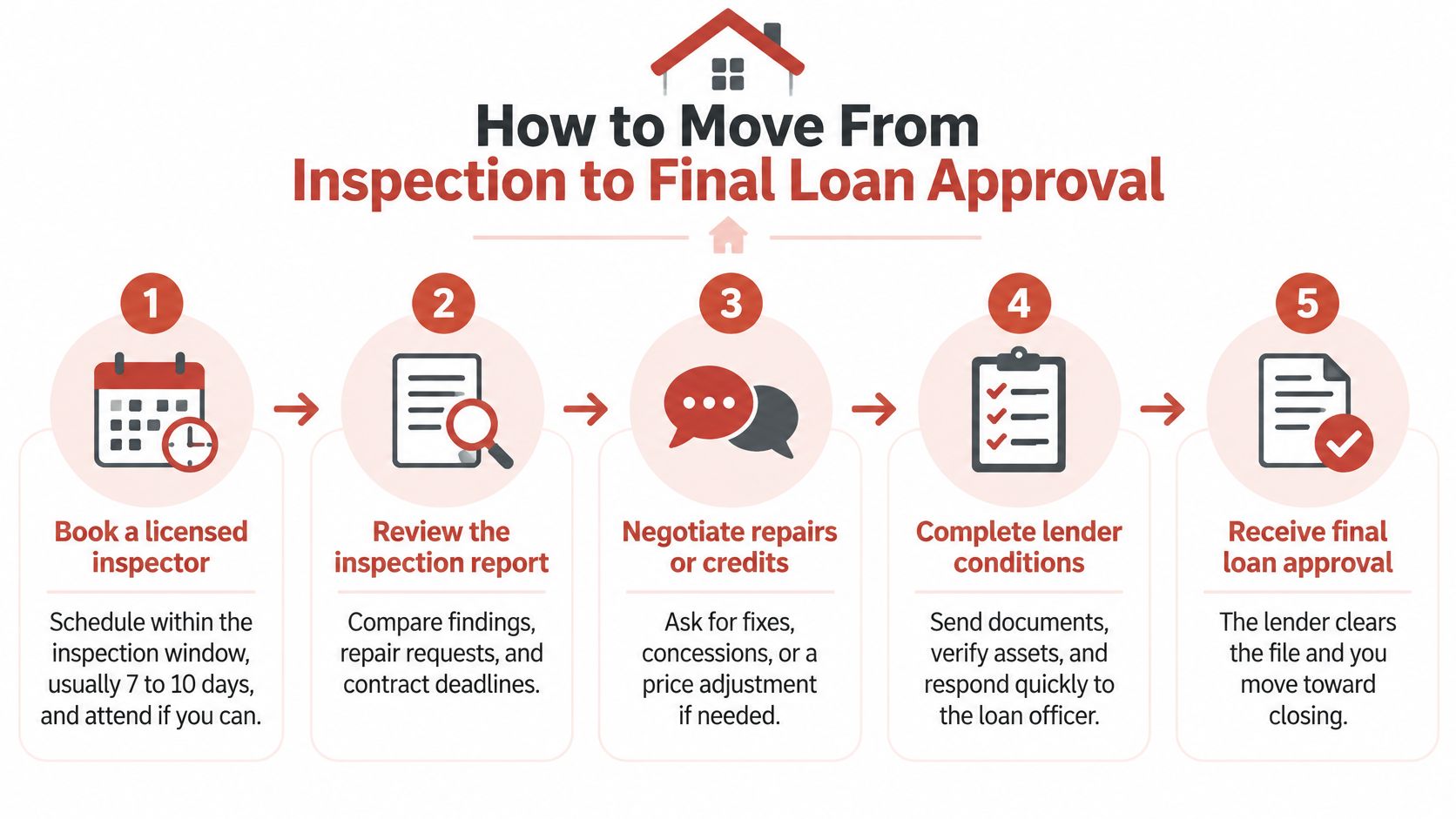
The Contract Period Step by Step
- Book the inspector fast: Schedule a licensed inspector inside your inspection window and attend if you can. You'll understand the report better if you see the attic access, panel, and basement concerns yourself.
- Sort the report: Put safety, structural, water, roof, sewer, and electrical items in one list. Put paint, minor caulk, and dated fixtures in another. Sellers respond better to a short, documented list than to forty cosmetic demands.
- Negotiate in writing before the deadline: Request repairs, a seller credit, or a price reduction, and use the approach for how to negotiate repairs after a home inspection to tie each request to a report finding and a cost.
- Handle the appraisal: Your lender orders it. If value comes in low, your options are renegotiate, bring cash within your written limit, challenge with better comparable sales where the lender allows it, or use your contingency if you kept it.
- Clear underwriting conditions: The underwriter rechecks income, assets, employment, debts, and the appraisal. Expect requests for updated pay stubs, bank statements, or explanations for large deposits. Send complete pages, not screenshots with missing account details.
- Get clear to close: Final loan approval means the lender has cleared conditions and can prepare closing documents. It doesn't mean you can finance furniture or change jobs before funding.
A credit often beats a seller completed repair. Say the water heater is near the end of its life. A credit lets you hire your own plumber after closing and choose the unit and warranty. A rushed seller repair may be the cheapest fix that technically satisfies the contract.
Don't open a store card, buy a car, move money between accounts without a paper trail, or quit a job during underwriting. Any of those can change your debt ratios or verified income and stop approval late, when you've already paid for inspection and appraisal.
Closing Day, Ownership Costs and Your Next Step
Closing isn't a formality. It's your last chance to catch a fee that moved, a repair that wasn't finished, or a tax proration that doesn't match the contract.
Close Without Surprises
- Compare disclosures line by line: Check the Closing Disclosure against your Loan Estimate. It must reach you at least three business days before closing, and any change you don't understand needs a call to your lender before you sign, not at the table.
- Do the final walkthrough: Book it close to closing, typically within 24 hours, and confirm agreed repairs are done, included appliances remain, and the home is in the condition the contract requires. Run water, test heat or cooling, and photograph any new damage.
- Move money safely: Send cash to close by wire or cashier's check only using instructions you verify by phone with the title company or closing attorney. Wire fraud targets buyers at exactly this stage, so don't trust changed instructions sent by email alone.
- Sign, record, then keys: Sign the loan and transfer documents, let the deed record, and collect keys, garage remotes, and any codes or manuals the seller agreed to leave.
Carmen works with clients from the first showing through to the closing table, tracking contract deadlines, coordinating inspection, and reviewing the Closing Disclosure with you. That continuity matters because the person who saw the basement stain on tour should also be asking about it at the walkthrough.
Budget for the House After the Mortgage
Qualifying for a loan and sustaining ownership are different tests. A 2025 Zillow analysis of hidden homeownership costs estimated average U.S. ownership costs beyond the mortgage at $15,979 annually, including $10,946 for maintenance, $2,003 for homeowners insurance, and $3,030 for property taxes.
| Cost | Average per year |
|---|---|
| Maintenance | $10,946 |
| Homeowners insurance | $2,003 |
| Property taxes | $3,030 |
| Total beyond the mortgage | $15,979 |
That's more than $1,300 per month before utilities. Your Chicagoland number won't match a national average, especially with local property taxes, older housing stock, storm exposure, and sewer or drainage risk. Use the table as a warning to build your own budget, not as a quote.
Stress test the payment four ways. Model it at purchase, after a tax reassessment, after an insurance renewal increase, and with one major repair such as a roof or HVAC replacement. Keep predictable taxes and insurance in escrow, but hold lumpy repairs in a separate reserve you don't raid for furniture.
You can be mortgage qualified and still be unprepared to own. Judge affordability by resilient cash flow after a bad year, not by approval on a good day.
After you move in, set up files for the deed, closing packet, warranties, insurance policy, and tax bills before boxes bury them, and use these ideas to get organized as a new homeowner while the details are fresh. Change locks, locate the main water shutoff, test sump and backup systems, and calendar furnace filters, gutter cleaning, and insurance renewal shopping.
Clients can reach out to schedule a consultation or get answers to their real estate questions, and prospective clients can book a call through the Schedule A Call button on homesbycarmen.com. Bring your preapproval letter, your one page cash plan, and your tour checklist. Decide this week which of three numbers you can confirm first, your monthly budget, your cash to close, or the reserve you'll still hold after closing. That's your real starting point.
If you're buying your first home in Melrose Park or a nearby western suburb, Homes By Carmen can help you turn your budget, preapproval, and search criteria into an offer that protects your cash and a closing plan you can follow deadline by deadline. Bring your numbers, ask direct questions about taxes, insurance, contingencies, and repairs, and visit Homes By Carmen to schedule your consultation.