The party that hired the broker usually pays, but local law and the written agreement can change that, so confirm the payer in writing before paying or signing.
If a listing says the landlord pays the commission, does that make it the less expensive apartment? Not necessarily. You still need to understand the rent, mandatory charges, concessions, and any agreement you sign with your own representative.
For renters in Chicago and the western suburbs, the useful question isn't just who pays realtor fees for rentals. It's what you'll owe, what triggers payment, and how much the home will cost over your first year.
Table of Contents
- Who Usually Pays Realtor Fees on a Rental
- Local Rules in New York, Chicago and Illinois
- Separate Broker Fees from Other Move-In Charges
- When Tenants Pay Through a Representation Agreement
- What the Full Move-In Cost Looks Like
- Checklist to Verify the Payer and the Amount
Who Usually Pays Realtor Fees on a Rental
Start with who engaged the agent, rather than who opened the door or sent you the listing. An agent showing an apartment might be working for the owner, helping you under a separate representation agreement, or coordinating with another brokerage.
Those relationships can produce different payment obligations. A friendly conversation or a scheduled tour doesn't tell you which arrangement applies.
Who pays the rental broker in each scenario
| Who hired the agent | Usual payer | Document to check |
|---|---|---|
| Landlord or building owner | Landlord, typically | Listing or leasing agreement with the owner |
| Tenant hires own representative | Tenant, subject to agreed compensation and credits | Written tenant-representation agreement |
| Landlord hires agent in New York City under the FARE Act | Landlord; the landlord's broker can't charge the tenant | Required fee disclosure and itemized fee list |
| Landlord hires agent but tenant is asked to pay under the practice addressed by the Illinois proposal | Disputed; the proposed rule would bar it | Lease fee schedule and written terms |
| Nonparticipating listing with tenant-side agreement | Tenant, if the agreement assigns that obligation | Fee formula and nonparticipating-listing clause |
The payment arrangements behind the paperwork
- Landlord-paid listing commission: The owner engages a broker to market the property and find a renter.
- Tenant-paid representation: You independently retain someone to help with your search and agree to compensation.
- Fee shifting or a shortfall: Your agreement assigns you a payment obligation when the selected property doesn't compensate your representative sufficiently.
Local law can override an attempted charge. According to the New York City Department of Consumer and Worker Protection, the FARE Act took effect on June 11, 2025, prohibiting landlords and their agents from passing the landlord's broker fee to prospective tenants, while allowing renters to hire their own brokers.
In a standard Chicago rental, the owner typically pays the leasing commission. But don't treat that market custom as a promise about every property or every agreement.
Before touring, ask the agent to identify whom they represent and who retained them. Before money changes hands, get written confirmation of your own payment obligation, including whether it's absent, conditional, or fixed.
Local Rules in New York, Chicago and Illinois
Moving between markets can change your expectations about broker fees. A practice that's familiar in one city isn't proof that the same charge is appropriate somewhere else.
Separate a legal requirement from a customary arrangement. Then distinguish both from the private contract you might sign for representation.
Default payer and fee size by market
| Market or case | Default payer | Typical fee size or calculation | Status |
|---|---|---|---|
| New York City, landlord-hired broker | Landlord | Historical tenant-fee benchmark, not a current mandatory rate | FARE Act in effect |
| Chicago-area standard rental | Landlord, typically | About one month's rent or a percentage of annual lease value | Market practice; confirm written terms |
| Illinois proposed transparency rule | Party hiring the broker would pay | Negotiated compensation, not a fee schedule established by the proposal | Proposal in the cited legislative materials; verify current law |
| Renter independently hires a broker | Renter, subject to credits and applicable law | Formula in the tenant-representation agreement | Contract-based |
New York City versus Chicago practice
New York City's change addressed a practice in which renters often paid a broker connected to the landlord's listing. For historical context, the New York City Council's published coverage identified the 2024 average broker fee as 15% of annual rent. That historical figure isn't a current legal fee ceiling or a price every broker must charge.
Chicago generally works differently. An industry explanation of rental-agent compensation describes owners typically paying a referral or leasing commission, commonly about one month's rent or a percentage of annual lease value. That arrangement often lets renters receive search and showing assistance without writing a separate broker-fee check.
For a Chicago-suburb search, ask whether each property offers cooperating compensation, meaning payment available to the brokerage assisting the renter. Customized relocation work, off-market sourcing, and exclusive representation deserve particular attention because the parties may negotiate those services separately.
Treat a proposal differently from an enacted rule
The Illinois proposal described in legislative materials addresses landlords requiring tenants to pay brokers the landlords hired. Don't assume a proposal governs your lease because its principle sounds straightforward.
Check the current rule applicable to the property, then compare it with the lease and representation documents. If someone describes a fee as legally required, ask them to identify the rule rather than accepting a verbal explanation.
Practical rule: A market custom tells you what commonly happens. The applicable law and your written terms determine what you should agree to pay.
A renter who independently chooses a personal representative should review that contract in any market. The landlord's listing arrangement doesn't automatically resolve the renter's separate agreement.
Separate Broker Fees from Other Move-In Charges
An apartment advertised without a broker fee can still require substantial move-in money. Keep the charges separate so you can tell which payment buys a service, which secures the tenancy, and which remains refundable.
Organize the listing, application instructions, and payment requests together before agreeing to any charge.

Sort the money by purpose
Landlord listing compensation pays for marketing and leasing work the owner commissioned. When the owner is responsible for that compensation, don't place it in your personal move-in budget as though it's automatically your bill.
Tenant-requested representation pays for services you independently selected under agreed terms. Ask what work the agreement covers, rather than assuming every person involved in your search provides the same service.
Other move-in charges can include application, screening, administrative, move-in, and lease-preparation fees. These aren't interchangeable with brokerage compensation, and describing a charge clearly doesn't by itself establish that it's lawful.
The NYC 311 explanation of rental broker fees distinguishes landlord brokerage from independently chosen tenant representation and explains the city's requirement to disclose tenant-paid fees in listings and an itemized written disclosure. Elsewhere, requesting an equivalent written breakdown is a sensible way to identify unexplained charges.
Turn each charge into a complete entry
A usable fee schedule should contain more than a label and a total. For every requested payment, record:
- Amount: The dollar charge or a formula you can convert into dollars.
- Recipient: The legal name of the person or business receiving it.
- Trigger: The event that creates the obligation.
- Refundability: What happens if you're denied, withdraw, or never sign a lease.
- Deadline: When the payment must arrive.
Use the rental application process guide to organize application preparation alongside this fee review. Having documents ready shouldn't mean paying an unexplained charge just to keep the application moving.
Keep optional moving services outside the landlord's fee schedule. For example, if you're deciding whether to hire a cleaner, you can compare maid service pricing using Aquastar Cleaning Services, LLC's resource, then obtain a quote for your own home and scope of work.
A service you choose for convenience belongs in your moving budget, but it isn't automatically a condition of renting the apartment.
That separation helps you compare properties fairly without confusing optional spending with mandatory lease costs.
When Tenants Pay Through a Representation Agreement
A renter assumes the landlord will pay, chooses an apartment, and then learns that their own representation agreement assigns them a commission. The disagreement often centers on a nonparticipating-listing clause, not on whether the agent calls themselves a realtor.
If you independently retain a broker, the written agreement may make you responsible when the property offers no cooperating compensation. Read the payment terms before the search expands beyond participating listings.
Illinois Senate legislative materials on the proposed broker-fee rule describe the distinction between hiring a broker and being required to pay one the landlord hired. The materials describe a proposal, so they shouldn't be treated as proof of the law currently governing an individual lease.
Read the compensation clauses together
- Fee formula: Identify whether compensation is a flat amount, a percentage, or an equivalent rent period. If it's a percentage, confirm what amount the percentage applies to.
- Payment trigger: Find the event that makes the fee due. Don't assume payment requires an executed lease if the document describes another trigger.
- Credit for owner-paid compensation: Check whether money paid by the landlord reduces what you owe. Ask how any remaining shortfall will be disclosed before you commit to a property.
- Nonparticipating properties: Determine what happens when you find a rental outside the broker's compensation network, including a listing you discover yourself.
These clauses work together. A clearly stated commission can still surprise you if the agreement doesn't explain how landlord payments are credited or which properties activate your obligation.
Apply the terms to the property you want
Say you select a rental whose owner won't compensate your representative. Before applying, request a property-specific explanation showing the agreed fee formula, any available owner contribution, and the remaining amount assigned to you.
Also check the agreement's scope and duration. Understand whether it's exclusive, which searches it covers, and how you can end it. If the wording is unclear, request clarification or an amendment before signing rather than relying on reassurance that landlords generally pay.
For readers also considering a purchase, our explanation of buyer-agent compensation addresses a separate transaction type. Don't transfer purchase-agreement assumptions into a rental contract.
Carmen Salerno is a REALTOR®. A client, Christian D., described Carmen as “a highly professional real estate agent working in both rentals and buying.” Regardless of an agent's credentials or reviews, the compensation document still deserves its own careful review.
Read the nonparticipating clause before signing any representation agreement. It's the provision most likely to matter when your preferred home doesn't offer the compensation you expected.
What the Full Move-In Cost Looks Like
Consider a hypothetical apartment with monthly rent of $2,500: the city's FARE Act rollout notice illustrates that a fee equal to one month's rent would be $2,500, while 15% of annual rent would be $4,500. Those formulas produce different bills even though the apartment's advertised monthly rent is identical.
Now compare a landlord-paid listing, a tenant-paid arrangement, and a listing advertised without a broker fee. The commission alone won't tell you which home fits your budget.
| Cost component | Landlord-paid listing | Tenant-paid representation | Listing advertised without a broker fee |
|---|---|---|---|
| Brokerage payment from renter | None for the owner's commission | Amount assigned by the representation agreement | Confirm whether the description also accounts for your own agreement |
| Rent and possible offset | Compare asking rent with similar homes | Include rent plus your agreed compensation | Don't assume the rent is lower |
| Administrative charges | Request the complete schedule | Separate these from representation costs | Check for mandatory charges despite the advertising |
| Concessions | Confirm conditions and expiration | Apply only concessions you qualify for | Verify whether advertised savings are temporary |
| Refundability | Review deposits and other charges | Review commission and other payment terms separately | Obtain written refund terms for every upfront payment |
Separate cash needed from actual expense
Move-in cash includes everything you must produce before receiving possession, including refundable money. First-year cost should distinguish rent and nonrefundable charges from deposits you may recover.
For a practical comparison, calculate rent due during the first year, subtract applicable written concessions, and add mandatory nonrefundable charges and any tenant-paid brokerage compensation. Keep refundable deposits in a separate column so you don't mistake tied-up cash for a permanent expense.
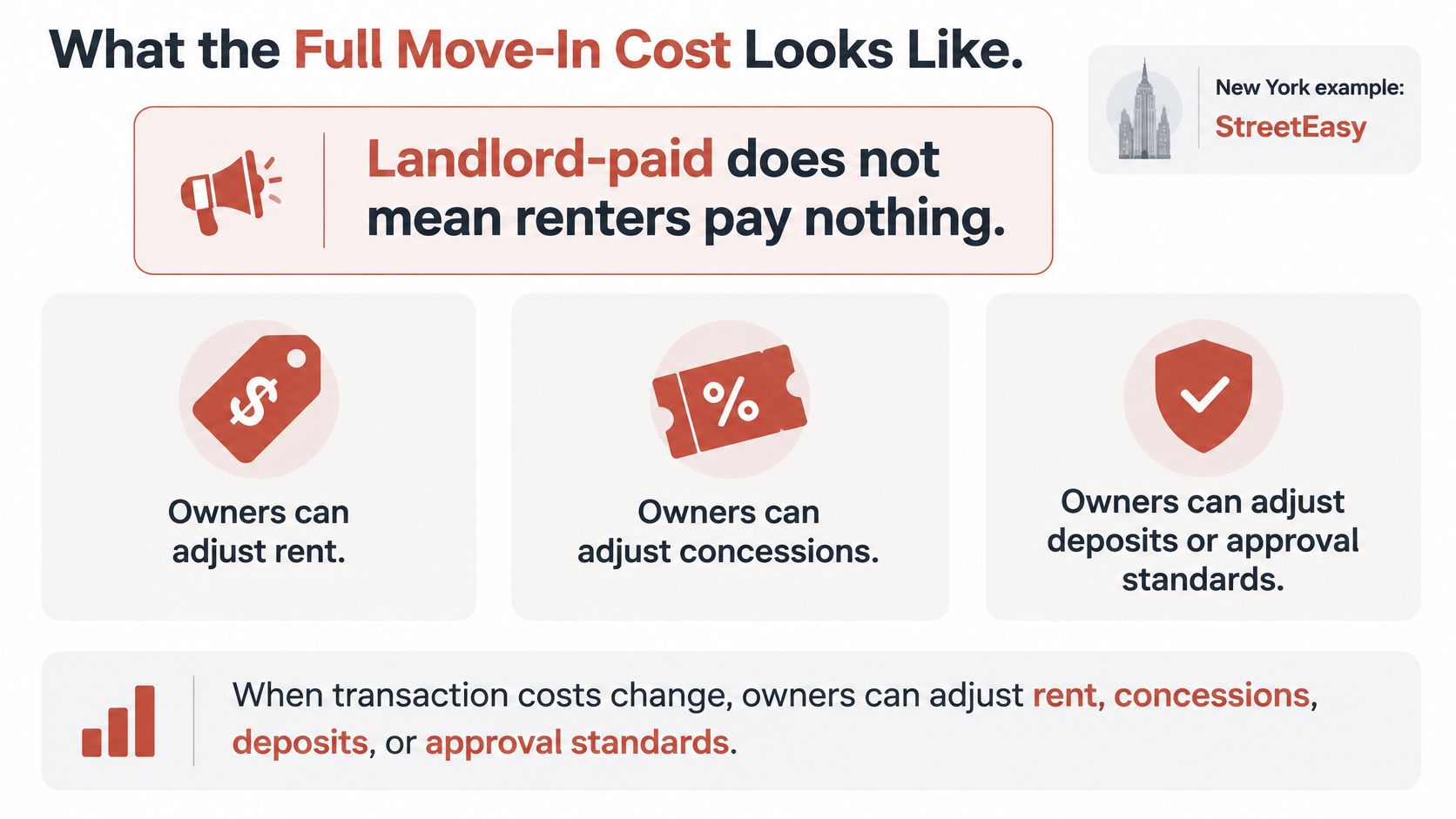
The New York City Rent Guidelines Board's broker-information resource helps distinguish brokerage costs from the broader apartment-hunting budget. Landlord-paid doesn't mean renters pay nothing: owners can factor leasing expenses into rent and other lawful terms, but you shouldn't assume a particular owner increased rent without comparing actual listings.
Check what the comparison leaves unresolved
Ask whether a concession disappears at renewal, whether administrative charges are mandatory, and whether money is returned if approval fails. Compare base rent separately from an advertised effective rent so a temporary discount doesn't obscure the ongoing obligation.
Don't assume changes to rent, deposits, or approval standards are automatically permitted. Each proposed term still needs to comply with applicable law.
Moving expenses belong in a separate budget category. House Moving Melbourne's budget guide for Melbourne downsizers can help identify moving-related categories, but its local pricing shouldn't be transferred to a Chicago-suburb move.
Compare the money you must produce before move-in and the expense you'll carry through the first year. They're related figures, not the same figure.
A landlord-paid apartment may be the better choice, but only the complete written comparison can establish that for your situation.
Checklist to Verify the Payer and the Amount
Run this check against the listing, application instructions, lease fee schedule, and any representation agreement. Use the actual property address so the response applies to the apartment you're considering, not just the brokerage's usual practice.
Save the documents together. If the listing changes or someone gives a different explanation later, you'll have a record of what you were told before committing.
Verify each payment before sending it
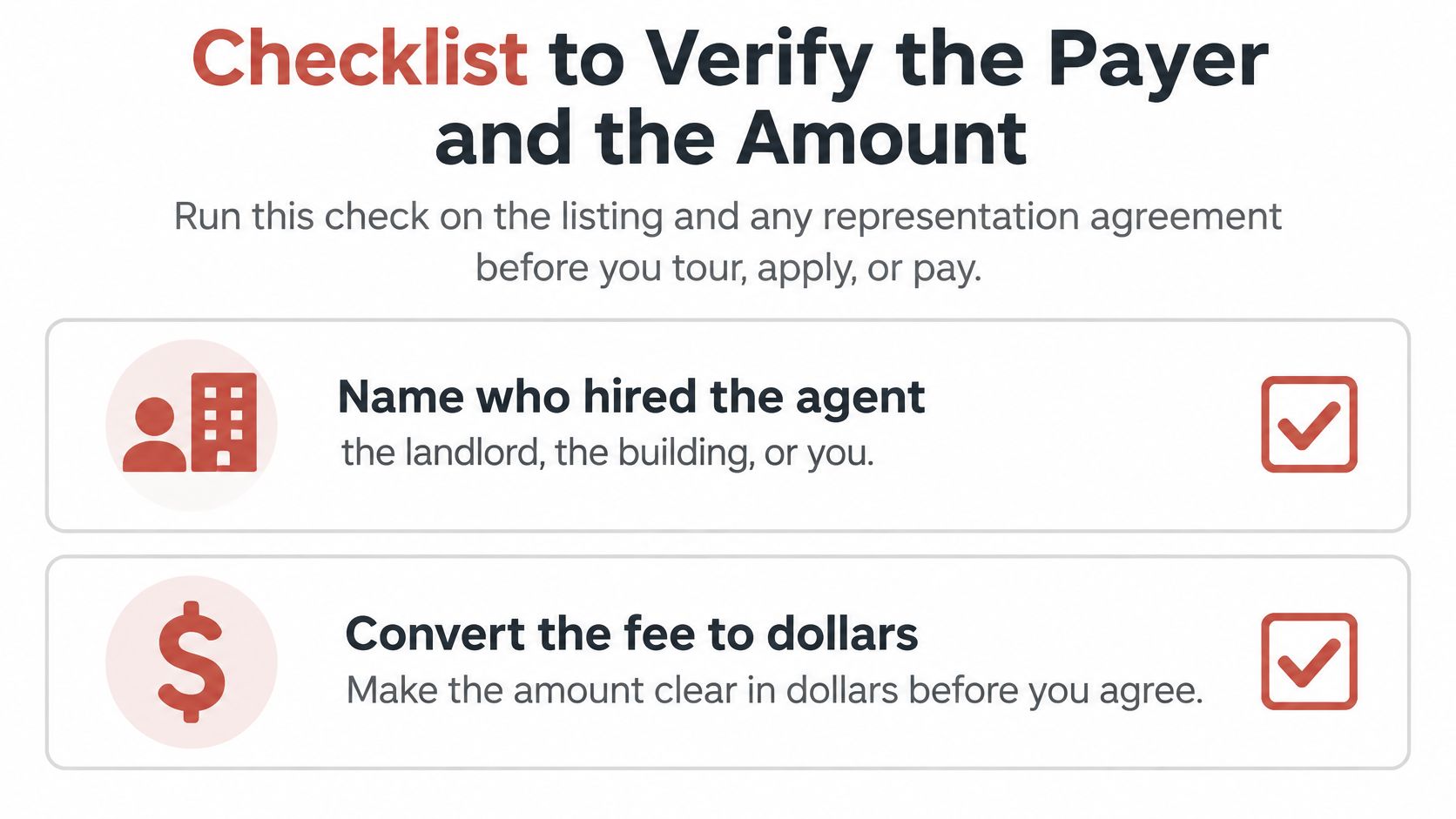
Name who hired the agent. Record whether the landlord, building owner, or you engaged the brokerage. Ask the agent to identify their role in this particular transaction, especially when several people are coordinating tours.
Convert the formula to dollars. Request a written calculation using the selected apartment's rent. Check that the formula uses the correct rent figure and that any landlord contribution appears as a credit rather than an unexplained verbal promise.
Identify the recipient. Match payment instructions to the brokerage or other named recipient in the documents. If someone changes the payee or payment destination, verify the change through an established contact before transferring money.
Write down the trigger. Distinguish touring, applying, approval, lease execution, and move-in. If you're asked to pay at a showing, pause until you understand what the payment purchases and which document authorizes it.
Confirm the refund conditions. Ask what happens if your application is denied, the owner withdraws the property, or the lease isn't completed. A statement that a charge is refundable isn't complete unless you know the conditions and return process.
Set the deadline and method. Record the due date, accepted payment method, and receipt procedure. Keep proof of payment alongside the agreement, not only in a banking app or text thread.
Request an itemized disclosure. Reconcile the total requested with each individual charge. If the application instructions, lease, and agent's explanation disagree, request a corrected written breakdown before paying.
Keep a property-specific record
You can use the rental property search to identify homes to investigate, then maintain a comparison sheet for each serious option. Include the listing address, agent's name, representation relationship, fee calculation, concessions, and unresolved questions.
Don't treat silence as confirmation. An unanswered email doesn't establish that a fee has been waived, and an oral explanation doesn't amend contradictory written terms.
For your next action, email the agent with the property address and request confirmation of your total brokerage obligation, the recipient, payment trigger, deadline, and refund conditions. Ask them to attach the applicable agreement or fee schedule, then retain the reply before touring, applying, or paying where a charge may arise.
If a demand appears inconsistent with local law or the signed documents, pause and seek clarification from the brokerage or appropriate local authority. You don't need to resolve a disputed obligation by sending money first.
Homes By Carmen is licensed in Illinois and provides rental search and application support in Chicago and nearby suburbs. Visit Homes By Carmen to schedule a consultation or get answers to your real estate questions, and bring the listing and any proposed fee agreement so you can discuss the terms before committing.