
Rental assistance is public help that lowers an eligible household's housing cost through a voucher, a subsidized unit, or short-term emergency rent relief, and it is not a guaranteed payment to every renter.
You may be holding a lease renewal, looking at apartments, or trying to cover rent after your work hours dropped. The useful question isn't just whether you qualify. It's who pays which part of the bill, when that help can start, and whether you can find a home the program will approve.
Table of Contents
- What Rental Assistance Means for a Monthly Rent Bill
- How a Housing Choice Voucher Splits the Rent
- Emergency Rent Relief Compared with a Lasting Subsidy
- Who Can Qualify and Why Many Still Wait
- How to Apply for Rental Assistance in Chicago Suburbs
- Three Suburban Renters and Your Next Move
What Rental Assistance Means for a Monthly Rent Bill
Rental assistance lowers the household's housing bill either through an approved subsidy or through a unit that's kept affordable. Say you're renting in Melrose Park and your renewal arrives before your next raise. A neighbor mentions Section 8, someone else suggests a voucher, and another person tells you to apply for rent relief.
Those terms don't all describe the same payment. Housing Choice Vouchers, public housing, and project-based rental assistance are the main continuing models. Emergency relief and rapid rehousing address more immediate housing instability, with assistance that's limited rather than assumed to continue indefinitely.
Think of a voucher as a shared rent bill. The household owes its assigned share, and the housing agency pays an approved subsidy to the landlord. The landlord doesn't erase the balance because the renter qualifies.
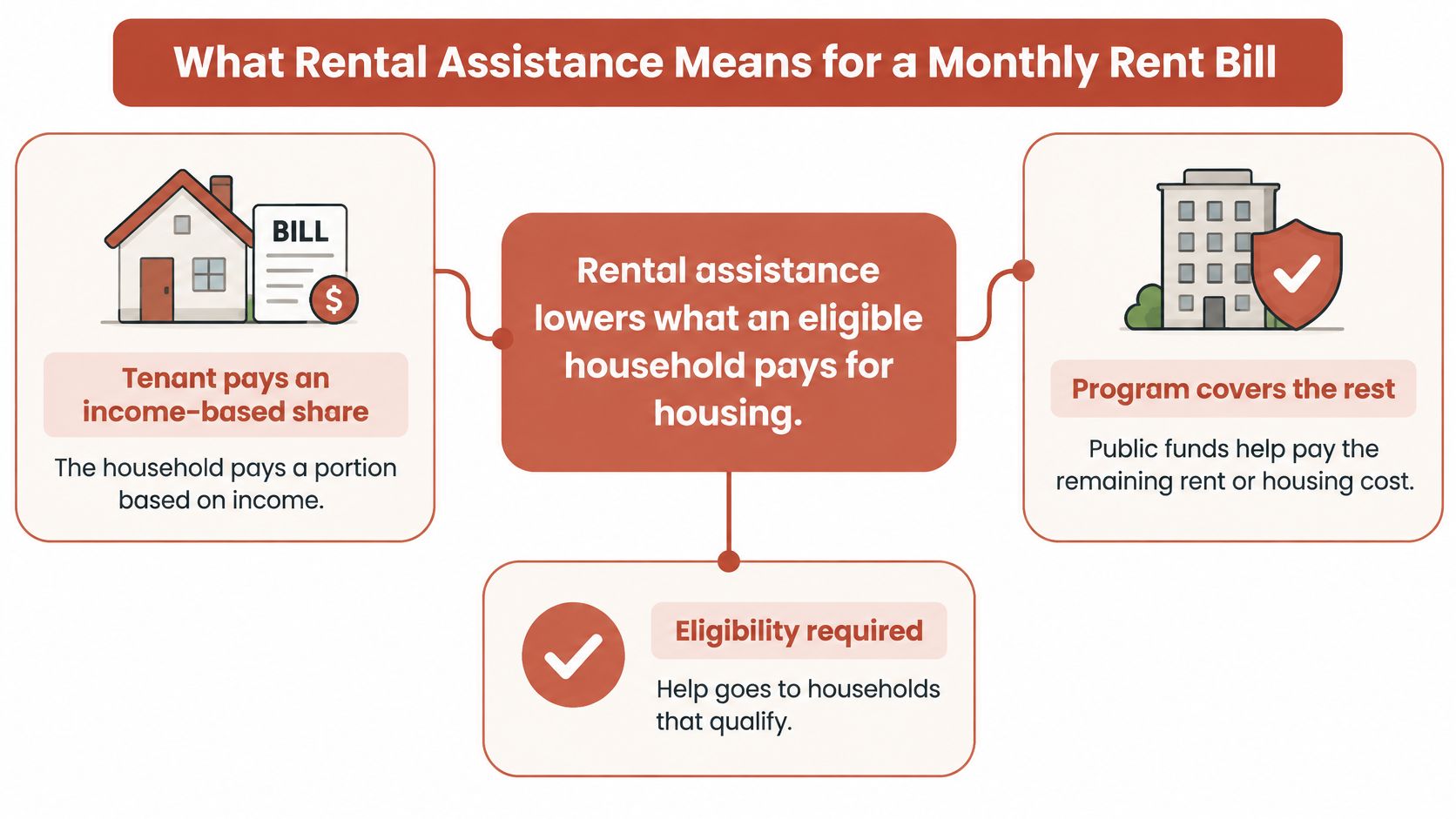
Which rental assistance model fits
| Program | Subsidy follows | Household still pays | Best fit |
|---|---|---|---|
| Housing Choice Voucher | The household, in a qualifying private unit | An income-based contribution, plus any approved excess rent | You need a choice of private-market apartments or houses |
| Public housing | A specific public housing development | An income-based share | You can live in a unit owned or run by the housing agency |
| Project-based rental assistance | A specific unit, even if you move out | An income-based share for that unit | You prefer a known affordable unit over flexibility to move |
| Emergency rental assistance | A time-limited payment for arrears or current rent | Whatever the grant doesn't cover | You're behind on rent or at risk of eviction |
| Rapid rehousing | A short-term subsidy while you lease up | The contribution set by the program, which may increase during assistance | You're exiting homelessness and need help securing a lease |
Read the table by asking what you would receive. A voucher supports a search for a qualifying private rental. Public housing means applying for a housing-agency unit, not receiving money to spend at any building.
Project-based assistance is an application for a particular affordable home. If that location works for your job, transportation, and household, it can be a practical option. But don't assume the assistance becomes yours to take elsewhere.
A housing system, not a coupon
The current system developed over time: HUD's account of the Housing Choice Voucher program traces its origins to the Housing and Community Development Act of 1974 and the consolidation of earlier certificate and voucher approaches through the Quality Housing and Work Responsibility Act of 1998.
That history matters because rental assistance isn't a store-style discount that a property manager can apply at the counter. The agency, household, landlord, and property each have a role.
Before choosing a program, identify the problem you need to solve. Is your monthly rent consistently beyond your income, or did a temporary setback leave you behind? That answer helps you distinguish a lasting affordability need from an overdue bill.
How a Housing Choice Voucher Splits the Rent
A voucher doesn't promise that the household will pay the same amount at every apartment. Income, the local payment standard, the unit's rent, and utilities all affect the split.
Under HUD's Housing Choice Voucher tenant guidance, Total Tenant Payment is generally 30% of adjusted monthly income, including the household's contribution toward rent and tenant-paid utilities; when gross rent exceeds the payment standard at initial lease-up, the household's share generally can't exceed 40% of adjusted monthly income.
Adjusted income means the income figure after the agency applies applicable allowances. Don't calculate your expected payment from take-home pay alone and assume the result is an approval.
Sample voucher rent split
The following worked example uses HUD's income, payment-standard, and gross-rent scenario, with the subtraction and affordability cap calculated from those amounts.
| Line | Amount | What it means |
|---|---|---|
| Adjusted monthly income | $2,000 | Income after the allowances the agency applies |
| 30% tenant contribution | $600 | Usual Total Tenant Payment before excess rent |
| Payment standard | $1,500 | Local subsidy benchmark, not a ban on higher rent |
| Housing Assistance Payment | $900 | Paid to the landlord, calculated here as payment standard minus tenant payment |
| Gross rent | $1,650 | Rent plus the applicable utility allowance, not advertised rent alone |
| Excess above the standard | $150 | Paid by the household on top of its usual contribution |
| Household monthly share | $750 | Contribution plus excess rent, including the applicable utility component |
| 40% initial-occupancy cap | $800 | The initial affordability guardrail in this example |
The important distinction is between the household's total housing contribution and the check it writes to the landlord. When the tenant pays utilities separately, part of that contribution goes toward those utilities. It isn't necessarily all rent payable to the owner.
The agency calculates the Housing Assistance Payment, generally using the applicable payment standard minus the tenant payment, subject to the unit's gross rent. The example shows why choosing a home above the payment standard can increase your contribution even though your income hasn't changed.
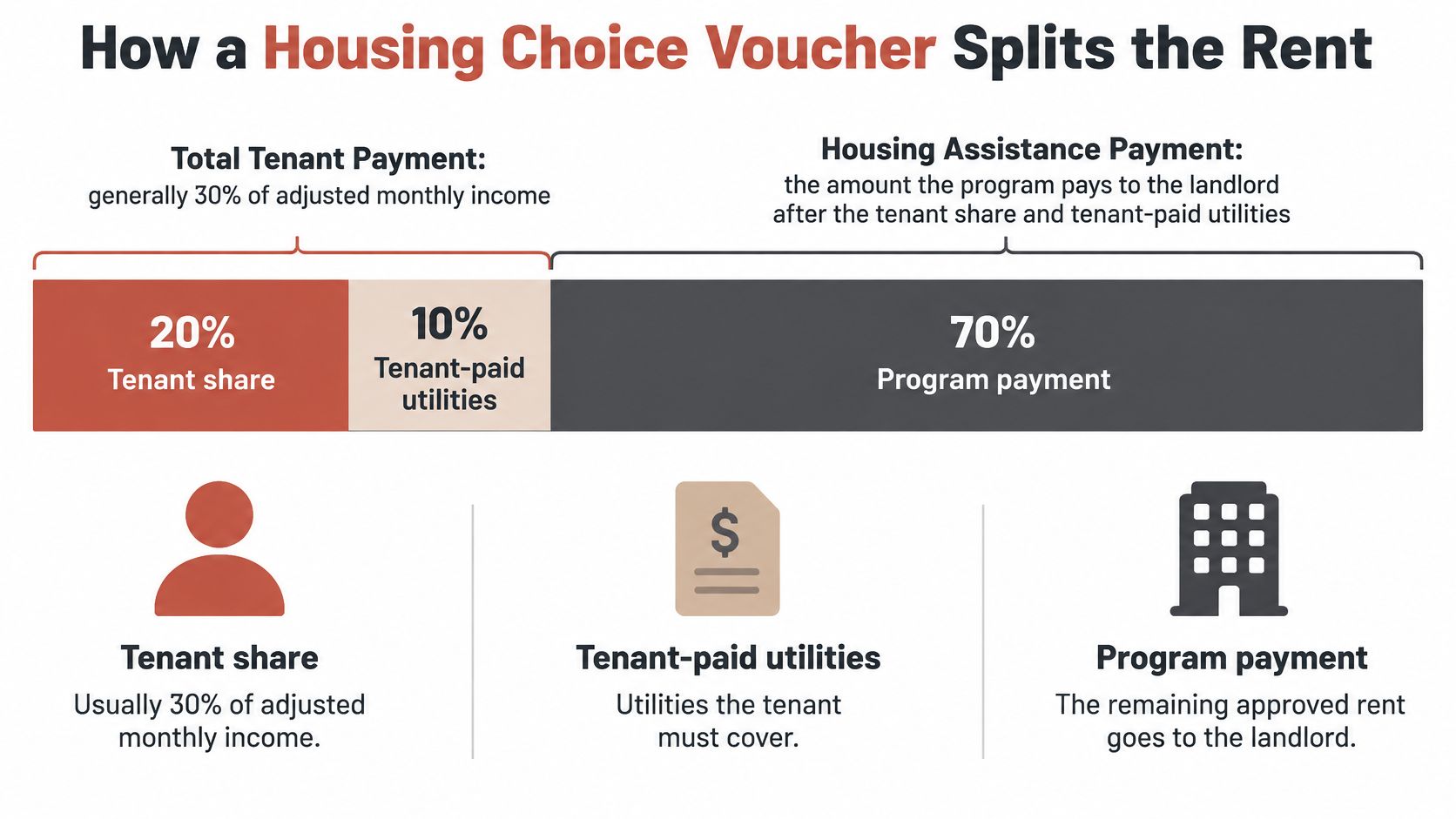
Compare gross rent before applying
The payment standard reflects local market rents and bedroom size. It's a subsidy benchmark, not a promise that every apartment below it will qualify or that every apartment above it will fail.
Practical rule: Ask for the utility responsibilities before deciding that an advertised rent fits your voucher.
An apartment with tenant-paid heat can produce a different calculation from an otherwise similar apartment where heat is included. Ask the housing agency which payment standard and utility allowance apply before paying an application fee.
For the owner's side of the transaction, VerticalRent's guide to Section 8 participation for property owners offers context on landlord participation. Use the rental assistance apartments guide to organize property questions without treating a listing as program approval.
A later income change or rent increase can change the allocation. Report changes through the agency's process and request an updated calculation rather than treating the initial split as a permanent quote.
Emergency Rent Relief Compared with a Lasting Subsidy
Emergency rent relief addresses a crisis. A continuing subsidy addresses an ongoing mismatch between household income and housing costs. Choosing between them isn't about which program sounds more generous, it's about which problem needs solving and how soon.
If you normally cover rent but missed work during an illness, catching up on arrears may restore a workable budget. If you're short every month even with steady work, paying the arrears won't make the next lease affordable.
According to the Government Accountability Office's review of Emergency Rental Assistance, Congress authorized pandemic-era programs totaling $46.55 billion, and just under 500,000 households per month received assistance at the peak.
What a crisis payment can accomplish
Those federal programs supported rent and, in many cases, housing-related expenses such as utility arrears. State, local, and tribal governments administered the funding. That history demonstrates what emergency assistance can do, but it doesn't establish that a comparable fund is accepting applications in your suburb today.
Ask the current administrator what it covers. Current rent, past-due rent, utilities, relocation expenses, and payment timing are separate questions. A program name won't answer them.
Emergency aid can address a past-due or short-term bill. A continuing subsidy changes what the household must budget for an ongoing lease.
A grant can be the right tool when keeping the existing tenancy is realistic. It's less useful as a complete plan when the household can't sustain the rent after the award ends.
Handle the immediate deadline separately
Prepare for an emergency application before the portal opens. Keep your lease, rent ledger, income documentation, and any landlord notice together so you aren't trying to reconstruct the file during an application window.
- Confirm current funding. An old announcement or an accessible webpage doesn't prove that applications are open.
- Check the payment process. Ask whether landlord documentation is needed and how the administrator confirms the balance.
- Keep communicating. Tell the landlord when you've applied, but don't represent an application as an approved payment.
- Address legal deadlines. If you've received a notice or court papers, seek qualified legal help promptly rather than waiting for a funding decision.
Apply promptly when an appropriate emergency fund opens. Separately, pursue continuing assistance if your household needs it and a relevant list is accepting applications. A denial from an emergency fund doesn't, by itself, answer whether you qualify for another program.
Who Can Qualify and Why Many Still Wait
Being income-eligible doesn't create a funded housing slot. The City of Chicago's Annual Report on Homelessness describes national access gaps, including about one in four income-eligible households receiving federal rental assistance, alongside the Chicago housing shortage summarized below.
Begin with the administrator's actual eligibility rules. Ask for the income limit for your household size, how the program defines income, and what household or residency requirements apply. Don't use another family's approval as your eligibility test.
Prepare documentation of identity, household members, and income. If your earnings fluctuate, ask which records the agency needs rather than selecting only the pay statement that seems most favorable.
From eligible on paper to housed
These national access measures and Chicago-specific housing figures describe different barriers. They aren't a prediction of an individual applicant's outcome.
| Measure | Figure |
|---|---|
| Income-eligible households receiving federal rental assistance | About 1 in 4 |
| Average time applicants spend on voucher waitlists | More than 2 years |
| Voucher recipients who successfully use their voucher | About 60% |
| Chicago shortage of affordable, available units for households below 50% of area median income | More than 115,000 |
| Low-income, rent-cost-burdened renter households in Chicago | More than 173,000 |
The waiting-list measure concerns access to assistance. The voucher-use measure concerns what happens after issuance. Combining them into a single promise of approval would hide the hardest part of many searches.
A household may receive a voucher and still struggle to locate an available unit, satisfy lawful rental screening, complete the property approval process, and meet the search deadline. The figures don't establish that every unsuccessful household encountered the same obstacle.
Eligibility and lease approval are separate decisions
The housing agency reviews program eligibility. The property must also qualify, and the lease-up process must be completed. An eligibility letter is not a set of keys.
In the western suburbs, confirm the geographic area each agency serves. Don't assume a City of Chicago program covers an Elmhurst or Naperville address because all are part of the same regional housing search.
A closed list is another distinct barrier. It may mean the agency isn't accepting new applications, not that your household has been reviewed and rejected.
Keep two questions separate: Can this household receive this assistance, and can this particular home be leased with it?
Treat those questions as separate checkpoints in your budget. Until assistance and a qualifying lease are confirmed, don't commit to a rent you can afford only if a pending application succeeds. That's especially important when a move would require deposits, transportation changes, or leaving an existing affordable arrangement.
How to Apply for Rental Assistance in Chicago Suburbs
Start with the address and the program type, not with a generic application form. A renter considering Melrose Park, Oak Park, and Naperville may need to contact different administrators and track separate applications.
The Congressional Research Service's overview of rental assistance explains that Housing Choice Vouchers generally support qualifying private-market rentals, while project-based assistance remains attached to the property; it also notes that waiting lists can last months to years because voucher assistance isn't an entitlement.
That distinction changes where you spend your search time. For a tenant-based voucher, investigate qualifying private rentals and the agency's geographic procedures. For project-based help, investigate the assisted properties themselves and their application requirements.
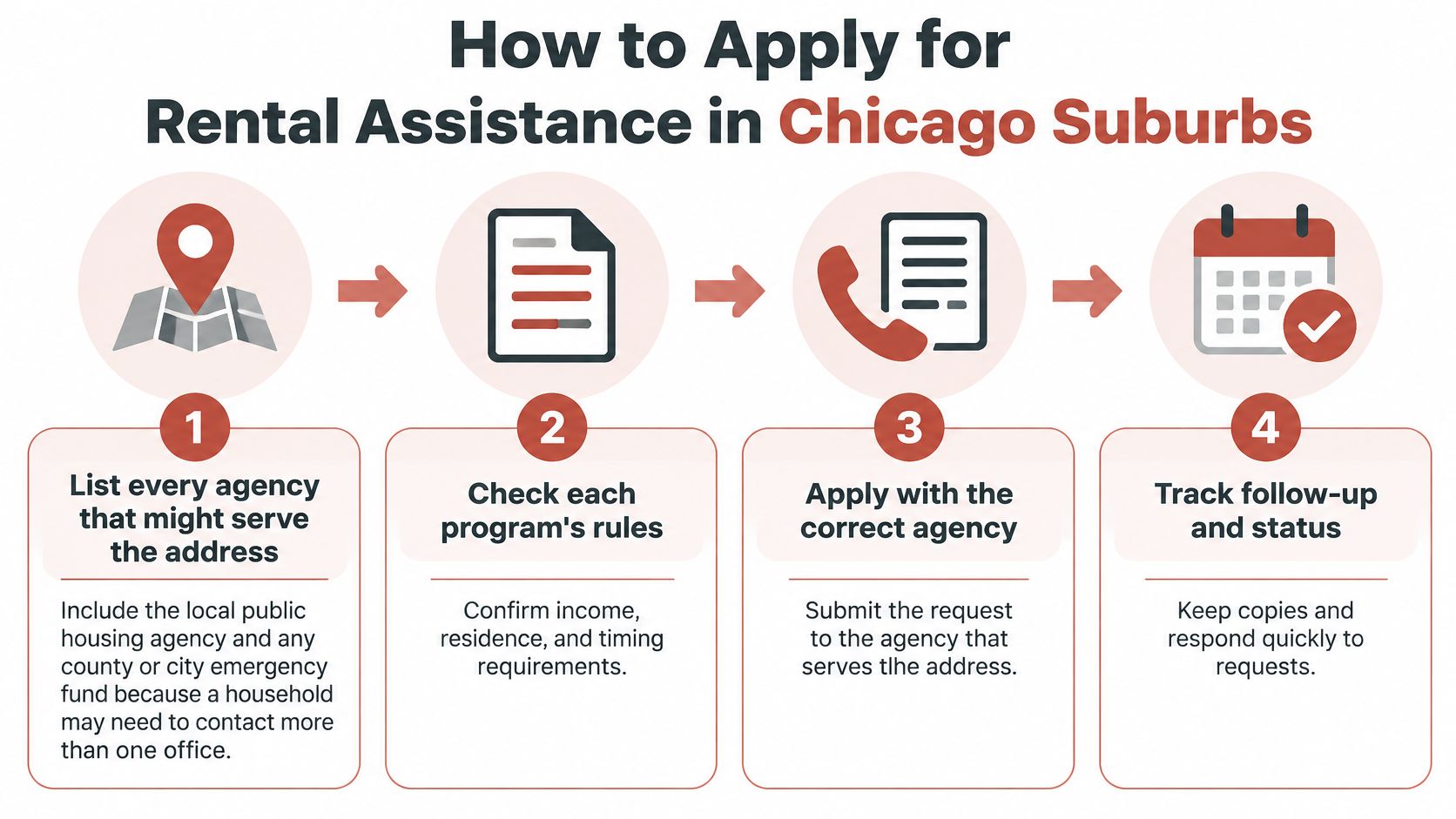
Build an application file you can use
List every administrator that may serve the address. Include the relevant public housing agency and any city or county emergency program. Confirm service boundaries directly so you don't spend time completing an application for the wrong jurisdiction.
Check whether each list is open. Record whether it accepts applications now, offers an opening notification, or requires a separate property application. Check program requirements before uploading sensitive documents.
Apply to all relevant open programs. Don't treat an application to a single list as a complete housing plan. Keep answers consistent across applications, and retain copies so you can explain any later change in household circumstances.
Prepare the supporting documents. Gather identification, household information, income records, and the current lease. Add a rent ledger or landlord notice when applying for emergency help, and follow the administrator's exact document checklist.
Protect the property search
Verify subsidy compatibility before paying a landlord's application fee. Identify the actual assistance you hold rather than asking only whether the property takes rental assistance. Ask about the proposed rent, utility responsibilities, screening criteria, and required agency paperwork.
Coordinate the approval process once a voucher is issued. Ask who submits the property packet and arranges inspection. Respond to document requests by the stated deadline, track your search expiration date, and ask about extension procedures before time runs out.
Maintain a simple application log. Record the program, portal, confirmation number, submission date, status, and next action. Update your contact information with each administrator so a missed email or old mailing address doesn't interrupt your application.
Use the rental application process guide to prepare for the landlord's application alongside the public-program paperwork. They're related files, but neither substitutes for the other.
Your immediate task is to identify which applications you can submit now and which housing options you can pursue while they're pending. Keep that short-term plan separate from the possibility of future assistance.
Three Suburban Renters and Your Next Move
The best path depends on the household's problem, not just its preferred suburb. These hypothetical renters illustrate how the same phrase, rental assistance, can lead to different decisions.
An Elmhurst family preparing for renewal
Consider a family with steady but low wages and a lease that remains stable for now. They aren't trying to cure a sudden arrears balance. They need a housing cost they can sustain through future renewals.
Their useful path is to investigate open voucher lists and suitable project-based properties while maintaining their current tenancy. They should compare commute costs, household needs, and available units rather than focusing only on a program label.
Their failure mode would be submitting to a closed list and assuming they've joined a queue. Instead, they should retain confirmation of accepted applications and check the next required action.
The timeline is the coming renewal, not an emergency move tomorrow. That gives them room to ask the current landlord about terms and consider alternatives without pretending assistance is already awarded.
A Naperville renter whose hours were cut
Now consider a renter with reduced work hours who has received a landlord notice. This household needs an immediate response to the arrears and the notice, not just a long-term affordability application.
The practical path is to identify an open emergency program serving the address, assemble the rent ledger and income records, and seek qualified legal guidance about the notice. A continuing-assistance application may still make sense, but it isn't the payment to promise the landlord now.
This renter's mistake would be applying to a city program without confirming suburban coverage. Another would be delaying every other action because an emergency application shows pending.
They also need to test whether the tenancy will be affordable after relief. If work hours won't recover, resolving the overdue balance should be paired with a realistic plan for the next rent bill.
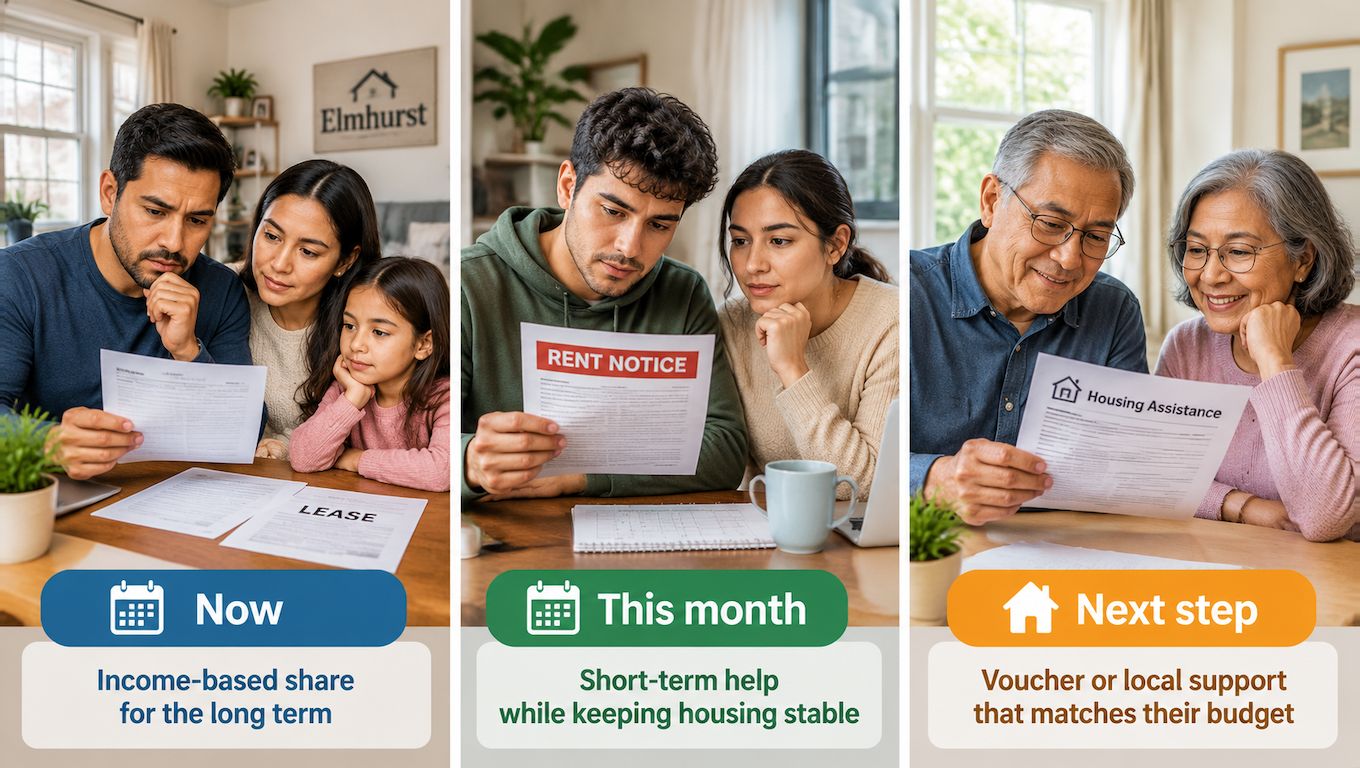
A renter leaving shelter for Oak Park or Melrose Park
A renter preparing to leave shelter needs coordinated housing placement. Rapid rehousing, if available and appropriate, or a voucher already issued may support the move, but the proposed unit and lease still need to work with the program.
The next conversation should include the housing worker, the property contact, and the administrator responsible for approval. Confirm the available unit, paperwork, inspection arrangements, and realistic possession date before arranging the move.
This renter's failure mode would be spending application money on properties that can't complete the required process. A property's willingness to discuss the program is useful, but completed approval is what makes a move possible.
This week's decisions
Keep the next actions concrete:
- Save proof of submission. Screenshot confirmations and retain the documents you uploaded.
- Search within your actual budget. Use assistance you already hold or rent you can pay without a pending award.
- Discuss private lease terms. Ask about rent, move-in timing, and concessions without assuming the landlord must negotiate.
- Keep deadlines visible. Put notice dates, application requests, and anticipated lease decisions on the same calendar.
A negotiated private lease can sometimes provide a bridge, but it isn't public assistance. A pending voucher application doesn't pause a renewal decision or replace a workable monthly budget.
For a search spanning Melrose Park, Elmhurst, Downers Grove, Naperville, Oak Park, and Glen Ellyn, our rental property search can help narrow apartments, condos, and houses to investigate. Homes By Carmen provides search and application support, while program administrators determine eligibility and provide public assistance.
File the appropriate public applications now. At the same time, keep looking for a place you can lease rather than waiting for a waiting list to find your next home.
Homes By Carmen offers rental search and application support for apartments, condos, and houses across western Chicagoland, including help organizing a search around your assistance status and budget. Bring your notice date, household income information, and moving timeline to a consultation so we can discuss practical options while your public applications proceed. Visit Homes By Carmen to schedule a consultation or ask questions about your next rental move.