
The most popular advice about home value is also the least reliable: enter your address into an online calculator and accept the number as fact. That figure can be useful for curiosity, but it rarely answers the question a Chicagoland homeowner really needs answered. Selling, refinancing, legal work, and simple curiosity are four different valuation goals, and each calls for a different level of evidence.
A home in Melrose Park, Oak Park, Downers Grove, or Naperville doesn't trade on square footage alone. Condition, updates, lot characteristics, buyer demand, competing listings, and the quality of comparable sales all shape the result. The right home valuation service gives you a number you can use for a specific decision, not just a number that looks precise on a screen.
Table of Contents
- Understanding How Real Estate Valuation Works
- Automated Estimates versus Comparative Market Analysis
- When a Professional Appraisal Becomes Necessary
- Why Online Numbers Can Be Misleading
- The Value of Local Market Expertise
- Next Steps for Your Home Valuation
Understanding How Real Estate Valuation Works
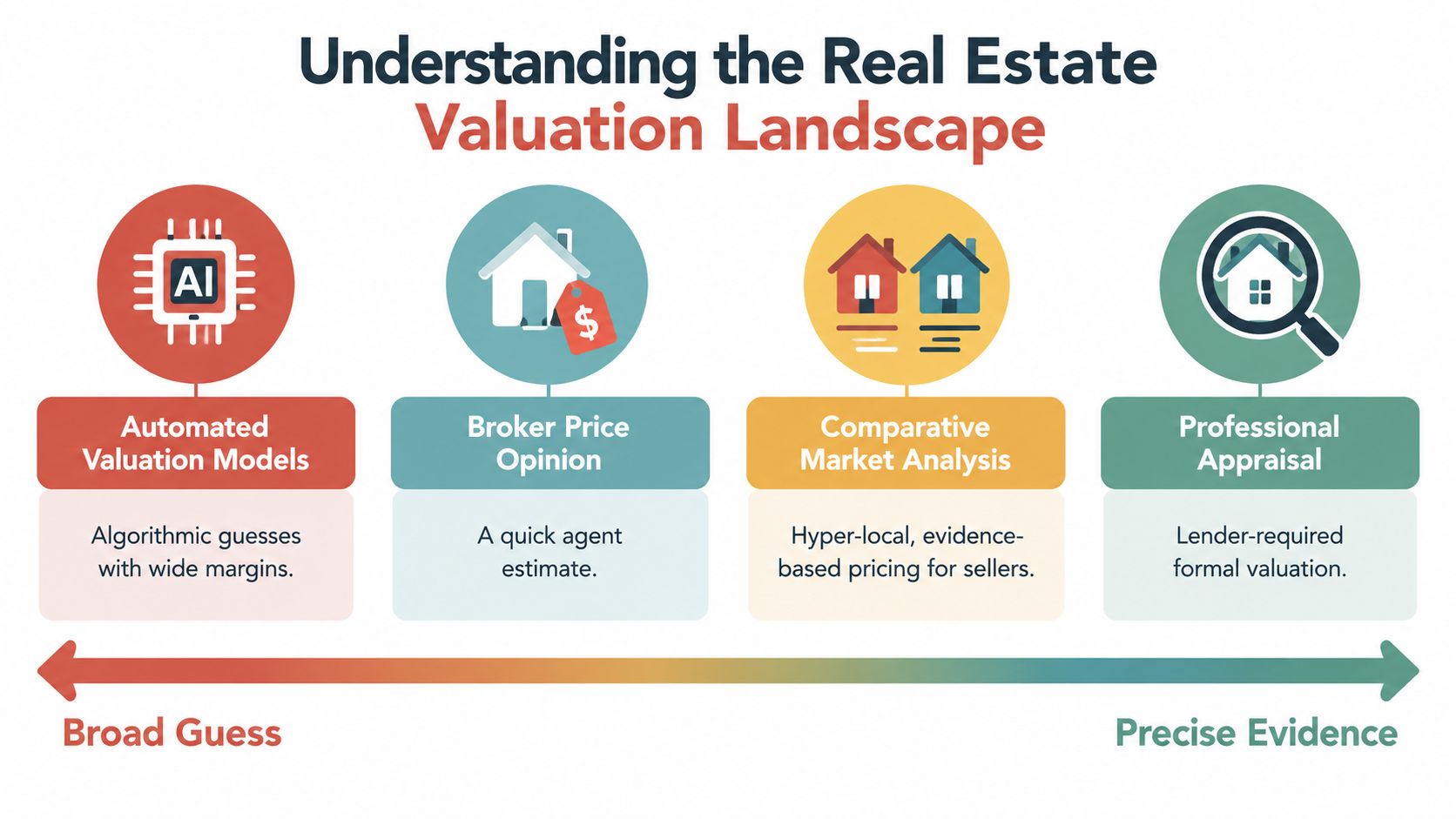
In practice, homeowners choose among three levels of evidence: a quick algorithmic estimate, a local comparative market analysis, and a licensed appraisal for formal use. The right choice depends on the decision, not on which number appears most polished. Selling, refinancing, legal work, and curiosity each call for a different valuation service, and a digital estimate rarely answers all four needs.
The scale of the field reflects how much depends on getting value reasonably right. IBISWorld estimates the U.S. real estate appraisal industry at $10.3 billion in 2026, with 39,350 businesses operating in the sector. The same source reports revenue declined at a 4.6% compound annual rate from 2021 to 2026, despite a 2.8% gain in 2026 as mortgage rates eased and market stability improved. Valuation supports pricing, refinancing, loan approvals, and transaction risk management across the housing market.
Two paths homeowners commonly encounter
An automated valuation model, or AVM, processes public records and market data to produce a fast estimate. It can help with early research, but the result depends on the quality and completeness of the records. A human-led analysis, such as a broker price opinion or comparative market analysis, adds property review and local judgment.
A global industry report estimated valuation services at $14.2 billion in 2025, with a projection of $21 billion by 2033, representing a projected 5.0% CAGR. Residential valuation accounted for 38.4% of global revenue in 2025, or about $5.7 billion, while North America represented $5.1 billion and 34.5% of worldwide share, according to the industry market overview.
Those figures describe the field, not the value of an individual home. For a Chicagoland property, the useful evidence is the evidence that matches the intended decision.
Match the method to the decision
Use a digital estimate for curiosity or a rough equity reference. Choose a comparative market analysis when preparing to sell and setting a pricing strategy. Use a licensed appraisal when a lender, court, estate process, or another formal requirement needs an independent opinion.
Homeowners seeking a property-specific starting point can request a home valuation report. The practical question is which method can support the decision at hand, not which number looks most precise on a screen.
Automated Estimates versus Comparative Market Analysis
An AVM answers a narrow question quickly: what might a property be worth based on available data and patterns? That can be convenient, but convenience isn't the same as decision-grade accuracy. An algorithm may know the recorded living area, sale history, tax information, and nearby transactions while missing the remodeled kitchen, deferred maintenance, awkward floor plan, finished attic, busy street, or unusually strong backyard.
A comparative market analysis, by contrast, is built for a market decision. A local real estate professional reviews recent comparable sales, current competition, property condition, improvements, location details, and the likely behavior of buyers in that price range. In western Chicagoland, those distinctions matter because two homes that appear similar online can attract very different buyer responses from one neighborhood to the next.
| Method | Best For | Accuracy Factor |
|---|---|---|
| Automated valuation model | Curiosity, rough equity context, early research | Data coverage, property similarity, and how recently the underlying records reflect the home |
| Broker price opinion | A quick professional estimate before a larger decision | Agent familiarity with the neighborhood and ability to recognize obvious condition differences |
| Comparative market analysis | Listing preparation, offer strategy, and pricing decisions | Relevant comparable sales, active competition, repairs, updates, and market timing |
| Professional appraisal | Lending, refinancing, estate, legal, or other formal purposes | Independent inspection, documented evidence, accepted appraisal methods, and lender requirements |
Where AVMs help
Online estimates are useful when you need a starting point without scheduling a consultation. They can help you notice broad changes in the market, think about possible equity, or decide whether a conversation with a professional makes sense.
They work better when the property is conventional, recently exposed to the market, and surrounded by many similar homes with dependable public records. They become less dependable when the home is off-market, unusual, heavily renovated, or located in a neighborhood with limited comparable sales.
Where a CMA earns its place
A CMA doesn't just replace one number with another. It explains the pricing range and the reasoning behind it. A seller needs to know which homes compete directly, whether current listings are overpriced, what features buyers are rewarding, and how the recommended price could affect showing activity and negotiation power.
In Downers Grove, Naperville, and Oak Park, a local analysis may distinguish between school boundaries, housing styles, street conditions, and buyer preferences that a broad model treats as interchangeable. Homeowners considering a sale can review the process in a comparative market analysis before deciding how much professional input they need.
Practical rule: Use an AVM to start a conversation, not to finish a pricing decision.
When a Professional Appraisal Becomes Necessary
A CMA is a marketing and pricing tool. An appraisal is a formal, independent opinion of value prepared for a defined purpose. Confusing the two can create problems because a strong listing strategy doesn't automatically satisfy a bank's underwriting requirements.
Refinancing and purchase financing
Lenders commonly require a professional appraisal during a purchase or refinance when they need independent evidence that the property supports the proposed loan. The lender isn't asking, “What asking price might attract buyers?” The lender is assessing collateral risk and determining whether the property value is consistent with the financing.
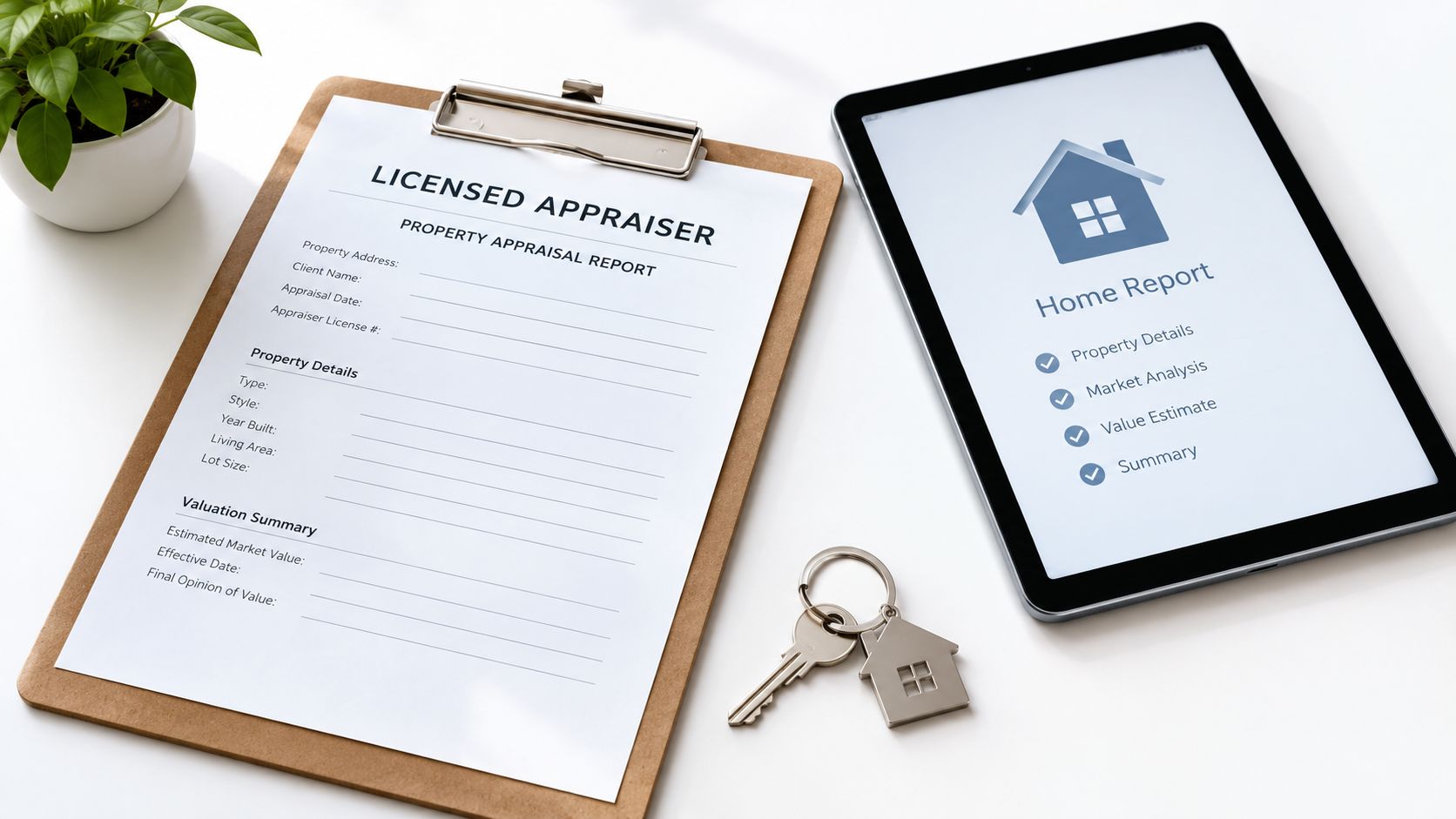
A licensed appraiser typically reviews the property, studies comparable sales, considers condition and improvements, and prepares a report using recognized valuation approaches. The exact process can vary by loan type and lender, so borrowers should ask the lending team what valuation method and documentation the transaction requires.
Legal and estate situations
An appraisal may also be appropriate for an estate, divorce, tax matter, partnership dispute, or another situation where parties need a defensible third-party opinion. In those settings, the purpose, effective date, and intended users of the appraisal matter. A casual online estimate doesn't provide the same documentation.
If you believe a lender's valuation contains factual errors, missing information, weak comparable selection, or evidence of prohibited bias, ask the lender about its reconsideration process. The Consumer Financial Protection Bureau's guidance on reconsidering inaccurate appraisals explains that borrowers can raise concerns and provide relevant information for review.
Prepare before the appraiser arrives
Gather records of major improvements, clarify finished areas, and point out features that may not be obvious from a brief inspection. Don't coach the appraiser toward a target number. Provide accurate facts and let the independent process evaluate them.
Why Online Numbers Can Be Misleading
An online estimate can look exact because it displays a single figure. The underlying confidence may be much weaker, especially for a home that hasn't recently sold or has characteristics that nearby properties don't share.
The Federal Reserve defines sales error as the AVM valuation minus the eventual selling price. In its empirical analysis, only about half of AVM estimates were within 10% of the sales price, while owner estimates were within 10% about 40% of the time, according to the Federal Reserve analysis of model-based and owner estimates. That doesn't make an AVM useless. It shows why a homeowner shouldn't treat one automated number as a final pricing conclusion.
The off-market problem
Off-market homes present a particular challenge because there isn't a current listing process revealing how buyers respond to the property. Recent coverage reports median error rates around 7% for off-market properties versus about 2% for on-market homes in 2025 and 2026. For a $400,000 off-market estimate, a 7% error would represent roughly $28,000, a difference that can materially affect pricing, refinancing, or negotiation. Those figures are summarized in coverage of home value estimate accuracy.
The practical response is to widen your skepticism, not to choose whichever estimate is highest. Ask whether the property has recent comparable sales, whether the records reflect renovations, and whether the model understands the home's location at a neighborhood level.
Bias and missing context
Model performance can also vary by neighborhood and demographic context. The Urban Institute found that AVM valuation errors were 3.4 percentage points higher for Black homeowners than for white homeowners in Atlanta and Memphis, and that Black-owned homes were undervalued by about 5% on average, as reported in its research on automated valuation models and disparities.
That finding reinforces a broader practice: automated output should be checked against relevant comparable sales, condition, time-on-market patterns, and neighborhood context. A home valuation calculator can help organize an initial estimate, but it shouldn't substitute for a property-specific review when money or timing is at stake.
The Value of Local Market Expertise
A homeowner in Melrose Park may own a house with the same bedroom count and apparent size as one in Elk Grove Village, yet the two properties can face different buyer pools, competing inventory, transit considerations, and neighborhood expectations. In Chicago's suburbs, location isn't just a municipality name. It includes the block, the housing stock, the nearby alternatives, and the details buyers notice during a showing.
Consider a representative Chicagoland seller preparing an older home with a dated interior and a recently improved kitchen. An online estimate might compare the property with nearby sales that have different renovation levels. A local professional reviewing the home would separate those sales, identify which features influence buyer interest, and account for the fact that some improvements appeal strongly to local buyers while others may not justify their cost.
A pricing decision is also a timing decision
Suppose the seller wants an aggressive price because the kitchen is attractive. The local analysis may show that the improvement supports a stronger position, but not necessarily the highest number the seller has seen online. It may also reveal that a competing home has better condition, a more practical layout, or a more desirable location within the same broad area.
The value of the consultation isn't a promise of a particular result. It's the ability to choose a launch price with a clear understanding of the trade-off:
- Higher starting price: More room to negotiate, but a greater risk of fewer showings if buyers see stronger alternatives.
- Market-supported price: Better alignment with comparable evidence and buyer expectations, while still preserving negotiation strategy.
- Lower positioning: Potentially more attention, but less room to protect proceeds if demand is already strong.
A local valuation should explain not only what the home could sell for, but also what the seller may need to do to reach that outcome.
Evidence beats confidence
The strongest local analysis uses MLS-based comparable data, active competition, condition adjustments, and a discussion of buyer behavior. It doesn't rely on a neighborhood reputation or an agent's instinct alone. In practice, Homes By Carmen offers complimentary property valuations and strategy consultations for prospective sellers in Melrose Park and the greater Chicago area, using local market information to frame the decision.
That distinction matters for inherited properties, as-is homes, older houses, and remodeled properties. The more a home differs from nearby alternatives, the more useful human interpretation becomes.
Next Steps for Your Home Valuation
Start by naming the decision. If you're curious, an automated estimate can provide orientation. If you're preparing to sell, request a CMA that reviews comparable sales, current competition, condition, improvements, and pricing strategy. If you're refinancing or handling a legal or estate matter, confirm whether a licensed appraisal is required.
Don't average several online estimates and call the result a valuation. When the numbers disagree, treat the disagreement as a signal to investigate the comparable data, property records, renovations, and market context.
For homeowners in Melrose Park and nearby western suburbs, a complimentary consultation can turn uncertainty into a practical plan. Bring renovation details, your intended timeline, and the reason you need the valuation. The right home valuation service should leave you with a defensible range and a clear next action.
Homes By Carmen provides complimentary property valuations and local pricing consultations for homeowners preparing to sell in Melrose Park and greater Chicagoland. Visit Homes By Carmen to request a valuation discussion grounded in local market evidence and your specific property goals.