
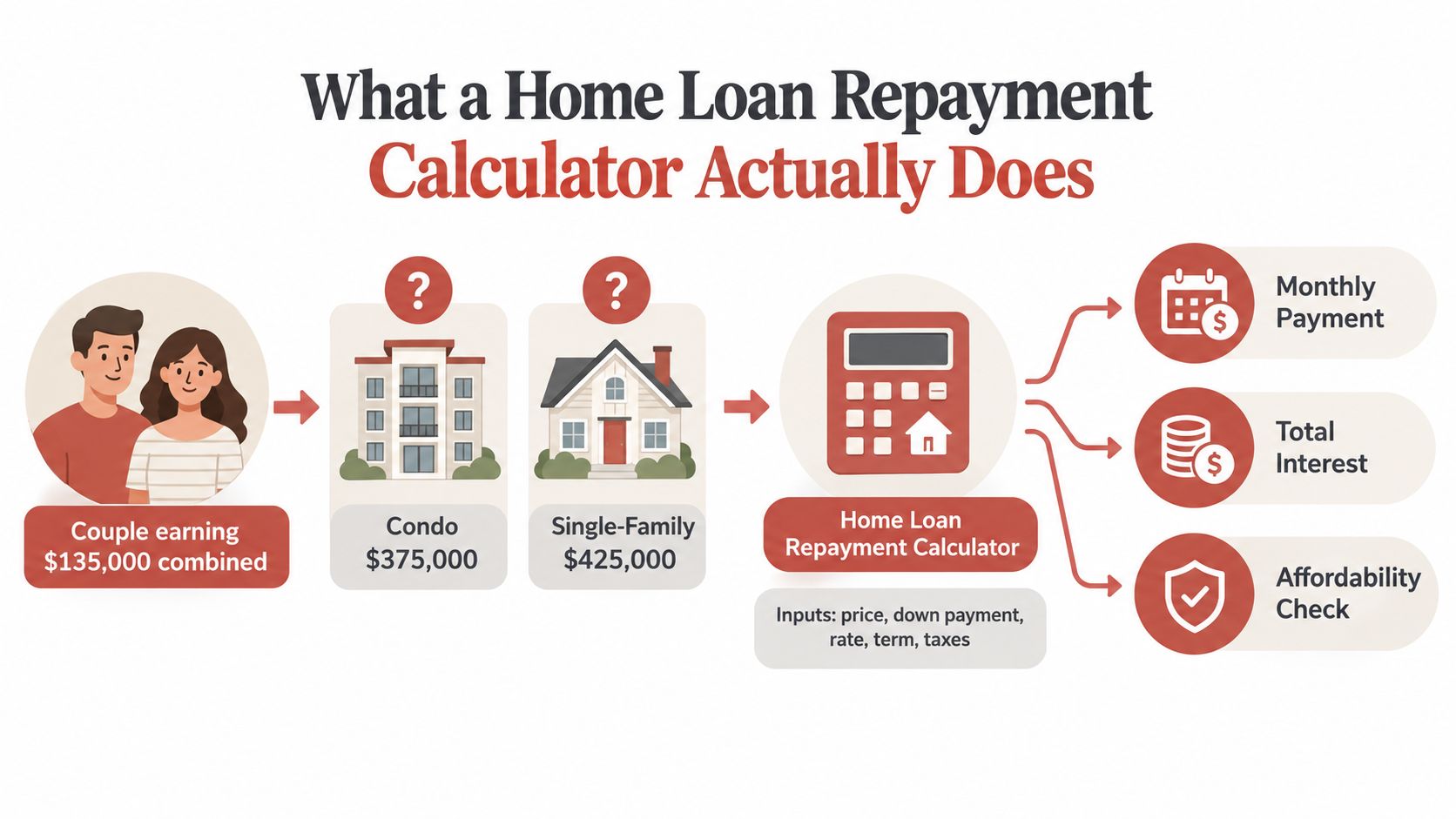
A couple in Mount Prospect can earn a solid combined income and still feel unsure about what a $375,000 condo or a $425,000 single-family home will cost each month. The listing price is only the starting point. The payment also depends on the down payment, interest rate, loan term, property taxes, insurance, PMI, and any association fees.
That's where a home loan repayment calculator becomes useful. It doesn't give you a magic approval number. It helps you build a realistic budget, compare structures, and see which assumptions create a payment you can live with before you spend your weekend touring homes.
Table of Contents
- What a Home Loan Repayment Calculator Actually Does
- How the Monthly Payment Is Calculated
- The Inputs That Matter Most for Chicago Buyers
- A Worked Example on a $400,000 Home
- Comparing Fixed Rate and Adjustable Rate Scenarios
- Why the Lowest Monthly Payment Is Not Always the Best Loan
- Where Calculator Estimates Differ From Real Lender Quotes
- Using the Results to Budget and Choose With Confidence
What a Home Loan Repayment Calculator Actually Does
Two Mount Prospect buyers can compare a condo and a single-family home without relying on listing-page guesses. Enter the same down payment, loan term, and rate for each property, then adjust one assumption at a time. The resulting figures show how the purchase price and property-specific costs affect the monthly budget.
A home loan repayment calculator is best used as a budgeting and comparison tool. Depending on its fields, it can organize:
- Principal: The portion of the payment that reduces the loan balance.
- Interest: The lender's charge for providing the loan.
- Property taxes: A major Chicago-area cost that should reflect the property's current tax history when available. Future reassessments can change this expense.
- Homeowners insurance: The annual policy premium converted into a monthly amount.
- PMI: Mortgage insurance that may apply until the loan reaches the lender's required equity threshold.
- HOA fees: A separate monthly housing cost for many condos and some planned communities.
The result remains an estimate. It is not a pre-approval, Loan Estimate, or rate lock. A lender still reviews income, credit, debts, assets, property details, and loan-program requirements before confirming eligibility and final terms.
Use it to compare decisions
Run the condo and single-family options side by side using the same assumed rate and down payment. Then test the inputs that create real trade-offs:
- Raise or lower the down payment to see when PMI may disappear.
- Use the property's tax history, then allow for a possible reassessment.
- Add HOA dues and compare the full monthly obligation.
- Test fixed-rate and adjustable-rate scenarios under the same purchase assumptions.
- Compare a shorter term, discount points, or extra principal payments.
Basic calculators often ask only for the loan amount, rate, and term. More useful scenario tools let buyers examine payment frequency, term changes, and rate structures, but every output still depends on the accuracy of the inputs.
For a broader affordability check, pair the payment estimate with a Chicago home valuation calculator. The goal is to compare choices, not chase one supposedly perfect payment. A helpful result shows how price, taxes, PMI, loan structure, and repayment strategy could affect both the monthly budget and total interest.
How the Monthly Payment Is Calculated
A fully loaded mortgage payment is easier to understand when you separate it into four buckets. The shorthand is PITI, meaning Principal, Interest, Taxes, and Insurance.
Think of the payment as a monthly housing envelope. One slice reduces what you owe, one slice pays the lender for the loan, and the remaining slices cover recurring ownership costs.
The four PITI buckets
Principal is the part that lowers the loan balance. Early in a standard amortizing loan, a larger share of the payment generally goes toward interest. Over time, the balance falls and the principal portion grows.
Interest is calculated from the outstanding balance and the interest rate. The standard amortization formula is:
M = P[r(1+r)^n] / [(1+r)^n - 1]
Here, P is the loan principal, r is the periodic interest rate, and n is the total number of payments. For a $320,000 loan at 6.875% over 30 years, the estimated principal and interest payment is roughly $2,104 per month.
Taxes are usually estimated from the annual property tax bill and divided by twelve. Insurance is quoted as an annual premium and also converted into a monthly amount. These figures don't reduce the loan, but they determine what your household must budget.
| Component | What It Covers | How It Is Calculated |
|---|---|---|
| Principal | Reduction of the loan balance | Included in the amortized payment |
| Interest | Cost of borrowing | Based on the rate and unpaid balance |
| Property taxes | Local government tax obligation | Annual bill divided by twelve |
| Homeowners insurance | Protection for the property and belongings | Annual premium divided by twelve |
PMI and escrow
PMI commonly enters the calculation when the down payment is below 20%. It protects the lender rather than the buyer, so buyers should treat it as a real cost even though it doesn't build equity.
An escrow account can combine taxes and insurance with principal, interest, and PMI into one payment. That arrangement makes budgeting easier, but it doesn't make those expenses disappear. The calculator is only as accurate as the tax, insurance, and PMI assumptions you enter.
The Inputs That Matter Most for Chicago Buyers
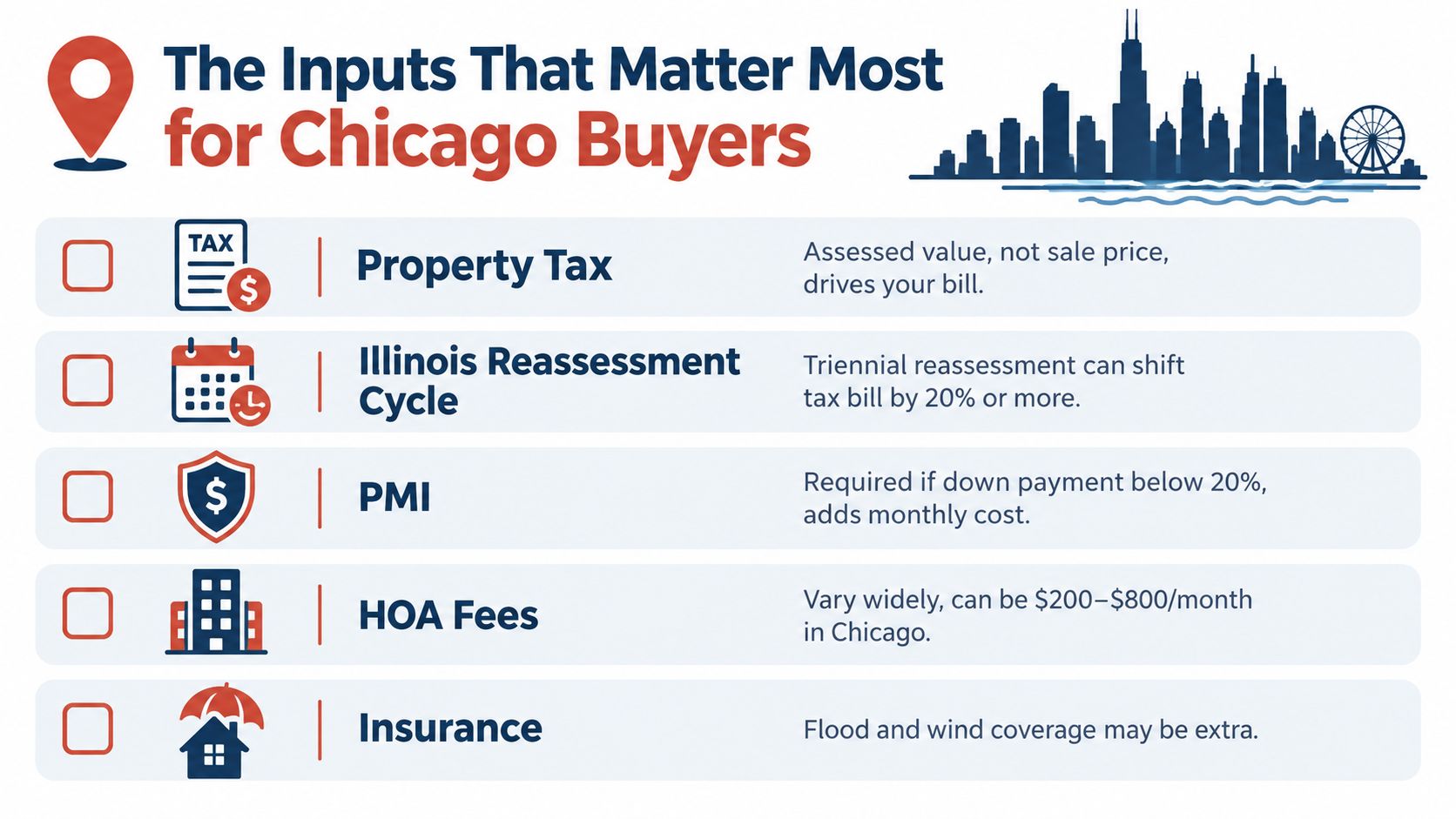
Chicago-area buyers often focus on the interest rate first. In practice, property taxes can change the payment just as dramatically as the loan terms, especially when the tax history doesn't reflect the bill a new owner may face.
Illinois reassessments and local valuation changes can shift a property's tax obligation between reassessment events. A current bill may also include exemptions the buyer won't qualify for, including homestead, senior, or long-time homeowner benefits. I review the actual bill, the property's assessment history, and possible future changes rather than relying on a broad state-average assumption.
Equity, insurance, and association costs
The down payment affects more than the loan amount. Reaching the 20% equity threshold may remove conventional PMI, while other loan programs use their own mortgage insurance or funding-fee rules. Buyers should enter the actual program-specific charge instead of assuming every loan handles insurance the same way.
A condo budget needs another layer. HOA dues aren't part of PITI, but they belong in the monthly housing calculation. Special assessments can also create a substantial cash obligation outside the calculator's standard fields, so review association budgets, meeting minutes, reserves, and pending projects.
Properties near the Des Plaines or Chicago rivers may require additional flood coverage. Some Chicago neighborhoods fall in flood Zone AE and may require elevation documentation, which can affect both insurance planning and the lender's review.
Input quality determines the result
The two weakest inputs in many self-run calculations are guessed tax rates and stale insurance quotes. Replace both with the latest available property documents and a current insurance estimate.
Local practice: I show buyers the realistic monthly housing cost and the cash needed to close. Those are separate decisions, and a calculator should help with both.
A Worked Example on a $400,000 Home
Consider a $400,000 Chicago-area purchase with 10% down. The down payment is $40,000, leaving a $360,000 loan. At 6.75% over 30 years, the estimated principal and interest payment is roughly $2,331 per month.
That number is useful, but it's incomplete. A buyer who stops at principal and interest may think the home fits comfortably when the full payment tells a different story.
Add the recurring ownership costs
For this illustration, add Cook County property taxes estimated at $5,200 annually, or about $433 per month. Add homeowners insurance estimated at $1,800 annually, or $150 per month. Because the loan-to-value ratio is 90%, add estimated PMI of about $165 per month.
| Line Item | Calculation Basis | Monthly Amount |
|---|---|---|
| Principal and interest | $360,000 at 6.75% for 30 years | About $2,331 |
| Property taxes | $5,200 annually divided by twelve | About $433 |
| Homeowners insurance | $1,800 annually divided by twelve | About $150 |
| PMI | Estimated annual mortgage insurance charge | About $165 |
| Estimated housing payment before HOA | Sum of listed monthly items | About $3,079 |
The example produces an estimated monthly housing payment of about $3,079 before HOA dues. It also requires the buyer to bring the down payment, closing costs, prepaid items, and any lender-required escrow funding to closing.
Change one input at a time
Suppose the buyer increases the down payment by $5,000 on a 30-year mortgage at 6.5%. The principal and interest payment would fall by about $32 per month. That reduction may sound modest, but if the additional funds also eliminate PMI, the total savings could be considerably greater.
That's why I run multiple versions rather than presenting one number. Change the down payment, then the rate, then the term. The buyer can see whether a lower payment comes from a meaningful improvement in affordability or from shifting more cost into interest over time.
Comparing Fixed Rate and Adjustable Rate Scenarios
Fixed and adjustable-rate loans answer different budgeting needs. A fixed-rate loan prioritizes payment certainty. An adjustable-rate mortgage, or ARM, may offer a lower opening payment but exposes the borrower to future rate and payment changes.
Using the same $400,000 home and $360,000 loan, the fixed-rate example at 6.75% produces roughly $2,331 in monthly principal and interest for the full 30-year schedule. A 7/1 ARM opening around 5.75% could reduce the initial principal and interest payment by roughly $250 per month before taxes, insurance, and PMI are added.
| Year of Loan | Fixed-Rate P&I at 6.75% | 7/1 ARM P&I at 5.75% Start |
|---|---|---|
| Initial period | About $2,331 | About $2,081 |
| Before first adjustment | About $2,331 | Opening payment may remain in effect |
| After adjustment | Remains tied to the fixed contract rate | Depends on the index, margin, caps, and new rate |
The opening payment isn't the whole story
The “7/1” structure generally means the initial rate lasts for the opening period and then adjusts. At that point, the new rate depends on the loan's index, margin, adjustment limits, and the market environment.
A calculator should model several possible post-adjustment rates rather than show only the attractive starting figure. Stress testing at 7.5%, 8.5%, and 9.5% can show how exposed the household would be if the adjustment produces a substantially higher payment.
The practical comparison: A fixed loan buys predictability. An ARM trades some of that certainty for a potentially lower opening cost.
ARMs tend to confuse buyers because the initial payment looks like a permanent bargain. It isn't. Compare the initial payment with plausible future payments, and ask whether your income, savings, and moving plans can handle the adjustment risk.
Why the Lowest Monthly Payment Is Not Always the Best Loan
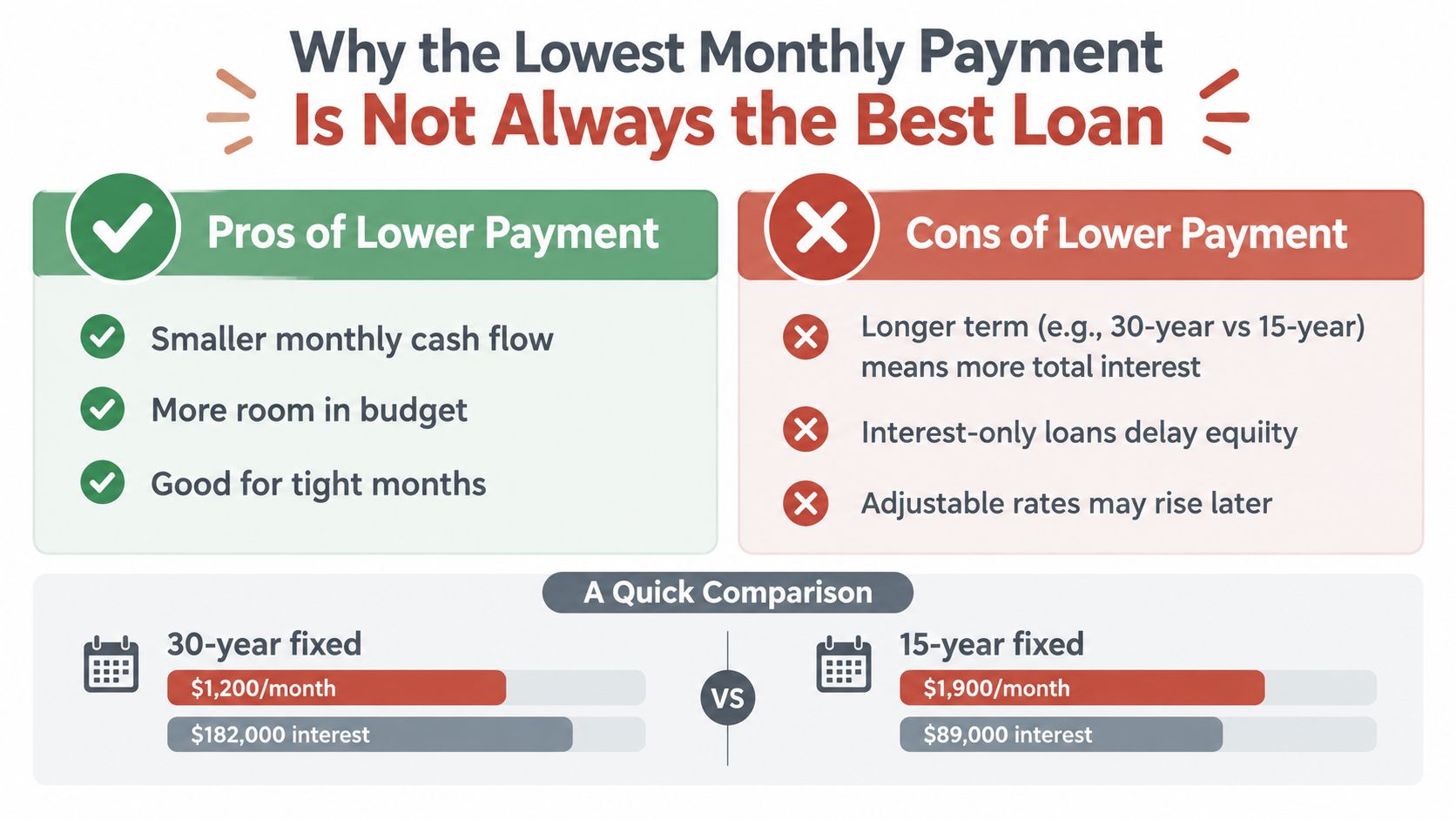
A calculator can reward the wrong decision if you sort every option by the smallest monthly number. A lower payment may come from a longer term, an interest-only structure, or an adjustable rate that moves higher later.
The payment matters, but so does what the payment buys. A longer term can preserve cash flow while increasing total interest. An interest-only period can delay equity growth. An ARM can make sense for someone expecting to move before the adjustment, but it can be a poor fit for a buyer who wants a stable long-term home.
Extra payments change the trade-off
On the original fixed-rate example, adding $200 per month toward principal could shorten the payoff period by roughly seven years and save tens of thousands in interest. The exact result depends on the loan balance, rate, payment timing, and contract terms, so the calculator should display both the revised payoff schedule and the estimated interest reduction.
That comparison helps buyers decide whether extra cash belongs in the down payment, an emergency reserve, home improvements, or accelerated principal reduction. The lowest payment isn't automatically the strongest financial choice, and the fastest payoff isn't automatically right if it leaves the buyer without liquidity.
Mobility matters
A buyer planning to relocate within five years may value a lower opening payment and accept more ARM risk. Another buyer purchasing a long-term home may prefer a fixed payment even if it starts higher.
Use the calculator to compare:
- Total interest: How much borrowing costs over the planned holding period.
- Optionality: Whether you can make extra payments or refinance without costly restrictions.
- Mobility: Whether the loan still fits if you sell or move before the rate changes.
- Liquidity: Whether the down payment leaves enough cash for repairs, reserves, and unexpected ownership costs.
The calculator gives you a starting point for those trade-offs. It shouldn't make the decision for you.
Where Calculator Estimates Differ From Real Lender Quotes
An online estimate isn't a contract price. I haven't formally tracked the variance between calculator results and lender quotes, so I won't attach a made-up percentage to it. The largest differences usually come from property taxes, insurance, PMI, lender fees, and borrower-specific pricing.
A lender's quote may also account for credit score overlays, debt-to-income calculations, occupancy, property type, and loan-level pricing adjustments. The exact PMI factor can change with the insurer and the borrower's loan-to-value band, while a generic calculator may use a broad assumption.
| Line Item | Calculator Estimate | Real Lender Quote |
|---|---|---|
| Interest rate | User-entered assumption | Rate based on current pricing and borrower profile |
| PMI | Generic estimate or omitted | Insurer-specific factor tied to the loan profile |
| Property taxes | Current bill or broad estimate | Underwriting review of the property and escrow requirements |
| Insurance | Approximate annual premium | Current policy quote and required coverage |
| Closing costs | Often excluded from monthly result | Lender, title, recording, prepaid, and transaction charges |
| Escrow funding | May not be shown | Lender-required initial deposits and cushion |
Chicago transaction details can sit outside the payment
A recent reassessment may produce a higher effective tax burden than the current calculator input suggests. Transfer tax stamps can increase closing costs, and condo assessments may be omitted entirely from a basic monthly estimate.
The lender may also require an escrow cushion, which can add one to three months of taxes and insurance to the cash needed at closing. Those funds affect the buyer's upfront budget even though they don't necessarily change the long-term monthly payment.
For a fuller cash-to-close discussion, review this guide to Illinois closing costs for buyers. Treat the calculator output as a planning range. Before making an offer, ask for an actual lender quote and compare every line item.
Using the Results to Budget and Choose With Confidence
The most useful calculator session ends with three or more scenarios at the same purchase price. Keep the home price constant, then test the down payment, rate, term, and loan structure. Compare the monthly payment, total interest, cash required to close, and the month when refinancing would break even.
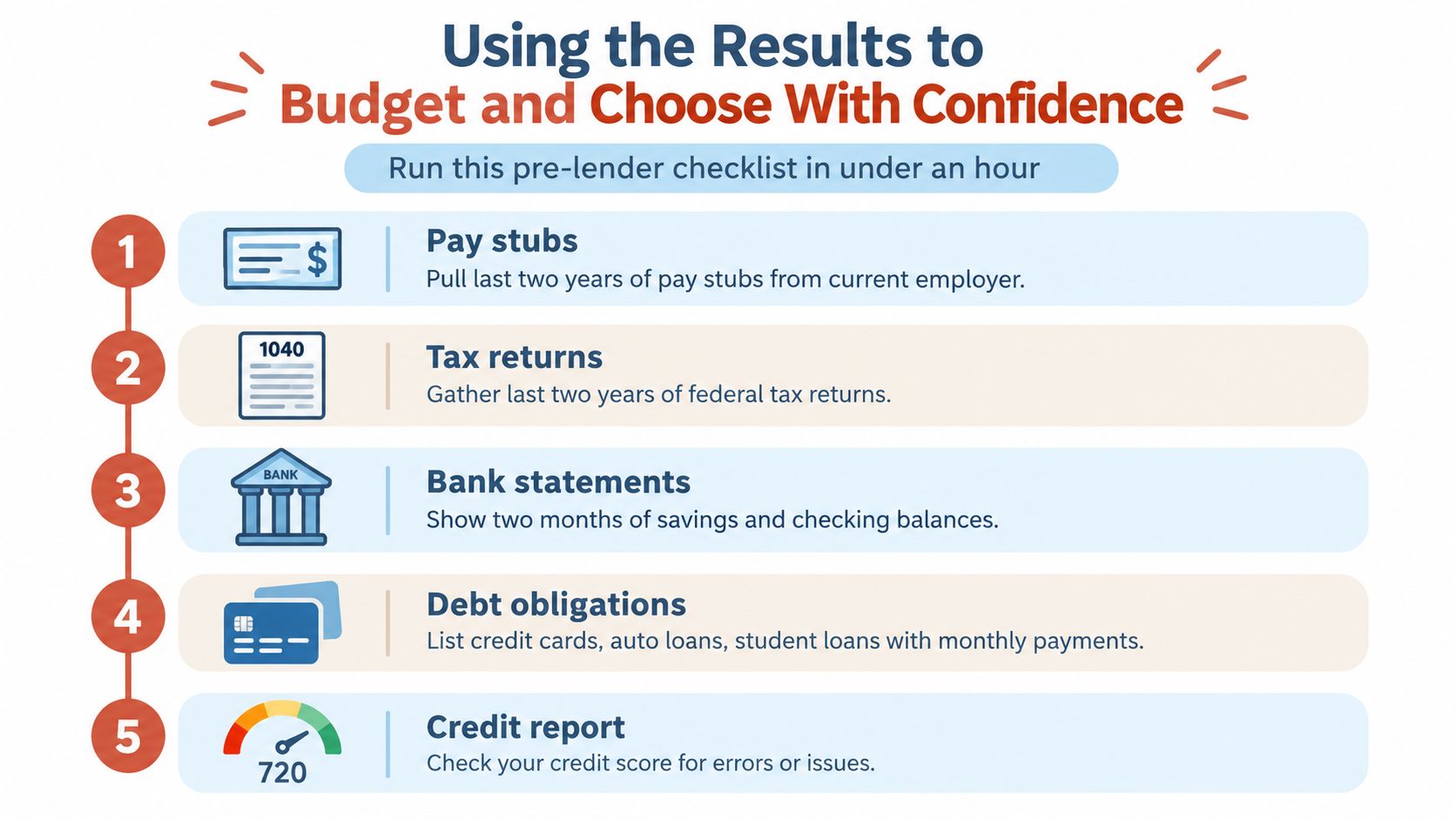
A practical pre-lender review can be completed quickly if you gather the right information first:
- Pull recent tax bills: Use the latest two years of property tax records and look for exemptions, reassessment changes, or unusual adjustments.
- Confirm HOA costs: Request current dues, planned increases, special assessments, reserve information, and association budgets for a condo.
- List income and debts: Gather gross monthly income and minimum monthly debt obligations so the lender can evaluate the debt-to-income picture.
- Choose a down payment target: Compare the payment, PMI impact, and remaining cash reserves at each down payment level.
- Run three loan scenarios: Compare fixed and adjustable structures, different terms, total interest, monthly payment, and refinance break-even timing.
Stress test before you shop seriously
One of the most useful habits is testing the budget at a rate two points higher than the quoted rate. That scenario isn't a prediction. It's a way to find out whether a future payment increase would force you to reduce savings, delay repairs, or change neighborhoods.
Bring the printed or saved scenarios to the lender meeting. The conversation will start with clear assumptions instead of a vague payment target, and the lender can identify which inputs need to be replaced with verified figures.
A Chicago homebuyer guide can help you pair the payment estimate with neighborhood, inspection, offer, and closing decisions. The calculator's real value is not one answer. It's the ability to see the trade-offs before those decisions become expensive.
Homes By Carmen helps Chicago-area buyers compare properties, payment assumptions, neighborhood costs, and offer terms with practical local guidance. Visit Homes By Carmen to connect with Carmen and bring a clearer budget into your home search.