
A first-time home buyer, under HUD's standard, is someone who has had no ownership interest in a principal residence during the three years before the purchase date. That isn't the same as never having owned property.
The familiar advice that former homeowners can't qualify is too broad. For a buyer in Melrose Park or a nearby Chicago suburb, the better starting point is your ownership history, the home you intend to buy, and the rules attached to your financing.
Table of Contents
- Why the First Time Home Buyer Label Matters
- Who Qualifies as a First Time Home Buyer
- Eligibility Details That Change the Answer
- Tax Credits, Loan Programs, and Assistance Benefits
- Typical Steps From Pre-Approval to Closing
- Choosing Lenders and Listing Sources in the Chicago Suburbs
- Next Steps for First Time Buyers in Melrose Park
Why the First Time Home Buyer Label Matters
Don't cross yourself off an assistance list because you once had a mortgage. First-time buyer status is an eligibility category, not a description of your entire adult life. A returning buyer may fit a program's definition, while someone purchasing their first property may still miss other requirements.
That distinction matters when you're deciding whether to keep renting, begin saving more aggressively, or speak with a lender. You shouldn't assume help is unavailable. You also shouldn't build a purchase budget around assistance that hasn't been confirmed.
The label and the financial reality are different
First-time buyers represented 21% of buyers in transactions completed from July 2024 through June 2025, the lowest share since tracking began in 1981, according to the National Association of REALTORS® buyer profile. The same report placed the median first-time buyer's age at 40 and the typical down payment at 10%.
Those figures describe people who successfully purchased. They aren't minimum age, savings, or down-payment requirements, and they shouldn't become targets you assume every lender demands.
Practical rule: Treat first-time status as a question to verify, not a benefit you automatically receive or a category you automatically lose.
For a Melrose Park buyer, separate the conversation into distinct questions:
- Buyer classification: Does your ownership history satisfy the selected program?
- Mortgage approval: Can the lender approve your finances and the property?
- Assistance eligibility: Do you meet the additional conditions attached to the help you're requesting?
- Ownership readiness: Can you manage the costs and responsibilities after moving in?
Think past the closing table
Buying successfully means more than receiving the keys. It also means knowing how you'll handle maintenance and who you'll call when something needs attention.
For that practical side of ownership, Artisan Quality Roofing's roof care tips for new homeowners can serve as a starting resource when you create a maintenance checklist. Keep that checklist alongside your financing notes. The approval conversation tells you whether you can complete the purchase; your household plan helps you decide whether you'll feel comfortable afterward.
Who Qualifies as a First Time Home Buyer
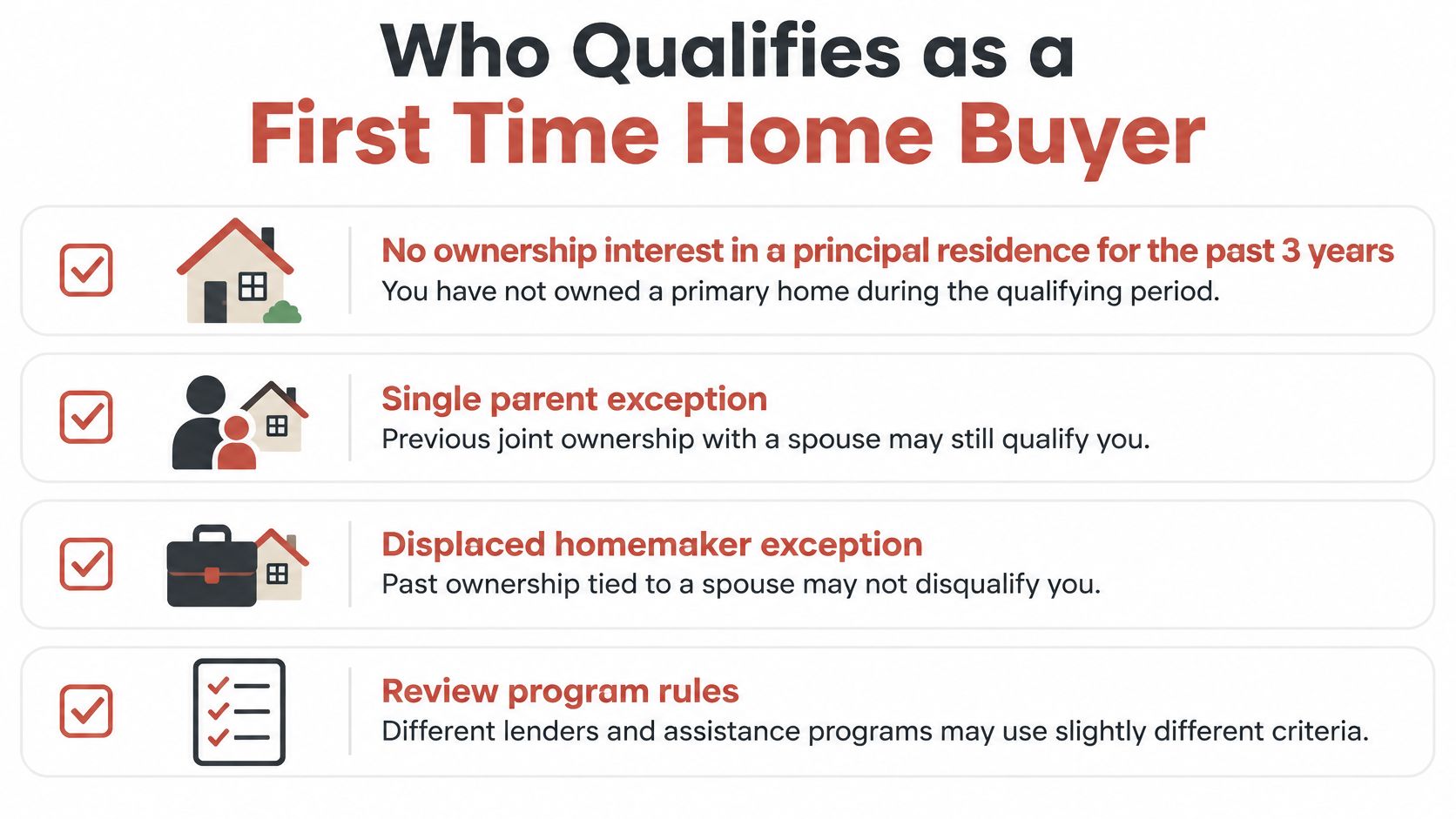
Eligibility turns on a three-year lookback ending on the purchase date, not on whether you have ever owned. The test works like a window on a calendar rather than a permanent stamp in your file. Under the definition published in HUD's FHA annual report, the question is whether you held an ownership interest in a principal residence during the three-year period ending on the purchase date.
A married couple can qualify when either spouse meets the requirement. Individual ownership histories matter even when you buy together.
Break the definition into everyday terms
A principal residence means your main home. The distinction matters because the test isn't whether your name has ever appeared on any real estate document.
An ownership interest is also different from making a mortgage payment. Don't use the date you stopped paying the loan, moved out, or began renting elsewhere as a substitute for reviewing when your ownership ended.
Consider a former homeowner who sold, became a renter, and is preparing to buy again. That earlier purchase doesn't automatically settle the question. The lender needs the ownership timeline and the planned purchase date to evaluate the applicable lookback.
Gather the details in advance with a short checklist.
Run a preliminary self-check
- List prior homes: Identify properties you owned alone or with another person.
- Identify their use: Note which property was your principal residence and whether you held other residential property.
- Locate the transfer dates: Gather records showing when your ownership began and ended.
- Include your spouse's history: Don't assume you both receive the same answer without review.
- Describe the intended purchase: Tell the lender whether you'll live in the home or use it as an investment.
That last distinction carries extra weight under other program definitions. Fannie Mae's first-time homebuyer definition requires the borrower to purchase and occupy the subject property as a principal residence and have no sole or joint ownership interest in residential property during the preceding three years.
Read the wording closely: residential property is broader than principal residence. A person who kept another residential ownership interest shouldn't assume the HUD wording produces the same answer for every loan.
A completed checklist is preparation. Approval still comes from the lender's review. Before you apply, ask which definition applies, which transaction date controls the review, and whether the assistance program adds its own conditions. For buyers shopping in the Chicago suburbs, those answers determine which loan programs and assistance options a lender can offer, so confirm them early rather than after you have chosen a home.
Eligibility Details That Change the Answer
Ownership histories rarely fit neatly into a checkbox. Divorce, shared title, and a move from ownership back to renting can all require a closer look.
The following examples are hypothetical situations, not accounts of actual clients. Their purpose is to show which questions and documents deserve attention.

A buyer returning after a divorce
Suppose a buyer previously owned a marital home and now wants to purchase independently. Saying “I've owned before” leaves out details that may change the answer.
HUD's first-time homebuyer glossary includes qualifying exceptions for a single parent or displaced homemaker whose previous ownership was only joint ownership with a spouse. These aren't automatic approvals for everyone who has divorced or left the workforce. The lender must evaluate the applicable category and supporting records.
Useful documents to gather include:
- Prior deeds: Show who held title to the property.
- Settlement statements: Help establish the completed sale or purchase.
- Divorce records: Provide relevant details about the ownership arrangement.
- Title-transfer records: Help establish when an ownership interest ended.
A buyer who moved out but remained on title
Another buyer may have left a shared home and rented elsewhere while still holding an interest in the original property. Their rental history doesn't resolve the ownership question.
Ordinary language can mislead. “It hasn't been my house for a long time” might describe where the person lived, not what the title records show. Give the lender both facts rather than trying to choose the more favorable description.
A buyer who assumes FHA means first-time only
A standard FHA loan doesn't require first-time-buyer status, although certain features, including treatment of positive rental-payment history, may have that condition. HUD's glossary also explains that assistance programs can impose their own income, purchase-price, occupancy, education, or geographic requirements.
Ask for the name of the actual loan and assistance program before asking whether you qualify.
Once the lender identifies possible paths, test whether the payments fit your life. This guide to calculating mortgage affordability can help you prepare a household budget for that discussion.
Keep eligibility and affordability on separate lines in your notes. A favorable answer to the ownership question doesn't establish a comfortable payment, and a comfortable payment doesn't establish assistance eligibility.
Tax Credits, Loan Programs, and Assistance Benefits
The most useful financing comparison isn't “Which option has the smallest down payment?” It's “Which option leaves me with manageable upfront costs, sustainable payments, and enough financial breathing room?”
The savings hurdle is real. A 2025 homeownership survey report reported that 81% of prospective buyers considered the combined down payment and closing costs an obstacle; it also described assistance use among 27.5% of recent first-time buyers, compared with 65.3% of renters planning to use it.
That difference doesn't prove why buyers did or didn't receive help. It does support a practical recommendation: investigate eligibility before assuming assistance will be part of your purchase.
Compare the help with its conditions
| Option to discuss | What to evaluate | What to confirm |
|---|---|---|
| Mortgage program | Upfront cash and ongoing payment | Written loan terms and any mortgage insurance |
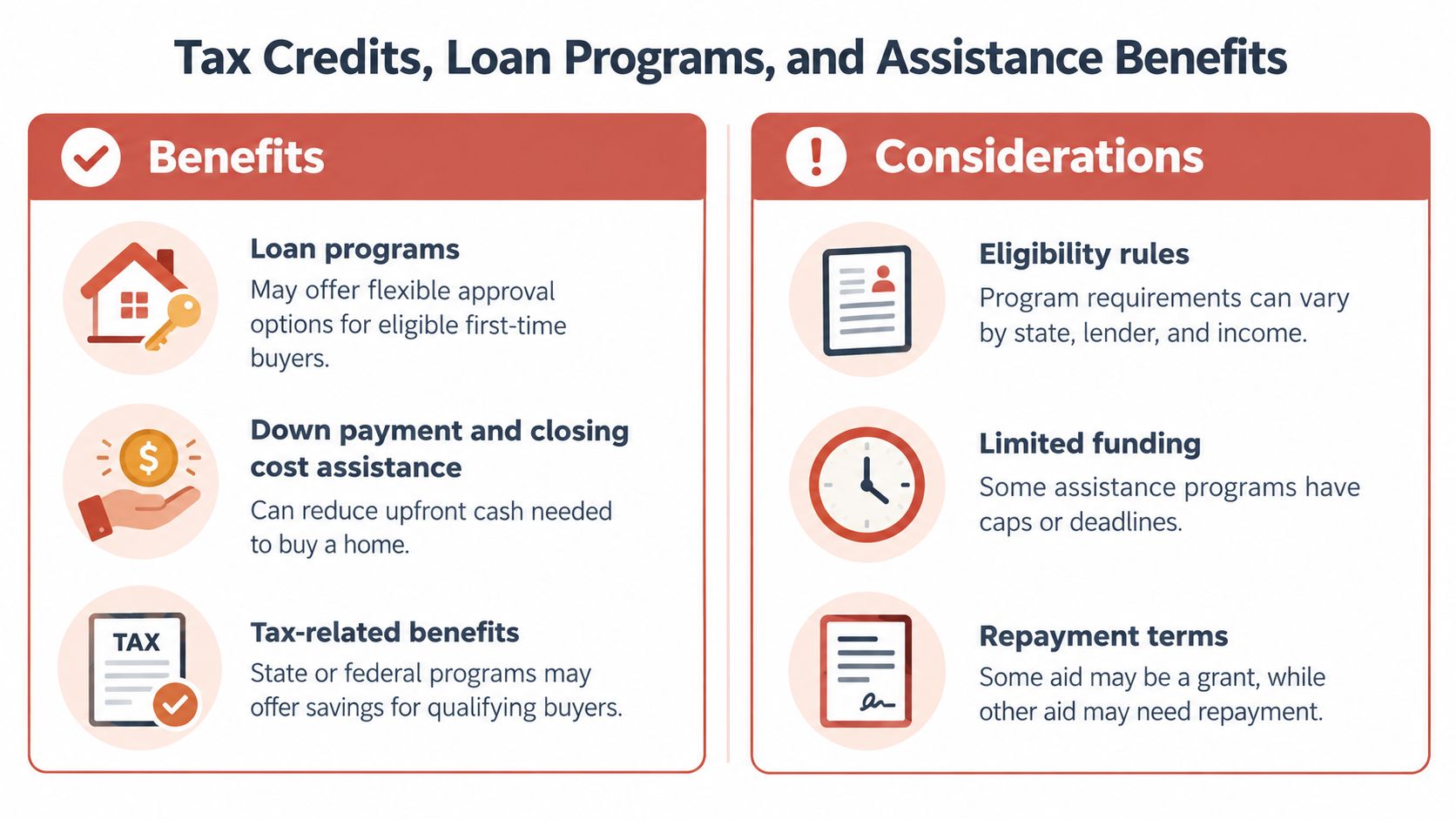
| Down-payment or closing-cost assistance | How it changes cash needed at closing | Eligibility, repayment obligations, and compatibility with the mortgage |
| Tax-related benefit | Whether it applies to your situation | Current availability and treatment with a qualified tax professional |
| Buying without targeted assistance | Whether a simpler structure fits your savings | Total cost rather than the absence of an assistance application |
Don't assume a tax credit exists just because you qualify as a first-time buyer. Ask for the specific benefit's name and current rules, and don't count an unconfirmed tax saving as money available for closing.
The categories below can help organize questions, but they aren't a promise of locally available benefits.
Ask for a full cash plan
The down payment is only part of your purchase budget. Include closing costs, inspections, prepaid taxes and insurance, reserves, moving expenses, and possible repairs when you compare options.
Ask the lender to prepare conventional, FHA, and assistance-supported scenarios, where appropriate for your situation. Keep the purchase assumptions consistent so you can understand what changes.
- Upfront comparison: How much money must you provide, and what savings remain afterward?
- Monthly comparison: What will you pay after including insurance, taxes, and applicable mortgage insurance?
- Longer-term comparison: What obligations would remain if you sell, refinance, or change your plans?
Lower upfront cash may come with higher ongoing costs. That can still be a reasonable choice, but make it deliberately rather than treating the smallest cash-to-close estimate as the automatic winner.
Typical Steps From Pre-Approval to Closing
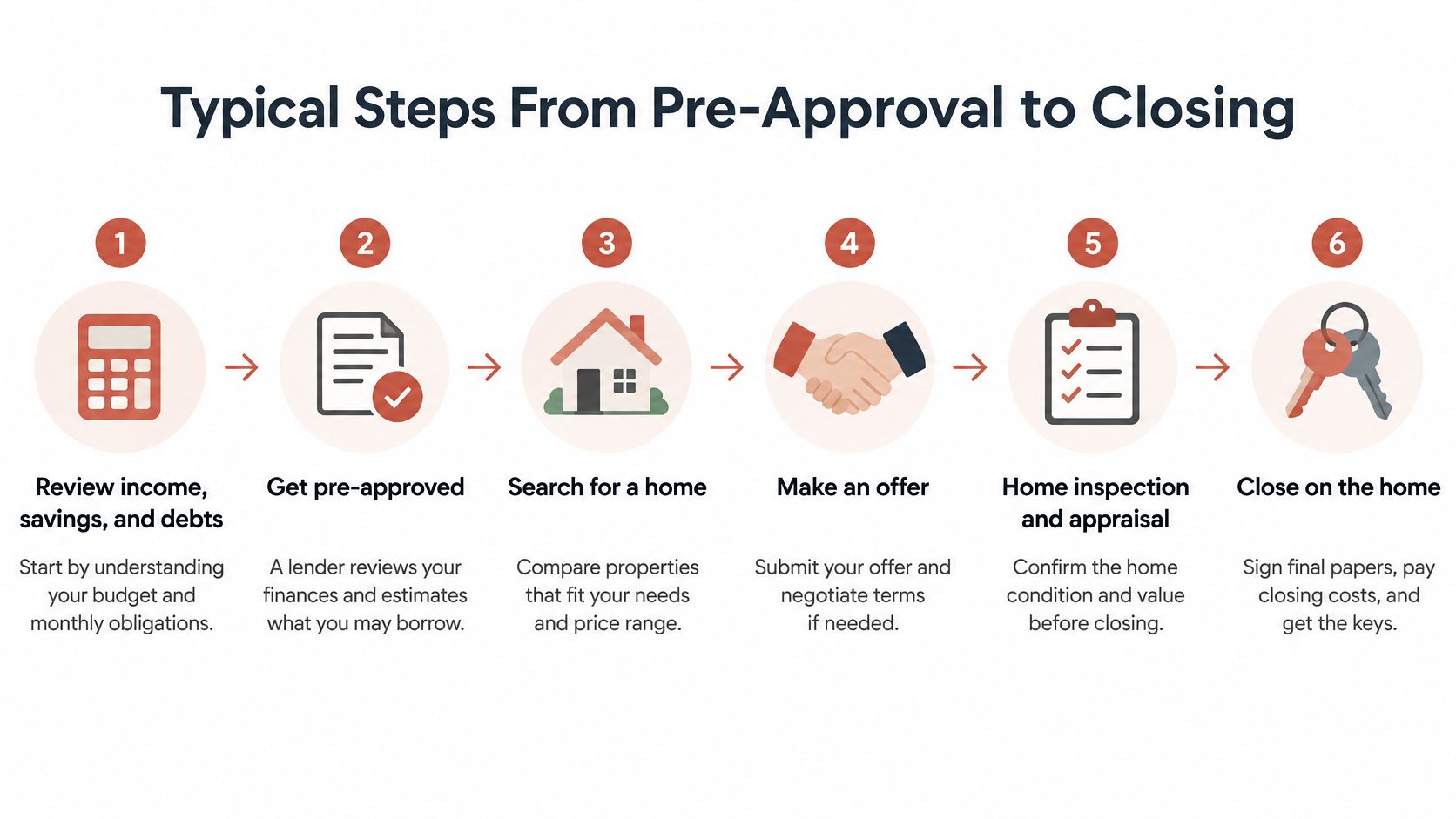
Establish financial limits before you evaluate specific properties. The sequence below is a planning map for pre-approval to closing, not a promise that every transaction will unfold identically. Your lender, agent, and attorney should explain the requirements and deadlines for your purchase.
The order matters because each stage depends on the one before it. Pre-approval is where a lender checks your ownership history against each program's lookback rules, so this is the stage where you learn which first-time buyer definition you meet. Property decisions sit on top of that answer, the way finishes sit on a foundation.
Establish the financial foundation
Start with your household records. Review income, savings, debts, and spending before asking how much you can borrow. Decide what payment leaves room for your other priorities.
Bring your ownership documents into the pre-approval conversation. Ask the lender to identify outstanding questions, explain the proposed terms in writing, and distinguish an early approval assessment from final loan approval.
For a companion checklist, Groen's Fine Furniture publishes a resource buyers can use to navigate the 2026 housing market. Treat it as a way to organize questions and tasks, not as a substitute for transaction-specific advice.
Move from search to a signed agreement
Give your agent a comfortable budget, location preferences, and property needs, including any lender-confirmed restrictions. When a home fits, review the proposed price, financing terms, contingencies, and timing before you offer. Ask your attorney about legal obligations you don't understand.
Negotiate on the whole agreement rather than price alone. Every change should stay compatible with your financing. A home that looks affordable in a listing may still require a closer review of condition and ownership expenses, so don't let enthusiasm replace the budget work you completed earlier.
Verify condition, financing, and closing figures
Use the inspection to discuss the home's condition with the appropriate professionals. Ask your lender to explain the appraisal's role and what happens if a property-related issue needs resolution.
Continue responding to document requests through final loan review. Before closing, compare the closing disclosure with your expectations and ask about unfamiliar charges or changed figures.
This explanation of closing costs when buying a home can help you prepare specific questions. Confirm final payment instructions through a trusted, independently verified contact process rather than acting on an unexpected message, whether the home is in Melrose Park or a neighboring suburb.
Before signing: You should be able to explain your payment, your cash needed to close, and any assistance obligations in your own words.
Choosing Lenders and Listing Sources in the Chicago Suburbs
A lender evaluates the financing. A buyer representative helps you evaluate properties and manage the purchase. Keeping those roles separate makes it easier to know whom to ask when a question arises.
When comparing banks, credit unions, and mortgage companies, don't choose by category alone. Ask each candidate to explain the options relevant to your ownership history and budget.
Compare answers, not just advertised terms
Use the same purchase assumptions when requesting lender comparisons. Otherwise, differences in price, down payment, or included expenses can make unlike proposals look comparable.
| Question | What a useful answer should provide |
|---|---|
| Which definition applies? | The named program and its ownership criteria |
| Can you evaluate assistance? | The specific options the lender can review |
| What remains unresolved? | Missing records, conditions, or property questions |
| What will I actually pay? | An explanation of upfront cash and ongoing expenses |
| Who handles my questions? | A clear contact and communication process |
A lender who explains a limitation clearly gives you something useful. An unexplained assurance that you're “fine” doesn't give you enough information to plan an offer.
Turn listing access into a focused search
In western Chicagoland, Midwest Real Estate Data, or MRED, supports the publisher's MLS-powered search. For buyers, the practical value is a way to organize property options, then work with a representative to review them and schedule tours.
This guide to searching MLS listings offers a starting point. Begin with location, price, and property needs, then adjust filters when the results are too broad or too restrictive.
A search across Melrose Park, Elmhurst, Downers Grove, Naperville, Oak Park, and Glen Ellyn should reflect your daily routine, not just map boundaries. Discuss commute needs, preferred home type, and your willingness to consider repairs.
Local buyer representation is one option for coordinating that work. The publisher's service includes MLS-powered search, tour scheduling, offer drafting, negotiation, inspection coordination, professional referrals, and closing support.
Keep the division of responsibility clear: listing access helps identify candidates, your representative helps evaluate the transaction, and your lender confirms financing compatibility. A promising listing isn't confirmation that a particular assistance program will accept the property.
Next Steps for First Time Buyers in Melrose Park
The useful answer to “what is first time home buyer status?” isn't just a definition you can repeat. It's a documented answer you can use when choosing financing and deciding whether you're ready to shop.
Start with the pieces you control. You don't need a selected house to organize your history, identify questions, and establish a comfortable budget.
Prepare a buyer planning folder
- Collect ownership records: Keep relevant deeds, settlement statements, and title-transfer documents together. Add divorce records if they help explain prior joint ownership.
- Request written program details: Ask the lender to identify the loan, any proposed assistance, and unresolved eligibility questions.
- Draft your household budget: Include the costs you expect after moving, not just the proposed mortgage payment.
- Use the mortgage calculator: Treat its results as early estimates to discuss with a lender, not approval.
- Download the Buyers Guide: Use the first-time-client resource to track questions and responsibilities.
Choose the next conversation, not the final house
Bring your folder to a lender and ask for a clear distinction between confirmed information and assumptions. If a record is missing or a program doesn't fit, you'll know what needs attention before committing to a property.
Then discuss buyer representation in Melrose Park. Explain where you want guidance, whether that's narrowing neighborhoods, understanding an offer, coordinating inspections, or preparing for closing.
You don't have to solve every question at once. A productive planning conversation should leave you with named tasks, the person responsible for each one, and a clear understanding of what must be confirmed before you move forward.
Homes By Carmen offers buyer representation, MLS-powered search, a downloadable Buyers Guide, and mortgage planning tools for buyers in Melrose Park and nearby Chicago suburbs. Visit Homes By Carmen to request a free planning conversation, discuss your ownership history, and prepare the questions your lender needs to answer before you begin touring homes.