
An escalation clause is a term in a buyer's offer that automatically raises the price by a set amount above a verified competing offer, up to a maximum cap. It normally uses three numbers, an initial offer, an increment above the competing bid, and a firm maximum purchase price.
You're looking at a home in Elmhurst, Oak Park, Naperville, or another competitive Chicagoland suburb. The listing agent says multiple offers are expected, and you're trying to stay competitive without immediately showing the seller the most you're willing to pay. An escalation clause may help, but only if the contract explains exactly what triggers the increase, how the competing offer will be verified, and what happens if the appraisal doesn't support the final price.
Many online explanations make escalation clauses sound automatic and foolproof. They aren't. The clause is a contract-design tool, and its usefulness depends on precise language, Illinois practice, lender approval, and your ability to handle the financial exposure it creates.
Table of Contents
- What an Escalation Clause Actually Does
- When Escalation Clauses Make Sense in Competitive Markets
- How an Escalation Clause Is Structured and Enforced
- Escalation Clause vs Traditional Bidding and Direct Offers
- Legal and Local Considerations That Often Get Missed
- Appraisal Gaps and Financing Risks You Must Plan For
- Local Strategy for Chicagoland Buyers and Sellers
- Frequently Asked Questions About Escalation Clauses
What an Escalation Clause Actually Does
Suppose you submit an offer on a western suburban home while other buyers are also preparing bids. Rather than immediately offering your absolute limit, you might make a strong initial offer and authorize an increase if the seller receives a qualifying competing offer.
That increase isn't unlimited. A properly designed escalation clause sets a defined increment above the verified competing price and stops at a maximum cap. The National Association of REALTORS® consumer guide on multiple offers describes this structure as allowing a buyer to identify both the amount added above another offer and the highest total price the buyer will pay.
The three numbers
The mechanism depends on three figures:
- Initial offer: The price you offer before another bid triggers the clause.
- Escalation increment: The amount added above a qualifying competing offer.
- Maximum cap: The highest purchase price you authorize, regardless of how high another offer goes.
For example, a buyer might offer $400,000, agree to exceed a bona fide competing offer by $5,000, and set a ceiling of $430,000. Those figures come from the verified example in the consumer guidance, not from a recommendation for your transaction.
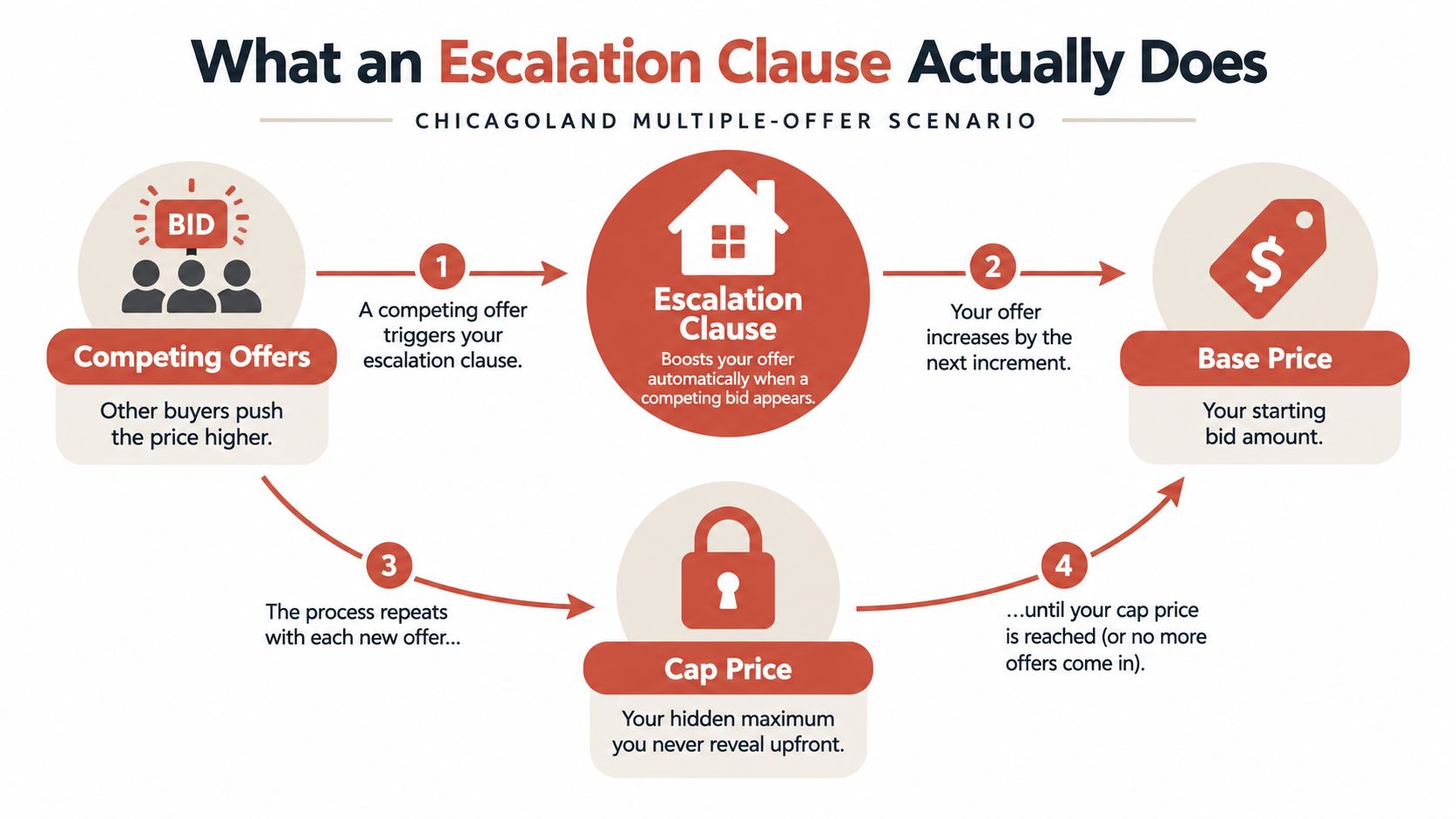
The clause is a bounded decision rule, not an open promise to keep paying more. It can keep your offer competitive while preventing an unlimited bidding process, but it doesn't guarantee that the seller will accept it or that the seller won't counter at your cap.
When Escalation Clauses Make Sense in Competitive Markets
A Chicagoland buyer sees several offers expected on a well-priced home and wants to stay competitive without immediately committing the full budget. An escalation clause may fit that situation, but only if the competing offer is real, verifiable, and acceptable under the seller's contract process. Local brokerage practices vary, and some listing agents or sellers may decline this structure altogether.
Escalation clauses became especially visible during the COVID-19 housing-competition surge, when bidding wars pushed buyers to seek an advantage without automatically offering their maximum. The National Association of REALTORS® discussion of escalation clauses notes that some REALTOR® associations cautioned members about using them.
For the buyer, the main benefit is a preset limit. You decide in advance how much to exceed a qualifying offer and where to stop, rather than reacting to an informal “best and final” request. That ceiling must be supportable through financing, appraisal, inspection, and other due diligence. A contract price above the appraised value can require additional cash, even if the escalation was triggered properly.
The seller receives a signal that the buyer is prepared to compete, but the highest theoretical cap is not automatically the strongest offer. A lower price with dependable financing, workable contingencies, and a realistic closing plan may create less risk of a failed transaction.
Before recommending or accepting the clause, examine the deal as a whole:
- Confirm that genuine competition exists. With one offer, an escalator may give away pricing power without adding value.
- Check whether the competing offer can be verified under the agreed process.
- Compare financing, contingencies, closing timing, and other material terms, not only price.
- Confirm that the seller and local agents accept the clause and understand how it will operate.
A clause should strengthen a competitive offer on a house, not compensate for weak terms or an unsupported cap. In Chicagoland, that distinction matters because brokerage custom and contract language can determine whether the strategy works as intended.
How an Escalation Clause Is Structured and Enforced
The clause should answer a basic question before anyone signs: what exact event changes the contract price? A vague statement that the buyer will beat another offer isn't enough. The parties need agreed definitions and a reliable verification process.
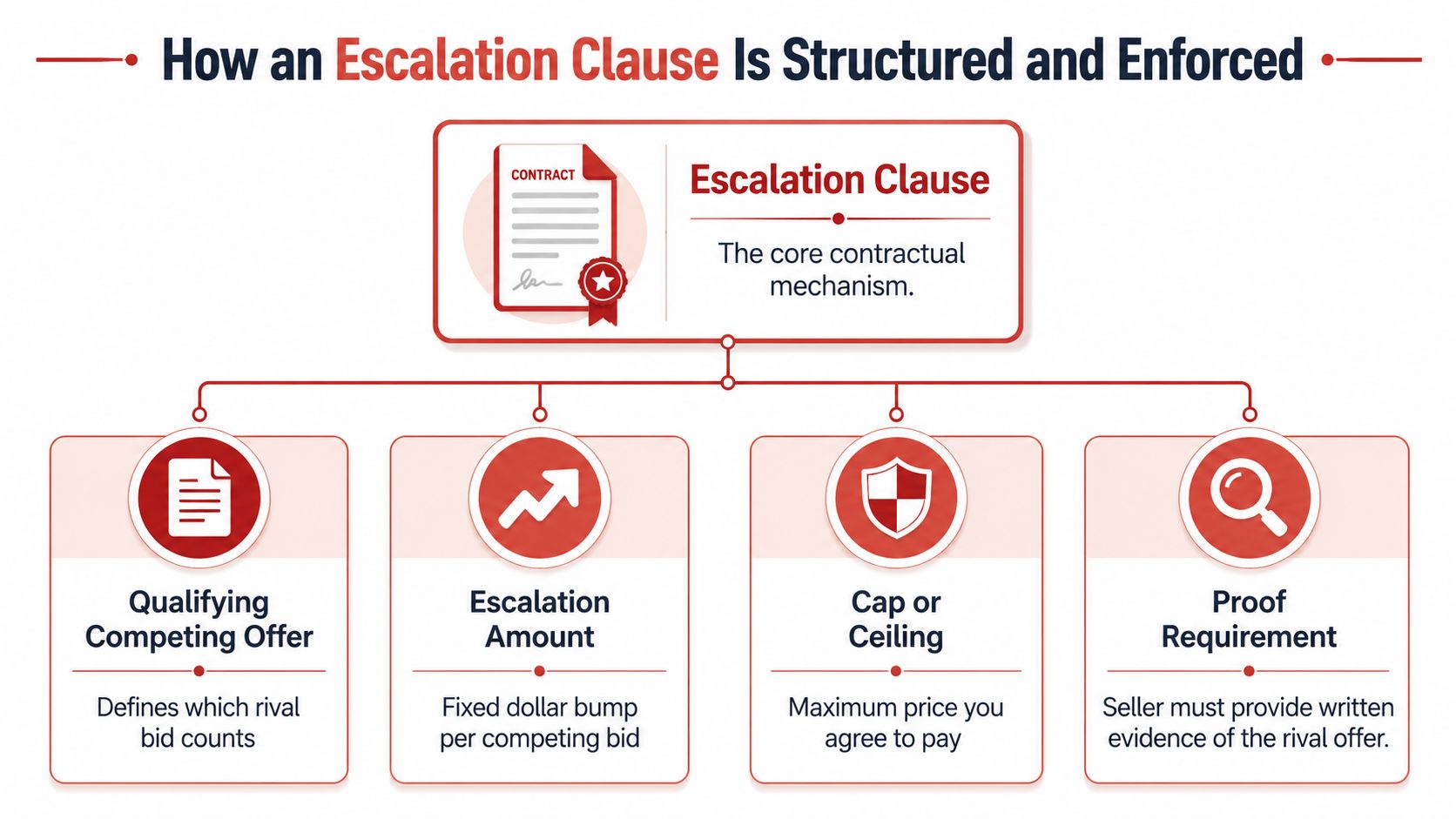
A technically complete provision should address four elements:
- Qualifying competing offer: Identify what counts as a trigger. The language may need to require a bona fide written offer rather than an unverified statement that another buyer is interested.
- Escalation amount: State the fixed increment added above the qualifying offer.
- Cap or ceiling: Establish the absolute maximum price. Without one, the buyer's exposure can become unexpectedly high.
- Proof requirement: Require documentary evidence of the competing offer before the increase takes effect.
Price isn't the only question
The clause should also explain whether the competing offer must have comparable contingencies, financing, closing timing, and other material terms. A higher nominal price with substantially weaker financing may not be the same type of offer as yours.
Ambiguity creates practical problems. If the clause doesn't explain whether the seller can use an offer with different contingencies, or whether the calculation applies only to purchase price, the parties may disagree about the proper escalated amount. The regulatory bulletin addressing escalation-clause risks emphasizes the importance of a maximum price, written competing-offer requirements, and clear drafting.
Practical rule: Don't copy generic escalation language from an online form. Have the transaction's licensed professionals determine whether the wording fits the contract and jurisdiction.
Your buyer's agent can help identify the business terms and communicate the offer, but drafting authority can be restricted by state law and local rules. Understanding what a real estate agent does for a buyer helps clarify where brokerage guidance ends and legal advice may be needed.
Escalation Clause vs Traditional Bidding and Direct Offers
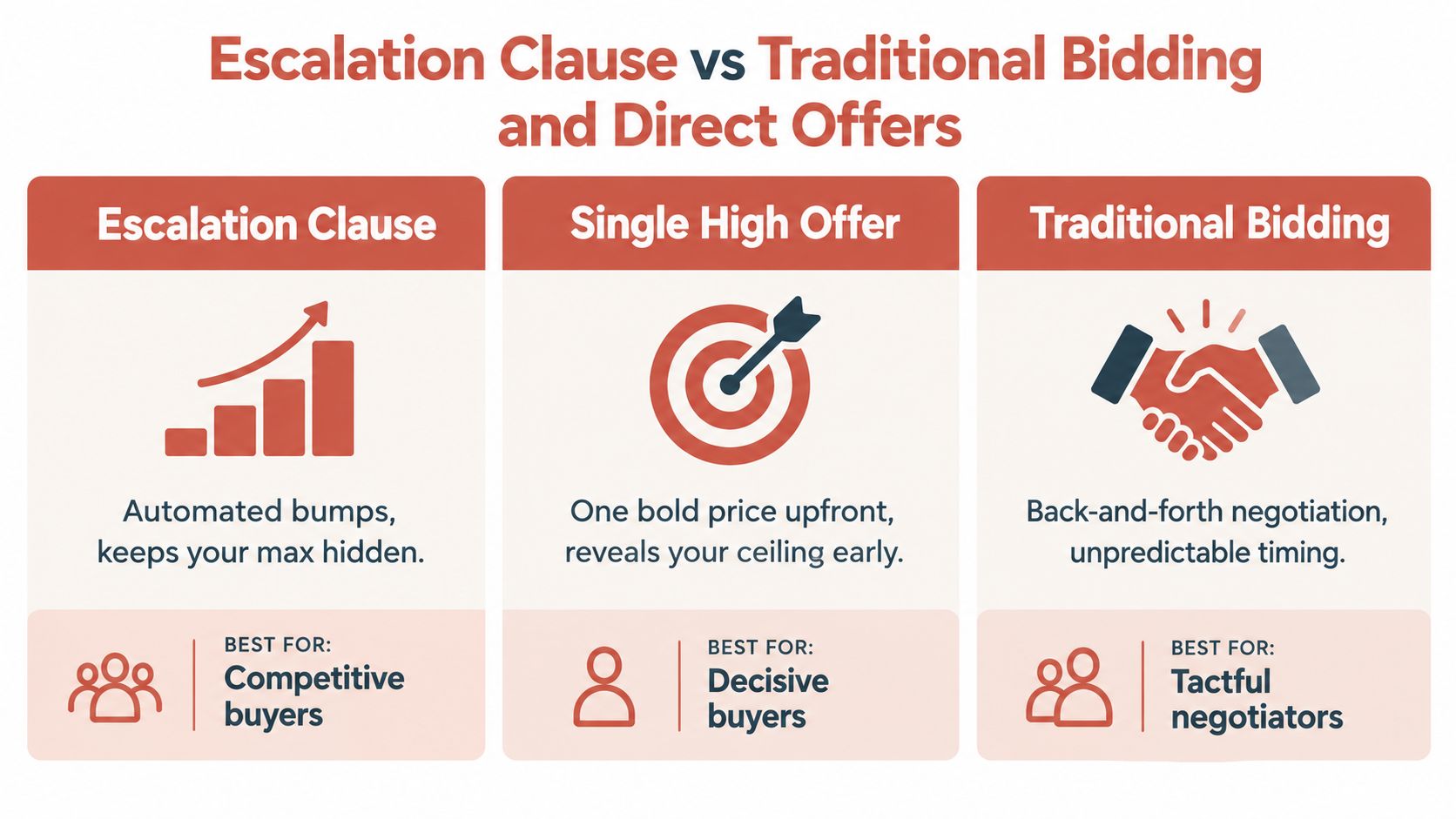
An escalation clause isn't automatically better than every alternative. The right choice depends on how much competition exists, how quickly the seller is deciding, and how much uncertainty you can accept.
| Strategy | Main advantage | Main drawback |
|---|---|---|
| Escalation clause | Raises the price only when a qualifying competing offer appears, subject to a cap | Requires precise verification and may expose the buyer to appraisal risk |
| Single high offer | Gives the seller a clear, decisive number immediately | Can reveal the buyer's negotiating limit and overpay if no real competition exists |
| Traditional bidding | Preserves room for discussion and comparison of complete terms | May create delay, uncertainty, or another opportunity for competitors |
A direct high offer can work when the seller values certainty and the buyer knows the property justifies the price. It can also fail when the buyer offers more than necessary or concedes negotiating power before understanding the competition.
Traditional negotiation may suit a seller who wants to compare financing, contingencies, possession, and timing rather than rely on an automated price mechanism. It gives the parties flexibility, but the buyer may not receive a meaningful chance to improve the offer.
An escalation clause sits between those approaches. It automates a limited response while keeping the cap private at the outset, but the buyer must accept the verification and drafting complications that come with it.
Choose the structure that matches the facts. Don't use an escalator merely because the listing agent mentions multiple interest. A real competing offer, a defensible valuation, and a lender who understands the proposed price mechanics matter more than the label attached to the strategy.
Legal and Local Considerations That Often Get Missed
An escalation clause is not a universal form with uniform enforcement. State law, contract language, brokerage rules, and local practice affect who may draft it, what information can be shared, and how the provision operates.
The North Carolina Real Estate Commission said in a 2021 bulletin that it discouraged escalation clauses without prohibiting them. The bulletin also warned that brokers could not disclose competing-offer prices without express authority and could not draft language that amounted to unauthorized practice of law. That guidance does not establish Illinois law. It does show why copying an out-of-state clause into a Chicagoland transaction creates avoidable risk.
Verification must be written into the provision
A buyer may authorize an automatic increase without a reliable way to assess whether the competing offer is genuine or materially comparable. The seller may need to provide evidence, but the contract should identify the evidence, the deadline, and the consequence if verification is incomplete.
A sound clause should answer these questions:
- What document triggers the clause? A bona fide written offer carries different weight from an informal statement that another buyer is interested.
- Which terms must be comparable? Financing, appraisal, inspection, closing date, possession, and other contingencies can change the practical value of an offer.
- What may be disclosed? Illinois brokerage practice and the terms of the competing offer may limit how much information can be shared.
- Who prepares the language? A broker may explain transaction practice and present approved forms, while an Illinois attorney addresses legal drafting and interpretation.
The clause also needs a clear response if the seller cannot verify the competing offer or if the buyer disputes the trigger. Without that procedure, the parties may disagree about whether the higher price ever became binding.
For Illinois buyers and sellers, treat an escalation provision as a jurisdiction-specific contract term, not a standard shortcut. A local broker can explain Chicagoland practice, while an Illinois attorney can address drafting and enforceability. That division of responsibility helps prevent assumptions from another state from controlling a local transaction.
Appraisal Gaps and Financing Risks You Must Plan For
Your escalation cap may exceed the property's appraised value. Mortgage lenders generally base the loan amount on the lower of the purchase price and the appraised value, so a higher contract price does not raise your borrowing capacity. This financing relationship is addressed in guidance on escalation clauses and appraisal value.
Suppose your clause sets a $550,000 contract price, but the appraisal comes in at $530,000. The $20,000 difference may require cash at closing, a price adjustment, or a specifically negotiated appraisal-gap provision. In Chicagoland, confirm how the contract handles that shortfall before you authorize an escalation cap. Local brokerage practice may affect the form and process, but the written contract controls the parties' obligations.
Your financing contingency should address the escalated price, not just the initial offer. If it does not, you could win the multiple-offer process and then discover that your approved loan does not cover the price you agreed to pay.
Before submitting, ask your lender:
- How will the loan be underwritten if the clause activates?
- What cash would be required if the appraisal is lower?
- Does the financing contingency preserve a termination or renegotiation right?
- Can the lender evaluate the cap against recent comparable sales?
Sellers face the same exposure from the opposite side. A high escalated price can become difficult to close if the buyer cannot cover the appraisal gap. A price supported by comparable sales and credible financing may offer a safer closing than a headline figure the lender will not recognize. Put the appraisal response, funding source, and deadlines in writing rather than relying on an informal understanding.
Local Strategy for Chicagoland Buyers and Sellers
In Melrose Park, Elmhurst, Downers Grove, Naperville, Oak Park, and Glen Ellyn, the right escalation strategy depends on the specific property and offer pool. Neighborhood reputation alone doesn't establish value. The relevant questions are whether the home has genuine competition, whether comparable sales support the likely price, and whether your financing can absorb the result.
For buyers
Coordinate with your lender before you write the clause. Confirm the maximum price, appraisal exposure, and financing-contingency language in advance. Then ask your agent how the seller will verify a competing offer and whether the proposed terms compare fairly.
First-time buyers should be especially careful with the cap because it defines the maximum contractual price before inspection, appraisal, financing, and other protections are fully tested. Move-up buyers need to account for sale proceeds and timing if another property must sell. Investors should evaluate rent, repairs, financing, and exit assumptions without treating competition as proof that the property is worth the escalated amount.
For sellers
An escalation clause can create useful pricing information in a multiple-offer setting, but don't focus only on the highest cap. Review the proof requirement, financing strength, appraisal provisions, contingencies, and closing terms. Compare the escalated price with defensible comparable sales before assuming the buyer can close at that figure.
Use a focused checklist with your professionals:
- Verification: What written evidence will establish a qualifying competing offer?
- Terms: Which non-price provisions must be comparable?
- Financing: Has the lender reviewed the cap and possible appraisal result?
- Authority: Who is responsible for drafting and reviewing the language?
- Fallback: What happens if the seller rejects the escalator or the buyer reaches the cap?
For broader neighborhood and transaction guidance, consult a local resource covering Chicago real estate, then obtain advice specific to the property and contract.
Frequently Asked Questions About Escalation Clauses
Does an escalation clause guarantee that I'll win?
No. The seller may reject the clause, choose another offer with better terms, counter at your cap, or question whether the competing bid qualifies. An escalator improves your response to certain competition, but it isn't a guarantee of acceptance or closing.
Must the seller show me the competing offer?
Not automatically. The contract should state what proof is required, and disclosure rights may be limited by applicable law, the offer's terms, and the authority of the parties involved. Ask what documentation you'll receive before agreeing to automatic increases.
Can the seller simply counter at my maximum?
The seller may choose how to respond, subject to the contract and applicable rules. A disclosed cap can reveal your negotiating limit, so don't set a ceiling higher than the price and financial exposure you accept.
What if the other offer has better terms but a lower price?
The clause should explain whether terms must be comparable and whether only purchase price is used in the calculation. Financing, appraisal, inspection, closing timing, and possession can affect the practical strength of an offer.
Should I waive appraisal or financing protections?
Don't waive protections casually to make an escalator more attractive. If the price rises but your lender won't support it, you may face a cash requirement, renegotiation, or a failed closing. Have your lender and Illinois attorney review how the clause interacts with your contingencies before submission.
Homes By Carmen helps buyers and sellers in Melrose Park and greater Chicagoland evaluate offer terms, comparable sales, financing coordination, and escalation-clause risks. Visit Homes By Carmen to request practical local guidance before you submit or accept a competitive offer.