
The Federal Reserve reported a median monthly mortgage payment of $1,500 nationally in 2023, with a $1,200 median in the Midwest. That figure typically includes escrowed property taxes and homeowners insurance, so it's a useful benchmark, not a promise of what a new Chicagoland purchase will cost.
The number most buyers want is more personal: what will leave my bank account every month? A mortgage calculator may show principal and interest, while your lender's payment estimate may add taxes and insurance. Your real housing budget may also include mortgage insurance, association dues, utilities, maintenance, and changes to your escrow account.
For someone shopping in Melrose Park, Elmhurst, Oak Park, or another western suburb, the right answer depends on the property and the loan, not just the national average. By the end of this guide, you'll know how to read each part of a Loan Estimate, compare rate scenarios, and turn a listing price into a more realistic monthly obligation.
Table of Contents
- The Real Answer to a Typical Mortgage Payment
- What Your Monthly Mortgage Payment Actually Includes
- How Amortization Shapes Every Payment You Make
- Why Interest Rates Change What Counts as Typical
- Sample Monthly Payments for Real Home Prices
- Using a Mortgage Calculator Without Getting Fooled
- Typical Payments in Melrose Park and Western Chicagoland
- What You Can Actually Afford Each Month
The Real Answer to a Typical Mortgage Payment
A buyer who asks, “What is a typical monthly mortgage payment?” is rarely looking for a trivia answer. Usually, they're trying to decide whether a home fits comfortably into their budget.
The Federal Reserve's $1,500 national median in 2023 provides useful context, but it describes homeowners who already had a positive mortgage payment. The Midwest median was $1,200, while the regional medians were $1,500 in the Northeast, $1,422 in the South, and $1,745 in the West. The same Federal Reserve data shows that timing mattered too. The national median was $1,400 for owners who moved before 2022, compared with $2,100 for owners who moved during 2022 or 2023. You can review the full definitions and regional breakdown in the Federal Reserve housing data.
That difference illustrates why “typical” changes. A buyer's payment reflects the home price, loan balance, interest rate, down payment, property taxes, insurance, and the date the purchase occurs. Two buyers can choose similar homes and still have very different monthly obligations.
The number on the listing is only a starting point
Suppose you're looking at a Melrose Park home. The advertised principal-and-interest payment might look manageable, but it may not include the property tax bill or homeowners insurance. If the down payment is below 20%, mortgage insurance may be added. A condominium or townhouse may also have association dues that are billed separately.
The Federal Reserve defines its reported mortgage payment as the total amount sent to the lender. It typically includes escrowed property taxes and homeowners insurance, but it excludes utilities. That makes the figure more useful than a principal-and-interest-only estimate, but it still isn't a universal answer for a new purchase.
The useful question isn't “What does the average buyer pay?” It's “What will this specific home require from my account every month?”
The rest of the decision comes from building the payment piece by piece. Start with the loan itself, then add escrow, mortgage insurance, and any separate housing charges. After that, test the result against current interest rates and your own income.
What Your Monthly Mortgage Payment Actually Includes
A mortgage payment has several layers. Principal and interest are the loan repayment. Taxes and insurance are often collected through escrow. Mortgage insurance and association dues may sit outside the basic loan payment but still affect your monthly housing budget.
A helpful framework is PITI:
PITI means principal, interest, property taxes, and homeowners insurance.
Principal is the part that builds ownership
Principal reduces the amount you borrowed. If your loan balance falls, you own a larger share of the property, assuming the home's value itself doesn't change.
Think of principal as paying down your personal slice of the house. It isn't an expense that disappears in the same way interest does. It converts part of each payment into equity.
Interest is the cost of using the lender's money. A larger balance or higher rate generally produces a larger interest charge. The loan term also matters because it determines how quickly you repay the balance.
Escrow turns annual bills into monthly deposits
Property taxes and homeowners insurance are commonly collected through escrow. Instead of waiting for a large tax or insurance bill, the lender collects a monthly amount and pays those bills when they come due.
Escrow works like a savings envelope managed as part of the mortgage process. It doesn't make taxes or insurance cheaper. It spreads the cash requirement across the year, which makes the monthly payment easier to plan.
The Consumer Financial Protection Bureau's explanation of total mortgage payments distinguishes principal and interest from the broader payment that can include taxes, insurance, and mortgage insurance. It also explains why escrow amounts can change even when the principal-and-interest portion of a fixed-rate loan stays stable.
PMI and association dues sit outside the basic quote
Private mortgage insurance, or PMI, may be required when you put less than 20% down. PMI protects the lender, not the buyer, so it adds to your cost without directly reducing the loan balance.
Homeowners association or condominium dues are usually separate from the mortgage payment. They may cover shared building services, exterior maintenance, common areas, or other association responsibilities. You need to add them to your housing budget even if they don't appear in the lender's principal-and-interest figure.
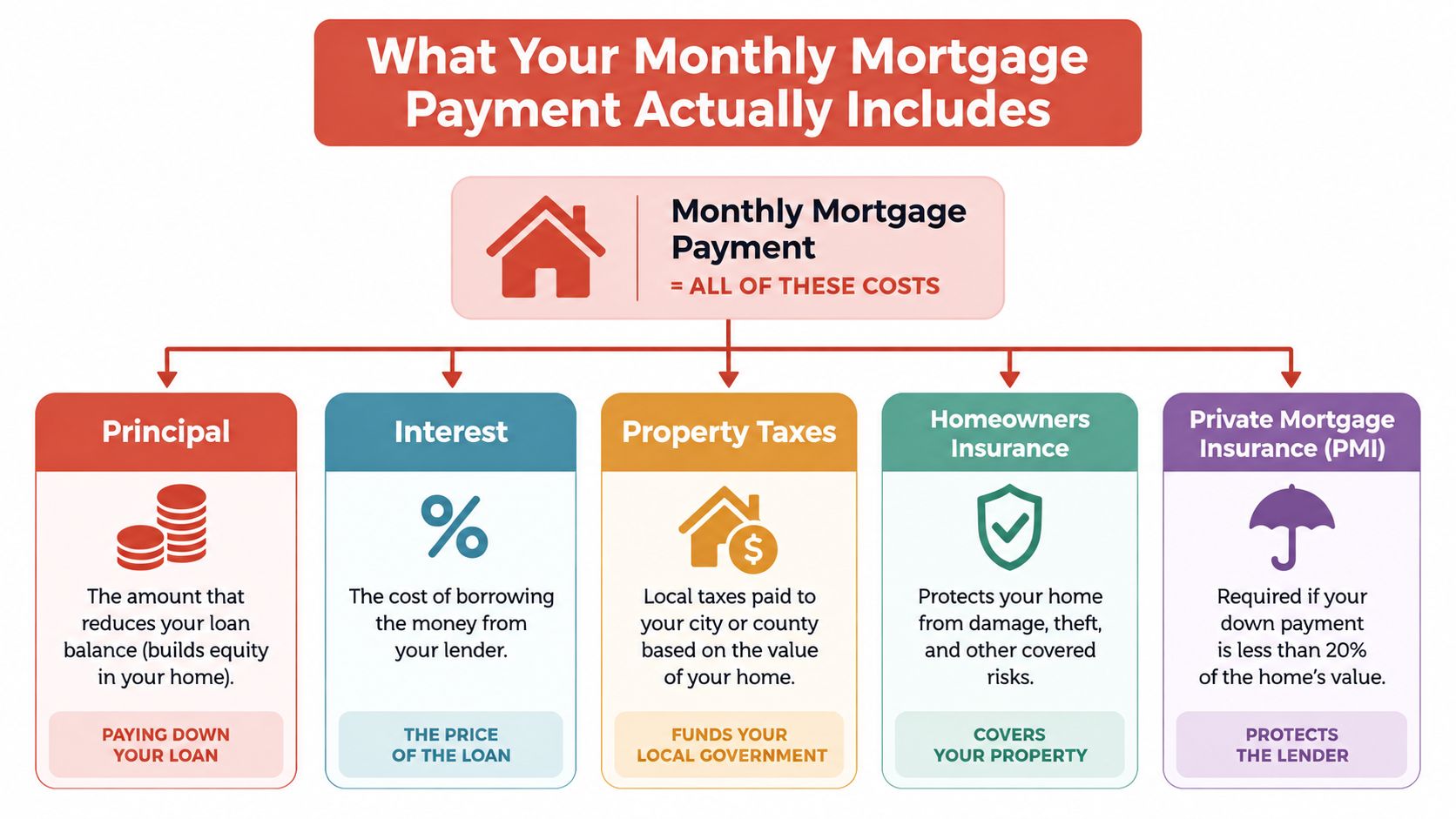
The practical distinction is simple. Principal and interest describe the loan. PITI describes the core housing payment. PMI and association dues help describe what you may need to budget.
How Amortization Shapes Every Payment You Make
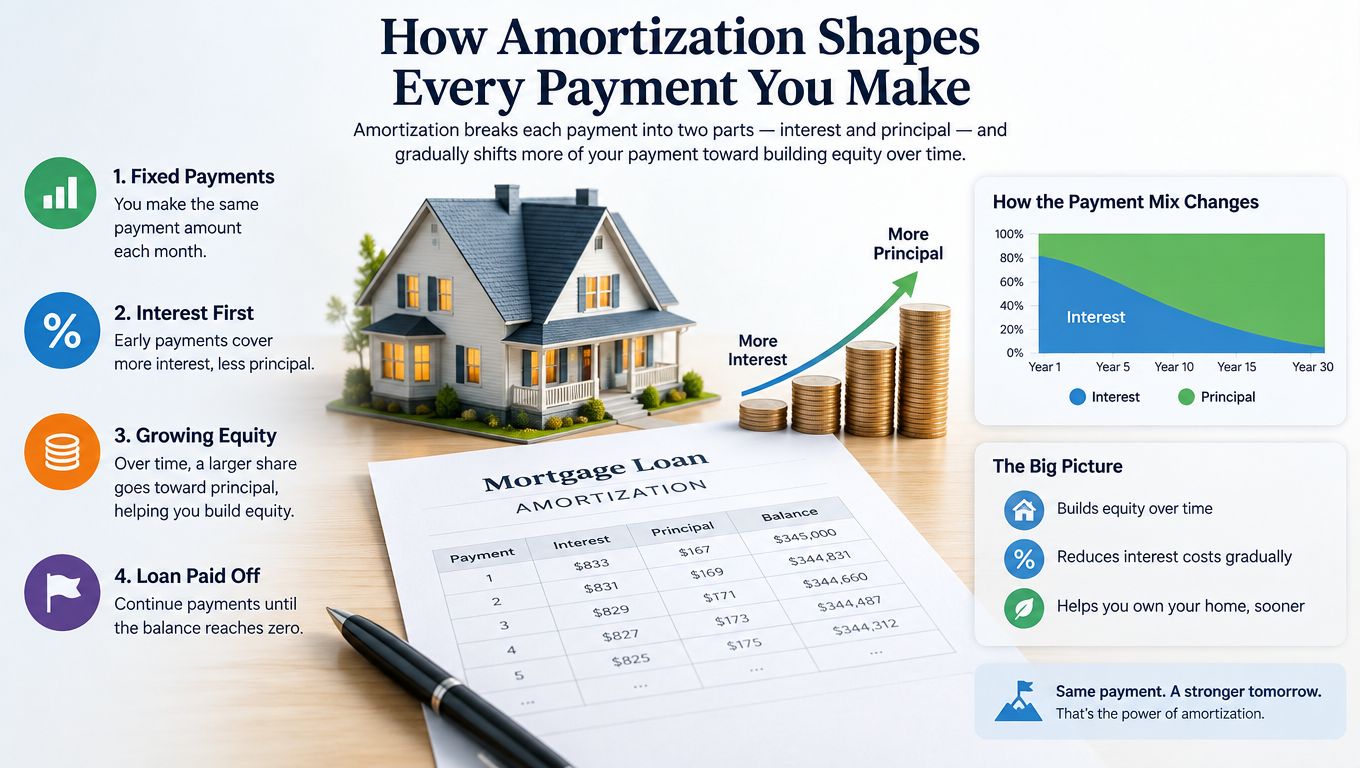
Amortization is the schedule that divides a loan into regular payments over its term. With a fixed-rate mortgage, the scheduled principal-and-interest payment generally stays level, but the internal split changes as the balance declines.
At the beginning, interest is calculated against the full outstanding balance. Because that balance is largest at the start, the interest portion takes up more of the payment. The principal portion is smaller.
As you make payments, the balance falls. The lender then calculates interest on a slightly smaller amount, leaving more of the scheduled payment available to reduce principal. The change is gradual, but it continues throughout the loan.
A fixed payment has a moving internal mix
The CFPB mortgage key terms guide explains that reducing principal lowers the balance on which future interest is calculated. That's the mechanism behind amortization.
For example, a $320,000, 30-year fixed loan at 7.28% produces approximately $2,182 per month in principal and interest, before taxes, insurance, mortgage insurance, or association dues. The rate used for this illustration is the reported U.S. average 30-year fixed rate as of October 1, 2026. The figure is a loan-payment example, not a complete housing budget.
If you make an extra principal payment, you reduce the balance sooner. That can reduce future interest because the lender has less principal on which to calculate interest. The precise benefit depends on the loan terms, timing, and whether the lender applies the extra amount directly to principal.
Practical rule: A fixed-rate mortgage can stabilize scheduled principal and interest, but it doesn't freeze your total housing cost.
Property taxes and insurance can be revised. Escrow can rise even when the loan's scheduled principal-and-interest payment doesn't. Association dues can also change independently of the mortgage.
Use a per-borrowed-amount check
At the same 7.28% rate, each $100,000 borrowed requires approximately $682 per month for principal and interest, according to the same CFPB-linked illustration. A $400,000 loan therefore requires about $2,727 per month before taxes, insurance, mortgage insurance, or dues.
This is a useful sanity check when reviewing a calculator. If your loan amount is near that example, a dramatically different principal-and-interest result deserves a second look. Confirm the term, rate, loan balance, and whether the calculator is showing monthly or annual figures.
The check is not a substitute for a Loan Estimate. It only helps you spot an input error before you build a budget around it.
Why Interest Rates Change What Counts as Typical
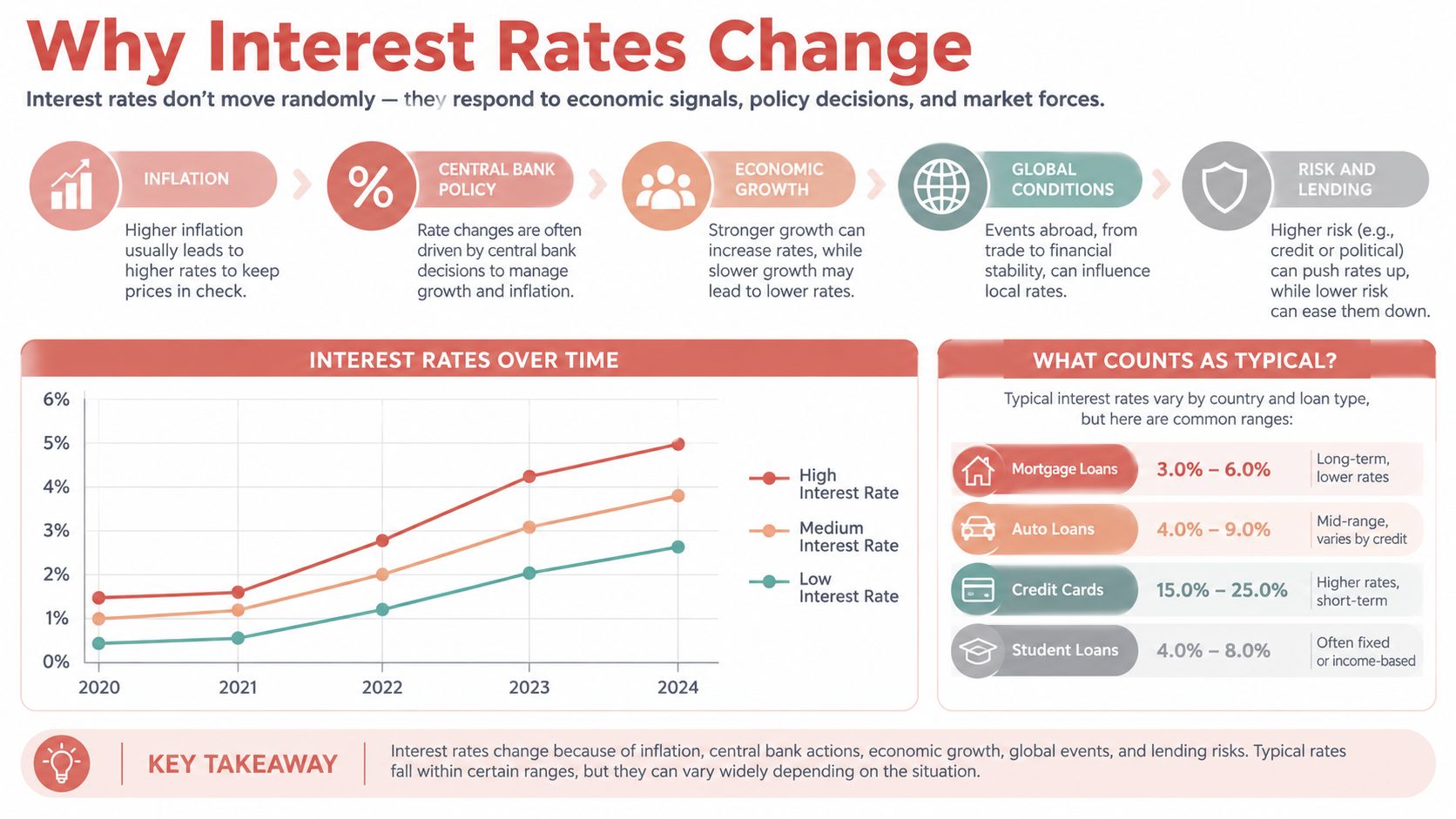
A home price and loan amount can stay exactly the same while the monthly principal-and-interest payment changes sharply. The interest rate converts the borrowed balance into a payment, so rate cycles directly affect affordability.
Consider a $300,000, 30-year fixed loan. At an annual average rate of 3.15% in 2021, principal and interest were approximately $1,289 per month. At an annual average of 7.00% in 2023, the same loan required approximately $1,996 per month, before taxes and insurance. The comparison and historical rate context are documented in this historical mortgage rate overview.
| Same loan scenario | Principal and interest |
|---|---|
| $300,000 at 3.15% | Approximately $1,289 per month |
| $300,000 at 7.00% | Approximately $1,996 per month |
| Difference | Approximately $707 per month |
That difference is about 55% higher, or roughly $8,484 over a year, before property taxes, insurance, mortgage insurance, or maintenance. The loan balance and term didn't change. The rate did.
Why a friend's old payment may mislead you
A friend who bought during a low-rate period may have a payment that sounds surprisingly small. Their purchase price, down payment, and rate may not resemble the terms available for your purchase, even if you're considering a similar home.
The average 30-year fixed rate reached a historic weekly low of 2.65% in January 2021. Rates later rose as monetary policy tightened and inflation increased, with annual averages of 5.53% in 2022 and 7.00% in 2023. Rates exceeded 8% in October 2023, the first time since 2000, according to the linked historical rate source.
That history doesn't tell you what your future rate will be. It does explain why old payment anecdotes are poor planning tools.
Evaluate today's payment, not yesterday's opportunity
Rate shopping still matters. A lower rate can reduce the principal-and-interest portion of the payment, subject to the loan's terms and any costs associated with obtaining that rate.
But you shouldn't make an offer based on a hoped-for rate. Ask the lender to calculate the payment using the rate and assumptions you can reasonably qualify for now. Then test whether the full payment still works if taxes, insurance, or association charges move higher.
Sample Monthly Payments for Real Home Prices
A calculator becomes more useful when you separate the loan payment from the complete monthly housing cost. The table below shows the difference using verified examples rather than pretending one national figure fits every home.
| Payment Scenario | Monthly Amount | What It Includes |
|---|---|---|
| $320,000 loan at 7.28% | Approximately $2,182 | Principal and interest only |
| Same $320,000 loan with $600 added | Approximately $2,782 | Principal, interest, taxes, and insurance |
| $400,000 loan at 7.28% | Approximately $2,727 | Principal and interest only |
| Recent U.S. typical purchase with 20% down | Approximately $1,738 | Principal and interest only |
| Recent U.S. typical purchase with escrow costs included | Approximately $2,331 | Principal, interest, property taxes, insurance, and other escrow costs |
The $2,782 example shows how quickly the cash requirement can change. The $2,182 loan payment may be the number displayed prominently, but adding $600 for taxes and insurance makes the broader monthly payment approximately $2,782. That still doesn't include PMI, association dues, utilities, or maintenance.
Recent data also places the typical principal-and-interest payment at approximately $1,738 for a home purchased with 20% down, compared with approximately $2,331 when property taxes, homeowners insurance, and other escrow costs are included. The payment breakdown and insurance-cost discussion provides that comparison and notes that the average annual property-insurance bill for single-family mortgage holders reached nearly $2,370 in 2025.
Down payment changes more than the loan balance
A larger down payment usually means a smaller loan. It may also avoid PMI when the down payment reaches 20%, depending on the loan and lender requirements.
A smaller down payment can preserve cash for closing costs, repairs, and reserves, but it may increase the loan balance and add PMI. That's why comparing a 20% down scenario with a lower-down-payment scenario requires more than comparing purchase prices. You need to compare the full monthly payment and the cash required upfront.
For broader context on local housing conditions, review the Illinois housing market resource. Then ask your lender to show the same property under multiple down-payment assumptions.
The best table for your decision should include principal and interest, taxes, insurance, PMI if applicable, association dues, and a separate line for recurring ownership costs that won't appear on the Loan Estimate.
Using a Mortgage Calculator Without Getting Fooled
A mortgage calculator is useful when you treat it as a worksheet, not a final approval. The result depends entirely on the inputs, and many calculators make principal and interest more prominent than the costs that determine your actual monthly cash requirement.
Start with the loan amount, not just the listing price. Subtract the down payment and account for the financing structure your lender is discussing. Then enter the interest rate and loan term exactly as quoted. A small input difference can change the result.
Check every cost toggle
Look for fields or settings for:
- Property taxes: Use the tax information for the specific property when available, rather than relying only on a generic estimate.
- Homeowners insurance: Ask for an insurance estimate appropriate to the home and coverage.
- PMI: Include it when the loan structure requires mortgage insurance.
- Association dues: Add condominium or homeowners association charges separately if the calculator doesn't provide a field.
- Escrow treatment: Confirm whether the displayed result includes taxes and insurance or shows principal and interest only.
If a calculator doesn't accept one of these inputs, write the amount down and add it manually. Don't assume that an omitted cost is insignificant.
Perform a quick reasonableness check
Use the per-borrowed-amount example from the amortization discussion as a rough check. At 7.28%, each $100,000 borrowed is approximately $682 per month for principal and interest. The check won't account for every loan variation, but it can expose a mistaken rate, term, or loan balance.
The home-loan repayment calculator can help organize the estimate, but the lender's Loan Estimate is the document to use when comparing an actual financing offer. Request estimates from more than one lender and compare the assumptions, not just the headline payment.
A reliable process looks like this:
- Enter the exact loan amount, rate, and term.
- Add taxes, insurance, PMI, and association dues.
- Compare the result with the lender's Loan Estimate.
- Stress-test the payment for higher escrow costs.
- Keep a separate reserve for repairs and ownership expenses.
That approach turns a calculator from a sales number into a planning tool.
Typical Payments in Melrose Park and Western Chicagoland
The Midwest median of $1,200 offers national context for a western Chicagoland buyer, but it doesn't establish the payment for a Melrose Park property. Your final number depends on the home's price, your down payment, the current rate, and the property-specific charges attached to that address.
Property taxes deserve close attention. Buyers should verify the current tax bill, understand whether the property's assessment may change, and ask the lender how the estimate handles reassessment. Two homes with similar prices can produce different monthly budgets when their tax histories or assessments differ.
Insurance is another local variable. The insurer's estimate can depend on the property's construction, condition, coverage needs, deductible, and other underwriting details. Ask for a property-specific quote before treating a calculator result as settled.
Compare the full cost across suburbs
A buyer weighing Melrose Park against Elmhurst, Downers Grove, Naperville, Oak Park, or Glen Ellyn should compare more than list prices. Look at:
- Loan balance: A higher purchase price generally requires more borrowing unless the down payment also changes.
- Property taxes: Verify the actual bill and ask how future changes could affect escrow.
- Insurance: Obtain an estimate for the specific home, not just a generic regional assumption.
- Association dues: Condos and attached homes may carry a separate recurring charge.
- Rate and loan structure: Compare financing terms on the same basis.
Before you fall in love with a listing, ask for its current tax information and build a full payment estimate around that address.
The $1,500 national median is best used as a starting benchmark. A realistic Melrose Park budget comes from the property's own documents, your lender's assumptions, and a stress test that leaves room for changes.
What You Can Actually Afford Each Month
A “typical” payment can be comfortable for one household and overwhelming for another. Income, savings, debt obligations, job stability, down payment, and recurring ownership costs all shape affordability.
Recent affordability data shows why a national headline can hide financial pressure. In the fourth quarter of 2025, a median-income U.S. family needed 34% of its income for the mortgage payment on a median-priced new home. A household earning half the median income needed 67%, while the corresponding burden for a median-priced existing home was 69%. The calculations assumed a 10% down payment and included taxes, insurance, and PMI, as described in the housing affordability analysis.
Those figures don't determine what you personally can borrow. They do show why a payment based on 20% down can be unrealistic for a first-time buyer. A smaller down payment may bring PMI and a larger loan balance, while taxes and insurance can make the total materially higher than the advertised principal-and-interest figure.
Build your own affordability range
Use the payment you can sustain, not the maximum a lender says you qualify for. Calculate the full PITI amount at current rates, then add PMI or association dues where applicable.
Before shopping seriously, review:
- Full monthly obligation: Include principal, interest, taxes, insurance, PMI, and association dues.
- Cash reserves: Keep room for closing costs, repairs, moving expenses, and unexpected bills.
- Escrow sensitivity: Ask what happens if taxes or insurance rise.
- Down-payment scenarios: Compare lower and higher down payments rather than assuming one structure.
- Income stability: Leave room for ordinary life changes instead of budgeting to the limit.
A lender pre-approval helps establish a financing range, but it isn't a personal spending recommendation. Pair it with the practical guidance in this first-time home buyer guide, then compare homes using their complete monthly cost.
The most useful answer to “what is a typical monthly mortgage payment” isn't one national amount. It's the full payment you can carry reliably for a specific home, using a realistic rate, verified taxes and insurance, and enough breathing room for the costs that don't fit neatly into a calculator.
If you're buying in Melrose Park or western Chicagoland, Homes By Carmen can help you compare listings by their full monthly cost, coordinate tours, and connect you with lenders for scenario-based estimates. Visit Homes By Carmen to start planning around a payment that fits your actual budget.