
A household in Melrose Park can spend an evening comparing a rent-renewal notice with home listings, then discover that the hardest question isn't whether prices are rising. It's whether a city condo, a western-suburban house, or an affordable-looking listing with a volatile tax bill creates the safest monthly budget.
That's the key decision behind real estate Chicago in 2026. The region includes Chicago neighborhoods and communities such as Elmhurst, Downers Grove, Oak Park, Naperville, and Melrose Park, and each location trades one advantage for another. Inventory is constrained, prices remain firm, and buyers still have to look past the asking price to understand taxes, assessments, association costs, commuting, and future resale appeal.
Table of Contents
- What Today's Real Estate Chicago Market Looks Like
- How Inventory, Prices, and Speed Are Shaping 2026 Deals
- Comparing Chicago Neighborhoods and Western Suburbs
- Where Affordability Still Lives in Chicagoland
- The Hidden Cost of Property Taxes in Chicago and the Suburbs
- A Practical Playbook for Buying or Selling in Chicagoland
- Pulling It Together for Your Next Move
What Today's Real Estate Chicago Market Looks Like
The Melrose Park household at the kitchen table usually starts with a simple calculation. The rent renewal is predictable for another lease term, while a purchase would bring a mortgage, property taxes, insurance, maintenance, and a larger upfront commitment. The listings may look attainable until the buyer compares the full monthly carrying cost.
Chicago remains a large, liquid urban housing market, but buyers aren't shopping in a loose environment. In June 2026, Chicago had 3,338 homes for sale, down 28.9% from 4,693 a year earlier, while the city's median price reached $427,500, up 6.9% year over year from $400,000 in June 2025, according to the Chicago housing market report. The broader metro recorded a $407,000 median home price, up 4.6% from $389,000 a year earlier.
That combination tells buyers something important. They aren't facing the frantic conditions of every neighborhood at every price point, but desirable homes can still attract several interested parties because replacement inventory is limited.
The city versus suburb calculation
A buyer comparing Logan Square with Downers Grove isn't only comparing two prices. They're comparing space, parking, transit, schools, lot size, association expenses, property taxes, and how much time the household wants to spend maintaining a home.
The city may offer a shorter trip to restaurants, cultural destinations, and CTA routes. A western suburb may offer a larger home, a yard, garage space, and a different school-district profile. Neither is automatically the financially superior choice. The right answer depends on which costs are fixed, which are flexible, and which lifestyle benefits the household will use.
For buyers who need a regional overview before choosing a search area, this Illinois housing market guide provides a useful starting point. The next step should be a property-level budget, not a general assumption about what Chicago or the suburbs “cost.”
Practical rule: Treat the listing price as the entry point. Your decision should rest on the complete monthly cost and the compromises you're willing to make.
How Inventory, Prices, and Speed Are Shaping 2026 Deals
The June market data points to a seller-leaning environment in several practical ways. In the Chicago-Naperville-Elgin metro, active listings fell 7.8% year over year, new listings declined 11.8%, and median days on market were 33 days, compared with 53 days nationally, according to Realtor.com's June 2026 Chicago market coverage.
The metro's median list price rose 3.8% year over year to $394,500, while the national median declined 2.5% during the same period. That doesn't mean every seller can name a price and expect a bidding war. It means buyers have fewer substitute listings when a well-maintained property is priced close to its micro-market value.
What the numbers mean at the property level
A seller in Naperville should not copy the marketing strategy for a Lincoln Park condo. The right launch price depends on property type, condition, school and transit context, association health, parking, outdoor space, and the most recent comparable sales.
For buyers, speed should be calibrated rather than impulsive:
- Before touring: Secure financing guidance and define the maximum monthly carrying cost, including taxes and association charges.
- During the first showing: Ask how long the property has been listed, whether the price has changed, and whether the seller has disclosed competing interest.
- Before writing: Compare the home with recent closed sales, not only active listings. Active properties represent competition, but closed sales reveal what buyers truly accepted.
- In negotiation: A home with extended market time may provide an advantage, while a fresh, accurately priced listing may require cleaner terms and faster decision-making.
The market report also shows how speed differs by area and property. A 33-day metro median doesn't tell you whether a particular western-suburban home should be repositioned after a short period or whether a city condo needs a more patient strategy. Sellers need micro-comps. Buyers need a written walk-away number.
| Metric | Chicago City | Western Suburbs | 5-Yr Avg |
|---|---|---|---|
| Homes for sale, June 2026 | 3,338 | Not provided | Not provided |
| Median price | $427,500 | Not provided | Not provided |
| Annual price change | 6.9% | Not provided | Not provided |
| Metro median days on market | 33 days | Not provided | Not provided |
| Active listing change | Not provided | Not provided | Not provided |
The source data doesn't provide a complete city-versus-western-suburbs five-year table, so those cells should stay blank rather than be filled with estimates. That discipline matters. Overstated precision leads sellers to overprice and buyers to mistake broad market averages for a property-specific answer.
Comparing Chicago Neighborhoods and Western Suburbs
The city-to-suburb decision usually becomes clearer when buyers stop asking which area is “better” and start asking which trade-off fits their daily life.
A Lincoln Park or Lakeview buyer may prioritize walkability, lake access, restaurants, parks, and transit. A buyer in Elmhurst, Downers Grove, Naperville, Oak Park, or Glen Ellyn may place greater weight on a yard, garage, school-district research, finished living space, and a commuter rail station. Logan Square can appeal to buyers seeking neighborhood identity and transit access, while a western suburb can provide more separation between the home and the street.
Start with the daily commute
CTA access can make city living attractive when work, entertainment, or errands cluster along rail and bus routes. Metra can work well for a suburban household whose destination aligns with a station and schedule, but the practical experience depends on the full trip, including parking, walking, transfers, and the return journey.
A buyer should test the commute at the time it will happen. A convenient weekend trip doesn't prove that the weekday routine will be manageable.
Then compare the property itself
Price per square foot can be useful, but it isn't a complete value measure. A condo may have less private space but better access to amenities. A suburban house may offer more interior area and outdoor space but carry higher maintenance responsibilities and a longer trip to city destinations.
The following table is a decision framework, not a statistical market table. The brief doesn't provide verified median prices, average tax bills, or commute times for each named neighborhood, so those figures should be confirmed through current property-level research before anyone makes an offer.
| Neighborhood | Median Price | Avg Property Tax | Loop Commute | Typical Buyer |
|---|---|---|---|---|
| Lincoln Park | Verify current comps | Verify property record | Compare CTA and rail options | Walkability-focused buyer |
| Lakeview | Verify current comps | Verify property record | Compare CTA and rail options | Buyer prioritizing lake and neighborhood access |
| Logan Square | Verify current comps | Verify property record | Compare CTA and rail options | Transit-oriented buyer seeking neighborhood character |
| Elmhurst | Verify current comps | Verify property record | Compare Metra schedule and parking | Family seeking space and commuter access |
| Downers Grove | Verify current comps | Verify property record | Compare Metra schedule and parking | Move-up buyer balancing commute and home size |
| Naperville | Verify current comps | Verify property record | Compare Metra schedule and parking | Household prioritizing space and suburban amenities |
| Oak Park | Verify current comps | Verify property record | Compare CTA and Metra options | Buyer wanting suburban setting near Chicago |
| Glen Ellyn | Verify current comps | Verify property record | Compare Metra schedule and parking | Buyer seeking established community and larger lots |
A city-versus-suburb search becomes more efficient when the household sets nonnegotiables first. The western suburbs home search can then be filtered around commute, property type, parking, school research, and carrying-cost limits rather than browsing every available listing.
The budget example needs a tax check
A $550,000 budget may buy a compact, well-located condo in a Chicago neighborhood or a much larger single-family home farther west. The apparent space advantage doesn't settle the question. Association fees, property taxes, insurance, repairs, and commuting expenses can narrow the difference.
The best choice is the one that remains comfortable after those costs are added. Lifestyle matters, but the monthly budget decides whether that lifestyle is sustainable.
Where Affordability Still Lives in Chicagoland
Chicago's affordability story is more nuanced than the headline about rising prices suggests. In May 2026, 47.4% of Chicago metro listings were affordable to median-income buyers, up from 46.7% a year earlier, according to Chicago Agent Magazine's housing coverage. That doesn't mean every buyer can reach every suburb. It means affordable opportunities still exist, but they're concentrated in particular property types, conditions, and locations.
Western communities such as Joliet, Aurora, Elgin, Romeoville, Bolingbrook, Melrose Park, Berwyn, and Cicero can offer more entry points than the most competitive neighborhoods and affluent commuter communities. The trade-offs may include older systems, smaller lots, longer commutes, fewer included amenities, or the need for cosmetic work.
Look for the right kind of discount
A listing that has remained available beyond the first wave of attention can create more room for inspection and negotiation. A property needing paint, flooring, or dated finishes may be more useful to a buyer with renovation tolerance than a fully updated home carrying a premium.
Townhomes with limited association obligations can also deserve attention, but buyers must read the declaration, budget, reserves, pending assessments, and maintenance responsibilities. A low asking price isn't a bargain if the association is underfunded or the property needs immediate capital work.
| Suburb | Typical Price Ceiling | Min. Household Income | Affordability Signal |
|---|---|---|---|
| Joliet | Verify current listings | Verify lender qualification | More attainable entry points may appear |
| Aurora | Verify current listings | Verify lender qualification | Compare older homes with updated options |
| Elgin | Verify current listings | Verify lender qualification | Review commute and property condition |
| Romeoville | Verify current listings | Verify lender qualification | Consider townhomes and association costs |
| Bolingbrook | Verify current listings | Verify lender qualification | Balance space against carrying costs |
| Melrose Park | Verify current listings | Verify lender qualification | Evaluate location, condition, and taxes |
| Berwyn | Verify current listings | Verify lender qualification | Look closely at building systems and assessments |
| Cicero | Verify current listings | Verify lender qualification | Confirm total monthly cost before offering |
The table avoids invented ceilings and income thresholds because affordability depends on financing, debt, taxes, insurance, and the specific property. A lender can establish a qualified budget, but a buyer still needs an independent comfort ceiling.
Separate affordability from a cheap headline
Before calling a listing affordable, check:
- Tax history: Look for changes in the bill and assessment record.
- Association documents: Review dues, reserves, pending work, and special assessments.
- Service-area charges: Identify local charges that may not be obvious from the listing.
- Condition: Price deferred maintenance before deciding that cosmetic work is the only issue.
- Resale demand: Confirm whether future buyers will value the same trade-offs.
A lower purchase price helps only when the property's ongoing obligations remain predictable.
The Hidden Cost of Property Taxes in Chicago and the Suburbs
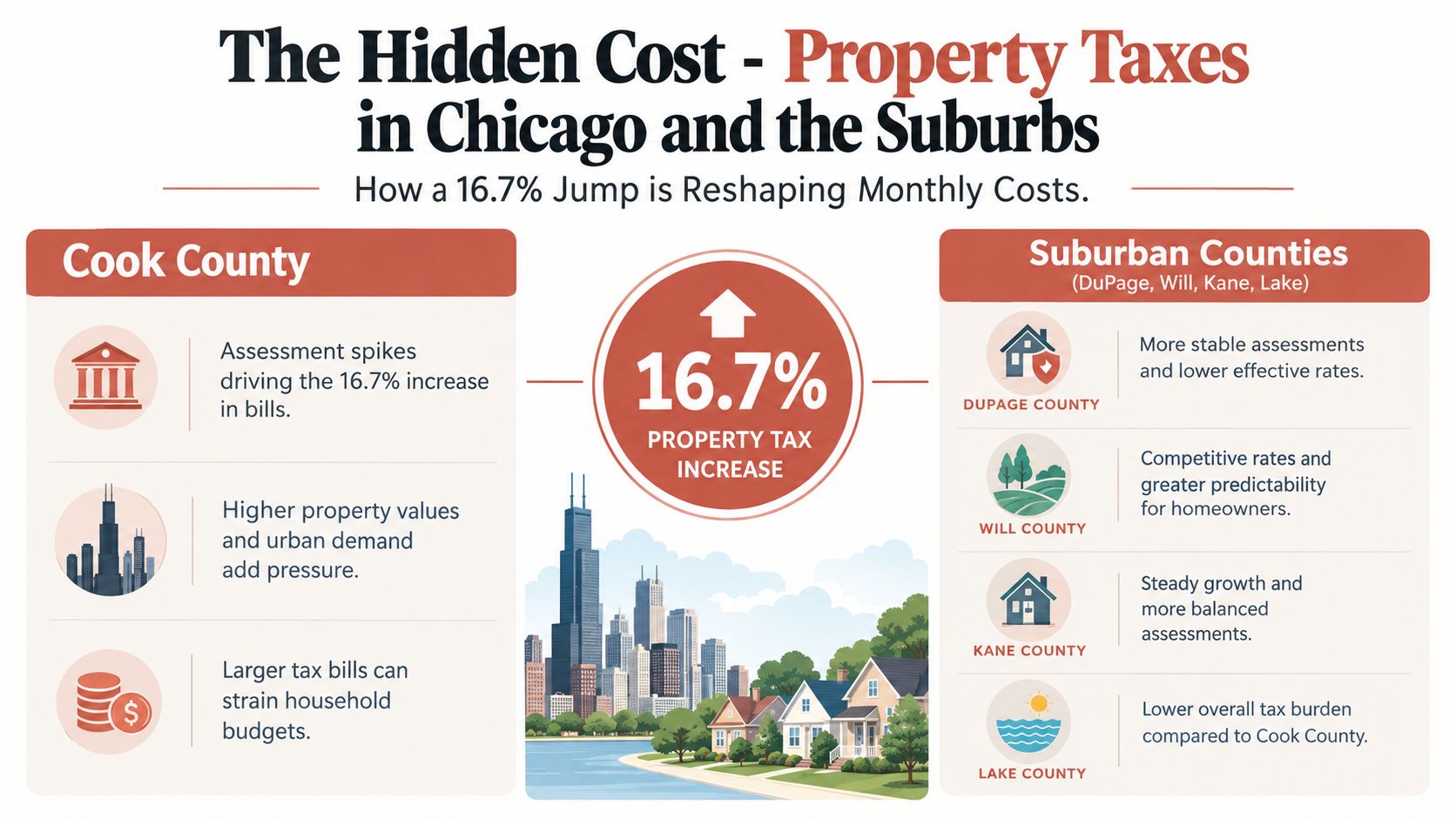
Property taxes can turn a seemingly manageable purchase into a strained monthly commitment. A late-2025 analysis reported that the typical Chicago homeowner's property-tax bill rose 16.7% year over year, described as the largest increase in more than three decades, according to Chicago Tribune coverage of the 2025 tax bills.
That increase should change how buyers evaluate a listing. Two homes with the same purchase price can produce very different monthly budgets because tax bills vary by municipality, county, assessment history, exemptions, and local taxing bodies. The difference isn't captured by the list price or a basic mortgage estimate.
Compare the bill, not the ZIP code
A $400,000 home in Elmhurst, Berwyn, or Naperville shouldn't be treated as having the same carrying cost merely because the prices match. Buyers need the actual tax bill, recent assessment information, exemption status, and a projection of what may change after the purchase.
This issue is especially important for move-up buyers stretching to qualify, retirees managing fixed income, and sellers whose current bill may not represent what a future owner will owe. Buyers should ask their lender and tax professional to model the payment with a conservative tax assumption.
Potential exemptions can include homestead, senior, and longtime-homeowner programs, but eligibility and filing windows must be verified with the relevant county assessor. Never assume an exemption transfers automatically with the property.
A Practical Playbook for Buying or Selling in Chicagoland
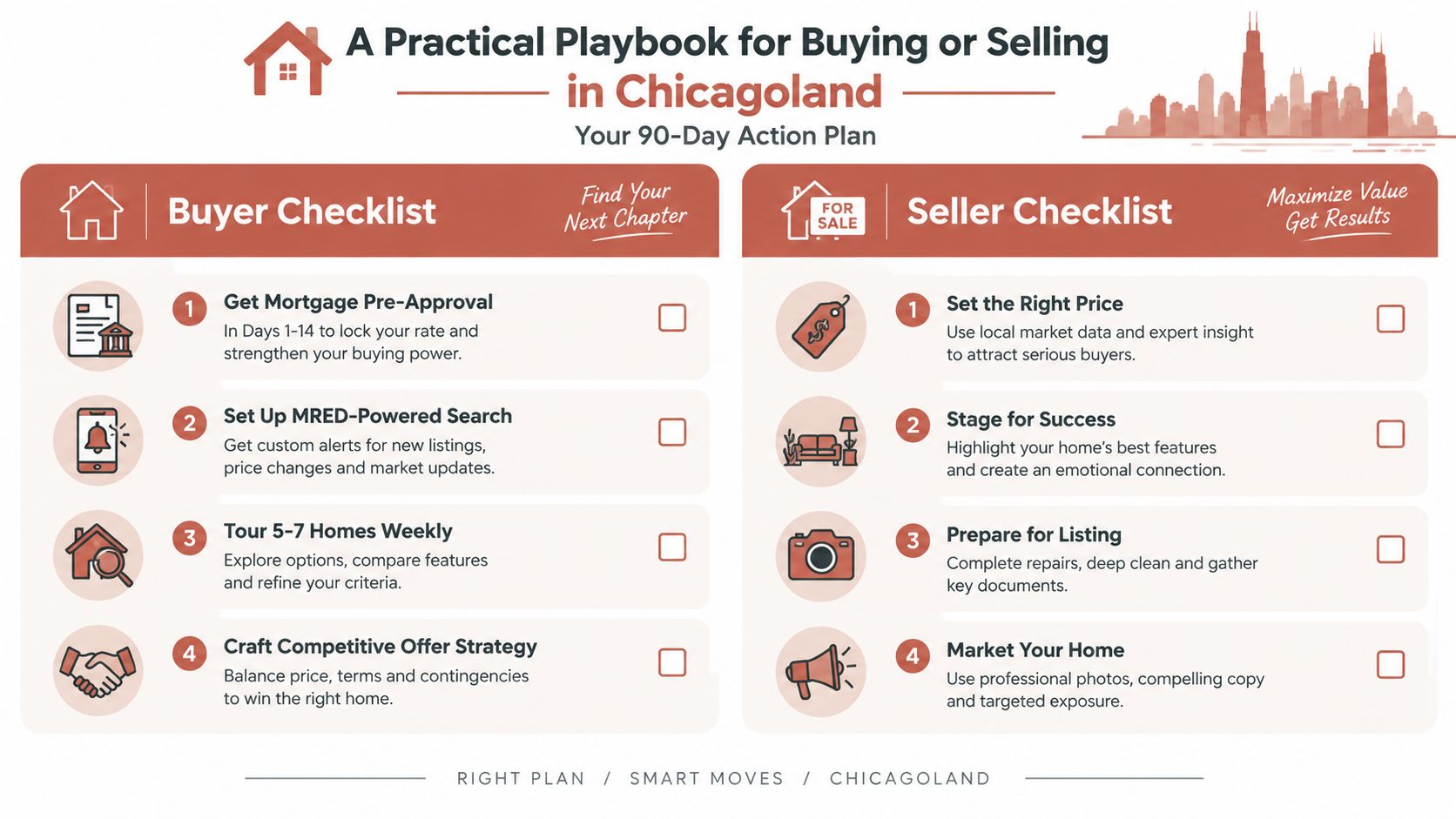
A 90-day plan works because it converts broad market anxiety into deadlines. Buyers should prepare before touring seriously, while sellers should complete the pricing and property review before putting a listing online.
Days 1 through 14
Buyer: Meet with a lender, document income and assets, and establish two numbers: the maximum approval and the lower monthly payment ceiling you're comfortable carrying. Set up an MLS-powered search with custom alerts for location, property type, price, taxes, parking, and association charges.
Seller: Request a comparative market analysis based on the closest property matches, not a broad ZIP-code average. Review the tax record, disclosures, repairs, title considerations, and likely buyer objections before selecting a list price.
Days 15 through 45
Buyers should tour enough homes to identify patterns, not merely chase the newest listing. Use each showing to refine the search. If every acceptable property has a longer commute, smaller kitchen, or higher association cost, adjust the criteria deliberately rather than making the adjustment during an offer deadline.
Sellers should focus preparation on visible condition and buyer confidence. In Chicago architecture, that may mean preserving greystone details, clarifying the condition of a vintage kitchen, improving light in a narrow layout, and presenting storage and parking accurately. Repairs that remove inspection uncertainty often matter more than decorative upgrades.
Days 46 through 75
Offer strategy: Match the terms to the listing's market time, condition, and comparable sales. A new listing with strong interest may call for clean financing, a realistic inspection timeline, and carefully considered contingencies. A property that has lingered may allow a buyer to negotiate price or credits, but the request should be supported by condition and market evidence.
Inspection and appraisal: Keep the inspection contingency meaningful. Buyers should identify major systems, structural concerns, water intrusion, and safety issues before treating cosmetic work as the central negotiation. If the agreed price could exceed appraised value, discuss appraisal-gap exposure before signing, not after the appraisal arrives.
Days 76 through 90
Sellers should compare offers by net proceeds, financing reliability, contingencies, timing, and the likelihood of closing, not just the highest headline price. Buyers should complete lender requests quickly, review title and closing documents, confirm insurance, and recheck the property before closing.
For households that want local guidance through search, valuation, negotiation, and closing coordination, Homes By Carmen offers buyer and seller representation in the Chicago area.
Negotiation principle: The strongest offer is the one that makes the seller confident while keeping the buyer protected from costs the inspection, appraisal, or tax review could reveal.
Pulling It Together for Your Next Move
The central question isn't whether Chicago prices are up or down. It's which decision fits your household's budget and time horizon: continue renting, buy in a city neighborhood, move west for space, list now, or wait for a different market window.
Three inputs deserve priority. First, constrained inventory and faster metro turnover can make well-priced homes competitive, so buyers need preparation before the right property appears. Second, the 47.4% affordability figure shows that middle-income buyers still have reachable options, but those options may involve location, condition, property type, or commute compromises. Third, the 16.7% property-tax increase shows why a purchase that works on price alone can fail after the complete carrying cost is calculated.
Write down your maximum monthly housing cost before you search. Then compare a city property with a western-suburban alternative using current MLS information, actual tax records, association documents, insurance estimates, and commute requirements. Sellers should perform the same exercise from the other side, measuring likely net proceeds and buyer objections instead of waiting for a broad market headline to make the decision.
The current window may favor a prepared buyer, a correctly priced seller, or a move-up household that can realize equity without overextending. Your answer depends on the property, the tax exposure, and the trade-offs you can live with.
Homes By Carmen helps buyers, sellers, and renters compare Melrose Park, Chicago, and western-suburban options using local guidance, MLS access, pricing analysis, and transaction support. Visit Homes By Carmen to define your carrying-cost ceiling, evaluate your next move, and schedule a practical consultation.