
Picking an agent from five stars and a friend's referral feels safe. It isn't a test. Reviews tell you past clients were satisfied. They rarely tell you how that agent handles a low appraisal, a messy inspection, or a deadline that slips on a Friday afternoon. The right question isn't who looks best online. It's whose process holds up when the transaction gets difficult.
Table of Contents
- Why Reviews Alone Miss the Best Real Estate Agent
- Western Suburb Markets Where Local Expertise Matters
- Testing Process Quality Before You Sign an Agreement
- Reading Negotiation Records and Testimonials Critically
- Comparing Agent Profiles by Client Situation
- How Homes By Carmen Supports Each Client Type
- Choosing Your Agent and Taking the Next Step
Why Reviews Alone Miss the Best Real Estate Agent
Start with reputation, then stop treating it as proof. A referral usually means one transaction went well for one person in one situation. Your budget, suburb, timeline, and risk tolerance may be completely different.
That gap matters because buyers still lean heavily on professional help. In the National Association of Realtors 2025 profile of buyers and sellers, 88% of buyers purchased through an agent or broker and 91% would use their agent again or recommend that agent. High satisfaction is real. It still doesn't show you the operating steps behind it.
What Reviews Show and What They Hide
| Signal | What it actually tells you | What you still need to test |
|---|---|---|
| Star rating | Clients were generally happy | Response time, deadline tracking, inspection support |
| Friend referral | Trust in one past deal | Fit for your suburb, price range, and situation |
| Sales volume | The agent closes business | Who personally handles your file day to day |
| Testimonial story | One outcome went well | Whether that outcome repeats under pressure |
A busy agent can be excellent. A busy agent can also delegate you to whoever's free. Volume alone won't tell you which one you're getting.
Two questions do more work than any ranking. First, how does this agent's process work before you sign, step by step, in writing. Second, does that process match your specific situation in Melrose Park or a nearby suburb. An agent who's strong with move-up sellers may move too fast for a first-time buyer who needs every contingency explained plainly.
Practical rule: Treat reviews as a reason to interview an agent, not as a reason to hire one.
Communication, negotiation habits, MRED access, and niche experience all matter. None of them are visible in a star count. You have to ask, compare answers, and score specificity. Vague confidence is easy in a consultation. A documented process is harder to fake.
Western Suburb Markets Where Local Expertise Matters
Melrose Park, Elmhurst, Oak Park, Downers Grove, Naperville, and Glen Ellyn aren't one market with six names. Housing age differs. Taxes differ. Transit access, inventory, and buyer competition differ. An agent using broad metro averages will give you broad, and often wrong, advice.
Ask how the agent adjusts for those differences. Which comparable sales would they use for an older Oak Park home versus a newer Naperville build, and why. How do taxes and association fees change the true monthly cost between two similar list prices. If the answer stays generic, the local knowledge is probably generic too. The community overviews at western Chicago suburbs covered by Homes By Carmen are a useful starting point for comparing those trade-offs side by side.

Affordability Is Usually the Real Constraint
Here's the part most agent rankings skip. Housing counselors reported that saving for a down payment was the leading first-time buyer challenge, cited by 88%, followed by finding a suitable home at 73%, while only 7% identified finding an agent as a barrier, according to housing counselor survey data on escalating housing costs. Access to an agent isn't your problem. Money and fit are.
So local expertise has to include arithmetic. A capable agent should walk you through:
- Total cash to close: Down payment, closing costs, and reserves, not just list price.
- Monthly carrying cost: Taxes, insurance, association fees, and likely maintenance for the home's age.
- Commute trade-offs: What a lower price farther out costs you in time and transit.
- Repair exposure: Whether a cheaper, older home needs immediate work that wipes out the savings.
That last point decides a lot of western suburb purchases. A lower-priced property needing a roof, sewer work, or electrical updates can be riskier than a higher-priced home that's been maintained. Your agent should say that out loud before showings, not after the inspection report lands.
Testing Process Quality Before You Sign an Agreement
Most buyers don't test anything. Buyer data shows 47% hired the first agent they contacted and 71% approached only one or two agents, with knowledge of the purchase process and responsiveness rated at roughly 89% as important characteristics, while experience was the top individual selection factor for only 23% of buyers, per Zillow's 2025 Consumer Housing Trends Report for agents. People value responsiveness. Then they sign without measuring it.
Interview at least three agents. Ask each one the same questions, in the same order, and write the answers down. You're scoring specificity, not personality.
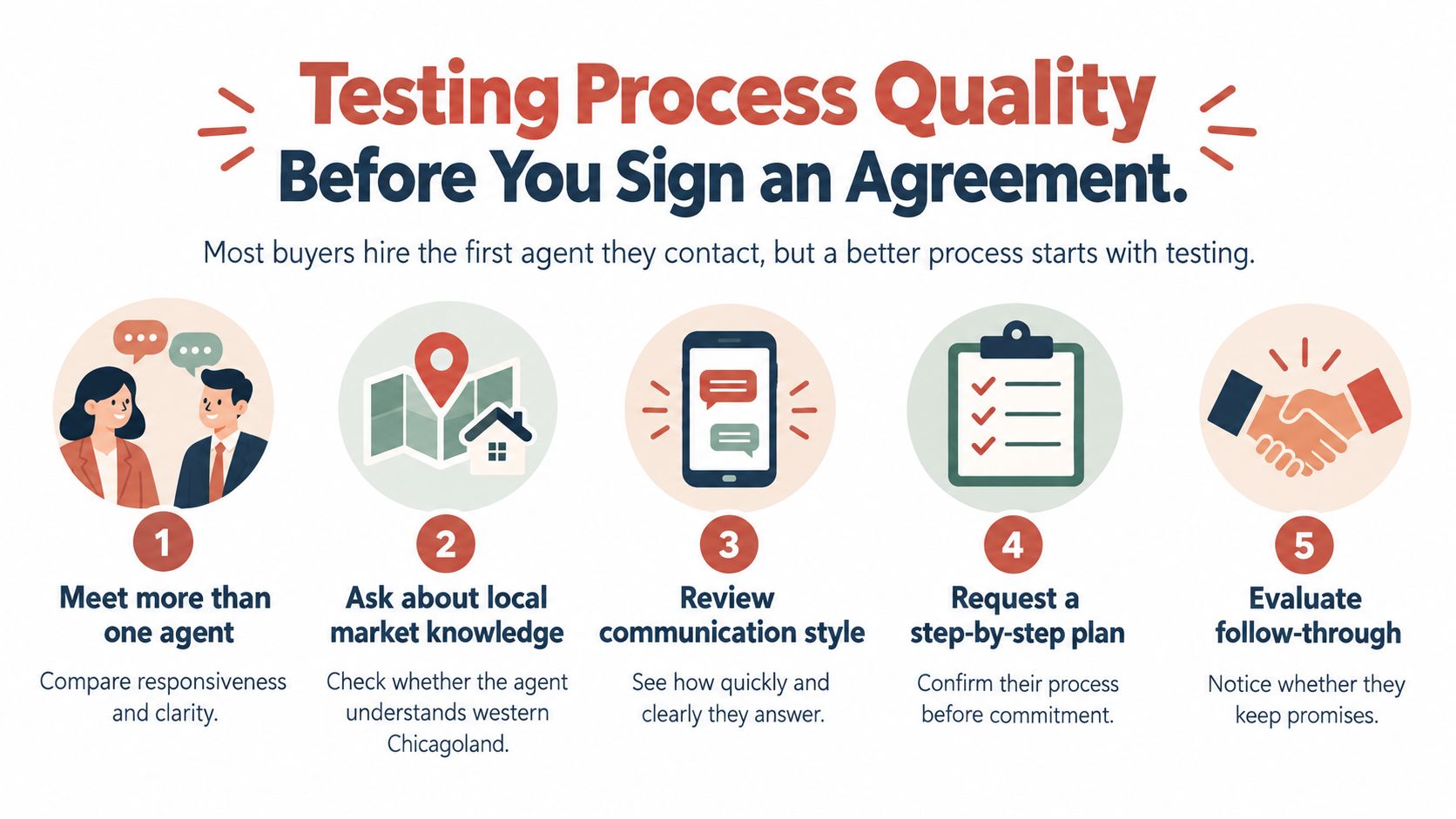
The Questions That Reveal Process
- Inspections: Who personally attends, and who explains what a finding means for cost and safety. "My team handles it" isn't an answer.
- Response standard: What response time do they commit to during business hours and on weekends. Get it stated, not implied.
- Offer terms: How do they evaluate contingencies, appraisal risk, and inspection credits before you sign an offer.
- Deadline tracking: What system tracks earnest money, attorney review, inspection, and mortgage dates, and who watches it.
- Exit terms: What happens if the relationship isn't working. A confident agent answers this calmly and points to the clause.
The full list at questions to ask a real estate agent before hiring gives you a ready script if you want one. Bring it to every interview so your comparison stays honest.
Small details during the interview predict bigger ones later. Does the agent follow up when promised. Do they send the sample documents they mentioned. It's the same discipline you'd want from any home professional, which is why practical checklists like window cleaning advice from Aloha Window Bros work on the same principle, namely judging a service by its stated process before money changes hands.
An agent who can't explain the next five steps clearly in a consultation won't explain them clearly under contract.
Score each candidate on communication, market evidence, negotiation preparation, coordination, and exit terms. Pick the clearest file, not the warmest conversation.
Reading Negotiation Records and Testimonials Critically
Testimonials aren't worthless. They're just incomplete. Read them like evidence, not advertising, and they become useful.
Look for outcomes with a mechanism attached. A review that says the agent was "amazing" tells you nothing. A review describing a seller concession after inspection, a rent reduction on a lease, or a contingency kept in place during a bidding round tells you what the agent did and why it worked. Patterns across several reviews matter more than one glowing story.
National benchmarks help you calibrate. The 2025 Profile of Home Buyers and Sellers highlights report that 92% of buyers were satisfied with the buying process, and 76% of first-time buyers credited their agent with helping them understand the process. More than half of first-time buyers also valued agents pointing out property features or defects they hadn't noticed. So when you read reviews, look for those two behaviors by name, teaching and defect spotting. They're what satisfied clients credit.
Separating Satisfaction From Evidence
Ask yourself three things about any testimonial set:
- Consistency: Do buying, selling, and leasing clients all describe clear communication, or only one group.
- Pressure: Do clients mention being given time to decide, or does every story sound rushed and relieved.
- Specifics: Do reviews name suburbs, property types, and problems solved, or stay at the level of praise.
Then verify in person. Ask the agent to walk you through a recent negotiation that didn't go to plan. What changed, what did they protect, what did the client give up. Strong negotiators talk about trade-offs comfortably because they've made them. Weak ones change the subject to their awards. The preparation habits in negotiation guidance for buyers show the kind of structured thinking you should hear echoed in that conversation.
Satisfaction plus repeat and referral intent is the strongest proxy you have. Documented process quality is what turns that proxy into a hiring decision. Demand both.
Comparing Agent Profiles by Client Situation
There's no single definition of the best real estate agent. There's a best fit for the constraint you're facing. A first-time buyer short on cash and an investor short on time need different strengths from the same license.

Agent Priorities by Client Situation
| Client situation | Priority agent qualities | Questions to ask |
|---|---|---|
| First-time buyer | Patient education, clear process steps, defect recognition | How will you explain each contingency before I sign |
| Move-up buyer or relocating family | Timing coordination, suburb comparison, negotiation | How do you sequence selling and buying without a gap |
| Seller of inherited or as-is home | Pricing strategy, realistic timelines, contractor referrals | What do we fix, what do we disclose, what do we leave |
| Renter | Search speed, application support, lease term review | How do you strengthen an application and check total lease cost |
| Residential investor | Comparable analysis, rent context, condition assessment | Which costs make this property a poor hold |
Notice how little overlap there is at the top of each column. The first-time buyer needs a teacher who slows down. The relocating family needs a coordinator who can compare Elmhurst against Glen Ellyn on taxes, transit, and inventory in one conversation, then evaluate estimates from professional movers with the same total-cost mindset once dates are set. The estate seller needs someone honest about condition and pricing, not someone promising a premium for an outdated home.
Decision rule: Match the agent's proven strength to your hardest constraint, whether that's affordability, timing, condition, or speed.
If an agent claims equal strength in all five profiles, press for examples in yours. Depth in your situation beats breadth across everyone else's.
How Homes By Carmen Supports Each Client Type
Apply the same test here that you'd apply anywhere. Carmen Salerno is a licensed residential real estate professional serving Melrose Park and the greater Chicago area, offering buyer, seller, and rental representation with MLS access through Midwest Real Estate Data (MRED).
For buyers, that means MLS-powered search with an interactive map and advanced filters, tour scheduling, offer drafting, negotiation, inspection coordination, and closing support. For sellers, it means a comparative market analysis, pricing strategy, listing through MRED Broker Reciprocity, showings management, and transaction oversight through closing. Renters get search and application support for apartments, condos, and single-family leases. Prospective sellers can request a complimentary property valuation before committing to a list price.

Tools Are Only Useful When Someone Interprets Them
Technology deserves skepticism. The 2025 REALTORS Technology Survey found electronic signatures used by 79% of respondents, with social media and drone photography each at 75%, yet the median satisfaction rating for core MLS technology was only 3 out of 5. Access is common. Good use isn't automatic.
So judge the workflow, not the tool list:
- Search setup: Filters and alerts configured to your suburbs and budget, then reviewed by a person for taxes, disclosures, and condition.
- Document handling: Electronic execution with secure sharing, plus a human explanation before you sign anything.
- Status changes: Price and status updates communicated quickly, with advice on whether they change your move.
- Deadline control: Automated reminders backed by someone checking that the work behind each date is done.
Client reviews for this practice describe reduced rents and concessions, clear communication across buying, selling, and leasing, and a low-pressure approach. Read those the critical way described earlier. Then test them in a consultation. Referrals to lenders, inspectors, and attorneys are available, and you should ask how those professionals are chosen. A referral network is part of process quality, not a bonus.
Choosing Your Agent and Taking the Next Step
Build a shortlist of three. Interview all three with the same process questions. Score the answers against the priorities for your client situation. Then check one more thing, neighborhood-specific competence for the exact suburbs on your list.
That check is simple. Ask each agent to explain, for one suburb you name, how comparable selection, housing age, taxes, and current inventory would shape their recommendation. Specific answers will sound different for Melrose Park than for Naperville. If the answers sound interchangeable, the expertise is too.
Your Shortlist Method
- Interview three agents using identical questions on inspections, response time, offer risk, and exit terms.
- Compare written answers against your situation's priorities, not against charisma.
- Verify one negotiation story in detail, including what the client gave up.
- Confirm communication commitments in writing before signing any agreement.
Favor the agent whose answers are specific, whose record is documented, and whose commitments you can point to later. That's not a sales standard. It's a risk standard, and it's the same one you'd use for a lender or an attorney.
If you're ready to start, begin with the resource that matches your position. Sellers can request a complimentary property valuation and strategy consultation. First-time clients can download the Buyers Guide or Sellers Guide. Anyone still working out affordability can run numbers through a mortgage calculator first, then bring those numbers to the interview. You'll ask better questions with your own figures in hand, and you'll spot vague answers faster.
If you're buying, selling, or renting in Melrose Park or the western suburbs, you can test this process directly with a complimentary valuation, a Buyers or Sellers Guide, and a consultation built around your questions. Visit Homes By Carmen to start that conversation and judge the answers the same way this guide taught you to judge any agent's.