
Your tenant has paid on the first of the month for two years, the furnace is newer than the roof, and you've decided to sell. The first agent you call says to get the tenant out before listing. The second says investors pay a premium for income. Neither of them has read the lease.
That lease decides almost everything. It sets which buyers can compete, whether you can promise vacant possession, how much notice you owe, and when you can realistically close. Treat the tenant as part of the sale strategy rather than an obstacle to clear, and the transaction moves faster and prices stronger.
Selling a house with tenants is not one transaction. It's four, wearing the same address.
Table of Contents
- Sale Paths for a Tenant-Occupied Home
- Lease and Records to Review Before Listing
- Notice Periods by Tenancy Type
- Showings and Access Without Upsetting the Tenant
- Pricing an Occupied Sale for Investors and Owner-Occupants
- Your First Week Before Listing
Sale Paths for a Tenant-Occupied Home
| Sale path | Typical buyer | Tenant at closing | Main risk |
|---|---|---|---|
| Sell with tenant in place | Investor underwriting rent | Stays under existing lease | Buyer inherits deposit and repair obligations |
| Negotiate early move-out | Owner-occupant | Leaves on an agreed date before closing | Tenant may refuse or delay the agreement |
| Sell after lease expires | Owner-occupant or investor | Lease ends, tenant may renew | Months of waiting and a lost selling season |
| Sell subject to occupancy | Investor or cash buyer | Remains until possession transfers | Restricted showings reduce offers |
One question decides which row fits: is your buyer paying for rental income or for a place to live? Everything downstream follows from that answer, including staging, showing hours, the possession clause and the closing date.
Why an investor buyer wants the lease
An investor looking at your property is underwriting a stream of rent, not a blank canvas. The tenant staying is the product. There's no vacancy to fill, no carry cost between closing and the first rent check, and no lease-up risk in a market where turnover eats returns.
The trade is documentation. A buyer who takes over an occupied unit inherits the deposit ledger and the maintenance obligations that come with it, and will check both before removing contingencies. A deposit that doesn't reconcile, or a repair history that stops eighteen months ago, becomes a renegotiation at inspection. Clean books are what turn a tenanted listing from a discount into a premium.
What an early move-out really costs
This is the route for the seller whose buyer wants to move in. Vacant possession is worth more to that buyer, which is why you pay to create it. The usual shape is cash for keys: a defined payment, a signed written agreement with a move-out date, and payment released on the day the keys come back, never before.
Get the date, the amount and the conditions on one page, signed by every adult on the lease. A verbal understanding collapses the week before closing, and you'll be the one explaining to your buyer why the walk-through has furniture in it.
The waiting route
If the lease ends in ten or twelve weeks, waiting is often the cheapest option. There's no incentive to negotiate, no access protocol to manage, and the final months of rent land in your account. What you spend instead is calendar time.
A lease expiring in late November means a winter listing, thinner traffic and a slower first two weeks. That trade, months of carry against a better showing season, is the one to weigh carefully. Renewal is the wildcard. Tenants renew when they like the place and the rent is below market, and a fresh twelve-month term resets the whole clock.
What I'd test first: pull the lease end date and ask the tenant plainly whether they'd move early for a specific sum. Every other route gets priced against those two answers, not against your hopes for the sale.
Selling subject to occupancy suits cash and investor buyers who accept a tenant in place and a showing schedule that has to be negotiated. Fewer showings mean fewer offers, and that shows up in the price rather than in the timeline. Start with the lease date and the tenant's willingness, then price the three options you have left against the timeline each one allows.
Lease and Records to Review Before Listing
In Illinois, a private sale generally doesn't end a fixed-term lease. Illinois Legal Aid explains that when a rental property changes ownership, the tenant's agreement normally remains in force and the buyer becomes the new landlord. Rent, duration and other contractual terms ordinarily continue unchanged until the stated expiration date, and the new owner assumes responsibility for the security deposit and must provide updated contact and payment information.
That's why you can't promise vacant possession just because the house is for sale. There's one exception worth hunting for: some written rental agreements expressly give the landlord a right to end the tenancy if the property is sold. Find that clause, or confirm it doesn't exist, before you write a listing. Foreclosure and tax-sale situations carry different rules and shouldn't be handled like an ordinary private sale.
The file that makes an occupied sale financeable
Assemble this package before photography, not after the first offer:
- The disclosure report. Complete your state's statutory disclosure form and deliver it to the buyer before the purchase contract is signed. Roof age, basement moisture, electrical, permits, everything you know belongs in it.
- Every lease and addendum. Read for renewal terms, early termination, entry notice, purchase options and relocation provisions. These terms shape your marketing, not the other way around.
- The deposit ledger and payment history. The exact deposit held, any deductions, and months of rent receipts. A buyer will reconcile this.
- Notices already served. Anything you've given the tenant in writing, with dates.
- Repair and maintenance records. Service dates, warranties, and any open code or violation notices.
- The utility split. Which accounts are in the tenant's name and which stay with the property.
Missing records have a cost that shows up in three places: inspection renegotiation, closing delays, and post-closing claims. A complete folder lets a buyer price the income and the condition accurately, so the negotiation happens once, at offer, instead of three times before closing.
Check the program before you set a closing date
Not all occupied tenancies are equal. Conventional, subsidized and foreclosure-related situations run on different rules, and the last two are stricter than most sellers expect. HUD guidance states that successors may be required to honor the remaining term of a bona fide lease, and qualifying tenants may receive at least 90 days' notice before being required to vacate, as set out in the federal guidance on occupied properties. Set a vacant-possession closing target only after you know which category your property falls into.
The lease has to answer three questions before you list. Can the property be sold? Almost always yes. Can it be shown? That depends on the entry clause and local rules. Can the buyer occupy it at closing? That depends on the term, the sale clause and what you negotiate in writing.
Notice Periods by Tenancy Type
| Tenancy type | Can the tenant be required to leave on sale? | Notice generally cited | Check before listing |
|---|---|---|---|
| Fixed-term lease | No, tenant may stay to the end date | Per lease terms | Look for a clause allowing termination on sale |
| Lease with sale clause | Yes, if the clause is valid | As written in the lease | Confirm the clause and the notice it requires |
| Month-to-month tenancy | Either side can end it | 30 days written notice in many Illinois situations, as noted in Illinois guidance on tenant rights when a landlord sells | Check the City of Chicago landlord-tenant rules or the municipality governing the property before relying on 30 days |
| Federally assisted or foreclosure tenancy | No, successor must honour the bona fide lease term | At least 90 days notice before vacating, as set out in the federal guidance on occupied properties | Confirm program rules and tenant qualification |
Two tenancies can sit in the same building and run on different clocks. The lease category sets the notice track, and the notice track sets which buyers can realistically close. A month-to-month tenancy may generally be ended with 30 days' written notice in many Illinois situations, while a fixed-term tenant ordinarily keeps the right to stay through the lease's end unless the agreement or law says otherwise. That 30-day figure is a starting point, not a plan. For Chicago properties, check the City of Chicago landlord-tenant rules; elsewhere, check the municipality governing the property's address before you put a date in a contract.
Counting backward from your closing date
Build the timeline in reverse:
- Confirm the tenancy type. Fixed term, month to month, or a program tenancy. This picks your notice track.
- Count the notice period backward from the closing date you want. A notice that expires after closing doesn't deliver possession at closing. It invites delay, dispute or a buyer who expects a rent stream instead of a home.
- Add the buyer's inspection and financing window. A contract that goes under agreement next week still needs weeks of appraisal, loan underwriting and title work before it closes.
A late start narrows the buyer pool. Owner-occupants need possession, so they may passes on a property with a tenant whose notice runs past the closing target. Investor buyers may accept the lease as an asset, but they price it against the rent, the term and the risk of turnover. If the count lands on a date you cannot live with, treat the property as an investor sale or wait until the tenancy clears. A late start pushes a closing into the next season, and a spring listing becomes a July listing with a stale price and a second round of showings.
Practical rule: The notice period sits at the front of your timeline, and the closing date is built around it.
Showings and Access Without Upsetting the Tenant
A viewing notice and a house key on entryway table signal how occupied showings should look: scheduled, written and expected.
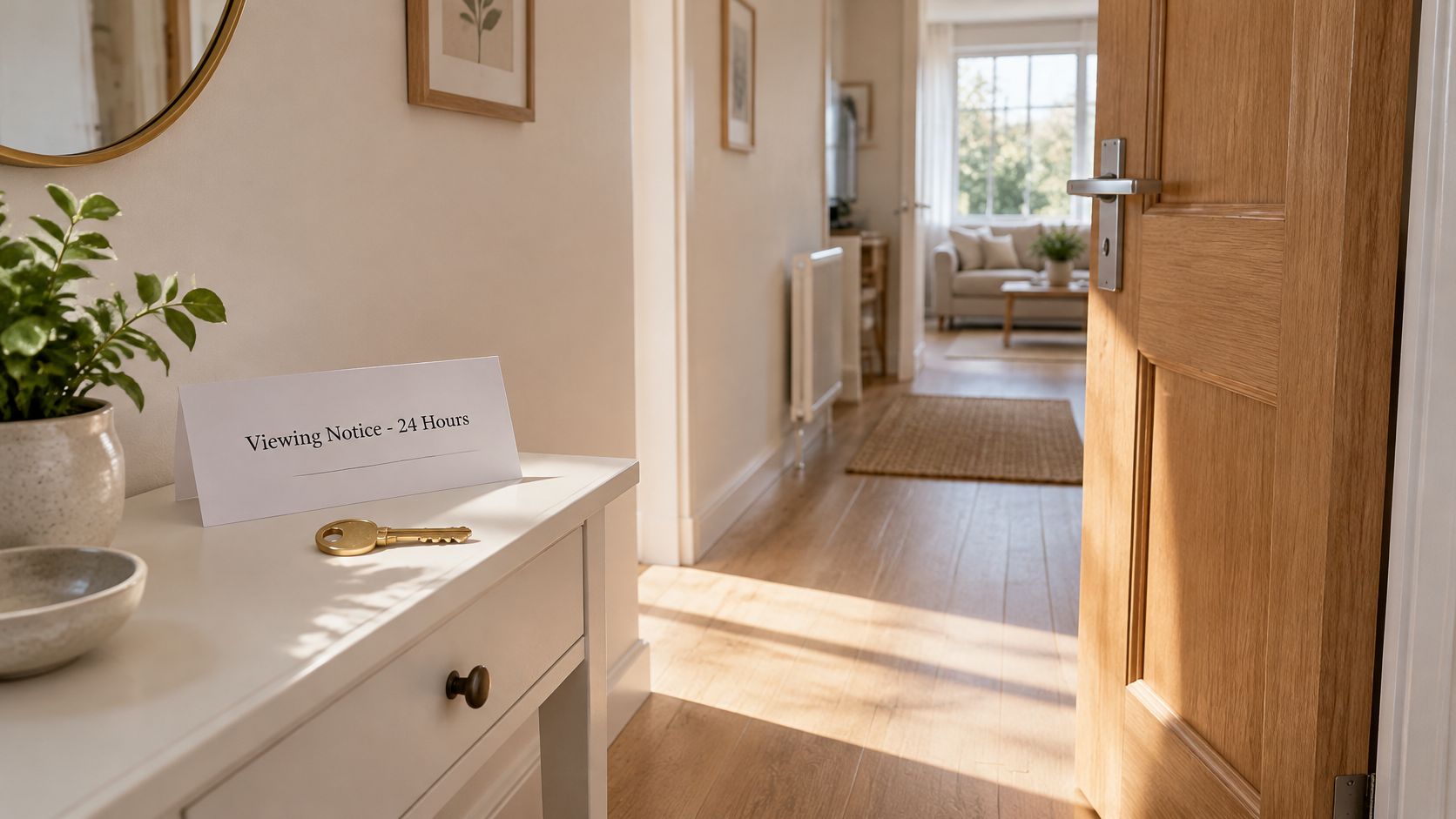
An unplanned visit has a price. Missed appointments cost a week of momentum. A tenant complaint about strangers at the door can turn into a refused inspection, and a refused appraisal stalls financing for a buyer who has already paid for an application.
The access protocol you send in writing
Put this in a message the tenant can keep, and copy it into the listing file:
- Advance notice in the period the lease requires. Calendar invites, not phone calls an hour ahead.
- Fixed entry hours. Two or three windows per week, agreed in advance, so the tenant can plan around them.
- A cap on traffic. Two scheduled showings per window plus one open house slot beats an open-ended stream.
- Photography handled with consent. Shoot around personal belongings, skip bedrooms with private documents visible, and never post photos of the tenant's possessions.
- Pet arrangements. Confirmation of crating or a walk, so nobody gets bitten and no door gets left open.
- Key and code control. One person holds the lockbox code, and the tenant is told every time it's used.
Predictable access does real work in the deal. Inspectors, appraisers and photographers book once and finish once, and the file stops accumulating reschedules. Pre-screening buyers with a virtual walk through for property listings cuts the number of physical visits, which matters most in an occupied unit where every appointment is a negotiation. If you're planning open house slots around a tenant's schedule, these showings guidelines are the practical companion.
The legal frame is on your side here. Illinois landlords keep the right to market and show a rental while the tenancy continues, and listing the home does not violate the tenant's quiet enjoyment. What violates it is the unannounced drop-in, the lockbox opened without warning, the agent who treats a leased home like a vacant one. In Chicago, the municipal landlord-tenant ordinance sets its own entry-notice requirements on top of whatever the lease says, so the notice period in your written protocol should satisfy the strictest of the three layers: lease, city rules and state law. When in doubt, give more notice rather than less. A tenant who feels informed is a tenant who cooperates, and cooperation is worth more than any single showing.
The contrast plays out in small, concrete ways. A tenant with a written schedule, two fixed windows per week and a named contact tends to tidy the kitchen before buyers arrive and passes along the plumber's phone number when the inspector asks. A tenant who learns at 9am that strangers arrive at 10am answers the door in a dressing gown and refuses the next request.
If the tenant still refuses access, stop escalating and start documenting. Log every request, the date, the time and the response, then read the entry clause and any local rule that governs it before you press the point. A written record is what you bring to a lawyer, and a lawyer's letter is what changes the answer.
Pricing an Occupied Sale for Investors and Owner-Occupants
A rent roll with eight months left on a twelve-month term is a different asset from one that expires sixty days after transfer, and buyers price them differently. An investor tests gross income against actual rent collected, stresses the vacancy assumption, adds operating costs, and looks hard at any lease that rolls over soon after closing. When the tenant stays, the buyer collects rent from the first day of ownership and skips the void period entirely, so a tenant in place makes the property worth more to that buyer. That premium only exists when the numbers are easy to verify.
Occupied homes change hands this way routinely, sold subject to the existing tenancy rather than held off the market until vacant. The lease transfers with the deed, and the buyer steps into the landlord position on the closing date. Your job as seller is to make that transfer easy to underwrite.
What makes the premium hold is a package a buyer can verify without asking you twice: executed leases, deposit accounting, operating statements, a utility responsibility matrix, maintenance history and a capital expenditure schedule. Hand that over at first showing and the offer comes in cleaner.
What an owner-occupant is actually paying for
For the buyer who intends to sleep there, the tenant is an obstacle with a cost attached. The price should reflect the time and money required to get possession, and the contract should say plainly who serves notices, who arranges relocation, and what happens if the home isn't vacant on the agreed date.
Delivery terms belong in the purchase contract, not in a side conversation. State whether the property transfers occupied or vacant, name the remedies if possession isn't delivered, and put a date next to each obligation. An owner-occupant who closes on a home with a tenant still inside has bought a rental and a problem.
The seller's net proceeds belong in the same conversation. Capital gains on rental sales reduce what a given price leaves you, so compare offers on after-tax proceeds and possession certainty rather than headline price. A higher offer that depends on a vacant transfer you cannot guarantee can be worth less than a lower one from an investor who takes the tenancy as-is. A comparative market analysis built on closed sales in your immediate blocks, adjusted for condition and tenancy, is the honest baseline for either comparison.
The handoff checklist for closing day
- Rent apportionment. Split the month so each owner pays for the days it owns the property, and show the arithmetic in the closing statement.
- Deposit transfer. The buyer takes on the deposit obligation, so the amount and any prior deductions must match the ledger you assembled before listing, to the cent.
- Keys, codes and contacts. Current keys, access codes, alarm details, trash day and the emergency contact list.
- A written notice to the tenant. New owner's name, payment method and contact details, delivered at closing.
Deposit records, utility responsibilities and the tenant file should already be assembled and verified before you ever reach this table, so closing day is a transfer rather than an audit. Anything unresolved at this point, a repair dispute or a deposit gap, needs a home in the contract before the deed records, because the buyer becomes the landlord on the closing date and the upper hand passes to them.
Price the investor version on verified income and the owner version on a firm possession date. Never list an occupied home as though it were vacant, because the first showing corrects the record.
Your First Week Before Listing
Work these in order before anyone books photos.
- Day one, read the paperwork. Pull the signed lease and every addendum as described in the lease review above, and write down the end date, any sale clause, and the entry-notice terms. Three lines on a notepad.
- Day two, set the clock. Apply the notice table for your tenancy type and count backward from a realistic closing date. Note the earliest date you can offer the property occupied or vacant.
- Day three, build the ledger. Assemble the deposit and payment records the earlier section lists. Mark every gap as unknown rather than filling it from memory.
- Day four, check the program and the address. Confirm whether the tenancy is conventional, subsidized or foreclosure-related, plus any municipal rule that governs your specific property.
- Day five, choose the route. Investor or owner-occupant, priced against the timeline each allows. Once the route is set, the seven steps of the selling process carry you from preparation through closing.
The one decision to record in writing is whether you can afford the time your chosen path needs. If the answer is no, the early move-out route is the one to test next, because it's the only path that brings possession forward without waiting for the lease to run out.
That week of paperwork is also where a tenant in place stops looking like an obstacle. A signed lease, a clean payment ledger and a cooperative showing arrangement are exactly what an investor buyer pays for, and they only exist if you assembled them before the listing went live.
If you want a second opinion on price before you commit, Homes By Carmen offers a free expert home valuation and strategy call for sellers.
A tenant-occupied sale goes smoother when the lease, the notice timeline and the pricing strategy are settled before the first photo is taken. Homes By Carmen helps clients buy, sell and rent homes across Melrose Park and the western Chicago suburbs, working with sellers from the first walk-through to the closing table. Visit Homes By Carmen to schedule a consultation or get your real estate questions answered.