
Naperville's city property-tax rate for levy year 2025 is 0.5583%, covering only the municipal share, while the total across all taxing districts was about 6.45% to 6.49% of equalized assessed value in the 2023 levy comparison for bills paid in 2024. Those figures measure different obligations, so neither should be applied directly to a home's asking price.
For a buyer planning a housing budget, the important question isn't whether Naperville has a low city rate. It's which taxing districts serve the property, what value they're taxing, and which exemptions the owner can claim. A favorable municipal rate can coexist with a substantial annual bill.
Table of Contents
- Naperville Property Tax Rates at a Glance
- How Naperville Turns Market Value Into a Tax Bill
- Why the City Rate Is Not Your Whole Bill
- Estimated Tax Bills at Common Home Prices
- Naperville Levy Trends Since 2023
- Exemptions and Appeals That Lower a Bill
- Confirm Your Naperville Bill Before You Buy or Sell
Naperville Property Tax Rates at a Glance
0.5583% is Naperville's municipal property-tax rate for levy year 2025. The City of Naperville's annual financial report identifies it as the city's lowest rate in the past 50 years. That figure covers the city's share, not the full property-tax bill.
The phrase “Naperville property tax rate” can refer to different measures. Compare each percentage only after checking what it covers and what value it applies to.
Naperville property tax rates by measure
| Rate measure | Rate | Applies to |
|---|---|---|
| City of Naperville municipal rate, levy year 2025 | 0.5583% of equalized assessed value | City share only, not the full bill |
| Total overlapping rate, 2023 levy paid in 2024 | Approximately 6.45% to 6.49% of equalized assessed value | Full bill across the taxing districts represented in that comparison |
| Median effective rate, market value, observation year unspecified | About 2.05% of market value | Quick screening estimate, not an official rate |
The combined-rate figures are historical comparisons, not a current rate for every parcel. The effective-rate estimate has no specified observation year, so it should not be treated as a newly adopted rate.
Use the city rate to understand the municipal share, the parcel's combined rate to estimate its full tax obligation, and the effective rate only as an initial affordability screen. Each measure answers a different question.
Read the base before comparing the percentage
A rate stated as a percentage of equalized assessed value applies to the taxable assessment, not directly to a buyer's offer. An effective rate instead expresses the tax burden as a share of market value. Comparing the percentages without their bases can make the larger figure seem more alarming than the underlying calculation warrants.
The city's levy supports municipal obligations, including pensions, the Naperville Public Library, and Naper Settlement. Other taxing districts serving the property add their own obligations to the full bill.
Budgeting rule: A low municipal rate describes the city's share. It does not establish the amount to budget for the complete property-tax bill.
Keep the levy year beside every quoted rate. Do not combine a 2025 municipal rate with a 2023 combined rate in one calculation.
How Naperville Turns Market Value Into a Tax Bill
Think of the calculation as a relay race. Market value passes the baton to the assessment process, the assessment passes it through equalization, and the taxable value reaches the taxing districts' combined rate. A mistake at any handoff changes the estimate.
The Illinois Department of Revenue's property assessment and equalization guide explains the assessment, correction, equalization, and state-multiplier process; the residential benchmark used here is approximately 33.33% of market value.
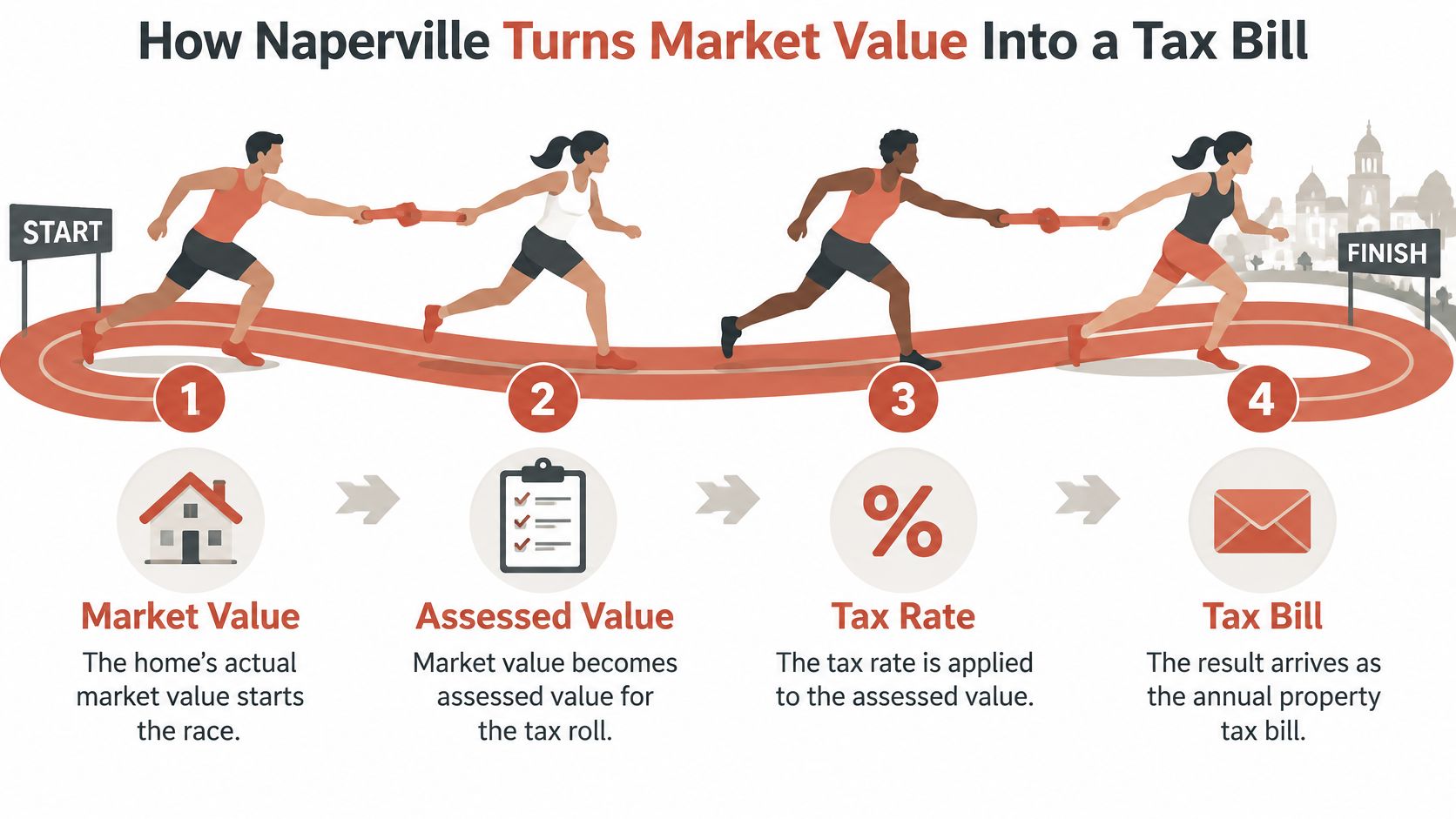
Follow the value through the calculation
Start with a market-value estimate. Use comparable properties rather than assuming an asking price establishes taxable value. This guide to how to value a home can help you separate a defensible market estimate from a seller's pricing decision.
Identify the assessed value. The assessor's valuation is the starting point for the tax roll. Check the assessment record rather than treating a purchase price as an automatic replacement for the recorded value.
Account for equalization. Assessment corrections, equalization adjustments, and the state-certified multiplier can change the value used in the tax calculation. This is why a rough market-value conversion isn't necessarily the parcel's final equalized assessed value, or EAV.
Determine taxable EAV after applicable exemptions. Exemptions generally reduce the value subject to tax, rather than acting as dollar-for-dollar credits against the finished bill. Apply them before multiplying by the rate, not after.
Apply the combined parcel rate. Multiply taxable EAV by the total rate for the taxing districts serving that property. Use the complete district list, not just the municipal line.
A hypothetical calculation, not a forecast
Using the assessment benchmark above, a hypothetical $400,000 home would have an assessment of approximately $133,333, assuming an exact one-third conversion and no equalization adjustment. That figure isn't yet a bill, and it isn't necessarily the home's recorded assessment.
Applying the historical combined-rate benchmark from the rate table to that hypothetical assessment produces a larger estimate than the market-value screening shortcut. The difference is useful: it shows why a broad effective-rate estimate can run below a calculation using a particular combined rate.
It does not prove that the shortcut usually understates every Naperville bill. The methods use different reference points, and exemptions, district boundaries, and valuation dates can change the comparison.
For an initial screen, multiply anticipated market value by the effective-rate benchmark in the table. Then replace that estimate with a calculation using the property's own assessment, exemption status, and combined rate. Appeals, reassessment, equalization changes, and new levies can all change the result.
Why the City Rate Is Not Your Whole Bill
Two parcels sit a few streets apart, on opposite sides of a school-district boundary. Both carry a Naperville mailing address, both are taxed at the city's 0.5583% municipal rate, and both sell near the same price. Their total bills still diverge, because the districts levying alongside the city differ between the two addresses.
The mechanism is overlapping jurisdiction. Several public bodies tax the same property for different responsibilities, and district boundaries do not follow the city line. A low municipal rate caps only one component of the bill; every other district stacks its own levy on top of it.
Identify the governments serving the address
The parcel's actual tax bill lists each taxing body individually. Entries typically include:
- School districts. Confirm the exact district names on the tax record, since a listing's neighborhood description can be imprecise.
- Park district. Confirm whether the parcel falls within the Naperville Park District's taxing boundaries.
- Library obligations. Check how library taxes appear on the bill; the municipal label alone does not resolve every library-related charge.
- County government. Establish whether the property is in DuPage County or Will County.
- Township. Identify the township and any separately listed township-related levies.
- Special districts. Review every additional district shown for the parcel.
Because the city levy already funds municipal institutions, resist rebuilding the bill from a list of services. Work from the lines and totals printed on the bill itself. Adding institutions a second time inflates the estimate, while assuming a district is covered elsewhere can omit it entirely.
Compare boundaries, not just city names
Two similarly priced homes can share the same municipal rate while carrying different combined bills. The county name alone will not settle that comparison: it identifies an administrative location, and the school, park, township, and special-district obligations attached to each parcel still decide the total.
Properties near a boundary deserve particular attention. The nearest school, the mailing address, and which side of a major road the home occupies can all point toward the wrong district.
Before treating competing listings as tax-equivalent, verify on each parcel's record which school district serves the address, which park and library entries appear on the bill, and which county and township contain the property. That check separates a different district burden from gaps created by the homes' assessments or their owners' exemptions.
Estimated Tax Bills at Common Home Prices
| Market value | Assessed value, approximately one-third | City share using the municipal benchmark | Estimated total using the effective-rate screen |
|---|---|---|---|
| $300,000 | $100,000 | $558 | $6,150 |
| $400,000 | $133,333 | $744 | $8,200 |
| $500,000 | $166,667 | $931 | $10,250 |
| $750,000 | $250,000 | $1,396 | $15,375 |
These are hypothetical calculations, not published tax bills. The table applies the municipal and effective-rate benchmarks already identified, assumes an exact one-third assessment for convenient arithmetic, rounds dollar results, and makes no exemption or equalization adjustment. It combines benchmarks from different contexts, so the city-share column isn't a component that should be subtracted from the screened total to calculate other districts' exact charges.
Read the middle row carefully
For the hypothetical $500,000 property, dividing market value by three gives an illustrative assessment of approximately $166,667. Applying the municipal benchmark produces approximately $931, while applying the market-value screening benchmark produces approximately $10,250.
Those calculations answer different questions. The municipal estimate illustrates the scale of the city portion under the assumptions; the effective-rate estimate offers an early all-in affordability screen.
Using the historical combined-rate benchmark instead would produce approximately $10,750 before exemptions on that same illustrative assessment. That isn't a correction to the screening estimate. It's a different scenario using a specific assessed-value rate rather than a median effective rate.
The higher-priced hypothetical row makes the distinction especially visible. The modeled municipal share remains below $1,400, while the screened total reaches approximately $15,375. The useful conclusion isn't that either amount will appear on a future bill, but that budgeting with only the municipal calculation would omit most of the modeled obligation.
Adjust the model to the property
A seller's exemptions may not match a buyer's eligibility. If an exemption reduces taxable assessed value, the owner's actual bill can be below an otherwise comparable no-exemption calculation.
Changes to the property also matter. A recent sale doesn't automatically establish the next assessment, and new construction or improvements can make a historical bill a poor guide to the property's future taxable condition.
Treat the table as a way to reject an unrealistic budget early, not as permission to skip the parcel record.
For monthly planning, use the estimated total, not the city-share column. Include taxes alongside principal, interest, insurance, and other ownership expenses when evaluating a typical monthly mortgage payment.
If a lender will collect taxes through escrow, ask which bill or projection supports that amount. An escrow estimate and a tax assessment are different documents, and a payment quote doesn't independently verify the property's future tax liability.
Replace the screening figure as soon as the current bill and assessment are available. If the verified amount changes what you can comfortably afford, revise the purchase budget before negotiating the price.
Naperville Levy Trends Since 2023
Naperville levy totals, 2023 to 2024
| Levy item | 2023 levy | 2024 estimate | Change |
|---|---|---|---|
| Total municipal property taxes | $63,706,402 | $67,026,303 | +5.2% |
| Corporate and special-purpose taxes | $48,927,483 | $51,437,834 | +5.1% |
The levy statistics document puts total municipal property taxes at $67,026,303 for 2024, up from $63,706,402 extended or abated for 2023, while the corporate and special-purpose component rises from $48,927,483 to $51,437,834.
Treat the rows as a total and a component. Corporate and special-purpose taxes sit inside the broader municipal total, so adding them together would overstate what the city is trying to collect.
A levy and a rate answer different questions
A levy is the amount a government seeks to collect. A rate is that amount measured against the taxable assessed base available to support it.
In a simplified calculation, the rate equals the levy divided by the relevant taxable assessed value. If the base grows faster than the levy, the rate can fall even while collections rise.
Take a year in which the levy rises 5.2%. If the taxable base expands by more than that pace, levy divided by base produces a lower rate; a parcel with unchanged taxable value can show a flat or lower municipal line, while a parcel with an unusually large reassessment can still carry a bigger share of the total.
A lower rate isn't the same thing as a lower bill. You need both the taxable value and the applicable rate to evaluate the result.
Watch the parcel, not just the headline
Do not copy the 5.2% municipal levy increase onto every prior payment. A parcel's result depends on whether its assessed value moved with the wider base, lagged it, or outran it.
A historical comparison also does not set the next bill's rate. Published levy estimates, final extensions, and parcel assessments answer related but separate questions.
For a purchase or listing, monitor three inputs together: the next published levy, the property's assessed value, and the complete bill once all districts are included. A calm city headline can hide movement elsewhere in the district list.
The strongest comparison keeps the property constant. Review the same parcel across billing periods, identify whether the levy, the base, or the parcel assessment changed, then decide whether that pattern is likely to remain relevant after a sale.
Exemptions and Appeals That Lower a Bill
Exemptions and assessment appeals address different problems. An exemption recognizes an owner's eligibility for a reduction in taxable value; an appeal challenges the assessment itself. Neither substitutes for checking the taxing districts and rate.
Start by distinguishing an eligibility question from a valuation question. If the property record omits an exemption you may qualify for, gather the application requirements. If the assessed value appears unsupported by comparable properties, investigate the assessment-review process.
Check eligibility before assuming a reduction
- Owner-occupied primary residence. Ask the county assessment office whether the property and owner qualify for a homestead exemption and whether an application is necessary.
- Senior-related relief. Confirm current age, income, occupancy, and documentation requirements for the particular exemption being considered.
- Disability-related relief. Check the applicable eligibility and evidence requirements rather than assuming all disability programs operate alike.
- Ownership changes. Verify when your eligibility begins and whether the seller's exemptions will continue, end, or require a new application.
For a preliminary overview, Home Ready Calculator's guide to 2026 homestead exemption eligibility and deadlines can help organize your questions. Confirm the controlling requirements and filing dates with the county office responsible for your parcel.
Don't budget for an exemption merely because it appears on the seller's bill. Your ownership, occupancy, and eligibility must support your own treatment.
Build an appeal around valuation evidence
- Read the assessment notice. Identify the property, assessed value, valuation period, and instructions so you're challenging the correct record.
- Gather comparable evidence. Choose recent sales or assessments of similar homes, accounting for size, condition, location, and improvements.
- Confirm the filing window. Ask the responsible assessment office or review body which deadline and submission process apply.
- Submit a documented case. Explain the valuation discrepancy, attach supporting records, and retain copies and confirmation of filing.
- Clarify further review options. If the requested change is denied, ask what review procedures remain and what their requirements are.
An appeal may produce a reduction or leave the assessment unchanged. A high bill alone doesn't establish an incorrect valuation, because the district rates and exemption status also affect the amount due.
Avoid building an appeal around the city rate or a neighbor's total payment. The more useful evidence addresses whether the assessment fairly reflects the property relative to comparable homes.
Confirm Your Naperville Bill Before You Buy or Sell
Before committing to an offer or listing strategy, assemble a parcel-specific tax file. Keep the bill, assessment record, exemption information, and supporting comparable sales together so everyone is evaluating the same property and billing period.
Verify the inputs before accepting the estimate
- Retrieve the latest bill by parcel identification number. Obtain it from the appropriate county treasurer and confirm that the parcel identification number, or PIN, matches the property.
- Review the assessment against comparable sales. Separate market-value evidence from asking prices; a home-value estimate by address can provide a starting point, though it doesn't replace the assessment record.
- Check exemption status. Identify what's already applied and ask which benefits will remain available after the ownership change.
- Match the parcel to the right offices. DuPage County assessment and treasury offices handle parcels on that side of the boundary, the corresponding Will County offices serve properties on theirs, and the City of Naperville publishes municipal levy information.
- Recalculate and investigate discrepancies. Apply the combined rate to taxable EAV, account for the bill's stated adjustments, and ask the assessor or treasurer about an unexplained gap.
County records supply the details for the individual property, while Illinois Department of Revenue guidance provides the statewide framework those offices apply.
Homes By Carmen is licensed in Illinois and serves Naperville among its western Chicagoland communities. We can help buyers and sellers review comparable sales when checking whether an assessment aligns with the market before committing to a transaction.
Plan around the complete bill, with the buyer's likely assessment and exemption situation in mind. The combined levy across every taxing district produces the ownership cost a household has to fund; the municipal rate is only one line inside that total.
Homes By Carmen offers buyer and seller representation and comparable-market analysis to help you connect a Naperville property's price with its ongoing ownership costs. Visit Homes By Carmen to discuss a property you're considering or preparing to sell, and bring its current tax bill and assessment so we can help you identify the questions to resolve before moving forward.