
You're at the kitchen table with a tax notice, an online estimate, and the sale price of the house down the block. They don't agree, and you're trying to decide whether to list, make an offer, or keep renovating.
The mistake is treating those numbers as interchangeable. Probable market value, assessed value, and the true cost of ownership answer different questions. To value a Chicagoland home properly, start with competing properties, verify what buyers purchased, and keep taxes and insurance on separate lines.
Table of Contents
- How to Value a Home Step by Step
- Adjusting Each Comparable Sale Line by Line
- Estimators, Agent CMAs and Appraisals Compared
- Reading Market Trends Behind Your Number
- Assessments and Insurance Costs Are Not Market Value
- When to Order a Professional Appraisal or Agent Valuation
How to Value a Home Step by Step
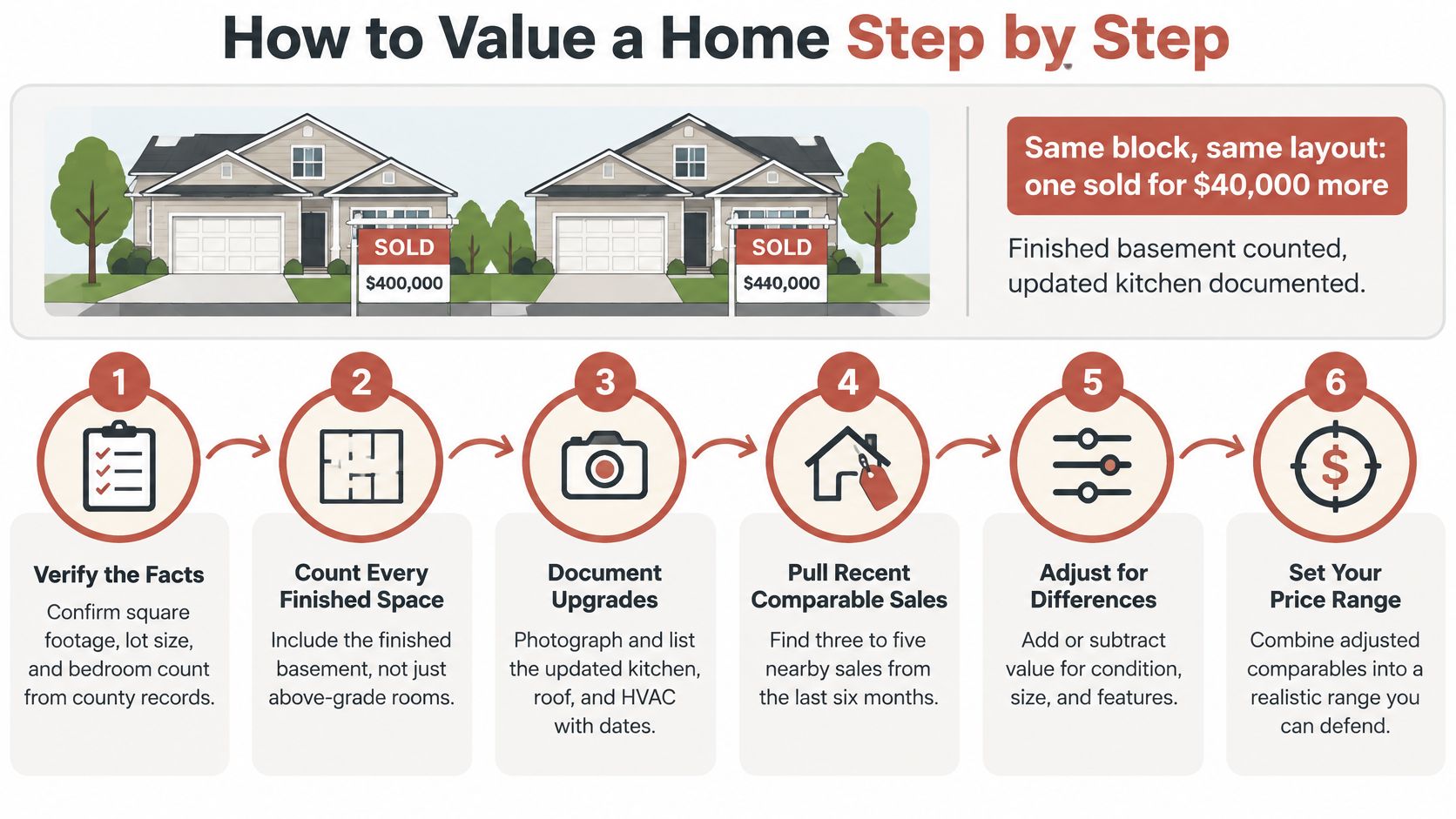
Say similar houses on the same block sell for different amounts. One listing documents an updated kitchen and usable finished basement; the other leaves buyers guessing about improvements and condition. Before assuming the difference proves your home's value, check what each property actually offered.
A useful valuation starts with a property file, not a price guess. Gather the county record, previous listing, floor plan, renovation receipts, and current photographs. Resolve disagreements between those documents before selecting comparable sales.
Build a worksheet you can defend
Verify your home's facts. Record bedrooms, bathrooms, finished living area, lot size, year built, garage, and major update dates. Separate above-grade living area from finished basement space rather than combining everything into an inflated square-footage total.
Select closely competing closed sales. Start nearby and match property type, architectural style, size, age, and condition. Widen the search when necessary, but don't cross into a different buyer market just to find a higher sale price.
Check active and pending competition. Active listings show what buyers can choose today, while pending properties show which offerings attracted a contract. Asking prices aren't proof of value, and a pending listing's final price may not yet be available.
Adjust for meaningful differences. Compare living area, condition, site, parking, improvements, and transaction terms. Keep a written explanation for each adjustment so you can distinguish a supported conclusion from a convenient guess.
Rank the evidence by similarity. Give the strongest matches more influence instead of averaging every property equally. A nearby home with the same layout and condition may tell you more than a newer sale with a substantially different design.
Reconcile a range. Identify which adjusted sales support the lower and upper ends, then explain where your home fits. Make the range wider when records are incomplete, comparable properties are scarce, or the home has unusual features.
Keep uncertainty visible
Your finished worksheet should contain the subject property's verified facts, comparable addresses, recorded prices, adjustments, and adjusted prices. Add a written value range and a brief confidence note explaining the weakest part of the analysis.
Don't hide a missing measurement or undocumented renovation behind a precise-looking estimate. If the basement's finish quality is uncertain, photograph it and confirm how competing listings describe similar space.
Practical rule: A defensible range is more useful than an exact number you can't explain.
For sellers, this worksheet becomes the basis for a pricing discussion. For buyers, it helps separate what a house is likely worth from what you personally want to spend.
Adjusting Each Comparable Sale Line by Line
Adjust the comparable to resemble your home, not the other way around. If the comparable is better, subtract from its sale price. If it's worse, add.
Fannie Mae's comparable-sales guidance requires at least three closed comparable sales, generally considers sales from the previous 12 months, and emphasizes market relevance rather than recency alone. That's a better discipline than choosing the latest expensive closing in your ZIP code.
Common adjustments and how to price them
| Difference | How to adjust | Example |
|---|---|---|
| Finished square footage | Derive a marginal area adjustment from closely matched sales, then apply it to the size gap | Comparable has more above-grade living area, so subtract the supported area premium |
| Condition | Compare dated and updated sales; use contractor estimates to understand repair scope | Subject is updated and comparable has an original kitchen, so add the market-supported condition difference |
| Recent updates | Measure buyer-supported value, using work costs as context rather than automatic reimbursement | Comparable has a new roof and subject doesn't, so subtract the supported roof premium |
| Lot size and site | Compare sales with similar homes but different usable sites | Comparable has a larger usable yard, so subtract the demonstrated site premium |
| Garage or parking | Use the local price gap for comparable parking arrangements | Comparable has an attached garage and subject doesn't, so subtract the local difference |
| Location in neighborhood | Compare traffic, rail exposure, views, and adjoining uses | Comparable backs onto a rail line and subject doesn't, so add the supported location adjustment |
| Financing concessions | Analyze whether seller-paid credits inflated the recorded price | Comparable's price reflects a seller credit, so subtract the supported concession-related amount |
| Time since sale | Apply a supported local trend between contract date and valuation date | Local prices rose over that interval, so adjust the older comparable upward |
Avoid multiplying the size difference by a whole-home average price per square foot. That average includes land, location, and other features, not just additional living space.
Likewise, renovation cost isn't automatically resale value. Contractor estimates help describe a condition gap, but buyers may pay less than the work costs. Use the guide to increasing home value before selling to evaluate improvements before assuming they belong in your asking price.
Test the adjustment before accepting it
Look for paired sales where the properties are closely matched except for the feature you're pricing. If an adjustment dominates the calculation, find a better comparable rather than forcing the match.
For an accessory dwelling, first estimate your guest house building costs using CozyCube's planning resource, then evaluate legality, permitted use, and comparable-sale evidence separately. Building expense alone doesn't establish contributory value.
Total the supported additions and deductions for each sale. Keep both the raw price and resulting adjusted price visible, with a note identifying the evidence behind each change.
Estimators, Agent CMAs and Appraisals Compared
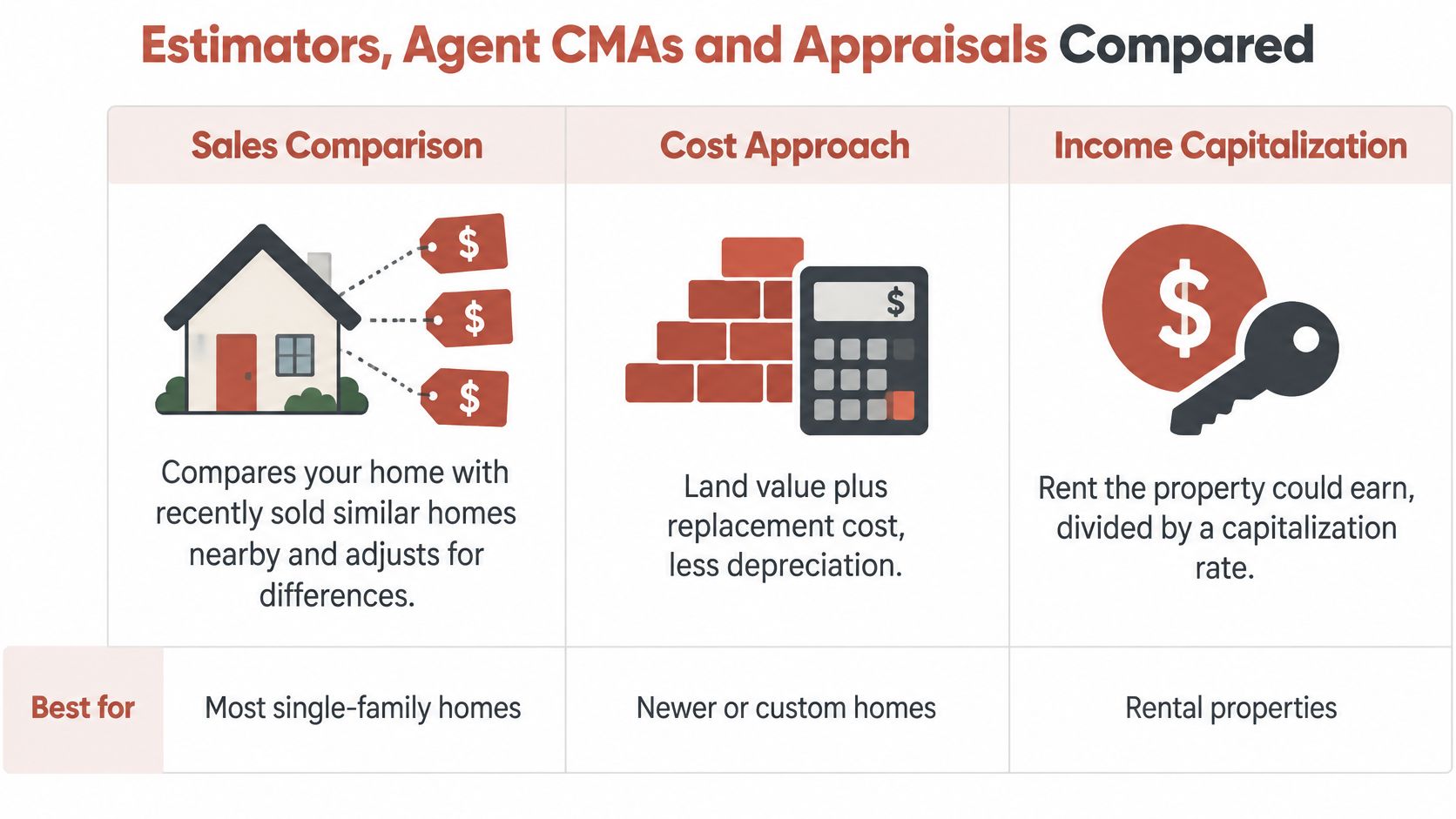
There are three valuation approaches, but they aren't interchangeable. Sales comparison examines competing property sales. The cost approach considers land plus replacement or reproduction cost, less depreciation, while income capitalization converts expected rental income into an indication of value.
For an owner-occupied house, buyers' competing choices usually make sales comparison central. Rental properties also need an income analysis. Broad indexes, such as those maintained in the Federal Reserve Economic Data housing-price collection, provide historical context rather than an address-specific answer.
Valuation tools compared by inputs, cost and blind spots
| Tool | What it uses | Typical cost | Best for | Main blind spot |
|---|---|---|---|---|
| Online estimator | Public records and sales data processed by an algorithm | Free consumer estimates are available | A rough starting range | Can miss interior condition, upgrades, and unusual features |
| Agent comparative market analysis | Local sold, pending, and active properties plus agent judgment | Often complimentary for prospective sellers | Listing strategy or a second opinion | The agent may be seeking the listing |
| Licensed appraisal | Verified property information and documented comparable-sale adjustments | Request a property-specific fee quote | Lending, refinancing, estates, and divorce matters | Costs money and reflects a particular effective date |
| Cost and income approaches | Land and depreciated improvement costs, or rent-based capitalization | Confirm inclusion in the appraisal scope | Specialized properties and rentals | May not explain typical owner-occupant purchasing decisions |
Choose the tool for the decision
An online estimate is a starting point, not permission to skip the property review. Check whether its underlying record recognizes your actual layout, condition, and improvements before giving it much weight.
An agent's comparative market analysis, or CMA, should show the properties behind the recommendation. Ask why each sale belongs in the analysis and whether the suggested asking price differs from the probable closing range.
Use the home value map to orient your search geographically, then investigate individual properties. A map can help you locate evidence, but it can't tell you whether a kitchen needs replacement or a basement has moisture damage.
Choose the professional output your decision requires, not the number you most want to hear.
For a rental, ask how the analysis handles expenses, vacancy, and expected income. For a lender or legal matter, confirm the required qualifications, report format, and effective date before ordering an appraisal.
Reading Market Trends Behind Your Number
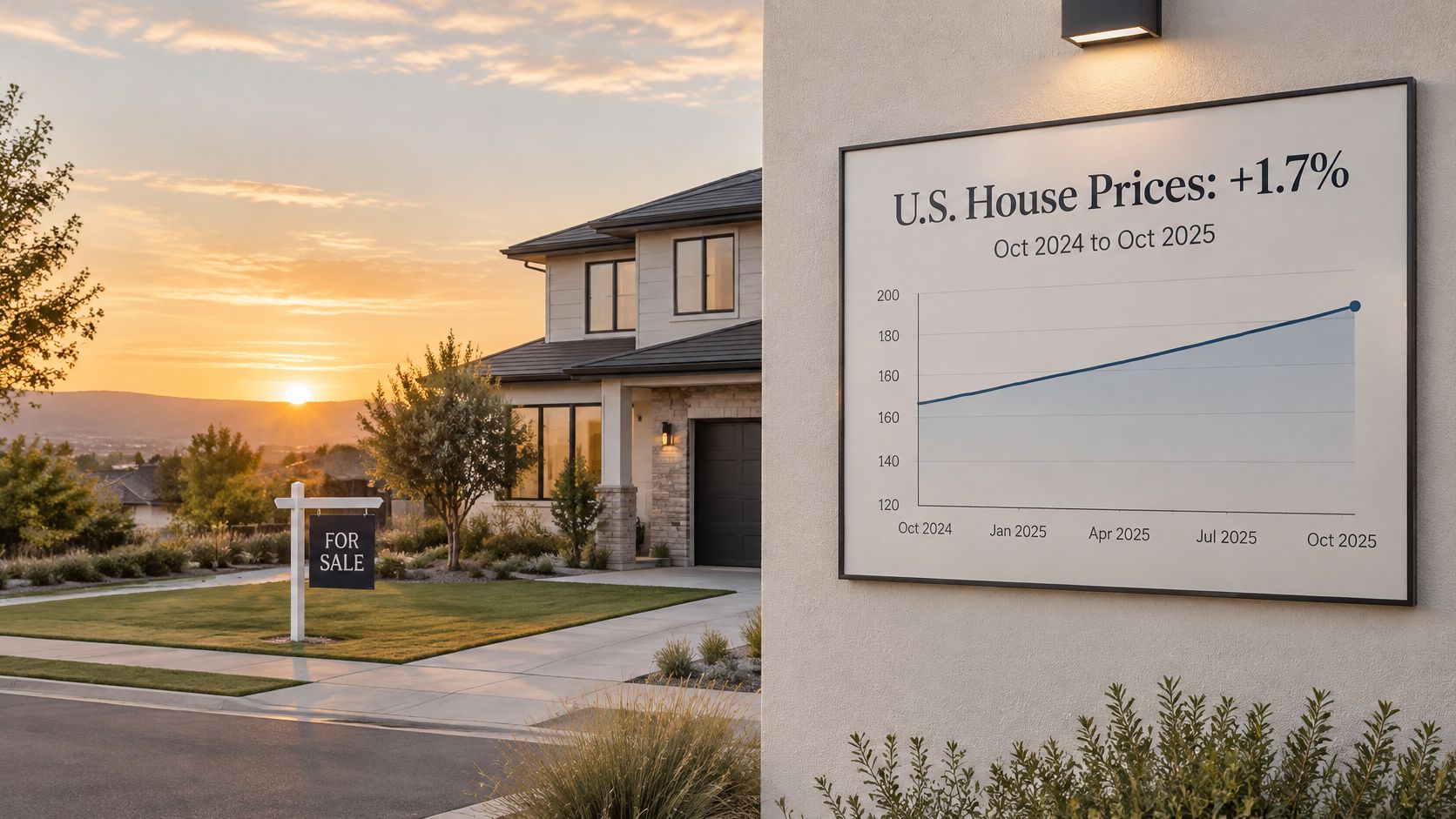
U.S. house prices increased 1.7% from October 2024 to October 2025, according to the Federal Housing Finance Agency's monthly House Price Index. That's national background, not an adjustment you should automatically apply to a home in Melrose Park or Elmhurst.
Check the recent direction of your local property segment. Detached houses, condos, and investment properties don't necessarily attract the same buyers, even within the same community.
Market signals that move a valuation
| Indicator | Seller's market reading | Buyer's market reading |
|---|---|---|
| Months of inventory | Limited supply relative to the current sales pace | Ample supply relative to the current sales pace |
| Days on market | Similar homes go under contract quickly | Similar homes remain available much longer |
| Sale-to-list price ratio | Sales close at or above asking | Sales close meaningfully below asking |
| Share of listings with price cuts | Few competing sellers reduce prices | Price reductions are widespread |
| Local price trend | Comparable properties achieve progressively stronger prices | Comparable prices flatten or decline |
Read the signals together. A fast sale doesn't prove strong demand if the seller deliberately priced below competing homes. A high sale-to-list ratio also means little without checking whether the asking price had already been reduced.
Compare similar properties and separate original asking price from final asking price. Otherwise, a listing that underwent repeated cuts can look stronger than it was.
Use buyer behavior to place your range
Suppose a comparable closed while buyers had few alternatives. If today's buyers can choose among several similar homes with price reductions, that closing may support your range without supporting its upper end.
Use the Chicago housing market trends guide for regional orientation, then narrow the analysis to your neighborhood, property type, and price bracket. Don't substitute a citywide headline for competing inventory you can inspect.
When local evidence favors buyers, lean toward the lower portion of the supported range. When similar homes attract strong competition and supply is limited, the upper portion becomes more defensible. Neither situation justifies a price outside the comparable evidence.
Assessments and Insurance Costs Are Not Market Value
A Schaumburg Township notice shows a 2025 single-family estimate of $381,000, while the 2024 median sales price of $390,000 sits nearby in the Cook County Assessor's Schaumburg Township valuation explanation. A seller who treats the first number as an offer leaves money on the table. A seller who treats the second number as a guarantee for every house overprices the worn ones. Use the assessment for taxes. Use closed sales of competing homes for price.
An assessment is an administrative estimate made for taxation. Cook County residential assessed value equals 10% of the assessor's estimated market value. Those township figures describe different measures and periods. They work as a starting reference for the tax process. They do not set what a buyer will pay for your kitchen, roof, lot, and block today.
For an inherited or outdated home, inspect the record carefully. A county description will not necessarily capture a worn kitchen, an aging roof, basement seepage, or deferred masonry repairs. A higher assessment doesn't prove your home would sell for more.
Skip the shortcut of pricing off the notice. Price off current buyer demand, competing inventory, and a realistic account of condition. A tax appeal needs relevant comparable assessments or sales and accurate property facts. A listing decision needs something else entirely, offers from buyers choosing among homes like yours right now.
Keep separate columns: What the home could sell for, how it's assessed, and what a buyer must spend to own it.
That third column decides deals. Insurance belongs there, including the premium, deductible, exclusions, and exposure to flood or sewer-backup losses. Financing where applicable, taxes, utilities, maintenance, and potential uninsured losses belong there too.
Do not invent an insurance-adjusted value by subtracting an arbitrary amount from the comparable range. Identify costs that affect affordability or negotiations instead. A buyer who can handle the purchase price may still reject the property after reviewing coverage terms and expected repair expenses. Price the house from sales. Budget the risk from ownership cost.
When to Order a Professional Appraisal or Agent Valuation
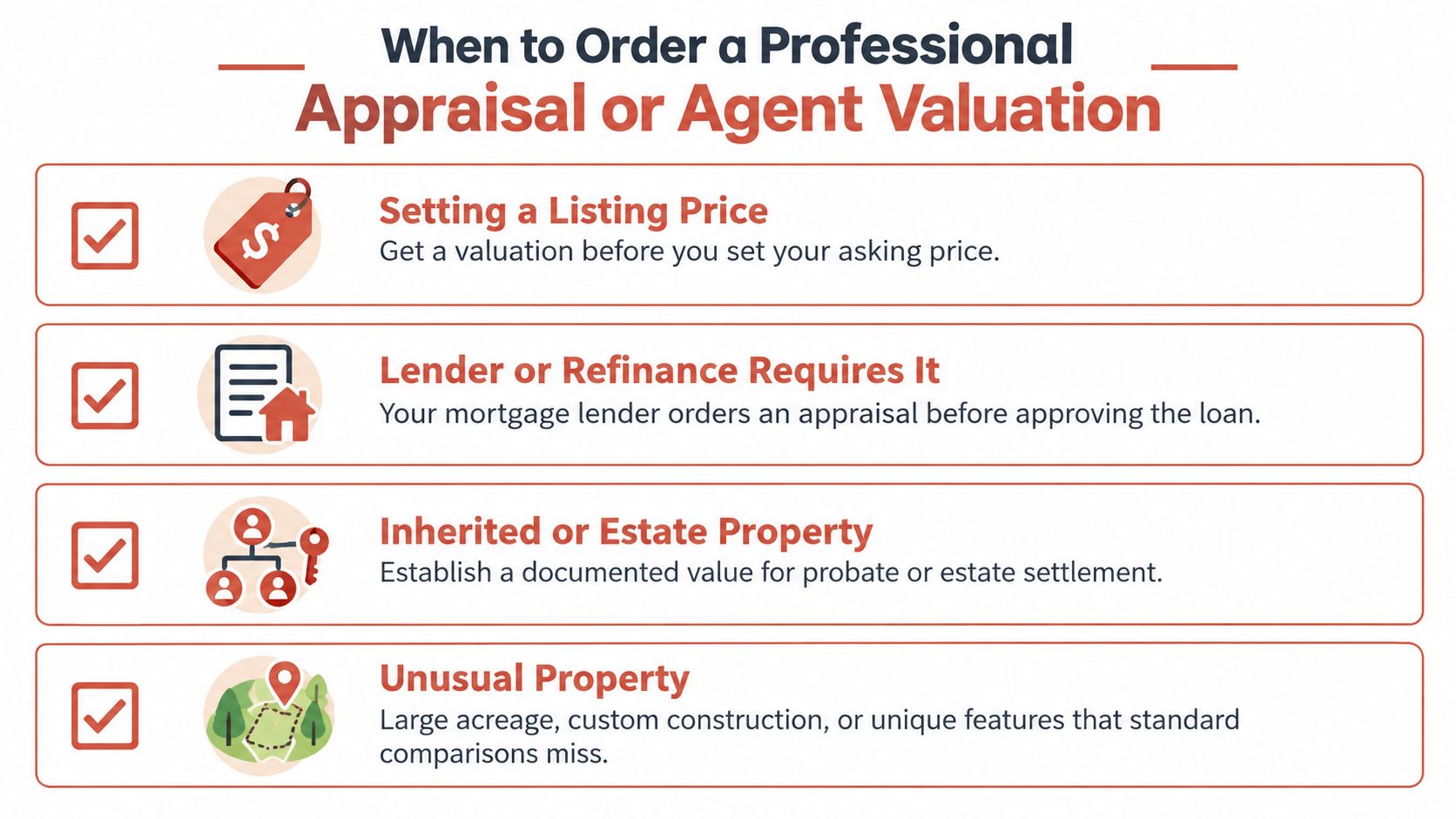
Get professional help when the decision has consequences you can't comfortably absorb. Use these triggers rather than waiting until an asking price or offer has already committed you.
- You're preparing to list. Request a written CMA with the supporting sales and a pricing strategy.
- A lender or legal process needs documentation. Confirm who must order the appraisal and what report is required.
- You've inherited the property. Establish the required valuation date and purpose before commissioning work.
- The property is unusual. Acreage, mixed use, custom construction, or scarce comparables require deeper analysis.
- Renovation or damage changed the home. Have the professional inspect what changed rather than relying on old records.
- Your estimates disagree materially. Ask someone qualified to resolve the assumptions behind the gap.
Obtain the insurance quote before committing
A U.S. Treasury analysis of more than 246 million homeowners policies found that properties in the 20% of ZIP codes with the highest expected climate-related building losses paid average premiums of $2,321, 82% more than properties in the lowest-risk 20% of ZIP codes. That national comparison makes the case for investigating coverage, not assigning a neighborhood-average premium to a particular Chicago-area address.
Get a property-specific quote before finalizing your offer or pricing decision. Ask about deductibles, exclusions, roof-related restrictions, flood and sewer-backup exposure, and whether coverage is available on acceptable terms.
Ask the valuation professional for the comparables, adjustment explanations, effective date, and supported conclusion. An agent can recommend a listing range; a licensed appraiser can provide the documented opinion required for the assignment.
This week, gather your property facts, comparable-sales worksheet, insurance quote, and latest tax notice. Book a valuation review and ask the professional to explain any difference between your range and theirs.
Homes By Carmen offers a complimentary property valuation and strategy consultation for prospective sellers in Melrose Park and greater Chicagoland. Bring your worksheet, tax notice, and improvement records to discuss a supported selling range and a practical listing strategy.