
Say you're renting in Melrose Park. Your voucher is approved, and you find an apartment with the bedrooms, bus access, and kitchen you need. Then the housing authority explains that the rent and tenant-paid utilities don't fit the applicable payment standard.
Your income paperwork wasn't the problem. You'd been comparing the apartment against information from the wrong housing authority. The landlord's willingness to participate couldn't fix that mismatch.
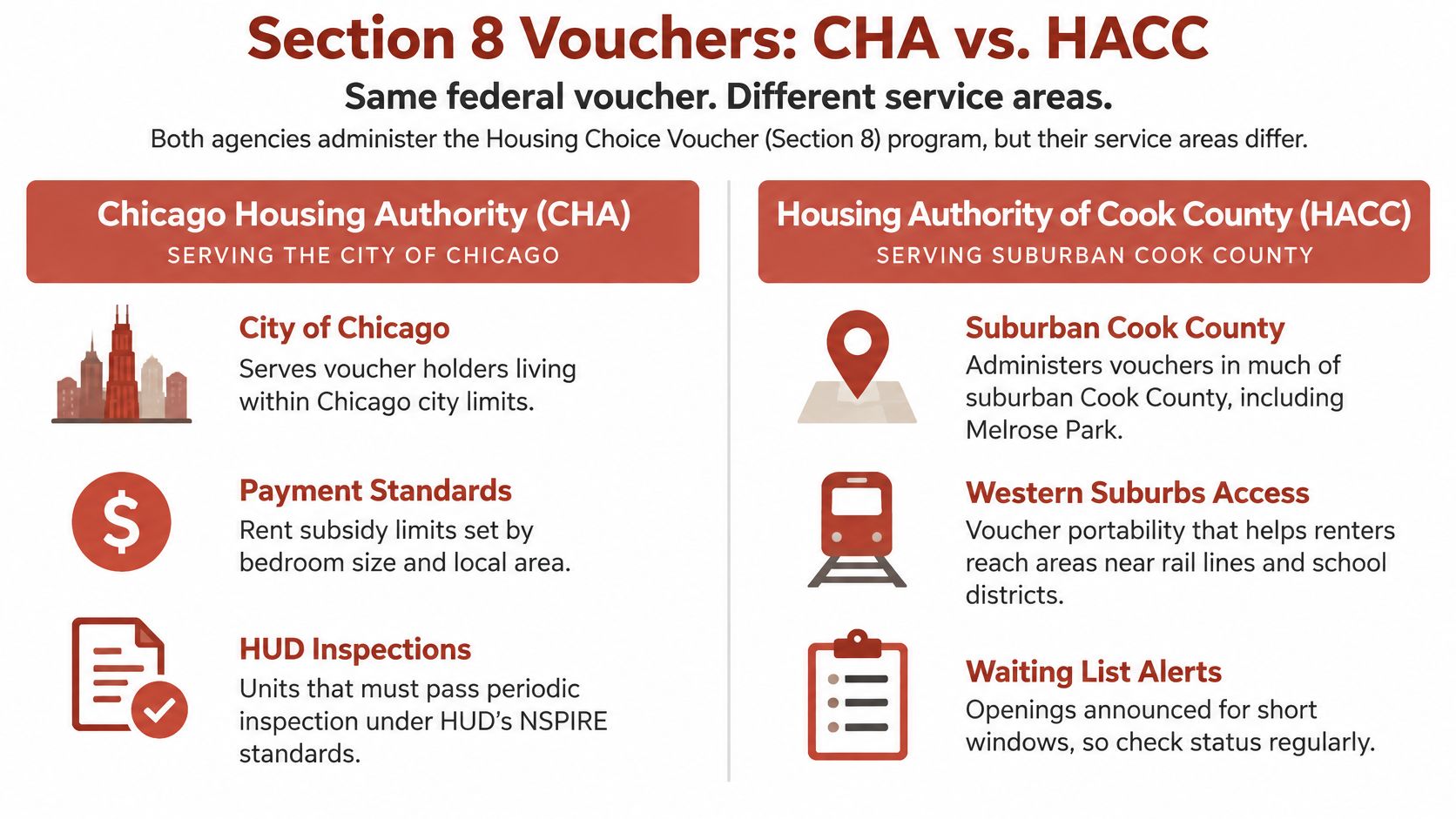
Start with your address, not the program name. A Melrose Park renter usually begins with the Housing Authority of Cook County, or HACC, rather than the Chicago Housing Authority, or CHA. If you already have a voucher from another authority, contact your assigned worker before assuming you need a new application.
The same distinction matters beyond vouchers. A Chicago-funded apartment subsidy isn't automatically available in suburban Cook County. Chicago's Residential Landlord and Tenant Ordinance doesn't extend to Melrose Park just because both communities are in the same county.
Before paying application fees, establish:
- Who administers the assistance: Identify the housing authority, property manager, or referring agency.
- Where it works: Confirm the apartment's municipality, not just its mailing address.
- What approval requires: Separate program eligibility from landlord screening and unit approval.
These rental assistance options serve different needs. Some reduce ongoing rent, some help during a crisis, and others help you find or keep an apartment.
Table of Contents
- 1. Housing Choice Voucher Program (Section 8)
- 2. Illinois Rental Housing Support Program (RHSP)
- 3. Chicago Low-Income Housing Trust Fund Rental Assistance Program (RAP)
- 4. Low-Income Housing Tax Credit (LIHTC)
- 5. Illinois Housing Search
- 6. HUD-VASH (Veterans Affairs Supportive Housing)
- 7. Homelessness Prevention and Emergency Rental Assistance Resources (211 Illinois and Local Agencies)
- 8. Chicago Residential Landlord and Tenant Ordinance (RLTO)
- How the 8 Rental Assistance Programs Compare for Western Chicagoland Renters
- Build Your Shortlist Before the Next Waiting List Opens
1. Housing Choice Voucher Program (Section 8)
A landlord who agrees to complete voucher paperwork gives you a lead, not an approval. For a Melrose Park renter seeking ongoing help with a private-market apartment, the Housing Authority of Cook County (HACC) is usually the first office to contact. The Chicago Housing Authority (CHA) serves Chicago. Check the municipality before applying, because surrounding communities may have their own housing authorities.
The voucher subsidizes an approved rental, subject to program requirements. Federal policy generally bases a tenant's rent contribution on about 30% of adjusted gross income. Household circumstances, deductions, utilities, and program rules affect the calculation, according to HUD's rental-assistance overview.
Get the apartment reviewed before committing
Even with a willing landlord, your worker must review the proposed rent, utilities, required inspection, and tenancy documents. Contact the office handling your voucher before you commit to the apartment.
- Call your assigned worker: Ask for the payment standard and utility allowance that apply to your search.
- Confirm the landlord's role: Ask who completes the tenancy paperwork and coordinates repairs, then clarify the expected timing.
- Prepare your application: Use this rental application process guide to organize identification, income records, and rental history.
- Track your voucher deadline: Keep a contact log and ask about an extension before your voucher expires.
A landlord's willingness, your applicant approval, and the apartment's approval are separate steps. A promising unit can still fail review if its rent, utilities, or condition do not meet program requirements.
If you plan to move across housing-authority boundaries, ask your current worker about portability before you act. Keep your existing voucher active, and don't sign a lease on the assumption that another office will accept the transfer.
2. Illinois Rental Housing Support Program (RHSP)
RHSP helps you pursue a participating affordable apartment. It does not freeze the rent at your current address or provide a portable subsidy for any landlord. The Illinois Housing Development Authority (IHDA) administers the statewide program through local administering agencies and participating housing providers.
For a Melrose Park renter, start with the local agency serving suburban Cook County. Ask which properties have RHSP assistance attached and whether they are accepting applications. The program is tied to participating housing, so the available unit and the agency's intake process determine whether this route fits your needs.

Ask for participating housing, not just an application
Contact IHDA's rental housing staff to identify the RHSP administering agency for suburban Cook County. Then call that agency about properties near Melrose Park, household eligibility, and how to apply. An application alone does not establish that an assisted unit is available.
If your landlord raises the rent, RHSP will not resolve the increase at your current address. Renters already behind should pursue emergency assistance separately. Use these questions to check whether RHSP is a workable option:
- Identify the opening: Ask whether an assisted unit is available, the property has an active waiting list, or the agency is only collecting information.
- Check household fit: Confirm bedroom suitability and household requirements before gathering a full application packet.
- Keep records consistent: Report income changes and explain missing documents rather than leaving gaps in your application.
RHSP suits renters who can consider designated properties and wait for an opening. It cannot provide an immediate move-in when no participating apartment is available. If buying is a later goal, keep that planning separate from your rental search. The Illinois first-time home buyer guide covers a different path.
3. Chicago Low-Income Housing Trust Fund Rental Assistance Program (RAP)
A RAP subsidy stays attached to a Chicago property, not to you. If you live in Melrose Park, you would need to move into a qualifying Chicago apartment to use this program. It does not provide portable assistance for a Melrose Park lease.
The Chicago Low-Income Housing Trust Fund's Rental Assistance Program works through participating housing providers to support affordable rents for eligible households. Start with the property manager or housing provider to ask about the specific apartment. A general voucher intake office may not handle the application.
Confirm the city boundary and the specific unit
For an apartment in Chicago's Austin neighborhood, ask whether that unit has RAP assistance available. A provider's participation does not mean every apartment in its building receives assistance. Check the property address, too. A listing described as near Chicago may be outside the city, where this Chicago program will not apply.
Before applying, get clear answers:
- Unit status: Is the available apartment assisted through RAP, or offered at market rent?
- Application route: Does the property accept applications directly, keep a waiting list, or use a referral partner?
- Household review: Which income and household-composition documents does the manager require?
- Move-in costs: Which deposits, fees, and utility arrangements remain your responsibility?
Application advantage: Ask the manager to identify missing documents before you submit your final packet. A complete application gives the property a clear basis to review your household, while disconnected emails can slow down the process.
RAP fits renters who can relocate to a participating Chicago property and whose commute and household needs suit that unit. It will not address rent at a Melrose Park home. Confirm the available unit, application process, and move-in costs before deciding whether a city move works for you.
4. Low-Income Housing Tax Credit (LIHTC)
Test whether the rent fits your budget before you check eligibility. LIHTC properties offer income-restricted apartments financed through a tax credit to the property. You apply through the property manager, who checks your household against the requirements for the specific unit. The assistance is tied to the property, not paid to you as a tax credit or portable rental payment.

Test affordability before eligibility
An income-restricted apartment near Melrose Park may still have a rent that stretches your budget. Qualifying means you may occupy the unit, not that its rent will be affordable for your household.
Before applying, ask the property manager for the unit's income category, current rent, tenant-paid utilities, and screening criteria. Find out whether the apartment also has a rental subsidy. Some properties combine housing programs, so the building's general description may not explain how your rent is set.
- Apply across properties: Managers may have separate applications and waiting lists. Track each one individually.
- Disclose variable income: Bring records explaining overtime, seasonal work, benefits, or self-employment.
- Ask about renewals: Confirm income-review requirements and how the manager handles rent changes.
Income restrictions do not necessarily waive credit or rental-history screening. Ask about those standards before paying an application fee. If the manager flags a problem, request an explanation so you can address it before your application stalls.
LIHTC can fit households with steady income seeking below-market rent. The trade-off is that, without an additional subsidy, the restricted rent may still be out of reach for a household with very limited income. If the numbers do not work after utilities, this option may not suit your budget, even if you qualify.
5. Illinois Housing Search
Filter by location, bedrooms, and accessibility, then call to confirm each feature. Illinois Housing Search helps Melrose Park renters find potential apartments, including income-restricted properties and listings that advertise voucher acceptance. These categories have different requirements, so check what applies to each unit with its property manager.

Turn search results into verified leads
An accessibility label may cover only some features. Ask about the entrance, bathroom, doorways, and parking arrangement that matter for your needs.
For voucher listings, check the housing authority's payment standard against gross rent, including tenant-paid utilities. Before paying an application fee, ask the manager about inspection and lease-up requirements. HUD's voucher performance reporting provides context on voucher performance, but the property manager and relevant housing authority can clarify the steps for a specific unit.
Track each lead in a spreadsheet:
- Availability: Record whether a unit is vacant or the property has a waiting list.
- Total cost: Note rent, utilities, deposits, parking, and mandatory fees.
- Next action: Write down the manager's contact details, requested documents, and when to follow up.
Use this rental property search guide to organize neighborhood preferences and compare properties alongside the statewide search.
A voucher-friendly label is a starting point, not confirmation that a unit will work. Ask whether the manager will complete the required paperwork and coordinate an inspection. Keep searching while you wait for a response, and pursue several leads rather than relying on one listing.
6. HUD-VASH (Veterans Affairs Supportive Housing)
Your first call is for a VA assessment, not a landlord. HUD-VASH combines rental voucher assistance with VA case management and supportive services for eligible veterans experiencing homelessness, helping them obtain and maintain housing.
Contact a VA homeless program office or the homeless services team at a VA medical center. For a Melrose Park resident, Hines VA is a practical place to ask about assessment and the referral route. The VA team can explain eligibility and identify which housing authority would handle the voucher.
Let the referral team establish the route
The assessment should cover your current housing, access to treatment, mobility needs, and any risk of losing your place to stay. Share these details before searching for apartments. The case manager can help clarify the next steps and keep the application aligned with your needs.
Prepare what you have:
- Veteran documentation: Bring discharge records or other service information. If records are missing, ask for help obtaining them.
- Housing details: Explain where you're staying and why that arrangement may end.
- Search priorities: Separate transportation, accessibility, and medical needs from preferences.
- Application barriers: Tell the case manager early about missing identification, prior rental debt, or screening concerns.
Don't wait until every document is perfect to ask for an assessment. Tell the VA team what's missing so staff can explain the next step.
HUD-VASH requires a VA evaluation; military service alone does not establish eligibility. It is designed for eligible veterans experiencing homelessness, so it may not fit a veteran who needs only a general rent discount.
After referral, keep the case manager updated about landlord responses and rejected applications. Share the specific issue, such as a screening concern or an unanswered property inquiry, so the team can help address the obstacle before the search stalls.
7. Homelessness Prevention and Emergency Rental Assistance Resources (211 Illinois and Local Agencies)
Describe your notice, court status, and ability to pay before you ask for a program name. Contact 211 Illinois and request homelessness-prevention resources that serve your Melrose Park address. You can also ask social services staff at the Village of Melrose Park or Proviso Township about current referrals.
Start with the facts that shape your options. Tell the intake worker whether you received a landlord notice, whether a court case is underway, and whether you can afford the rent after temporary help ends. These details help staff direct you toward emergency assistance, legal aid, or relocation support. Funding, service boundaries, and intake procedures can change, so ask which agency currently handles your area.
- Gather the ledger: Request an itemized statement from your landlord showing rent, fees, and payments.
- Prepare the lease: Keep your lease, income records, notices, and landlord contact information together.
- Ask about landlord participation: Find out whether the agency needs ownership documents, payment information, or a signed agreement.
- Request legal help promptly: If you receive court papers, ask for a tenant legal aid referral and keep every scheduled appearance.
Use the rental assistance eligibility guide to prepare questions about eligibility. Then confirm local requirements with the Illinois agency handling your application. Ask directly whether funding is available for your address and what documents the agency needs before it can assess your request.
Emergency help may cover a temporary interruption, but it may not make an unaffordable lease sustainable. Applying also does not automatically stop an eviction case. Keep communication with the agency and landlord in writing, and seek legal advice if a court case is underway.
8. Chicago Residential Landlord and Tenant Ordinance (RLTO)
The RLTO applies to covered rental properties within Chicago city limits. A Cook County address outside Chicago, such as an apartment in Melrose Park, does not fall under the ordinance just because it is in the county. This is a jurisdiction question, not a rental-assistance option.
For a Melrose Park tenancy, contact tenant legal aid or Cook County housing staff to clarify which county, state, and local rules apply. The Chicago ordinance may not cover the apartment, but other tenant protections may. Confirm the property's location and the rules that apply before relying on advice written for Chicago renters.
Use the rules for the apartment's actual location
The same owner may have rentals in Chicago and Melrose Park, but the rules can differ by address. Check the ordinance's coverage and exclusions before relying on a remedy described in a Chicago tenant guide.
Keep clear records whichever municipality you rent in:
- Document condition: Take dated move-in photographs and keep inspection notes.
- Request repairs in writing: Identify the defect, where it is, and when it started.
- Track payments: Save receipts, deposit records, and written agreements.
- Get advice before acting: General online guidance is not enough to justify withholding rent, deducting repair costs, or ending a lease.
Understanding Land-use rights and housing stability can provide useful context, but the apartment's location determines which ordinance may apply.
If you receive rental assistance, tell your housing worker about unresolved conditions that could affect program requirements. For property-condition concerns, contact the building or code-enforcement office serving the apartment's municipality. Ask legal aid about your rights and the correct steps to take.
Accurate records help explain a repair dispute or billing problem, while following the right legal procedure protects your position. The RLTO can inform a tenant's options in covered Chicago rentals, but it does not approve rental assistance applications.
How the 8 Rental Assistance Programs Compare for Western Chicagoland Renters
The address determines which office to contact and which options can apply. A Melrose Park renter generally looks to the Housing Authority of Cook County for suburban voucher administration, while Chicago-only programs and protections do not apply outside the city. Compare the administering office and jurisdiction first, then weigh the type of help and its limits.
| Program | Administering office or contact | Geographic reach | Tenant cost or terms | Best fit |
|---|---|---|---|---|
| Housing Choice Voucher Program (Section 8) | Chicago Housing Authority in Chicago; Housing Authority of Cook County in suburban Cook County | Nationwide program, locally administered | Based on household income and program rules; HUD explains the Housing Choice Voucher program | Renters seeking assistance with private-market housing |
| Illinois Rental Housing Support Program (RHSP) | Illinois Housing Development Authority and participating local agencies | Statewide in Illinois | Assistance and terms depend on the local program | Renters seeking state-funded assistance or eviction prevention |
| Chicago Low-Income Housing Trust Fund Rental Assistance Program (RAP) | Chicago Low-Income Housing Trust Fund | City of Chicago | Based on household income | Eligible Chicago renters seeking rental subsidies |
| Low-Income Housing Tax Credit (LIHTC) | Owners and managers of participating properties | Nationwide, including Illinois | Income-restricted rent, often tied to an AMI limit | Renters seeking affordable housing without a voucher |
| Illinois Housing Search | Illinois Housing Development Authority's housing-search resource | Statewide in Illinois | Free to search; rent depends on the property | Renters looking for affordable, accessible, or voucher-friendly listings |
| HUD-VASH (Veterans Affairs Supportive Housing) | Local VA and housing authority partners | Nationwide | Typically based on income, similar to a housing voucher | Eligible veterans experiencing or at risk of homelessness who need housing support |
| Homelessness Prevention and Emergency Rental Assistance Resources (211 Illinois and Local Agencies) | 211 Illinois and local agencies | Illinois; referrals and programs vary locally | Assistance is generally free; amount and duration vary | Renters facing eviction, arrears, or housing instability |
| Chicago Residential Landlord and Tenant Ordinance (RLTO) | City of Chicago | City of Chicago | No program fee; ordinary rent still applies | Chicago renters seeking legal protections and remedies |
These options are not interchangeable. A property listing service does not provide rental assistance, and LIHTC housing does not work like a voucher. The RLTO sets tenant protections, not a rent subsidy. For a suburban renter, start with the local administering office or property manager. For city-only programs, confirm that the apartment is within Chicago before applying.
Build Your Shortlist Before the Next Waiting List Opens
A Melrose Park renter seeking ongoing assistance can start with the Housing Authority of Cook County, participating RHSP housing, and income-restricted properties. Chicago-only programs and protections may not apply in the suburbs, so check each option's jurisdiction before spending time on an application. If you face immediate displacement, pursue emergency intake and legal help while keeping longer-term applications active.
Put application deadlines alongside waiting-list timelines in your calendar. A waiting-list application, a property application, and an emergency-assistance request go to different people, and completing one does not advance the others. Track when each administrator expects a response and what action you need to take next.
Start a document folder with photo identification, Social Security documentation requested by the program, income records, and your current lease. Add landlord notices or court papers if you have them. Send sensitive documents only through the agency's secure submission method.
- Save the right contacts: Keep your housing authority worker, IHDA referral contact, property managers, and 211 intake information together.
- Record each submission: Save confirmation messages and note which documents are still outstanding.
- Update your contact information: Tell each waiting-list administrator when your phone number, email, or mailing address changes.
- Prepare for screening: Ask about credit, rental-history, and documentation requirements before paying application fees.
Assistance approval does not guarantee that a renter will secure an apartment. A literature review published in Housing Policy Debate reports that only about 60% of voucher recipients successfully use their vouchers. Keep the apartment search active while you complete the remaining paperwork.
When a voucher is issued, confirm its search deadline and how to request more time. Ask your worker which records support an extension, and plan property applications around the review and inspection steps. Do not assume extra time will be granted automatically.
Compare apartments by total cost and whether the required review can proceed. A different location may be a better fit if the apartment meets your needs and the manager responds promptly. Keep accessibility and safety requirements ahead of a rushed application.
For renters in Melrose Park and the western suburbs, Carmen Salerno at Homes By Carmen offers rental search and application support. Homes By Carmen can help narrow suitable properties, confirm landlord participation, and organize documents; the housing authority or program administrator decides eligibility and assistance. Visit Homes By Carmen to discuss your location, budget, voucher status, and move-in needs before paying to apply.